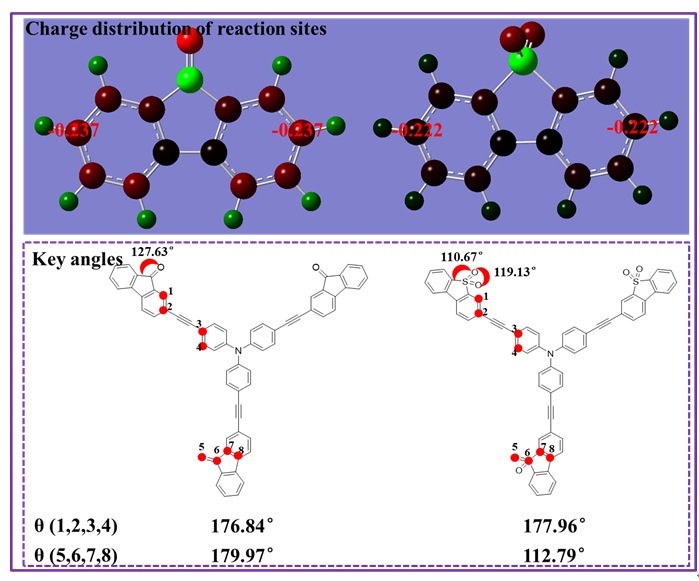
Photocatalytic water splitting hydrogen evolution has been widely recognized as one of the most promising strategies for the exploitation and utilization of solar energy, thereby alleviating the pressing environmental and energy crises. To realize this technology, one of the key factors is the development of novel, high-performance, and practically applicable photocatalysts. Herein, two tris(4-ethynylphenyl)amine (TEA)-based conjugated porous polymers (CPPs) TEA-FON and TEA-DTS have been synthesized via the Sonogashira-Hagihara coupling reaction with 2,7-dibromo-9-fluorenone and its structural analog 3,7-dibromo-5,5-dioxidodibenzothiophene which has been substituted at 9-position with single-atom sulfur as the difunctional comonomers, respectively. It has been demonstrated that both polymers possess excellent solvent, chemical, and thermal stabilities, along with a large specific surface area. More importantly, they exhibit remarkable photocatalytic hydrogen evolution activity even without the assistance of any cocatalysts. Notably, under identical reaction conditions, the hydrogen evolution rate (HER) of TEA-FON is 1.5 times higher than that of TEA-DTS. Further systematic investigations have revealed that the discrepancy in HER originates from the single-atom substitution, which efficiently modulates the light-harvesting efficiency, photogenerated carrier separation efficiency, and charge transfer rate of the polymers. It has suggested that photocatalytic performance of TEA-based CPPs can been modulated efficiently with the regulation of single-atom substitution of comonomers.
[1] Hisatomi T.; Yamada T.; Nishiyama H.; Takata T.; Domen, K. Nat. Rev. Mater.2025, 10, 769.
[2] Kumar S.; Kumar A.; Kumar A.; Krishnan V. Catal. Rev.2019, 62, 346.
[3] Lee G.-J.; Anandan S.; Masten S. J.; Wu, J. J. Renew. Energy2016, 89, 18.
[4] Maeda K.; Teramura K.; Lu D.; Takata T.; Saito N.; Inoue Y.; Domen K. Nature2006, 440, 295.
[5] Rahman M.; Tian H.; Edvinsson, T. Angew. Chem. Int. Ed.2020, 59, 16278.
[6] Rajaambal S.; Sivaranjani K.; Gopinath, C. S. J. Chem. Sci.2015, 127, 33.
[7] Shu C.; Han C.; Yang X.; Zhang C.; Chen Y.; Ren S.; Wang F.; Huang F.; Jiang, J. X. Adv. Mater.2021, 33, 2008498.
[8] Takata T.; Jiang J.; Sakata Y.; Nakabayashi M.; Shibata N.; Nandal V.; Seki K.; Hisatomi T.; Domen K. Nature2020, 581, 411.
[9] Yu F.; Wang L.; Xing Q.; Wang D.; Jiang X.; Li G.; Zheng A.; Ai F.; Zou, J.-P. Chin. Chem. Lett.2020, 31, 1648.
[10] Zhao Q.; Ji M.; Qian H.; Dai B.; Weng L.; Gui J.; Zhang J.; Ouyang M.; Zhu H. Adv. Mater.2013, 26, 1387.
[11] Zhou P.; Navid I. A.; Ma Y.; Xiao Y.; Wang P.; Ye Z.; Zhou B.; Sun K.; Mi Z. Nature2023, 613, 66.
[12] Tian C.; Liu X.; Yu M.; Wu Y.; Che Y.; Zhang W.; Zhu, W. J. Funct. Poly.2025, 38, 216 (in chinese)
(田昌昊, 刘雪岩, 虞苗杰, 吴永真, 车瑜, 张维伟, 朱为宏. 功能高分子学报, 2025, 38, 216.)
[13] Dubey N.; Labhsetwar N.; Devotta S.; Rayalu S.Catal. Today 2007, 129, 428.
[14] Guo L.; Niu Y.; Xu H.; Li Q.; Razzaque S.; Huang Q.; Jin S.; Tan, B. J. Mater. Chem. A.2018, 6, 19775.
[15] Pan Z.; Hisatomi T.; Wang Q.; Nakabayashi M.; Shibata N.; Pan C.; Takata T.; Domen, K. Appl. Catal. A: Gen.2016, 521, 26.
[16] Nishioka S.; Osterloh F. E.; Wang X.; Mallouk T. E.; Maeda, K. Nat. Rev. Method. Prime.2023, 3, 42.
[17] Dong Y.; Zhang X.; Yue H.; Wang L.; Zhao J.; Zhao F.; Wei Z.; Zhang, J. J. Colloid. Interf. Sci.2026, 709, 139896.
[18] Li Y.; Tsang, S. C. E. Mater. Today. Sustain.2020, 9, 100032.
[19] Jafari T.; Moharreri E.; Amin A.; Miao R.; Song W.; Suib S. Molecules2016, 21, 900.
[20] Li R.; Luan J.; Zhang Y.; Jiang L.; Yan H.; Chi Q.; Yan, Z. Renew. Sust. Energ. Rev.2024, 206, 114863.
[21] Liu P.; Ye F.; Han C.; Gao C.; Yang H.; Chen X.; Huang, Y. Chem. Eng. J.2026, 531, 174169.
[22] Yi D.; Li, Y. Acta Phys.-Chim. Sin.2026, 42, 100220 (in chinese)
(易丹凤,李玉麟,物理化学学报, 2026, 42, 100220).
[23] Zhang Y.; Heo Y.-J.; Lee J.-W.; Lee J.-H.; Bajgai J.; Lee K.-J.; Park S.-J. Catal.2018, 8, 655.
[24] Chen S.; Vequizo J. J.M.; Hisatomi, T.; Nakabayashi, M.; Lin, L.; Wang, Z.; Yamakata, A.; Shibata, N.; Takata, T.; Yamada, T.; Domen, K.
Chem. Sci.2020, 11, 6436.
[25] Dai S.; Montero-Lanzuela E.; Tissot A.; Baldoví H. G.; García H.; Navalón S.; Serre C. Chem. Sci.2023, 14, 3451.
[26] Yang Y.; Liu E.; Dai H.; Kang L.; Wu H.; Fan J.; Hu X.; Liu, H. Int. J. Hydrogen Energ.2014, 39, 7664.
[27] Anwar S.; Aslam Z.; Aslam U.; Mehmood U.; Rana A. G.; Mahmood N.; Rafique A.Fuel 2026, 404, 136280.
[28] Zhang G.; Lan Z. A.; Wang, X. Angew. Chem. Int. Ed.2016, 55, 15712.
[29] Maeda K.; Domen, K. J. Phys. Chem. Lett.2010, 1, 2655.
[30] Cheng J.-Z.; Tan Z.-R.; Xing Y.-Q.; Shen Z.-Q.; Zhang Y.-J.; Liu L.-L.; Yang K.; Chen L.; Liu, S.-Y. J. Mater. Chem. A.2021, 9, 5787.
[31] Cooper A. I.Adv. Mater. 2009, 21, 1291.
[32] Wong Y. L.; Tobin J. M.; Xu Z.; Vilela, F. J. Mater. Chem. A.2016, 4, 18677.
[33] Yu J.; Sun X.; Xu X.; Zhang C.; He, X. Appl. Catal. B: Environ.2019, 257, 117935.
[34] Albano G.; Aronica L. A.; Biver T.; Detti R.; Pucci A.ChemistrySelect 2018, 3, 1749.
[35] Barman S.; Singh A.; Rahimi F. A.; Maji, T. K. J. Am. Chem. Soc.2021, 143, 16284.
[36] Cui L.; Yu S.; Gao W.; Zhang X.; Deng S.; Zhang, C.-Y. ACS Appl. Mater. Interfaces2020, 12, 7966.
[37] Dai C.; Zhong L.; Gong X.; Zeng L.; Xue C.; Li S.; Liu B.Green. Chem. 2019, 21, 6606.
[38] Guo B.; Liu Q.; Su Q.; Liu W.; Ju P.; Li G.; Wu, Q. J. Mater. Sci.2018, 53, 15746.
[39] Ren S.; Dawson R.; Laybourn A.; Jiang J.-x.; Khimyak Y.; Adams D. J.; Cooper, A. I. Polym. Chem.2012, 3, 928.
[40] Xu J.; Zhang C.; Qiu Z.; Lei Z.; Chen B.; Jiang J. X.; Wang, F. Macromol. Chem. Phys.2017, 218, 1700275.
[41] Ren Q.; Li X.; Li M.; Ruan J.; Dong S.; Li N.; Xu Q.; Li H.; Chen D.; Lu, J. Adv. Funct. Mater.2025, 36, e21077.
[42] Liu W.; Zhu Z.; Liu X.; Zhao M.; Jiao R.; Mu P.; Sun H.; Li, A. Chem. Eng. J.2026, 534, 175099.
[43] Du J.; Feng S.; Zhang J.; Zhang Y.; Wang S.; Han L.; Chen J. Chin.J. Org. Chem 2022, 42, 2967 (in chinese)
(杜俊平, 封珊珊, 张婕, 张永辉, 王诗文, 韩莉峰, 陈俊利, 有机化学,2022, 42, 2967).
[44] Jiang J-X.; Su F.; Trewin A.; Wood C. D.; Niu H.; Jones J. T. A.; Khimyak Y. Z.; Cooper, A. I. J. Am. Chem. Soc.2008, 130, 7710.
[45] Du J.; Zhang X.; Zhou K.; Liang X.; Xu L.; Wang S.; Chen, J. J. Appl. Polym. Sci.2025, 142, e56776.


