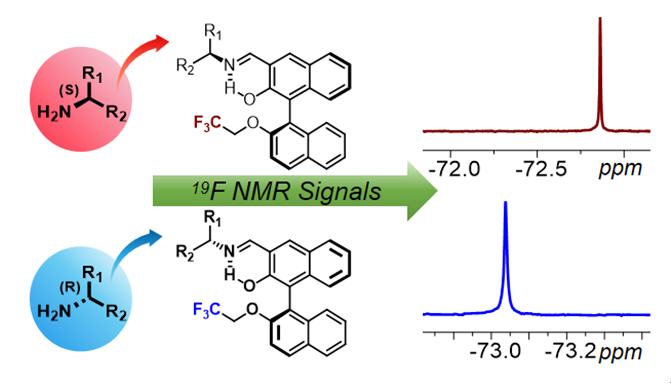
A concise and broadly applicable strategy for the chiral analysis of primary amines by 19F NMR remains difficult to realize because an effective probe must integrate a rigid chiral environment, a fluorinated reporter, and a reactive site for fast analyte capture. Here we report S-BINOL-probe, an axially chiral salicylaldehyde derived from BINOL and equipped with a trifluoroethoxy reporter. The probe is prepared in a short sequence from commercially available starting materials and forms diastereomeric imine adducts that display well-resolved 19F NMR signals. S-BINOL-probe discriminates 15 chiral primary amines, a broad set of amino acids, multicomponent amino acid mixtures, and representative chiral amine drugs. The same platform also enabled accurate determination of enantiomeric composition, with measured and prepared ee values showing excellent linearity. These results identify S-BINOL-probe as a synthetically accessible and analytically useful 19F NMR sensing reagent for rapid chiral analysis.
Tianci Peng
,
Jiajin Weng
,
Guangxin Gu
,
Yanchuan Zhao
. An Axially Chiral Salicylaldehyde-Based 19F NMR Probe for the Enantiomeric Discrimination of Chiral Amines[J]. Chinese Journal of Organic Chemistry, 0
: 3044
.
DOI: 10.6023/cjoc202603044
[1] Cabré A.; Verdaguer X.; Riera A. Chem. Rev2022, 122, 269-339.
[2] (a) Peluso P.; Chankvetadze B. Chem. Rev2022, 122, 13235-13400.
(b) Coelho M. M.; Fernandes C.; Remião F.; Tiritan M. E. Molecules2021, 26, 3113.
[3] Liu H.; Wu Z.; Chen J.; Wang J.; Qiu, H. J. Chromatogr. A2023, 1708, 464367.
[4] (a) Chai Z.; Wang, W; Chen, J; Wu, Q; Ma, L; Liu, Z; Xu, G; Ling, J; Shu, Y; Liu, M; Li, C. J. Am. Chem. Soc.2026, 148, 9213-9218.
(b) Cui C.-Y.; Li B.; Zhang X.; Guo S.-L.; Pan B.-B.; Su, X.-C. J. Am. Chem. Soc.2025, 147, 19893-19901.
(c) Xu Z.; Wang C.; He S.; Wu J.; Zhao, Y. Angew. Chem. Int. Ed.2025, 64, e202417112.
(d) Chen D.; Lin Y.; Fan Y.; Li L.; Tan C.; Wang J.; Lin H.; Gao, J. Angew. Chem. Int. Ed.2023, 62, e202313753.
(e) Zhu W.; Monnie C. M.; Kitoka K.; Gronenborn, A. M. Angew. Chem. Int. Ed.2025, 64, e202419709.
(f) Meng H.; Wen L.; Xu Z.; Li, Y; Hao J.; Zhao Y. Org. Lett.2019, 21, 5206-5210.
[5] (a) Wang W.; Xia X.; Bian G.; Song L. Chem. Commun.2019, 55, 6098-6101.
(b) Weng J.; Gu G.; Zhang W.; Jia Q.; Sun Y.; Wu J.; Zhao, Y. Angew. Chem. Int. Ed.2025, 64, e202505700.
[6] Chen Y.-T.; Li B.; Chen J.-L.; Su X.-C. Analyst2023, 148, 233-238.
[7] Huang B.; Xu L.; Wang N.; Ying J.; Zhao Y.; Huang S. Anal. Chem.2022, 94, 1867-1873.
[8] Jang S.; Park H.; Duong Q. H.; Kwahk E.-J.; Kim H. Anal. Chem.2022, 94, 1441-1446.
[9] (a) Gu G.; Wang C.; Zhao Y. Synthesis2025, 57, 1671-1689.
(b) Gu G.; Xu Z.; Yu N.; Zhao, Y. Coord. Chem. Rev.2026, 551, 217454.
[10] (a) Zhou Y.; Ren Y.; Zhang L.; You L.; Yuan Y.; Anslyn E. V. Tetrahedron.2015, 71, 3515-3521.
(b) Ni C.; Zha D.; Ye H.; Hai Y.; Zhou Y.; Anslyn E. V.; You, L. Angew. Chem. Int. Ed.2018, 57, 1300-1305.
(c) You L.; Berman J. S.; Anslyn, E. V. Nat. Chem.2011, 3, 943-948.
[11] Kriegelstein M.; Profous D.; Lyčka A.; Trávníček Z.; Přibylka A.; Volná T.; Benická S.; Cankař, P. J. Org. Chem.2019, 84, 11911-11921.
[12] Dale J. A.; Mosher, H. S. J. Am. Chem. Soc.1973, 95, 512-519.
[13] (a) Jolliffe J. D.; Armstrong R. J.; Smith, M. D. Nat. Chem.2017, 9, 558-562.
(b) Pu, L. Chem. Rev2024, 124, 6643-6689.
[14] (a) Pu, L. Acc. Chem. Res.2012, 45, 150-163.
(b) Pu, L.; Senge, M. O.; Olmstead, M. M.; Power, P. P.J. Am. Chem. Soc. 1998, 120, 12682-12683.
(c) Yu, H.-B.; Hu, Q.-S.; Pu, L.J. Am. Chem. Soc. 2000, 122, 6500-6501.
(d) Pu, L.Chem. Rev. 2004, 104, 1687-1716.
[15] Li Y.; Wen L.; Meng H.; Lv J.; Luo G.; Zhao, Y. Cell Rep. Phys. Sci.2020, 1, 100100.
[16] Ma Z.; Gu G.; Zeng Y.; Weng J.; Bao W.; Zhao Y. Talanta2026, 298, 129057.
[17] (a) Li, H.; Xu, Z.; Zhang, S.; Jia, Y.; Zhao, Y. Anal. Chem. 2022, 94, 2023-2031.
(b) Dong C.; Xu Z.; Wen L.; He S.; Wu J.; Deng Q.-H.; Zhao Y. Anal. Chem.2021, 93, 2968-2973.


