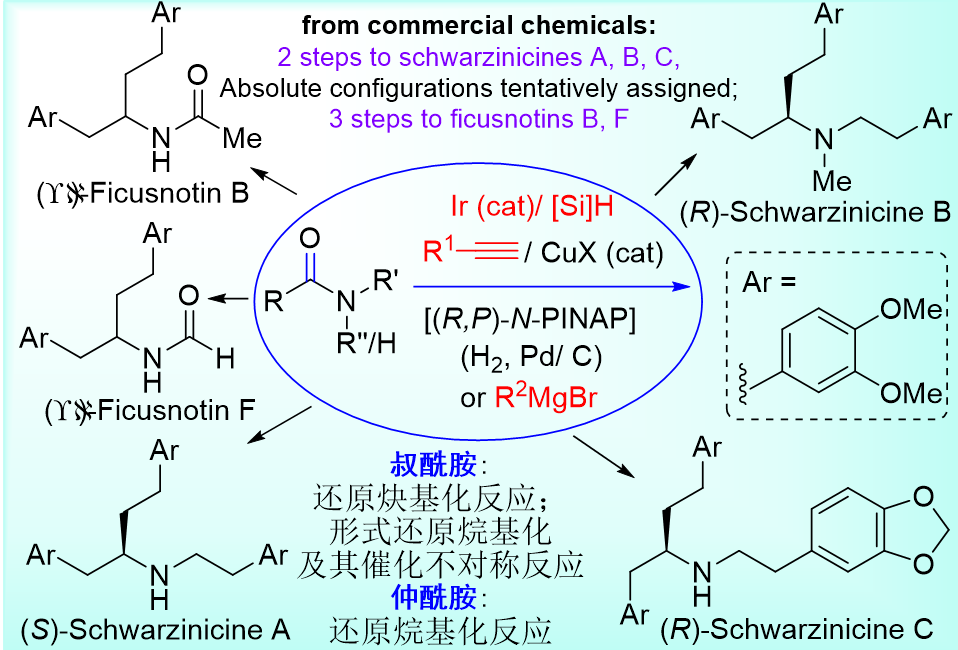
[1] (a) Daly, J. W.; Spande, T. F.; Garraffo, H. M. Alkaloids from Amphibian Skin: A Tabulation of Over Eight-Hundred Compounds. J. Nat. Prod. 2005, 68, 1556-1575;
(b) Marshall, C. M.; Federice, J. G.; Bell, C. N.; Cox, P. B.; Njardarson, J. T. An Update on the Nitrogen Heterocycle Compositions and Properties of U.S. FDA-Approved Pharmaceuticals (2013-2023). J. Med. Chem. 2024, 67, 11622-11655.
[2] (a) Zhao, Z. M.; Zheng, J. F.; Huang, P. Q. Chin. J. Org. Chem. 2026, 46, 1-20 (in Chinese);
(b) Chen, X.-Y.; Zhang, Y.; Gao, C.; Xu, G.-Q. Org. Chem. Front. 2026, 13, 1373-1423;
(c) Ha, X.; Hua, Y. Z.; Xu, G.-Q. Chem. Commun. 2025, 61, 17989-18016;
(d) Jia, J.; Xu, Q.-Q.; Fan, H.-T.; Lv, Y.-P.; Li, D. Org. Chem. Front. 2025, 12, 960-974;
(e) Yang, J. F.; Zhao, Y. Q.; Shi, L. Chin. J. Org. Chem. 2025, 45, 559-573 (in Chinese);
(f) Zhang, T. F.; Chang, J.;Chen, C. X.; Peng, J. S. Chin. J. Org. Chem 2025, 45, 168-188 (in Chinese);
(g) Tao, Y.; Guo, K.-G.; Chen, H.; Yan, G.-B.; Guo, M. Org. Chem. Front.2024, 11, 3270-3280;
(h) Escorihuela, J.; Lledós, A.; Ujaque, G. Chem. Rev. 2023, 123, 9139-9203;
(i) Ricci, A.; Bernardi, L. Methodologies in Amine Synthesis: Challenges and Applications; Wiley-VCH: Weinheim, 2021;
(j) Trowbridge, A.; Walton, S. M.; Gaunt, M. J. New Strategies for the Transition-Metal Catalyzed Synthesis of Aliphatic Amines. Chem. Rev. 2020, 120, 2613-2692; For selected recent examples, see:
(k) Zhang, Y. F.; Wang, B.; Chen, Z.; Liu, J. R.; Yang, N. Y.; Xiang, J. M.; Liu, J.; Gu, Q. S.; Hong, X.; Liu, X. Y. Science 2025, 388, 283-291;
(l) Lu, G.-S.; Ruan, Z.-L.; Wang, Y.; Lü, J.-F.; Ye, J.-L.; Huang, P.-Q. Angew. Chem. Int. Ed. 2025, 64, e202422742;
(m) Meng, Q.; Qin, T.; Miao, H.-R.; Zhang, G.; Zhang, Q. Sci. China Chem. 2024, 67, 2002-2008.
[3] (a) Pace, V.; Holzer, W.; Olofsson, B.Adv. Synth. Catal. 2014, 356, 3697-3736
(b) Sato T.; Chida, N. Org. Biomol. Chem.2014, 12, 3147-3150;
(c) Sato, T.; Yoritate, M.; Tajima, H.; Chida, N. Org. Biomol. Chem. 2018, 16, 3864-3875;
(d) Kaiser, D.; Bauer, A.; Lemmerer, M.; Maulide, N. Chem. Soc. Rev. 2018, 47, 7899–7925;
(e) Sato, T.; Yoritate, M.; Tajima, H.; Chida, N. Org. Biomol. Chem. 2018, 16, 3864–3875;
(f) Matheau-Raven, D.; Gabriel, P.; Leitch, J. A.; Almehmadi, Y. A.; Yamazaki, K.; Dixon, D. J. ACS Catal. 2020, 10, 8880–8897;
(g) Czerwiński, P. J.; Furman, B. Trends Chem. 2020, 2, 782–784;
(h) Czerwiński, P. J.; Furman, B. Front. Chem. 2021, 9, 655849;
(i) Ou, W.; Huang, P.-Q. Acc. Chem. Res. 2025, 58, 2332–2349.
[4] (a) Sheng, T.; Zhuang, Z.; Zhao, Z.-H.; Hoque, M. E.; Yu, J.-Q.Angew. Chem. Int. Ed. 2025, 64, e202416634;
(b) Faculak, M. S.; Veatch, A. M.; Alexanian, E. J. Science 2024, 383, 77-81
(c) Zhang, R.; Yu, T. T.; Dong, G. B. Science 2023, 382, 951-957;
(d) Winn, M.; Rowlinson, M.; Wang, F.; Bering, L.; Francis, D.; Levy, C.; Micklefield, J. Nature 2021, 593, 391-398;
(e) Huo, H.-H.; Gorsline, B. J.; Fu, G. C. Science 2020, 367, 559–564;
(f) Hong, S. Y.; Park, Y.; Hwang, Y.; Kim, Y. B.; Baik, M. H.; Chang, S. Science 2018, 359, 1016–1021;
(g) Choi, G. J.; Zhu, Q. L.; Miller, D. C.; Gu, C. J.; Knowles, R. R. Nature 2016, 539, 268;
(h) Clark, P.; Keenan, T.; Liu, S.; Huang, J.; Ma, Y.-R.; Hasija, A.; Huang, P.-Q.; Jean, A.; Leitch, D. C.; Arseniyadis, S. Chem. Commun. 2025, 61, 19064–19067;
(i) Lü, J.-F.; Wu, J.-F.; Ye, J.-L.; Huang, P.-Q. Beilstein J. Org. Chem. 2025, 21, 2072–2081.
[5] (a) Huang, P.-Q. Acta Chim. Sinica 2018, 76, 357-365;
(b) Abe, H.; Aoyagi, S.; Kibayashi, C. J. Am. Chem. Soc. 2000, 122, 4583-4592.
[6] (a) Efficiency in Natural Product Total Synthesis; Huang, P.-Q., Yao, Z.-J., Hsung, R. P., Eds.; Wiley: Hoboken, NJ, 2018;
(b) Zhao, Y. C.; Yu,B. Acta Chim. Sinica 2025, 83, 1397-1413 (in Chinese);
(c) Chen, L.-J; Chen, P.; Jia, Y.-X. Acc. Chem. Res. 2024, 57, 3524-3540;
(d) Gao, Y.; Ma, D. W. Acc. Chem. Res. 2021, 54, 569-582;
(e) Newhouse, T.; Baran, P. S.; Hoffmann, R. W. Chem. Soc. Rev. 2009, 38, 3010-3021;
(f) Wender, P. A.; Verma, V. A.; Paxton, T. J.; Pillow, T. H. Acc. Chem. Res.2008, 41, 40-49;
(g) Trost, B. M.; Dong, G. Nature 2008, 456, 485-488.
[7] (a) Xiao K.-J.; Luo J.-M.; Ye K.-Y.; Wang Y.; Huang, P.-Q. Angew. Chem., Int. Ed.2010, 49, 3037-3040
(b) Xiao K.-J.; Wang Y.; Ye K.-Y.; Huang, P.-Q. Chem. Eur. J.2010, 16, 12792-12796;
(c) Huang, P.-Q.; Ou, W.; Han, F. Chem. Commun. 2016, 52, 11967-11970;
(d) Ou, W.; Han, F.; Hu, X.-N.; Chen, H.; Huang, P.-Q. Angew. Chem. Int. Ed. 2018, 57, 11354-11358;
(e) Wang, X.-G.; Ou, W.; Liu, M.-H.; Liu, Z.-J.; Huang, P.-Q. Org. Chem. Front. 2022, 9, 3237–3246;
(f) Xu, F.-F.; Chen, J.-Q.; Shao, D.-Y.; Huang, P.-Q. Nat. Commun. 2023, 14, 6251;
(g) Xu, F.-F.; Chen, J.-Q.; Huang, P.-Q. Chem. Eur. J. 2026, 32, e70919;
(h) Lu, G.-S.; Han, Z.; Ye, J.-L.; Huang, P.-Q. Acta Chim. Sinica 2026, 84, 476–483;
(i) Weng, Z.-Y.; Li, Y.-Q.; He, W.-X.; Chen, Z.-Y.; Huang, P.-Q. CCS Chem. 2026, 8, https://doi.org/10.31635/ccschem.025.202506810
[8] (a) Xu Y. B.; Ruan Y.; Zheng J. F.; Huang, P. Q. Chin. J. Org. Chem.2025, 45, 988-995(in Chinese);
(b) Huang X.-Z.; Gao L.-H.; Huang P.-Q. Nat. Commun.2020, 11, 5314.
[9] (a) Fang W.; Luo Z. W.; Wang Y. C.; Zhou W.; Li L.; Chen Y. M.; Zhang X. K.; Dai M. J.; Dai, J. J. Angew. Chem. Int. Ed.2024, 63, e202317570;
(b) Huang, W.-W.; Cheng, J.-T.; Hsiao, W.-T.; Chiou, W.-H. J. Org. Chem. 2024, 89, 5091-5097
(c) Shu X.; Zhong D.; Lin Y.; Qin X.; Huo, H. J. Am. Chem. Soc.2022, 144, 8797-8806;
(d) Agrawal, T.; Perez-Morales, K. D.; Cort, J. A.; Sieber, J. D. J. Org. Chem. 2022, 87, 6387-6392;
(e) Gujarati, P. D.; Reber, K. P. Synthesis 2022, 54, 1404;
(f) Song, Q.; Wang, S.; Lei, X.; Liu, Y.; Wen, X.; Wang, Z. Molecules 2022, 27, 4698;
(g) Lindemann, C.; Schneider, C. Synthesis 2016, 48, 828–844;
(h) Guérot, C.; Tchitchanov, B. H.; Knust, H.; Carreira, E. M. Org. Lett. 2011, 13, 780–783.
[10] Latayada F. S.; Uy M. M.; Akihara Y.; Ohta E.; Nehira T.; Ômura H.; Ohta S. Phytochemistry2017, 141, 98-104.
[11] Krishnan P.; Lee F.-K.; Yap V. A.; Low Y.-Y.; Kam T.-S.; Yong K.-T.; Ting K.-N.; Lim, K.-H. J. Nat. Prod.2020, 83, 152-158.
[12] (a) Kanaoka Y.; Terashima M.; Kimura, T. Chem. Pharm. Bull.1959, 7, 648-649
(b) Yoon J. A.; Ahn S.; Han, Y. T. Synthesis of Ficusnotins, Rare 1,4-Diarylbutanoids Derived from Ficus nota, via Ruthenium-Catalyzed Conjugate Addition. Nat. Prod. Commun.2018, 13, 351-353.
[13] (a) Mak Y.-Y.; Loong B.-J.; Millns P.; Bauer C. C.; Bon R. S.; Mbaki Y.; Lee F.-K.; Lim K.-H.; Kong C.; Then S.-M.; Ting K.-N. Phytotherapy Res.2022, 36, 2952
(b) Mak Y. Y.; Lee F. K.; Lee M. K.; Mbaki Y.; Then S. M.; Yap C. S. A.; Fung S. Y.; Kong C.; Lim K. H.; Ting, K. N. Brit. J. Pharmacol.2023, 180, 546-548.
[14] (a) Lee F.-K.; Krishnan P.; Muhamad A.; Low Y.-Y.; Kam T.-S.; Ting K.-N.; Lim, K.-H. Nat. Prod. Res.2022, 36, 3972-3978
(b) Lee F.-K.; Chan N. J.-Y.; Krishnan P.; Salam D. S. D. A.; Chee X. W.; Muhamad A.; Low Y.-Y.; Ting K.-N.; Lim, K.-H. J. Nat. Prod.2024, 87, 675-691;
(c) Govindaraju, K.; Mak, Y. Y.; Lee, F. K.; Bauer, C. C.; Lim, K. H.; Bon, R. S.; Kong, C.; Then, S. M.; Ting, K. N. Phytochem. Lett. 2024, 59, 24-35.
[15] Bharate S. B.; Lindsley, C. W. J. Med. Chem.2024, 67, 20723-20730.
[16] Annapurna K.; Narsaiah A. V. Tetrahedron2024, 155, 133909.
[17] Wang M. H.; Lu J. X.; Yu Y.; Li Z. H.; Deng L. ACS Catal.2025, 15, 14392-14402.
[18] Xu H.-B.; Lin Z.-Z.; Bai J.-H.; Guo Y.-L.; Ma S. ACS Catal.2024, 14, 262-270.
[19] Shi C. Y.; Wang G. C.; Zhao C. Y.; Gu Q. N.; Hao X. J.; Zhou Y.CN 118063382 A (in Chinese).
[20] Suphaporn L.; Poonsakdi P.; Somsak R.; Chatphorn T.; Winai, I. Chem Asian J.2025, 20, e202401754.
[21] Lurie I. S.; Berrier A. L.; Casale J. F.; Iio R.; Bzenko Jr, J. S. Forensic Sc. Int.2012, 220, 191-196.
[22] Venkov A. P.; Vodenichrov D. M.; Ivanov I. I.Synthesis 1991, 476-478.