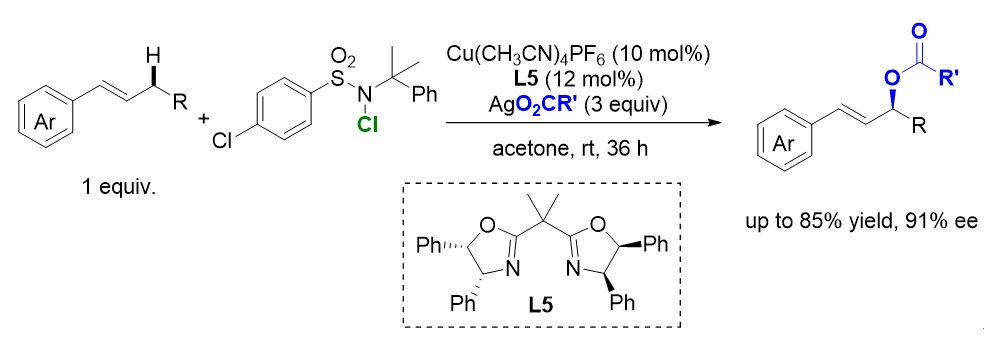
[1] Cernak, T.; Dykstra, K. D.; Tyagarajan, S.; Vachal, P.; Krska, S. W.Chem. Soc. Rev. 2016, 45, 546-576.
[2] Guillemard, L.; Kaplaneris, N.; Ackermann, L.; Johansson, M. J.Nat. Rev. Chem. 2021, 5, 522-545.
[3] Santaniello, E., Ferraboschi, P., Grisenti, P. & Manzocchi, A.Chem. Rev. 1992, 92, 1071-1140.
[4] Giri, R.; Shi, B. F.; Engle, K. M.; Maugel, N.; Yu, J.-Q.Chem. Soc. Rev. 2009, 38, 3242-3272.
[5] Sun, C.-L.; Li, B.-J.; Shi, Z.-J.Chem. Rev. 2011, 111, 1293-1314.
[6] Hartwig, J. F.; Larsen, M. A.ACS Cent. Sci. 2016, 2, 281-292.
[7] White, M. C.; Zhao, J.J. Am. Chem. Soc. 2018, 140, 13988-14009.
[8] Cheng, S.; Li, Q.; Cheng, X. L.; Lin, Y. M.; Gong, L.Chin. J. Chem. 2022, 40, 2825-2837.
[9] Qian, P.-F.; Shi, B.-F.Chem. Sci. 2026, 17, 2969-2989.
[10] Chakrabarty S.; Wang Y.; Perkins J. C.; Narayan, A. R. H. Chem. Soc. Rev.2020, 49, 8137-8155.
[11] Golden, D. L., Suh, S.-E.; Stahl, S. S. Nat. Rev. Chem.2022, 6, 405-427.
[12] Che, C.-M., Lo, V. K.-Y., Zhou, C.-Y.; Huang, J.-S. Chem. Soc. Rev. 2011, 40, 1950-1975.
[13] Milan, M., Salamone, M., Costas, M. & Bietti, M. Acc. Chem. Res. 2018, 51, 1984-1995.
[14] Chen M. S.; White M. C. Science2010, 327, 566-571.
[15] Qin, Y.; Zhu, L. H.; Luo, S.Chem. Rev. 2017, 117, 9433-9520.
[16] Cao M.; Sun H.-R.; Liu, L. Sci China Chem,2025, 68, 5429-5450.
[17] Rittle, J.; Green, M. T.Science 2010, 330, 933-937.
[18] Wang X.; Chen J.; Ma N.; Cong, Z. Acta Chim. Sinica2020, 78, 490-503
[19] Yang, Y.; Arnold, F. H.Acc. Chem. Res. 2021, 54, 1209-1225.
[20] Liu, W.; Groves, J. T.Acc. Chem. Res. 2015, 48, 1727-1735.
[21] Zaragoza, J. P. T.; Siegler, M. A.; Goldberg, D. P.J. Am. Chem. Soc. 2018, 140, 4380-4390.
[22] Gu, Y.; Natoli, S. N.; Liu, Z.; Clark, D. S.; Hartwig, J. F.Angew. Chem., Int. Ed. 2019, 58, 13954-13960.
[23] Huang, X.; Groves, J. T.Chem. Rev. 2018, 118, 2491-2553.
[24] Kawasaki, K.-i.; Katsuki, T.Tetrahedron 1997, 53, 6337-6350.
[25] Wang, F.0[25] Wang, F.; Chen, P.; Liu, G. Acc. Chem. Res. 2018, 51, 2036-2046.
[26] Zhang, Z.; Chen, P.; Liu, G.Chem. Soc. Rev. 2022, 51, 1640-1658.
[27] Wang, F.; Chen, P.; Liu, G.Nat. Synth. 2022, 1, 107-116.
[28] Ling T.; Qin H.; Liu, F. Chin. J. Org. Chem.2025, 45, 498-515 (in Chinese).
令天鹏, 秦海涛, 刘峰有机化学, 2025, 45, 498-515.
[29] Kharasch, M. S.; Sosnovsky, G.J. Am. Chem. Soc. 1958, 80, 756-756.
[30] Kharasch, M. S.; Fono, A.J. Org. Chem. 1958, 23, 324-324.
[31] Kharasch, M. S.; Sosnovsky, G.; Yang, N. C.J. Am. Chem. Soc.1959, 81, 5819-5824.
[32] Andrus M. B.; Lashley J. C. Tetrahedron2002, 58, 845-866.
[33] Zhang B.; Zhu S.-F.; Zhou Q.-L. Tetrahedron Lett.2013, 54, 2665-2668.
[34] Chen, X.; Li, H.-H.; Kramer, S.Angew. Chem., Int. Ed. 2024, 63, e202413190.
[35] Tang, S.; Xu, H.; Dang, Y.; Yu, S.J. Am. Chem. Soc. 2024, 146, 27196-27203.
[36] Liu, X.-M.; Li, F.; Wang, T.; Dai, L.; Yang, Y.; Jiang, N.-Q.; Xue, L.-Y.; Liu, J.-Y.; Xue, X.-S.; Xiao, L.-J.; Zhou, Q.-L.J. Am. Chem. Soc. 2025, 147, 627-635
[37] Zhang, H.; Zhou, Y.; Yang, T.; Wu, J.; Chen, P.; Lin, Z.; Liu, G.Nat. Catal. 2025, 8, 58-66.
[38] Zhou Y.; Chen P.; Liu, G. J. Am. Chem. Soc.2025, 147, 22873-22882.
[39] Qi X.-K.; Dai Q.; Gu Y.; Lau K. S.; Sung H. H. Y.; Williams I. D.; Lin Z.; Zhang C.; Sun, J. J. Am. Chem. Soc.2025, 147, 20225-20232.
[40] Li, J.; Zhang, Z.; Wu, L.; Zhang, W.; Chen, P.; Lin, Z.; Liu, G.Nature 2019, 574, 516-521.
[41] Fu, L.; Zhang, Z.; Chen, P.; Lin, Z.; Liu, G.J. Am. Chem. Soc. 2020, 142, 12493-12500.
[42] Cheng, Z.; Yang, T.; Li, C.; Deng, Y.; Zhang, F.; Chen, P.; Lin, Z.; Ma, S.; Liu, G.J. Am. Chem. Soc. 2023, 145, 25995-26002.
[43] Mezei G.; Rivera-Carrillo M.; Raptis, R. G. Inorganica Chimica Acta. 2004, 3573721-3732.
[44] Zhang F.; Yang T.; Cheng Z.; Chen P.; Lin Z.; Liu, G. J. Am. Chem. Soc.2026, 148, 20240-20253.