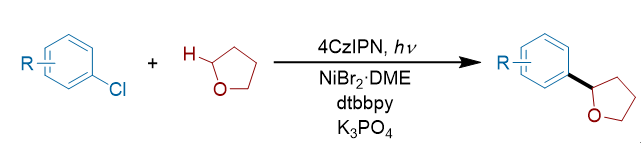
Cross-coupling between C(sp2)-Cl bond and C(sp3)-H bond is an essential way to construct C(sp2)-C(sp3) bond. By merging photosensitizer and nickel catalyst, photocatalytic system proceeds the reactions under mild and efficient condition, which enriches the activation fashion of C(sp3)-H bond. It is commonly accepted that the reaction undergoes the catalytic cycle containing Ni(0) species. Herein, we report that when carbazole is utilized as a photosensitizer, Ni(I) rather than Ni(0) species is the primary nickel species in the system. The cooperation between carbazole photosensitizer and Ni(I) species exhibits competent catalytic ability to the cross-coupling of C(sp2)-Cl bond in aryl chloride and C(sp3)-H bond in good to excellent yields.
Xiao-Jun He
,
Bin Chen
,
Xiao-Ning Guo
,
Chen-Ho Tung
,
Li-zhu Wu
. Photocatalytic C(sp2)-C(sp3) Cross-coupling between C(sp2)-Cl Bond and C(sp3)-H Bond[J]. Chinese Journal of Organic Chemistry, 0
: 202605031
.
DOI: 10.6023/cjoc202605031
[1] Gao G.; Li Z.; Li Y.; Lu X.,Recent Progress on the Construction of C(sp2)-C(sp3) Bonds via Photoredox/Nickel Dual Catalysis. Chin. J. Org. Chem. 2025, 45, 1905-1919.
[2] Wang X.; Xu S.; Ping Y.; Kong W.,Selective Functionalization of C(sp3)-H Bonds via Photoredox/ Nickel Dual Catalysis.Chin. J. Org. Chem. 2025, 45, 383-422.
[3] (a) Brunard, E.; Huang, F.; Díaz-Jiménez, À.; Kostiukovska, S.; Wencel-Delord, J., Intermolecular Enantioselective Nickel-Catalyzed Arylation of Un-Activated C(sp3)-H Bond.Angew. Chem. Int. Ed. 2026, 65, e23241;(b) Aihara, Y.; Chatani, N., Nickel-Catalyzed Direct Arylation of C(sp3)-H Bonds in Aliphatic Amides via Bidentate-Chelation Assistance. J. Am. Chem. Soc. 2014, 136, 898-901.
[4] (a) Li, G.; Li, T.; Luo, L.; Tan, Y.; Lu, Z., Photo and earth-abundant metal dual catalysis in organic synthesis.Org. Chem. Front. 2025, 12, 4530-4607.(b) Xu, S.; Ping, Y.; Li, W.; Guo, H.; Su, Y.; Li, Z.; Wang, M.; Kong, W., Enantioselective C(sp3)-H Functionalization of Oxacycles via Photo-HAT/Nickel Dual Catalysis. J. Am. Chem. Soc. 2023, 145, 5231-5241;(c) Xu, S.; Ping, Y.; Xu, M.; Wu, G.; Ke, Y.; Miao, R.; Qi, X.; Kong, W., Stereoselective and site-divergent synthesis of C-glycosides. Nat. Chem. 2024, 16, 2054-2065.
[5] Shields B. J.; Doyle A. G.,Direct C(sp3)-H Cross Coupling Enabled by Catalytic Generation of Chlorine Radicals.J. Am. Chem. Soc. 2016, 138, 12719-12722.
[6] Dewanji A.; Krach P. E.; Rueping M.,The Dual Role of Benzophenone in Visible-Light/Nickel Photoredox-Catalyzed C-H Arylations: Hydrogen-Atom Transfer and Energy Transfer.Angew. Chem. Int. Ed. 2019, 58, 3566-3570.
[7] Perry I. B.; Brewer T. F.; Sarver P. J.; Schultz D. M.; DiRocco, D. A.; MacMillan, D. W. C., Direct arylation of strong aliphatic C-H bonds.Nature 2018, 560, 70-75.
[8] Sun R.; Qin Y.; Ruccolo S.; Schnedermann C.; Costentin C.; Nocera D. G.,Elucidation of a Redox-Mediated Reaction Cycle for Nickel-Catalyzed Cross Coupling.J. Am. Chem. Soc. 2019, 141, 89-93.
[9] Ganguli K.; Cruz A. R.; Diccianni J. B.; García-Reynaga, P.; Weix, D. J., Cross-Electrophile Coupling of N-Hydroxyphthalimide Esters with Aryl Bromides Using an Inner-Sphere Homogeneous Reductant.J. Am. Chem. Soc. 2026, 148, 2590-2599.
[10] (a) Lee, S.-C.; Zhu, C.; Huang, K.; Bau, J. A.; Jia, J.; Yue, H.; Rueping, M., Photoinduced Nickel-Catalyzed Demethylative Cyanation and Decarboxylative Cyanomethylation of Aryl Halides.ACS Catal. 2023, 13, 16279-16285.(b) Day, C. S.; Rentería-Gómez, Á.; Ton, S. J.; Gogoi, A. R.; Gutierrez, O.; Martin, R., Elucidating electron-transfer events in polypyridine nickel complexes for reductive coupling reactions.Nat. Catal. 2023, 6, 244-253;(c) Lowry, M. S.; Goldsmith, J. I.; Slinker, J. D.; Rohl, R.; Pascal, R. A.; Malliaras, G. G.; Bernhard, S., Single-Layer Electroluminescent Devices and Photoinduced Hydrogen Production from an Ionic Iridium(III) Complex. Chem. Mater. 2005, 17, 5712-5719.
[11] Wang Z.; Ji X.; Han T.; Deng G.-J.; Huang H.,LiBr-Promoted Photoredox Minisci-Type Alkylations of Quinolines with Ethers.Adv. Synth. Catal. 2019, 361, 5643-5647.
[12] Ting S. I.; Williams W. L.; Doyle A. G.,Oxidative Addition of Aryl Halides to a Ni(I)-Bipyridine Complex.J. Am. Chem. Soc. 2022, 144, 5575-5582.