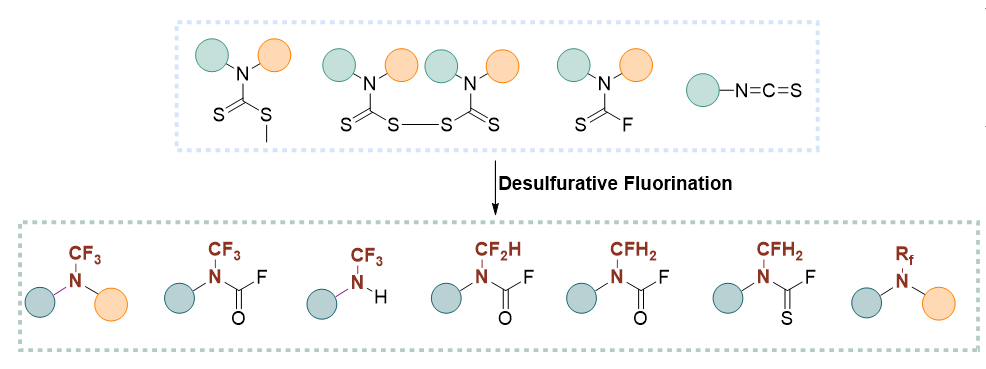
N-Fluoroalkyl compounds are important functional molecules in the fields of medicine, agrochemicals, and functional materials. The introduction of fluoroalkyl groups onto the nitrogen atom of amines can precisely modulate the physicochemical properties and biological activities of molecules, and has become a research hotspot in drug-structure modification. Desulfurative fluorination, as an efficient strategy for constructing N-fluoroalkyl structures, employs thiocarbonyl compounds such as thioamides, dithiocarbamates, thiocarbamoyl fluorides, and isothiocyanates as precursors. In the presence of fluorinating reagents, Lewis acids, or oxidizing additives, this strategy enables desulfurative transformation of C=S bonds, thereby efficiently constructing N-CF3, N-CF2H, N-CH2F, and perfluoroalkyl functional groups. This review systematically summarizes recent advances in the synthesis of diverse N-fluoroalkyl compounds via desulfurative fluorination, concludes the reaction rules, mechanisms and substrate scope of various thiocarbonyl precursors, and discusses the merits and limitations of different synthetic strategies. The advantages and limitations of various synthetic strategies are also discussed. In addition, the applications of these compounds in the synthesis of antibacterial molecules, heterocyclic drugs, and functional building blocks are introduced. Current challenges, including insufficient substrate generality and the lack of industrially scalable processes, are analyzed. Finally, future directions, such as the development of novel catalytic systems, green fluorination technologies, and scalable synthetic methods, are discussed, with the aim of providing guidance for the design and synthesis of functional fluorinated amine molecules.
[1] Smart, B. E. J. Fluorine Chem.2001, 109, 3.
[2] Meanwell N. A.; J. Med. Chem.2011, 54, 2529.
[3] Meanwell N. A.; J. Med. Chem.2018, 61, 5822.
[4] Picois N.; Boutahri Y.; Milbeo P.; Zanato C.; Lensen N.; Chaume G.; Brigaud T. Molecules.2024, 29, 1408.
[5] Zhang C.; Yan K.; Fu C. K.; Peng H.; Hawker C. J.; Whittaker, A. K. Chem. Rev.2022, 122, 167.
[6] Hird, M. Chem. Soc. Rev. 2007, 36, 2070.
[7] Fujiwara T.; O’Hagan, D. J. Fluorine Chem.2014, 167, 16.
[8] Han L.; Xu Y. J.; Dong M. F.; Qian, C. F. Bull. Environ. Contam. Toxicol.2007, 79, 445.
[9] Harder R. J.; Smith, W. C. J. Am. Chem. Soc.1961, 83, 3422.
[10] Dmowski W.; Kaminski, M. J. Fluorine Chem.1983, 23, 207.
[11] Pawelke, G. J. Fluorine Chem.1991, 52, 229.
[12] Lal G. S.; Lobach E.; Evans, A. J. Org. Chem.2000, 65, 4830.
[13] Umemoto T.; Singh, R. P. J. Fluorine Chem.2012, 140, 17.
[14] Kanie K.; Mizuno K.; Kuroboshi M.; Hiyama T.Bull. Chem. Soc. Jpn. 1998, 71, 1973.
[15] Raab C. E.; Dean, D. C. L; Melillo, D. G. J. Labelled Comp. Radiopharm.2001, 44, 815.
[16] Kanie K.; Mizuno K.; Kuroboshi M.; Takehara S.; Hiyama T. Chem. Lett.1995, 24, 683.
[17] Asahina Y.; Araya I.; Iwase K.; Iinuma F.; Hosaka M.; Ishizaki, T. J. Med. Chem.2005, 48, 3443.
[18] Hagooly Y.; Rozen S. Org. Lett.2012, 14, 1114.
[19] Tyrra, W. J. Fluorine Chem.2001, 109, 189.
[20] Scattolin T.; Deckers K.; Schoenebeck, F. Angew. Chem., Int. Ed.2017, 56, 221.
[21] Yu J.; Lin J. H.; Xiao, J. C. Angew. Chem., Int. Ed.2017, 56, 16669.
[22] Zheng J.; Cai J.; Lin J. H.; Guo, Y., Xiao, J. C. Chem. Commun.2013, 49, 7513.
[23] Jiang L. Q.; Qian J. L.; Yi W. B.; Lu G. P.; Cai C.; Zhang, W. Angew. Chem., Int. Ed.2015, 54, 14965.
[24] Liang S. S.; Wei J. J.; Jiang L. Q.; Liu J.; Mumtaz Y.; Yi, W. B. Chem. Commun.2019, 55, 8536.
[25] Wei J. J.; Liang S. S.; Jiang L. Q.; Yi, W. B. J. Org. Chem.2020, 85, 12374.
[26] Zhen L.; Fan H.; Wang X. J.; Jiang L. Q.Org. Lett. 2019, 21, 2106.
[27] Hong J. Q.; Wei C. B.; Feng R. L.; Zhao K.; Zhu Y.; Li C. X.; Chen X. F.; Gong X. X.; Yin D. J.; Zheng C. G.Org. Chem. Front. 2024
11, 1720.
[28] Onida K.; Vanoye L.; Tlili, A. Eur. J. Org. Chem.2019, 2019, 6106.
[29] Taponard A.; Jarrosson T.; Khrouz L.; Médebielle M.; Broggi J.; Tlili, A. Angew. Chem., Int. Ed.2022, 61, e202204623.
[30] Song H. X.; Wang Q.; Wang X. Y.; Zhang Y. B.; Duan X. H.; Hu M.Y. CCS Chem.2025, 7, 381.
[31] Sheppard, W. A. J. Am. Chem. Soc.1965, 87, 4338.
[32] Hagooly Y.; Gatenyo J.; Hagooly A.; Rozen, S. J. Org. Chem.2009, 74, 8578.
[33] Scattolin T.; Bouayad-Gervais S.; Schoenebeck F. Nature.2019, 573, 102.
[34] Turksoy A.; Scattolin T.; Bouayad‐Gervais, S.; Schoenebeck, F.Chem. Eur. J. 2020, 26, 2183.
[35] Nielsen C. D.; Zivkovic F. G.; Schoenebeck, F. J. Am. Chem. Soc.2021, 143, 13029.
[36] Zivkovic F. G.; Nielsen C. D.; Schoenebeck, F. Angew. Chem. Int. Ed.2022, 61, e202213829.
[37] Bouayad‐Gervais S.; Scattolin T.; Schoenebeck, F. Angew. Chem., Int. Ed.2020, 59, 11908.
[38] Bouayad-Gervais S.; Nielsen C. D.; Turksoy A.; Sperger T.; Deckers K.; Schoenebeck, F. J. Am. Chem. Soc.2022, 144, 6100.
[39] Turksoy A.; Bouayad‐Gervais S.; Schoenebeck, F. Chem. Eur. J.2022, 28, e202201435.
[40] Liu J. B.; Parker M. F. L.; Wang S. N.; Flavell R. R.; Toste F. D.; Wilson D. M. Chem.2021, 7, 2245.
[41] Wang L. B.; Wang. J. P.; Ye S. T.; Jiang B. H.; Guo Z. H.; Mumtaz Y.; Yi, W. B. Angew. Chem., Int. Ed.2022, 61, e202212115.
[42] Yang Y.; Saffon-Merceron N.; Vantourout J. C.; Tlili A. Chem. Sci.2023, 14, 3893.
[43] Zivkovic F. G.; Wycich G.; Liu L. H.; Schoenebeck F.J. Am. Chem. Soc. 2024, 146, 1276.
[44] Hu C. Y.; Jiang L. Q.; Guo Z. H.; Mumtaz Y.; Liu J.; Qin J. R.; Chen Y. X.; Lin Z. Q.; Yi, W. B. Angew. Chem. Int. Ed.2024, 63
e202319758.
[45] Song H. X.; Wang Q.; Wang X. Y.; Pan Y.; Li J.; Duan X. H.; Hu, M. Y. J. Org. Chem.2024, 89, 14341.
[46] Tao M.; Qian J. S.; Deng L. B.; Wilson D. M.; Zhang X. S.; Liu, J. B. Nat. Chem.2025, 17, 532.
[47] Zivkovic F. G.; Bahns F. C.; Hsu C.-M.; Schoenebeck, F. Angew. Chem., Int. Ed.2025, 64, e202505478.
[48] Ma L. Y.; Jiang L. Q.; Tian G. S.; Lin Z. J.; Lin Z. Q.; Xu Y.; Guo Z. H.; Wang L. B.; Liu J.; Yi, W. B. Angew. Chem. Int. Ed.2025, 64e202508594.
[49] Kuroboshi M.; Hiyama T. Tetrahedron Lett.1994, 35, 3983.
[50] Wang L. B.; Feng Z. Y.; Luo Z.; Guo Z. H.; Wang J. P.; Yi W. B. Chem. Sci. 2024, 15, 20171.


