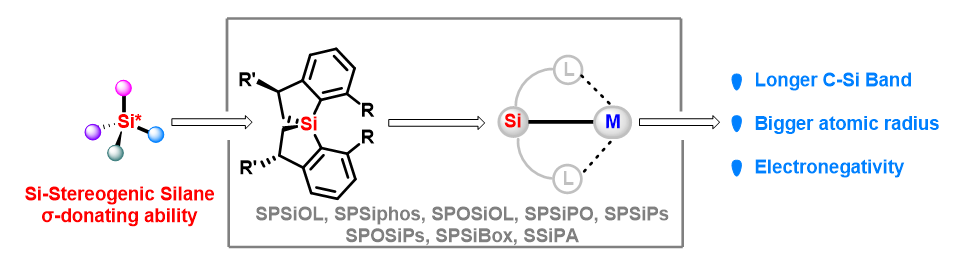
Asymmetric catalysis stands as a core domain in modern organic synthesis and catalysis science, wherein the design and innovation of chiral ligands represent the decisive driving force for breakthroughs. Benefiting from their rigid structures and outstanding chiral induction capability, spirocyclic scaffolds have become privileged platforms for chiral ligand development. In recent years, silicon-stereogenic spirocyclic frameworks have emerged as a new frontier in chiral ligand design, owing to the larger atomic radius, longer C-Si bonds, unique electronic effects, and distinct spatial configurations of silicon. This review systematically summarizes the developmental history of chiral silicon-centered spirocyclic scaffolds, with a focus on the synthetic strategies for two privileged cores, SPSiOL and SPOSiOL. The structural features and design philosophies of diverse silicon-spiro ligands, including diphosphines, bisphosphites, bisoxazolines, and phosphine-oxazolines, are comprehensively discussed. Their applications in Rh-, Ni-, Pd-, Cu-, and Ir-catalyzed asymmetric hydrogenation, hydrosilylation, hydroboration, cycloisomerization, [2+2+2] cycloaddition, and intramolecular alkynylamination are thoroughly overviewed. This review aims to provide a systematic reference for the rational design of novel chiral silicon-spiro ligands, mechanistic investigations, and synthetic applications, thereby promoting the advancement of chiral silicon chemistry in pharmaceuticals and materials.
Hou Fei
,
Qi Yuxuan
,
Tian Huhu
,
Han Dequan
,
Zhou Xiaodong
,
Wang Hui
,
Lu Tingting
,
Cao Luya
,
Yu Xiaoli
. Design, Development, and Application of Chiral Spirosilane Ligands in Asymmetric Catalysis[J]. Chinese Journal of Organic Chemistry, 0
: 0
.
DOI: 10.6023/cjoc202606017
[1] Lin G.-Q., Sun X.-W., Chen Y.-Q., Li Y.-M., Chen X.-Z., Chiral Synthesis: Asymmetric Reactions and Applications, Science Press, Beijing, 2013 (in Chinese).
(林国强, 孙兴文, 陈耀全, 李月明, 陈新滋, 手性合成:不对称反应及其应用. 科学出版社, 北京, 2013.)
[2] Ding K.-L., Fan Q.-H., New Concepts and New Methods in Asymmetric Catalysis, Chemical Industry Press, Beijing, 2009 (in Chinese).
(丁奎岭, 范青华, 不对称催化新概念与新方法. 化学工业出版社, 北京, 2009.)
[3] Yoon T. P.; Jacobsen E. N.Privileged Chiral Catalysts. Science, 2003, 1691-1693.
[4] Zhang Z.-H., Chin. J. Org. Chem.2005, 4, 355 (in Chinese).
(张占辉, 有机化学, 2005, 04, 355.)
[5] Zhu S.-F.; Zhou Q.-L. In Privileged Chiral Ligands and Catalysts, Ed.: Zhou, Q. L. Wiley-VCH Verlag GmbH & Co. KgaA, 2011, pp. 137-170.
[6] Xie, J.-H., Zhou Q.-L. The Amazing Chiral Spirocyclic Ligands. Acta Chimica Sinica.2014, 72, 778 (in Chinese).
(谢建华,周其林, 神奇的手性螺环配体. 化学学报, 2014, 72, 778.)
[7] Ding K.; Han Z.; Wang, Z. Spiro Skeletons: A Class of Privileged Structure for Chiral Ligand Design. Chem.-Asian J.2009, 4, 32.
[8] Gao J.; Ge Y.; He, C. X-Type Silyl Ligands for Transition-Metal Catalysis. Chem. Soc. Rev.2024, 53, 4648.
[9] Wu Y.; Wang, P. Silicon-Stereogenic Monohydrosilane: Synthesis and Applications. Angew. Chem. Int. Ed.2022, 61, e202205382.
[10] Wu Y.; Zheng L.; Wang Y.; Wang, P. Catalytic Asymmetric Synthesis of Silicon-Stereogenic Organosilanes. Chem.2023, 9, 3461.
[11] Li L.; Lai G.-Q.; Jiang J.-X.; Xu, L.-W. The recent synthesis and application of silicon-stereogenic silanes: A renewed and significant challenge in asymmetric synthesis. Chem. Soc. Rev.2011, 40, 1777.
[12] Bauer J. O.; Strohmann C. Recent Progress in Asymmetric Synthesis and Application of Difunctionalized Silicon-Stereogenic Silanes. Eur. J. Inorg. Chem.2016, 2016, 2868.
[13] Ye F.; Xu Z.; Xu, L.-W. The Discovery of Multifunctional Chiral P Ligands for the Catalytic Construction of Quaternary Carbon/Silicon and Multiple Stereogenic Centers. Acc. Chem. Res.2021, 54, 452.
[14] Li L.; Huang W.-S.; Xu Z.; Xu, L.-W. Catalytic asymmetric silicon-carbon bond-forming transformations based on Si-H functionalization. Sci. China Chem.2023, 66, 1654.
[15] Xu, L.-W. Desymmetrization Catalyzed by Transition-Metal Complexes: Enantioselective Formation of Silicon-Stereogenic Silanes. Angew. Chem. Int. Ed.2012, 51, 12932.
[16] Tamao K.; Nakamura K.; Ishii H.; Yamaguchi S.; Shiro, M. Axially Chiral Spirosilanes via Catalytic Asymmetric Intramolecular Hydrosilation. J. Am. Chem. Soc.1996, 118, 12469.
[17] Yoichiro K.; Kanae Y.; Naoya T.; Takayuki S.; Kazuhiko, T. Rhodium-Catalyzed Asymmetric Synthesis of Spirosilabifluorene Derivatives. Angew. Chem. Int. Ed.2013, 52, 1520.
[18] Murai M.; Takeshima H.; Morita H.; Kuninobu Y.; Takai, K. Acceleration Effects of Phosphine Ligands on the Rhodium-Catalyzed Dehydrogenative Silylationand Germylation of Unactivated C(sp3)-H Bonds. J. Org. Chem.2015, 80, 5407.
[19] Chang X.; Ma P.-L.; Chen H.-C.; Li C.-Y.; Wang P. Asymmetric Synthesis and Application of Chiral Spirosilabiindanes. Angew. Chem. Int. Ed.2020, 59, 8937.
[20] Li H.; Zhao P.-G.; Wang C.-Y.; Zhang R.-Y.; Li J.-J.; Wu Y.; Wang, P. SPSiPs, A Class of Diphosphine Ligands Based on SPSiOL with a Large Dihedral Angle. Org. Lett.2023, 25, 3859.
[21] Hou F.; Liu M.-J.; Ru T.; Tan Z.-Q.; Ning Y.-T.; Chen, F.-E. Chiral spirosiladiphosphines: ligand development and applications in Rh-catalyzed asymmetric hydrosilylation/cyclization of 1,6-enynes with enhanced reactivity. Chem. Sci.2023, 14, 4641.
[22] Hou F.; Y Ning Y.-T.; Song L.-L.; Tan Z.-Q.; Chen, F.-E. Rhodium-Catalyzed Asymmetric Hydroboration/Cyclization of 1,6-Enynes Enabled by Spirosiladiphosphine Ligands:Constructing Chiral Five-Membered Rings with a Boron Handle. Org. Lett.2023, 25, 7810.
[23] Tan Z.-Q.; Hou F.; Zeng J.; Yang F.; Zhou T.-Y.; Hu G.-H.; Zhang Y.-J.; Chen F.-E.A spirosilane ligand induced highly enantioselective Rh-catalyzed cycloisomerization of 1,6-enynes.Green Synth. Catal. 2024, doi.org/10.1016/i.gresc.2024.07.004.
[24] Hou F.; Liu Z.-G.; Zhou T.-Y.; Liu M.-J.; Tao Yuan.; Zhang Y.-J.; Chen F.-J.; Chen, F.-E. Enantioselective Synthesis of Fused Bicyclic Cyclohexadienes by Rh/Si-SDP-Catalysed [2+2+2] Cycloaddition of 1,6-Diynes with Acrylamides or Enamides. ACS Catal.2025, 15, 11337.
[25] Woldegiorgis A. G.; Yuan Z.; Wu Q.-Y.; Wang D.-M.; Ren F.; Zheng L.; Wu Y.-C.; Meng W.; Wang, P. SPSiP-Enabled Pd-Catalyzed Enantioselective Alkynylamination of Alkenes. J. Am. Chem. Soc.2026, 148, 12526.
[26] Liu T.; Mao X.-R.; Song, S. Chen Z.-Y.; Wu Y.; Xu L.-P.; Wang, P. Enantioselective Nickel-Catalyzed Hydrosilylation of 1,1-Disubstituted Allenes. Angew. Chem. Int. Ed.2023, 62, e202216878.
[27] Chen S.-H.; Zhang S.; Chen Z.-Y.; Wu Y.; Wang, P. The Developmentand Application of SPSiBox Ligands: Cu-Catalyzed Enantioselective Carbene Insertion of Ge-H Bonds. J. Am. Chem. Soc.2025, 147, 15666.
[28] Yang L.; Xu W.-Q.; Liu T.; Wu Y.-C.; Wang B.-Q.; Wang P. Concise Synthesis and Applications of Enantiopure Spirobiphenoxasilin-diol andits Related Chiral Ligands. Chem. Commun.2021, 57, 13365.
[29] Wu S.-L.; Zhang W.-C.; Zhang Z.-G.; Zhang, X.-M. Synthesis of New Monodentate Spiro Phosphoramidite Ligand and Its Application in Rh-Catalyzed Asymmetric Hydrogenation Reactions. Org. Lett.2004, 6, 3565.
[30] Li Z.-D.; Ren F.; Wu Y.; Li J.-J.; Luo J.; Wang P. Development and Application of SPOSiPs: A Class of Diphosphine Ligands Based on SPOSiOL. Org. Lett.2024, 26, 7436.
[31] Zhang H.-P.; Sun H.-X.; Zhao, D.-B. Si-O-Si Replacement of Spirobiindane Carbon Centers Unlocks a General Route to Tunable Chiral Spiro Ligands. J. Am. Chem. Soc.2026, 148, 26299.
[32] Li Y.-L.; Yuan Z.-D.; Hou, Y. From Carbon-Centered to Silicon-Centered: Development of Research on Chiral Spiro Diphosphine Ligands. Chemistry Bulletin.2024, 87, 190 (in Chinese).
(栗艳丽, 袁振东, 侯燕. 从碳中心到硅中心:手性螺环双膦配体研究的发展. 化学通报.2024, 87, 190.)