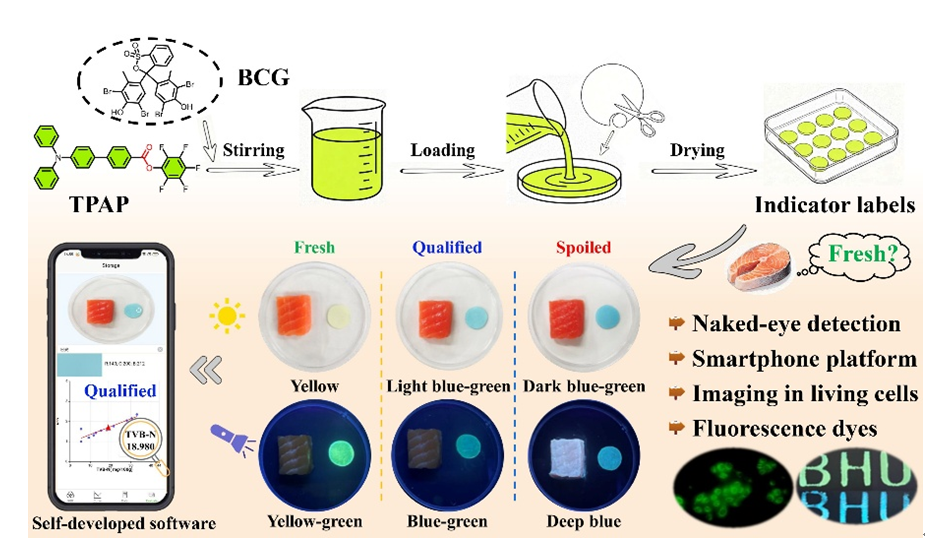
Fish freshness of is closely related to dietary safety. Conventional freshness detection techniques suffer from drawbacks including costly analytical instruments and cumbersome operational workflows. Meanwhile, existing indicator labels only rely on single-channel color variations, leading to inaccurate naked-eye evaluation. To address these limitations, this work synthesized a biogenic amine fluorescent probe TPAP, capable of recognition toward various amines with a fluorescent turn-on response. The probe possesses a large Stokes shift of 150 nm, a low limit of detection of 7.48 μM, and a broad pH range of 4-11. TPAP was blended with bromocresol green at a molar ratio of 4:1 and immobilized on filter paper to fabricate colorimetric and fluorescent dual-responding indicator labels. Visible color alterations under daylight and fluorescent light enable naked-eye evaluation of fish freshness, substantially improving detection reliability. Furthermore, a self-developed smartphone application was utilized to extract RGB from the indicator labels. A linear correlation was established between the B/R ratio and total volatile basic nitrogen (TVB-N) concentrations, enabling smartphone-based grading of fish freshness. In addition, probe TPAP exhibits versatile multifunctional properties: the formulated fluorescent ink can be applied for anti-counterfeiting, and TPAP achieves intracellular fluorescence imaging of cadaverine in living cells. This study not only establishes a novel strategy for rapid, accurate, and non-destructive detection of fish freshness, but also broadens the multi-scenario application potential of fluorescent probes.
Wen Xin
,
Li Yangyang
,
Zhong Keli
,
Sun Xiaofei
,
Li Xuepeng
,
Li Jianrong
,
Tang Lijun
. Dual-channel Indicator Label Based on Triphenylamine Fluorescent Probe for Visual Evaluation of Fish Freshness[J]. Chinese Journal of Organic Chemistry, 0
: 202606028
-202606028
.
DOI: 10.6023/cjoc202606028
[1] Chen L.;Wang,J.; Zhao, X.; Yan, X.Food Chem. 2025, 482, 144144.
[2] Chen C.; Wang X.; Wang X.; Waterhouse G.; Jiang M.; Qiao X.; Xu Z.Anal. Chem. 2024, 96, 12862.
[3] Ceylan B.; Çayci M.Glob. Nest. J. 2024, 26, 06420.
[4] Nguyen T.; Rupasinghe H.; Nguyen Q.; Pham T.; Hoang Q.; Pham B.; Mai T.; Le T.; Le T.; Mai T.J. Food Compos. Anal. 2025, 138, 106997.
[5] Sánchez-Parra, M.; Pierna, J.; Baeten, V.; Muñoz-Redondo, J.; Ordóñez-Díaz, J.; Moreno-Rojas, J.J. Food Eng. 2024, 379, 112129.
[6] He H.; Nie R.; Dong N.Microchem. J. 2024, 200, 110429.
[7] Jiang D.; Ling W.; Yi Z.; Jiang Y.; Wang Z.; An X.; Ji C.; Wang X.; Sun Q.; Kang B.Microchem. J. 2024, 203, 110821.
[8] Wei Y.; Huang L.; Shi Z.; Tang Y.; Huang X.; Wu Y.Microchem. J. 2024, 198, 110148.
[9] Wang Z.; Li X.; Xue X.; Wang Q.; Wang X.; Li J.J. Rare Earth., 2026, 44, 2028.
[10] Liu S.; Liang T.; Tian M.; Wu C.; Tang L.; Li Y.; Zhong K.; Sun X.; Li X.; Li J.J. Food Eng. 2025, 399, 112614.
[11] Sun X.; Jiang X.; Zhao X.; Wang Z.; Yuan J.; Li Y.; Li X.; Li J.; Tang L.; Zhong K.Food Chem. 2025, 473, 143013.
[12] Yang Y.; Yan X.; Liang T.; Tian M.; Wu C.; Tang L.; Sun X.; Zhang J.; Li Y.; Zhong K.J. Hazard. Mater. 2024, 469, 134003.
[13] Zhong K.; Liu S.; Li Y.; Tang L.; Sun X.; Li X.; Li, J. J. Sci. Food. Agr.2025, 105, 3951.
[14] Chen Q.; Wang C.; Wang Y.; Tian M.; Liang T.; Wu C.; Tang L.; Yan X.; Zhong K.Talanta 2026, 298, 129014.
[15] Wang A.; Tang F.; Zang T.; Liu X.; Cheng G.; Chen W.; Shu W.; Li D.; Tang Y.; Sun X.; Xiao H.Food Chem. 2024, 454, 139714.
[16] Noushija M.; Krishna A.; Ali R.; Shanmugaraju S. Sens. Diagn.2025, 4, 293.
[17] Miao X.; Jiang Y.; Liu W.; Lu C.; Tan W.; Li F.; Zhang M.ACS Sensors 2025, 10, 3669.
[18] Li J.; Wang C.; Tian M.; Liang T.; Yan X.; Li Y.; Wu C.; Zhong K.; Tang, L. Chem. Eng. J.2026, 540, 177268.
[19] Liu L.; Zhou L.; Liang T.; Zhong K.; Yan X.; Tang, L. Chin. J. Org. Chem.2026, 46, 866 (in Chinese).
(刘琳, 周璐璐, 梁天宇, 钟克利, 燕小梅, 汤立军, 有机化学, 2026, 46, 866.).
[20] Erdemir S.; Malkondu S.; Oguz M.Microchem. J. 2026, 220, 116598.
[21] Wang C.; Yu Z.; Zhao X.; Lu H.; Wang Q.Dyes.Pigm. 2021, 189, 109228.
[22] Sun X.; Ren N.; Gong H.; Wang Z.; Li X.; Tang L.; Zhong K.; Li, J. Anal. Chim. Acta2025, 1374, 344525.
[23] Zhang L.; Peng M.; Su Y.; Wang Y.; Peng Y.Microchem. J. 2025, 216, 114710.
[24] Zhao Y.; Liu L.; Ha Y.; Hou B.; Liang T.; Zhong K.; Sun X.; Li X.; Yan X.; Tang L.Spectrochim. Acta A 2026, 358, 127833.
[25] Zhong K.; Liu L.; Li Y.; Liang T.; Tang L.; Yan X.; Sun X.; Li X.; Li, J. J. Food Sci.2025, 90, e70659.
[26] Zhong K.; Hu L.; Tian L.; Tang L.; Sun X.; Liang T.; Li J.; Li X.J. Mater. Chem. C 2025, 13, 13315.