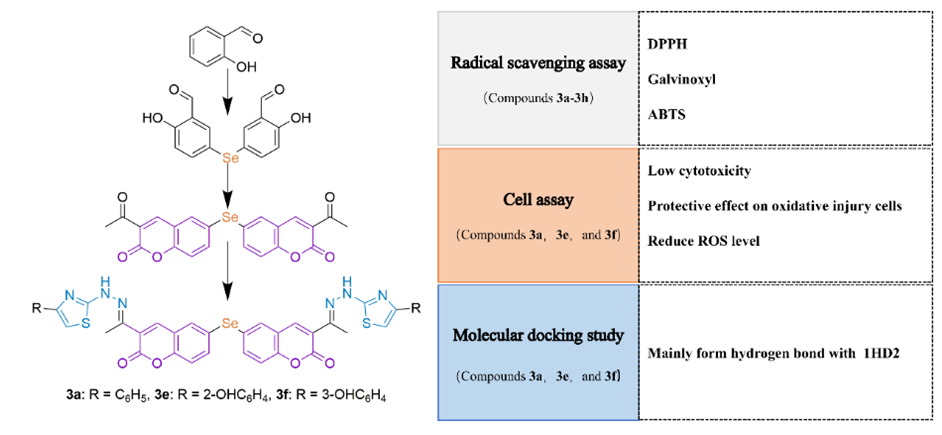
Coumarin derivatives have attracted significant interest due to their low toxicity and broad-spectrum biological activities. In this study, coumarin selenoether thiazolylhydrazone derivatives were synthesized, and characterized using 1H NMR, 13C NMR, and HRMS. Their in vitro antioxidant capacities were assessed based on their abilities to scavenge DPPH, galvinoxyl, and ABTS+ radicals. Derivatives 3a-3h demonstrated considerable radical-scavenging activity, with 3a, 3e, and 3f exhibiting superior performance compared to the standard drug ascorbic acid. while ortho‑hydroxy (3e) and meta‑hydroxy (3f) derivatives further improved activity to IC₅₀ values of 7.47/4.62/7.70 and 7.99/7.86/10.25 µmol/L, respectively, highlighting that ortho/meta hydroxyl positioning is the key structural determinant for enhanced antioxidant potency. Cytotoxicity was evaluated on RAW 264.7 macrophages using the CCK-8 assay, revealing low cytotoxicity for 3a, 3e, and 3f. Their antioxidant protective effects in RAW 264.7 cells were evaluated using an H2O2-induced oxidative injury model. 2',7'-Dichlorodihydrofluorescein diacetate (DCFH-DA) assays revealed that 3a, 3e, and 3f markedly reduced ROS levels in oxidative injury cells. The molecular docking study targeting the active site of human peroxiredoxin 5 (PDB ID: 1HD2) was performed to investigate the potential interactions of 3a, 3e, and 3f with the protein receptor. The results revealed that the mainly binding modes of them was hydrogen bond. In conclusion, these findings suggest that 3a, 3e, and 3f possess promising antioxidant properties and warrant further investigation and development.
吝婷婷
,
付磊清
,
张伟
,
王泳
,
郭孟萍
,
曾春来
. Synthesis, Characterization, Antioxidant Activity, and Molecular Docking Studies of Novel Coumarin Selenoether Thiazolylhydrazone Derivatives[J]. Chinese Journal of Organic Chemistry, 0
: 202604045
.
DOI: 10.6023/cjoc202604045
[1] Ray P. D.; Huang B. W.; Tsuji Y.Cell. Signalling. 2012, 24, 981.
[2] Dong C. C.; Fang W. Z.; Yi Q. Y.; Zhang J. L. Chemosphere.2022, 308, 136205.
[3] Snezhkina A. V.; Kudryavtseva A.V.; Kardymon O. L.; Savvateeva M. V.; Melnikova N. V.; Krasnov G. S.; Dmitriev, A. A. Oxid. Med. Cell. Longevity.2019, 2019, 6175804.
[4] Alfadda A. A.; Sallam, R. M. Biomed Res. Int.2012, 2012, 936486.
[5] Mihailović N.; Marković V.; Matić I. Z.; Stanisavljević N. S.; Jovanović Z. S.; Trifunović S.; Joksović L. RSC Adv.2017, 7, 8550.
[6] Blokhina O.; Virolainen E.; Fagerstedt, K. V. Ann. Bot.2003, 91, 179.
[7] Deshmukh T. R.; Khedkar V. M.; Sangshetti J. N.; Shingate, B. B. Res. Chem. Intermed.2023, 49, 635.
[8] Hamid A. A.; Aiyelaagbe O. O.; Usman1 L. A.; Ameen O. M.; Lawal, A. Afr. J. Pure Appl. Chem.2010, 4, 142.
[9] Kecel-Gunduz S.; Budama-Kilinc Y.; Bicak B.; Gok B.; Belmen B.; Aydogan F.; Yolacan, C. Arabian J. Chem.2023, 16, 104440.
[10] Salehian F.; Nadri H.; Jalili-Baleh L.; Youseftabar-Miri L.; Bukhari S. N. A.; Foroumadi A.; Küçükkilinç T. T.; Sharifzadeh M.; Khoob, M. Eur. J. Med. Chem.2021, 212, 113034.
[11] Pérez-Cruz F.; Vazquez-Rodriguez S.; Matos M. J.; Herrera-Morales A.; Villamena F. A.; Das A.; Gopalakrishnan B.; Olea-Azar C.; Santana L.; Uriarte, E. J. Med. Chem.2013, 56, 6136.
[12] Mamgain R.; Kostic M.; Singh, F. V. Curr. Med. Chem.2023, 30, 2421.
[13] Behne D.; Kyriakopoulos A.; Meinhold H.; Köhrle, J. Biochem. Biophys. Res. Commun.1990, 173, 1143.
[14] Capperucci A.; Coronnello M.; Salvini F.; Tanini D.; Dei S.; Teodori E.; Giovannelli L. Bioorg. Chem.2021, 110, 104812.
[15] Muller A.; Cadenas E.; Graf P.; Sies H. Biochem. Pharmacol.1984, 33, 3235.
[16] Shaaban S.; Vervandier-Fasseur D.; Andreoletti P.; Zarrouka A.; Richard P.; Negm A.; Manolikakes G.; Jacobg C.; CherkaouiMalki M. Bioorg. Chem.2018, 80, 43.
[17] Zhang Y.; Fu X.; Yan Y. T.; Liu, J. B. J. Heterocyclic Chem.2020, 57, 991.
[18] Paudel Y. N.; Ali M. R.; Shah S.; Adil M.; Akhtar M. S.; Wadhwa R.; Bawa S.; Sharma M. Biomed. Pharmacother.2017, 89, 651.
[19] Bensalah D.; Mnasri A.; Chakchouk-Mtibaa A.; Mansour L.; Mellouli L.; Hamdi, N. Green Chem. Lett. Rev.2020, 13, 155.
[20] Djafarou S.; Mermer A.; Barut B.; Yılmaz G. T.; Khodj I. A.; Boulebd H. Food Chem.2023, 414, 135745.
[21] Belkheiri N.; Bouguerne B.; Bedos-Belval F.; Duran H.; Bernis C.; Salvayre R.; Nègre-Salvayre A.; Baltas, M. Eur. J. Med. Chem.2010, 45, 3019.
[22] Dincel E. D.; Gürsoy E.; Yilmaz-Ozden T.; Ulusoy-Güzeldemirci N. Bioorg. Chem.2020, 103, 104220
[23] Tvrdoňová M.; Borovská B.; Salayová A.; Rončák R.; Michalčin P.; Bednáriková Z.; Gažová Z. Bioorg. Chem.2023, 137, 106636.
[24] Tian J.; Xu Q.; Wang X.; Zhang X.; Chen X.; Rui X.; Zhang Q.; Dong M.; Li, W. Chem. Bio. Drug. Des.2023, 102, 471.
[25] Lin T. T.; Peng Q. L.; Lv M. Y.; Guo, M. P. Z Krist-New Cryst St.2023, 238, 673.
[26] Wu M. H.; Liu, W. J. Acta Crtstallogr E.2011, 67, o2983.