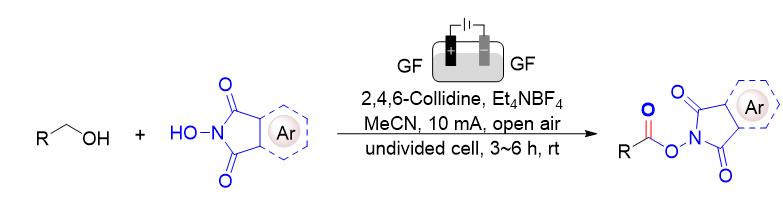
Amide bonds constitute the core structural scaffolds of pharmaceuticals, natural products and functional polymers, and N-hydroxyimide active esters serve as pivotal acylating intermediates for amide formation. Conventional synthetic routes depend on carbodiimide condensation reagents, stoichiometric oxidants or transition-metal catalysis, which suffer from several inherent drawbacks including metal residues, tedious separation and purification, limited substrate scopes and abundant waste output. Therefore, mild and environmentally benign synthetic methodologies are urgently required. In this work, we developed the first metal-free electrochemical cross-dehydrogenative coupling strategy employing low-cost graphite felt as electrodes. This protocol realized efficient intermolecular CDC coupling of alcohols with N-hydroxyphthalimide (NHPI) and N-hydroxysuccinimide (NHSI), affording a broad spectrum of N-hydroxyimide active esters. This electrochemical system excludes exogenous metal catalysts, features mild reaction conditions and straightforward operation, and offers an innovative synthetic route for the green and scalable preparation of active ester-based pharmaceutical intermediates.
[1] (a) Humphrey, M. J.; Chamberlin, R. A.Chem. Rev. 1997, 97, 2243.
(b) Pattabiraman V. R.; Bode J. W. Nature2012, 480, 471.
(c) Wilson R. M.; Stock-dill J. L.; Wu X.; Li X.; Vadola P. A.; Park P. K.; Wang P.; Danishefsky, S. J. Angew. Chem. Int. Ed.2012, 51, 2834.
[2] (a) Liu H.-Y.; Lu Y.; Li Y.; Li J.-H. Org. Lett.2020, 22, 8819.
(b) Liu X.-J.; Zhou S.-Y.; Xiao Y.; Sun Q.; Lu X.; Li Y.; Li J.-H. Org. Lett.2021, 23, 7839.
[3] (a) Goossen L. J.; Rodriguez N.; Goossen, K. Angew. Chem. Int. Ed.2008, 47, 3100.
(b) Rodriguez N.; Goossen, L. J. Chem. Soc. Rev.2011, 40, 5030.
(c) Park K.; Lee S. RSC Adv.2013, 3, 14165.
(g) Shen C.; Zhang P.; Sun Q.; Bai S.; Hor T. S.; Liu, X. Chem. Soc. Rev.2015, 44, 291.
[4] (a) Ogura H.; Kobayashi T.; Shimizu K.; Kawabe K.; Takeda K. Tetrahedron Lett.1979, 20, 4745.
(b) Kim, M.; Han, K. J.; Synth. Commun. 2009, 39, 4467.
[5] (a) Mazitschek R.; Mülbaier M.; Giannis, A. Angew. Chem. Int. Ed.2002, 41, 4059
(b) Schulze A.; Giannis, A. Adv. Synth. Catal.2004, 346, 252
(c) Yao H.; Tang Y.; Yamamoto K. Tetrahedron Lett,2012, 53, 5094.
[6] (a) Nordstrøm L.U.; Vogt H.; Madsen, R. J. Am. Chem. Soc.2008, 130, 17672
(b) Ghosh S. C.; Muthaiah S.; Zhang Y.; Xu X. Y.; Hong, S. H. Adv. Synth. Catal.2009, 351, 2643.
[7] Tan B.; Toda N.; Barbas III, C. F. Angew. Chem. Int. Ed.2012, 51, 12538-12541.
[8] Yu X.; Wang G.; Yu Q.; Wang J.; Wang S.; Chen S.; Yu X.-Q. RSC Adv.2013, 3, 21306.
[9] Dinda M.; Bose C.; Ghosh T.; Maity S. RSC Adv.2015, 5, 44928-44932.
[10] Feizpour F.; Jafarpour M.; Rezaeifard, A. New J. Chem.2018, 42, 807.
[11] Singha K.; Ghosh S. C.; Panda, A. S. Chem. Asian J.2019, 14, 3205-3212.
[12] Lv Y.; Sun K.; Pu W.; Mao S.; Li G.; Niu J.; Chen Q.; Wang T.RSC Adv. 2016, 6, 93486-93490.
[13] Constable D. J. C.; Dunn P. J.; Hayler J. D.; Humphrey G. R.; Leazer J. L.; Linderman R. J.; Lorenz K.; Manley J.; Pearlman B. A.; Wells A.; Zaks A.; Zhang, T. Y. Green Chem.2007, 9, 411.
[14] (a) Recupero F.; Punta C. Chem. Rev.2007, 107, 3800-3842.
(b) Nutting J.; Rafiee M.; Stahl S. Chem. Rev.2018, 118, 4834-4885.
[15] (a) Shang X.; Liu, Z.-Q. Acta Chim. Sinica2015, 73, 1275-1282.
(b) Wu J.; Liu, Z.-Q. Chin. J. Org. Chem.2022, 42, 16-32.
(c) Zhao J.; Deng C.; Zhang L.; Zhang J.; Rong Q.; Wang F.; Liu, Z.-Q. J. Org. Chem.2024, 89, 15764-15876.
(d) Wang, Q.; Fang, P.; Zhao, J.; Huang, X.; Shen, X.; Wang, F. Liu, Z.-Q.Angew. Chem. Int. Ed. 2025, e202504478.
(e) Rong, Q.; Wang, Q.; Zhao, J.; Zhang, Z.; Huang, X.; Wang, F.; Liu, Z.-Q.Sci. China Chem. 2026, 69, 852-857.
[16] (a) Li Y.; Sun L.; Xu K.; Zeng, C. Chin. J. Org. Chem.2025, 45, 668-676.
(b) Yang L.; Zhao Z.; Shi A.; Yang G.; Qiu, Y. Chin. J. Org. Chem.2026, 46, 2511-2528.
[17] (a) Liu Z.-Q.; Sun L.; Wang J.-G.; Han J.; Zhao Y.-K.; Zhou B. Org. Lett.2009, 11, 1437-1439.
(b) Cui Z.; Shang X.; Shao X.-F.; Liu Z.-Q. Chem. Sci.2012, 3, 2853-2858.
(c) Li Z.; Fan F.; Yang J.; Liu Z.-Q. Org. Lett.2014, 16, 3396-3399.
(d) Xu Z.; Hang Z.; Chai L.; Liu Z.-Q. Org. Lett.2016, 18, 4662-4665.
(e) Tian Y.; Liu Z.-Q. Green Chem.2017, 19, 5230-5235.
(f) Xiao Y.; Liu, Z.-Q. J. Org. Chem.2019, 84, 9577-9583.
(g) Liu J.; Yu D.; Yang Y.; You H.; Sun M.; Wang Y.; Shen X.; Liu Z.-Q. Org. Lett.2020, 22, 4844-4847.
(h) Zhao J., Shen T., Sun Z., Wang N., Yang L., Wu J., You H., Liu Z.-Q. Org. Lett. 2021, 23, 4057-4061.
[18] Singha K.; Ghosh S. C.; Panda, A. S. Chem. Asian J.2019, 14, 3205-3212.