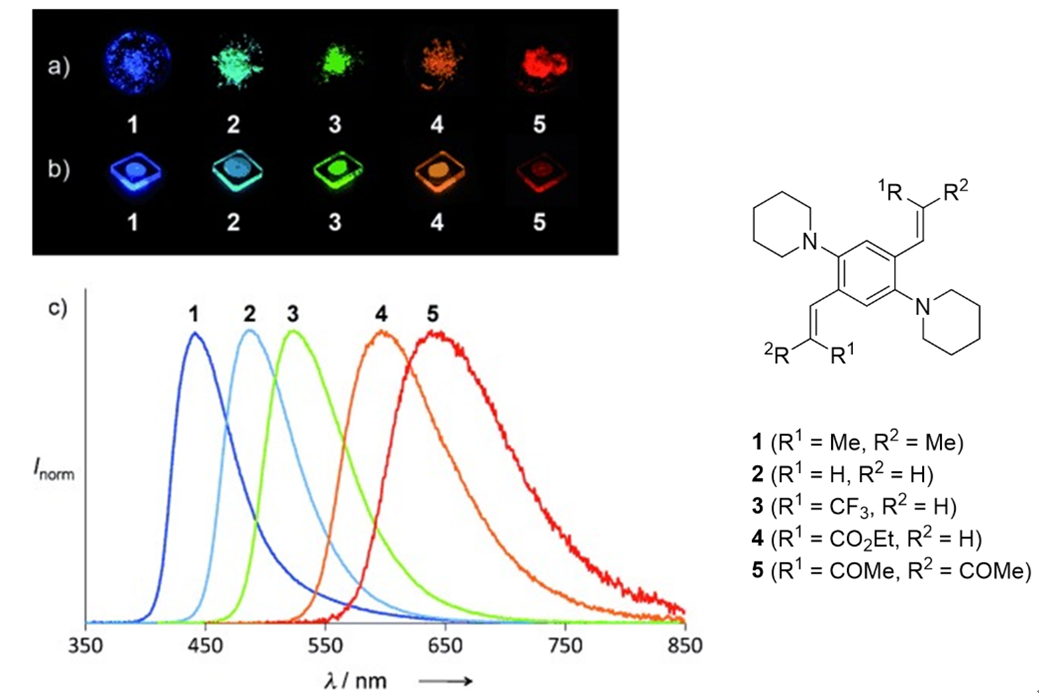
Single-benzene fluorophores (SBFs) reduce the aromatic conjugated framework required by conventional chromophores to a single benzene ring and offer notable advantages, including low molecular weight, facile derivatization, and tunable emission wavelengths. These features afford excellent optical performance and promising prospects for bioimaging applications. At the same time, SBFs provide a new platform for constructing functional circularly polarized luminescent (CPL) materials. However, simultaneously achieving stable chirality transfer, high luminescence efficiency, and an appreciable luminescence dissymmetry factor within such a minimal scaffold remains a major challenge. Moreover, CPL signals in the molecular, aggregated, and crystalline states differ in their generation mechanisms and evaluation criteria. This review first outlines the basic concepts of SBFs and the theoretical foundations of CPL and discusses the applicable scopes of the luminescence dissymmetry factor glum and CPL brightness BCPL. It then focuses on recent CPL studies of SBF-like systems, classifying them into three design strategies: intramolecular conformational locking, supramolecular chirality transfer, and solid-state expression of stable configurations, and compares their differences in signal intensity, reproducibility, and environmental dependence. Finally, the challenges and future directions for these materials in bioimaging probes, processable materials, and device integration are discussed.
原文献图片引用均已获得原作者许可
[1] Zhang M.; Zhuang, T. Processable, High-Performance Circularly Polarized Luminescence Architectures for Information Interaction. Acc. Chem. Res.2026, 59, 1507-1521. DOI: 10.1021/acs.accounts.5c00911.
[2] Huang R.; Qiao Q.; Seah D.; Shen T.; Wu X.; de Moliner F.; Wang C.; Ding N.; Chi W.; Sun H.; Vendrell M.; Xu Z.; Fang Y.; Liu, X. Precision Molecular Engineering of Compact Near-Infrared Fluorophores. J. Am. Chem. Soc.2025, 147, 5258-5268. DOI: 10.1021/jacs.4c16087.
[3] Zhang M.; Xin C.; Hou S.; Li, K. Circularly Polarized Luminescent-Active Small Organic Molecules with Thermally Activated Delayed Fluorescence Properties. Chem. Commun.2026, 62, 5178-5195. DOI: 10.1039/d5cc06059a.
[4] Kim H.; Park W.; Kim Y.; Filatov M.; Choi C. H.; Lee, D. Relief of Excited-State Antiaromaticity Enables the Smallest Red Emitter. Nat. Commun.2021, 12, 5409. DOI: 10.1038/s41467-021-25677-2.
[5] Shimizu M.; Takeda Y.; Higashi M.; Hiyama, T. 1 4-Bis(alkenyl)-2,5-dipiperidinobenzenes: Minimal Fluorophores Exhibiting Highly Efficient Emission in the Solid State. Angew. Chem. Int. Ed.2009, 48, 3653-3656. DOI: 10.1002/anie.200900963.
[6] Beppu T.; Tomiguchi K.; Masuhara A.; Pu Y.-J.; Katagiri, H. Single Benzene Green Fluorophore: Solid-State Emissive, Water-Soluble, and Solvent- and pH-Independent Fluorescence with Large Stokes Shifts. Angew. Chem. Int. Ed.2015, 54, 7332-7335. DOI: 10.1002/anie.201502365.
[7] Benson S.; Fernandez A.; Barth N. D.; de Moliner F.; Horrocks M. H.; Herrington C. S.; Abad J. L.; Delgado A.; Kelly L.; Chang Z.; Feng Y.; Nishiura M.; Hori Y.; Kikuchi K.; Vendrell, M. SCOTfluors: Small, Conjugatable, Orthogonal, and Tunable Fluorophores for In Vivo Imaging of Cell Metabolism. Angew. Chem. Int. Ed.2019, 58, 6911-6915. DOI: 10.1002/anie.201900465.
[8] Tang B.; Liu H.; Li F.; Wang Y.; Zhang, H. Single-benzene solid emitters with lasing properties based on aggregation-induced emissions. Chem. Commun.2016, 52, 6577-6580. DOI: 10.1039/C6CC02616H.
[9] Zhang, X.; Wang, J.; Zhao, H.; Jiang, Z.; Chen, K.; Wang, T.; Huang, X.; Wang, N.; Hao, H. Efficient single benzene AIE system: Optical waveguide and invisible ink. Dyes Pigm. 2023, 209, 110947. DOI: 10.1016/j.dyepig.2022.110947.
[10] Raghava T.; Chattopadhyay A.; Banerjee S.; Sarkar, N. Conversion of amino-terephthalonitriles to multi-substituted single benzene fluorophores with utility in bioimaging. Org. Biomol. Chem.2024, 22, 364-373. DOI: 10.1039/D3OB01761C.
[11] Heo J.-M.; Park J.; Flórez-Angarita M. F.; Wang L.; Yu C.; Choi J.; Woo H.; Milián-Medina B.; Matzger A. J.; Kwon M. S.; Gierschner J.; Kim J. Elucidating the molecular structural origin of efficient emission across solid and solution phases of single benzene fluorophores. Nat. Commun.2025, 16, 5560. DOI: 10.1038/s41467-025-60316-0.
[12] Kim H.; Kim Y.; Lee, D. Small is Beautiful: Electronic Origin and Synthetic Evolution of Single-Benzene Fluorophores. Acc. Chem. Res.2024, 57, 140-152. DOI: 10.1021/acs.accounts.3c00605.
[13] Riehl J. P.; Richardson F. S.Circularly Polarized Luminescence Spectroscopy. Chem. Rev. 1986, 86, 1-16. DOI: 10.1021/cr00071a001.
[14] Sánchez-Carnerero,E. M.; Agarrabeitia, A. R.; Moreno, F.; Maroto, B. L.; Muller, G.; Ortiz, M. J.; de la Moya, S. Circularly Polarized Luminescence from Simple Organic Molecules. Chem. Eur. J. 2015, 21, 13488-13500. DOI: 10.1002/chem.201501178.
[15] Arrico L.; Di Bari L.; Zinna, F. Chem. Eur. J.2021, 27, 2920-2934. DOI: 10.1002/chem.202002791.
[16] Zhang T.; Zhang Y.; He Z.; Yang T.; Hu X.; Zhu T.; Zhang Y.; Tang Y.; Jiao J. Recent Advances of Chiral Isolated and Small Organic Molecules: Structure and Properties for Circularly Polarized Luminescence. Chem. Asian J.2024, 19, e202400049. DOI: 10.1002/asia.202400049.
[17] Liu Y.; Hao A.; Xing P.Chiroluminophores Based on Non-Conjugated Benzenes. Sci. China Chem. 2023, 66, 2130-2140. DOI: 10.1007/s11426-023-1630-5.
[18] Pan X.; Zheng A.; Yu X.; Di Q.; Li L.; Duan P.; Ye K.; Naumov P.; Zhang, H. A Low-Temperature-Resistant Flexible Organic Crystal with Circularly Polarized Luminescence. Angew. Chem. Int. Ed.2022, 61, e202203938. DOI: 10.1002/anie.202203938.
[19] Guo Y.; Fang S.; Zhu L.; Song J.; Che J.; Xiang H.; Wang, T. Stereodivergent Access to C-N Atropisomers via Phosphonium Salt-Enabled Desymmetrizing Remote Cyclization/Aromatization Cascade. Angew. Chem. Int. Ed.2026, 65, e202518310. DOI: 10.1002/anie.202518310.
[20] Li Z.-Y.; Liu F.; Li H.; Guo X.; Jiao L.; Hao, E. Rhodium-Catalyzed Two-Fold, Regioselective and Enantioselective C-H Activation: an Efficient Strategy to Chiral Single-Benzene-Based Fluorophores. Org. Lett.2024, 26, 444-449. DOI: 10.1021/acs.orglett.3c03467.
[21] Wei S.-Q.; Li Z.-H.; Sun C.-L.; Li Y.; Wang X.-Y.; Ding T.-M.; Zhu X.; Tu Y.-Q.; Zhang S.-Y.Circularly Polarized Luminescence with Large Dissymmetry Factor over 10-1 Based on Flexible Point-Chirality via Programming at Molecular Level.Angew. Chem. Int. Ed. 2025, e202523152. DOI: 10.1002/anie.202523152.
[22] Kim Y.; Kim H.; Son J. B.; Filatov M.; Choi C. H.; Lee N. K.; Lee, D. Single-Benzene Dual-Emitters Harness Excited-State Antiaromaticity for White Light Generation and Fluorescence Imaging. Angew. Chem. Int. Ed.2023, 62, e202302107. DOI: 10.1002/anie.202302107.
[23] Stachelek P.; Serrano-Buitrago S.; Maroto B. L.; Pal R.; de la Moya, S. Circularly Polarized Luminescence Bioimaging Using Chiral BODIPYs: A Model Scaffold for Advancing Unprecedented CPL Microscopy Using Small Full-Organic Probes. ACS Appl. Mater. Interfaces2024, 16, 67246-67254. DOI: 10.1021/acsami.4c14127.
[24] Xiong Z.; Liu X.; Zhang Z.; Wei S.; Liu J.; Xu Q.; Sun J. Z.; Zhang J.; Tang B. Z.; Zhang, H. Intrinsic Circularly Polarized Luminescence with a Record-High Dissymmetry Factor via Dynamic Through-Space Conjugation. Chem2026, 12, 102858. DOI: 10.1016/j.chempr.2025.102858.
[25] Zinna F.;Di Bari, L. Emerging Field of Chiral Ln(III) Complexes for OLEDs. In Lanthanide-Based Multifunctional Materials: From OLEDs to SIMs; Martín-Ramos, P.; Ramos Silva, M., Eds.; Elsevier: Amsterdam, 2018; pp 171-194. DOI: 10.1016/B978-0-12-813840-3.00005-3.
[26] Nagata Y.; Mori T. Irreverent Nature of Dissymmetry Factor and Quantum Yield in Circularly Polarized Luminescence of Small Organic Molecules. Front. Chem.2020, 8, 448. DOI: 10.3389/fchem.2020.00448.
[27] Wong, K.-L.; Bünzli, J.-C. G.; Tanner, P. A. Quantum Yield and Brightness. J. Lumin. 2020, 224, 117256. DOI: 10.1016/j.jlumin.2020.117256.
[28] Wang H.-Q.; Tang Y.; Huang Z.-Y.; Wang F.-Z.; Qiu P.-F.; Zhang X.; Li C.-H.; Li, Q. A Dual-Responsive Liquid Crystal Elastomer for Multi-Level Encryption and Transient Information Display. Angew. Chem. Int. Ed.2023, 62, e202313728. DOI: 10.1002/anie.202313728.
[29] VanOrman Z. A.; Kitzmann W. R.; Reponen A.-P. M.; Deshpande T.; Jöbsis H. J.; Feldmann, S. Chiral Light-Matter Interactions in Solution-Processable Semiconductors. Nat. Rev. Chem.2025, 9, 208-223. DOI: 10.1038/s41570-025-00690-x.
[30] Grimm J. B.; Lavis, L. D. Caveat Fluorophore: An Insiders’ Guide to Small-Molecule Fluorescent Labels. Nat. Methods2022, 19, 149-158. DOI: 10.1038/s41592-021-01338-6.
[31] Harada T.; Kuroda R.; Moriyama, H. Solid-State Circularly Polarized Luminescence Measurements: Theoretical Analysis. Chem. Phys. Lett.2012, 530, 126-131. DOI: 10.1016/j.cplett.2012.01.059.
[32] Stachelek P.; MacKenzie L.; Parker D.; Pal, R. Circularly Polarised Luminescence Laser Scanning Confocal Microscopy to Study Live Cell Chiral Molecular Interactions. Nat. Commun.2022, 13, 553. DOI: 10.1038/s41467-022-28220-z.
[33] De Rosa, D. F.; Stachelek, P.; Black, D. J.; Pal, R. Rapid Handheld Time-Resolved Circularly Polarised Luminescence Photography Camera for Life and Material Sciences. Nat. Commun. 2023, 14, 1537. DOI: 10.1038/s41467-023-37329-8.
[34] Wang Y.; Niu D.; Ouyang G.; Liu M.Double Helical π-Aggregate Nanoarchitectonics for Amplified Circularly Polarized Luminescence. Nat. Commun. 2022, 13, 1710. DOI: 10.1038/s41467-022-29396-0.
[35] Liu Z.-F.; Liu X.-X.; Zhang H.; Zeng L.; Niu L.-Y.; Chen P.-Z.; Fang W.-H.; Peng X.; Cui G.; Yang Q.-Z.Intense Circularly Polarized Luminescence Induced by Chiral Supramolecular Assembly: The Importance of Intermolecular Electronic Coupling. Angew. Chem. Int. Ed. 2024, 63, e202407135. DOI: 10.1002/anie.202407135.
[36] Sengupta A.; Roy G.; Likhar A. R.; Asthana D.A Supramolecular Assembly-Based Strategy towards the Generation and Amplification of Photon Up-Conversion and Circularly Polarized Luminescence. Nanoscale 2023, 15, 18999-19015. DOI: 10.1039/D3NR04184K.