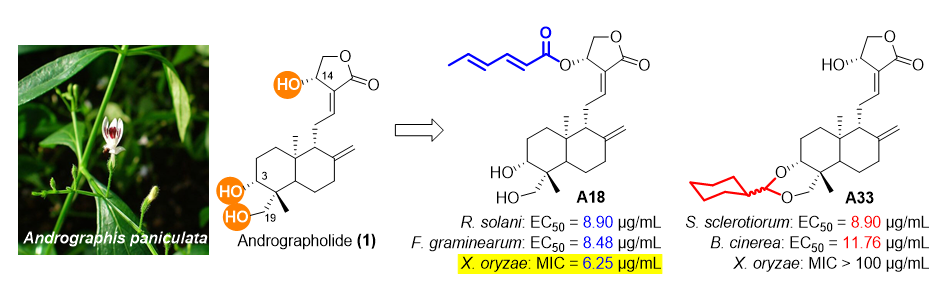
A series of esterified, sulfonylated, and acetalized andrographolide derivatives were synthesized by modifications of the hydroxyl groups at the C-3, C-14 and C-19 positions, and evaluated for their antimicrobial activities against pathogenic fungi and bacteria. Most of these compounds displayed excellent in vitro fungicidal activity compared to andrographolide and hymexazol. Among them, the esterified derivatives A16 and A18 exhibited the superior antifungal activity against Rhizoctonia solani and Fusarium graminearum, while the acetalized compounds A33 and A39 exhibited the highest inhibitory activities against Sclerotinia sclerotiorum and Botrytis cinerea. Moreover, compound A18 possessed remarkable in vitro antibacterial activity against Xanthomonas oryzae with a MIC value of 6.25 μg/mL, and was more potent than thiodiazole copper. The in vivo fungicidal and antibacterial evaluation further demonstrated that these highly active compounds could effectively control corresponding plant fungal or bacterial diseases. The structure-activity relationship revealed that alkyl chain extension and unsaturated bond increase were the crucial factors that governed antimicrobial activity for the esterified derivatives. These findings implied that andrographolide derivatives displayed superior antimicrobial activities, and could be potential candidates against plant fungal and bacterial diseases.
王慧文
,
张慧敏
,
丁俊辉
,
张绍勇
,
王玉灵
,
梁焯
,
刘映前
,
张智军
. Design, synthesis, and biological evaluation of andrographolide derivatives against phytopathogenic fungi and bacteria[J]. Chinese Journal of Organic Chemistry, 0
: 0
.
DOI: 10.6023/cjoc202608014
[1] Mansfield J.; Genin S.; Magori S.; Citovsky V.; Sriariyanum M.; Ronald P.; Dow M.; Verdier V.; Beer S. V.; Machado M. A.; Toth I.; Salmond G.; Foster G. D.Mol. Plant Pathol. 2012, 13, 614-629.
[2] Brauer V. S.; Rezende C. P.; Pessoni A. M.; De Paula, R. G.; Rangappa, K. S.; Nayaka, S. C.; Gupta, V. K.; Almeida, F.Biomolecules 2019, 9, 521.
[3] Oerke E. C.J. Agric. Sci. 2006, 144, 31-43.
[4] Shang X. F.; Dai L. X.; Zhang Z. J.; Yang C. J.; Du S. S.; Wu T. L.; He Y. H.; Zhu J. K.; Liu Y. Q.; Yan Y. F.; Miao X. L.; Zhang J. Y.J. Agric. Food Chem. 2021, 69, 6455-6464.
[5] Lin Y. L.; Zhong W. Q.; Dong C. Y.; Zhang C.; Feng X. X.; Zhang A. Q.ACS Appl. Bio. Mater. 2018, 1, 2062-2072.
[6] Huang N.; Angeles E. R.; Domingo J.; Magpantay G.; Singh S.; Zhang G.; Kumaravadivel N.; Bennett J.; Khush G. S.Theor. Appl. Genet. 1997, 95, 313-320.
[7] Lin D.; Qu L. J.; Gu H.; Chen Z.J. Appl. Microbiol. 2001, 91, 1044-1050.
[8] Watanabe H.; Horinouchi H.; Muramoto Y.; Ishii H.Plant Pathol. 2017, 66, 1472-1479.
[9] Jiang J. H.; Ding L. S.; Michailides T. J.; Li H. Y.; Ma Z. H.Pestic. Biochem. Phys. 2009, 93, 72-76.
[10] Forster H.;McGhee, G. C.; Sundin, G. W.; Adaskaveg, J. E.Phytopathology 2015, 105, 1302-1310.
[11] Han H. S.; Koh Y. J.; Hur J. S.; Jung J. S.J. Microbiol. 2004, 42, 365-368.
[12] Rodrigues T.; Reker D.; Schneider P.; Schneider G.Nat. Chem. 2016, 8, 531-541.
[13] Isman M. B.Annu. Rev. Entomol. 2006, 51, 45-66.
[14] Kumoro A. C.; Hasan M.; Singh H.Ind. Eng. Chem. Res. 2019, 58, 742-751.
[15] Manoharan S.; Singh A. K.; Suresh K.; Vasudevan K.; Subhasini R.; Baskaran N.Asian Pac. J. Cancer Prev. 2012, 13, 5701-5708.
[16] Hodroj M. H.; Jardaly A.; Raad S. A.; Zouein A.; Rizk S.Cancer Manage. Res. 2018, 10, 1079-1088.
[17] Wang W.; Wu Y. L.; Yang K. Y.; Wu C. R.; Tang R. T.; Li H.; Chen L. X.Eur. J. Med. Chem. 2019, 173, 282-293.
[18] Zhu Z. Y.; Duan H. B.; Jing M.; Xu L. P.; Yu P.Curr. Pharm. Des. 2018, 24, 3529-3533.
[19] Chen W.; Su H. M.; Feng L.; Zheng X. D.Life Sci. 2016, 156, 21-29.
[20] Guo X.; Zhang L. Y.; Wu S. C.; Xia F.; Fu Y. X.; Wu Y. L.; Leng C. Q.; Yi P. F.; Shen H. Q.; Wei X. B.; et al.Vet. Microbiol. 2014, 174, 496-503.
[21] Chen Z. G.; Zhu Q.; Zong M. H.; Gu Z. X.; Han Y. B.Process Biochem. 2011, 46, 1649-1653.
[22] Patil H. S.; Jadhav D. D.; Paul A.; Mulani F. A.; Karegaonkar S. J.; Thulasiram H. V.Bioorg. Med. Chem. Lett. 2018, 28, 1132-1137.
[23] Qiao Y.; Huang Y.; Feng F.; Chen Z. G.Process Biochem. 2016, 51, 675-680.
[24] Li F.; Li X.-M.; Sheng D.; Chen S.-R.; Nie X.; Liu Z.; Wang D.; Zhao Q.; Wang Y.; Wang Y.; et al.RSC Adv. 2018, 8, 9440-9456.
[25] Jiang X. J.; Yu P.; Jiang J.; Zhang Z. J.; Wang Z. L.; Yang Z. Q.; Tian Z. M.; Wright S. C.; Larrick J. W.; Wang, Y. Q. Eur. J. Med. Chem.2009, 44, 2936-2943.
[26] Wong C. C.; Sagineedu S. R.; Sumon S. H.; Sidik S. M.; Phillips R.; Lajis N. H.; Stanslas J.Environ. Toxicol. Pharmacol. 2014, 38, 489-501.
[27] Liu L.; Yan Y.; Zheng L. H.; Jia H. Y.; Han G.Nat. Prod. Res. 2020, 34, 782-789.
[28] Pandeti S.; Sonkar R.; Shukla A.; Bhatia G.; Tadigoppula N.Eur. J. Med. Chem. 2013, 69, 439-448.
[29] Zhang Z.-J.; Jiang Z.-Y.; Zhu Q.; Zhong G.-H.J. Agric. Food Chem. 2018, 66, 9598-9607.
[30] Chu Q.-R.; He Y.-H.; Tang C.; Zhang Z.-J.; Luo X.-F.; Zhang B.-Q.; Zhou Y.; Wu T.-L.; Du S.-S.; Yang C.-J.; Liu Y.-Q.J. Agric. Food Chem. 2022, 70, 2851-2863.