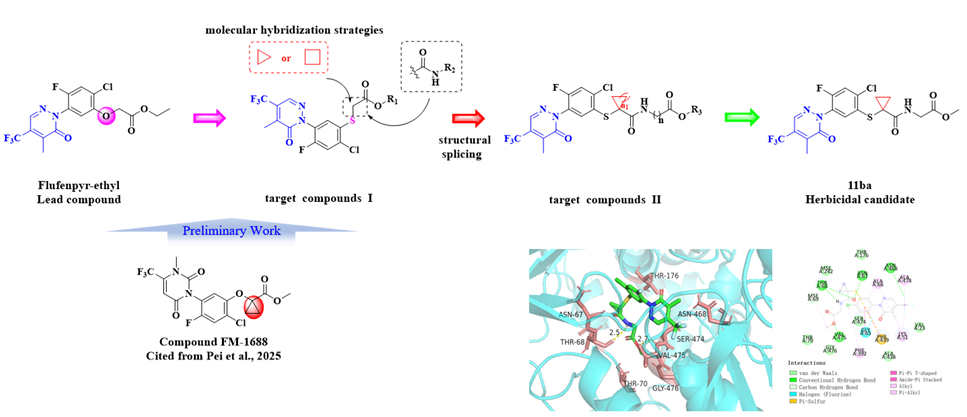
To discover novel and highly effective herbicidal compounds, a series of pyridazinone derivatives, 9a-9c, 11ba-11bd, and 11ca-11cd, were designed and synthesized using the commercial PPO inhibitor flufenpyr-ethyl as the lead compound. Based on bioisosteric replacement and active-substructure hybridization strategies, the pyridazinone core was retained, while O/S replacement and the introduction of small cycloalkyl amide-ester side chains were employed for structural optimization. The structures of all target compounds were confirmed by ¹H NMR, ¹³C NMR, and HRMS analyses. Greenhouse post-emergence pot assays showed that several compounds exhibited excellent herbicidal activity. In particular, compound 11ba displayed inhibition rates of 100%, 100%, 90%, and 100% against Zinnia elegans, Abutilon theophrasti, Setaria glauca, and Echinochloa crus-galli, respectively, at 37.5 g a.i./ha, showing better overall weed-control efficacy against the four tested species than flufenpyr-ethyl. Preliminary structure-activity relationship studies indicated that within the structural series examined, O/S replacement helped maintain herbicidal activity, while the cyclopropyl moiety was more favorable than the cyclobutyl moiety for improving the control of the tested grass weeds. In addition, a methyl ester terminus and a shorter amide linker further enhanced the overall herbicidal activity. Inhibition assays against Nicotiana tabacum protoporphyrinogen oxidase (NtPPO) gave IC50 values of 10.96 and 29.82 nM for 11ba and flufenpyr-ethyl, respectively, indicating that 11ba exhibited stronger apparent NtPPO inhibition under the present assay conditions. Molecular docking suggested that 11ba could occupy the NtPPO active pocket and that its cyclopropyl amide-ester side chain might form hydrogen-bonding interactions with Thr68 and Asn468. DFT calculations revealed differences between 11ba and flufenpyr-ethyl in their frontier molecular orbital distributions, HOMO-LUMO energy gaps, and molecular electrostatic potential profiles, providing qualitative electronic-structure support for the polar interactions predicted by molecular docking. These results identify 11ba as a representative compound worthy of further structural optimization and biological evaluation and provide a basis for the design of pyridazinone-based potential PPO inhibitors.
Yixing Gao
,
Jialin Ye
,
Yanhong Pei
,
Jing Zhang
,
Lixin Zhang
. Synthesis and Herbicidal Activity of Pyridazinone Derivatives Bearing Small Cycloalkyl Amide-Ester Side Chains[J]. Chinese Journal of Organic Chemistry, 0
: 202606019
.
DOI: 10.6023/cjoc202606019
[1] Qu R. Y.; He B.; Yang J. F.; Lin H. Y.; Yang W. C.; Wu Q. Y.; Li Q. X.; Yang, G. F. Pest Manag. Sci.2021, 77, 2620.
[2] Arasan A. P.; Radhamani S.; Sudha M.; Sundarrajan R. V.; Prasad, S. A. Discover Appl. Sci.2025, 7, 1430.
[3] Hao G.F.; Zuo Y.; Yang S.G.; Yang G.F. Chimia2011, 65, 961.
[4] Zhao L.X.; Chen K.Y.; Luo K.; He X.L.; Gao S.; Fu Y.; Zou Y.L.; Ye, F. J. Agric. Food Chem.2024, 72, 5625.
[5] Koch M.; Breithaupt C.; Kiefersauer R.; Freigang J.; Huber R.; Messerschmidt A. EMBO J.2004, 23, 1720.
[6] Liu H.-Y.; Yu L.-K.; Qin S.-N.; Yang H.-Z.; Wang D.-W.; Xi, Z. J. Agric. Food Chem.2023, 71, 3225.
[7] Liu C.L.; Li, H.C; Lu Z.C.World Pesticide Compendium: Herbicides, 2nd ed., Chemical Industry Press, Beijing, 2022 (in Chinese).
(刘长令, 李慧超, 芦志成. 世界农药大全——除草剂卷, 第2版, 化学工业出版社, 北京, 2022.)
[8] Li J.J.; Dai L.L.; Huang W.H.; Bi Y.L. Agrochemicals2019, 58, 703 (in Chinese).
(李君君, 戴玲玲, 黄文化, 毕亚玲, 农药, 2019, 58, 703.)
[9] Yin C.H.M.S. Thesis, Shenzhen University, Shenzhen, 2020 (in Chinese).
(尹春慧, 硕士论文, 深圳大学, 深圳, 2020.)
[10] Xu H.; Zou X.M.; Yang, H.Z. Pest Manage. Sci.2006, 62, 522.
[11] Lamberth, C. J. Heterocycl. Chem. 2017, 54, 2974.
[12] Xu H.; Hu X.H.; Zou X.M.; Liu B.; Zhu Y.Q.; Wang Y.; Hu F.Z.; Yang, H.-Z. J. Agric. Food Chem.2008, 56, 6567.
[13] Jin Y.; Kiji T.; Yamato, S. Pest Manage. Sci.2025, 81, 5727.
[14] Song C.X.; Li S.; Luo Y.Q.; Yao J.-H.; Shen Z.J.; Wang R.H.; Marambe B.; Jayawardana B.; Song R.J.; Song, B.A. J. Agric. Food Chem.2026, 74, 13552.
[15] Pei H.-Y.; Ye J.L.; Liu D.-D.; Gao Y.X.; Zhang J.; Zhang, L.X. Pest Manage. Sci.2026, 82, 2758.
[16] Park J.; Ahn Y. O.; Nam J. W.; Hong M. K.; Song N.; Kim T.; Yu G. H.; Sung, S. K. Pestic. Biochem. Physiol.2018, 152, 38.
[17] Motherwell W. B.; Moreno R. B.; Pavlakos I.; Arendorf J. R. T.; Arif T.; Tizzard G. J.; Coles S. J.; Aliev, A. E. Angew. Chem. Int. Ed.2018, 57, 1193.
[18] Kumari S.; Carmona A. V.; Tiwari A. K.; Trippier, P. C. J. Med. Chem.2020, 63, 12290.
[19] Watanabe M.; Hirokawa T.; Kobayashi T.; Yoshida A.; Ito Y.; Yamada S.; Orimoto N.; Yamasaki Y.; Arisawa M.; Shuto, S. J. Med. Chem.2010, 53, 3585.
[20] van der Kolk, M. R.; Janssen M. A. C. H.; Rutjes F. P. J. T.; Blanco-Ania D. ChemMedChem2022, 17, e202200020
[21] Wen Y.-P.; Zhang S.; Hou G.-F.; Yu Y.-H.; Gao, J.-S. Chin. J. Org. Chem.2016, 36, 642 (in Chinese).
(温彦鹏, 张爽, 侯广峰, 于颖慧, 高金胜, 有机化学, 2016, 36, 642.)
[22] Singh I.; Al-Wahaibi L. H.; Srivastava R.; Prasad O.; Pathak S. K.; Kumar S.; Parveen S.; Banerjee M.; El-Emam A. A.; Sinha L. ACS Omega2020, 5, 46.
[23] Li K.-M.; Li Y.-S.; Yi Y.-J.; Xu L.-T.; Ye J.; Ou X.-M.; Li J.-M.; Hu, A.-X. Chem. J. Chin. Univ.2020, 41, 716 (in Chinese).
(李康明, 李延赛, 易阳杰,徐雷涛, 叶姣, 欧晓明, 李建明, 胡艾希, 高等学校化学学报, 2020, 41, 716.)
[24] Zhang L.; Zhang J.; Liu D.; Kang Z.WO 2025209158 A1, 2025.
[25] Chen L.; Duan G.; Zhang Y.; Peng L.; Xu P.; Sun T.; Zhang Y.; Lv L.Chinese PatentCN 119613398 A, 2025.
[26] Katayama T.; Kawamura S.; Sanemitsu Y.; Mine Y.US PatentUS 6348628 B1, 2002.
[27] Gao W.; Li X.; Ren D.; Sun S.; Huo J.; Wang Y.; Chen L.; Zhang J. Molecules2019, 24, 4363
[28] Chen W.; Lei S.-M.; Lan Y.-X.; Xu H.-J.; Yu P.-B.; Zhang R.; Wu R.; Chen Y. Chin.J. Org. Chem. 2022, 42, 2164 (in Chinese).
(陈伟, 雷思敏, 兰雨欣, 许豪键, 余坪槟, 张锐, 吴润, 陈阳, 有机化学, 2022,42, 2164.)
[29] Ibrahim S.; Ghabi A.; Amiri N.; Mtiraoui H.; Hajji M.; Bel-Hadj-Tahar R.; Msaddek M. Monatsh. Chem.2021, 152, 523.