

化学学报 ›› 2025, Vol. 83 ›› Issue (3): 309-318.DOI: 10.6023/A24110357 上一篇
综述
郭煜静a, 张梦盼a, 巩子彤a, 赵云莉a, 石康琦a,b,*( ), 何磊良a,*()
投稿日期:2024-11-26
发布日期:2025-01-24
作者简介: |
郭煜静, 2000年8月出生, 河南焦作人, 自2022年9月起加入郑州大学公共卫生学院何磊良课题组从事硕士研究工作, 研究涉及主客体化学, 超分子自组装. |
 |
张梦盼, 2002年2月出生, 河北邢台人, 自2023年9月起加入郑州大学公共卫生学院何磊良课题组从事硕士研究工作, 研究涉及核酸纳米探针设计及生物传感. |
 |
巩子彤, 2001年10月出生, 山东济宁人, 自2023年9月起加入郑州大学公共卫生学院何磊良课题组从事硕士研究工作, 研究涉及超分子自组装探针用于膜受体成像. |
 |
赵云莉, 2001年1月出生, 安徽芜湖人, 自2023年9月起加入郑州大学公共卫生学院何磊良课题组从事硕士研究工作, 研究涉及荧光编码核酸纳米探针设计及多元成像. |
 |
石康琦, 1996年12月出生, 河南开封人, 自2021年9月起加入郑州大学公共卫生学院何磊良课题组从事硕士研究工作, 研究涉及主客体介导的超分子自组装探针设计及成像应用. |
 |
何磊良, 教授, 2015年于湖南大学获博士学位, 目前在郑州大学公共卫生学院进行研究工作, 主要研究兴趣包括肿瘤液体活检及单细胞分析与调控. |
基金资助:
Yujing Guoa, Mengpan Zhanga, Zitong Gonga, Yunli Zhaoa, Kangqi Shia,b(), Leiliang Hea()
Received:2024-11-26
Published:2025-01-24
Contact:
*E-mail: skq961228@163.com; hell2015@zzu.edu.cn
Supported by:文章分享

大环主体分子由于其独特的空腔结构及可灵活设计的主客体作用而得到广泛应用, 然而大环主体分子本身缺少靶向性, 因此在复杂的生物环境中很难对靶标进行特异性检测. 联合核酸探针可特异性识别生物靶标的优势, 设计基于大环主体分子的新型核酸探针, 可显著提高探针灵敏度、特异性和抗复杂环境干扰等性能. 本文系统综述了基于大环主体分子的核酸探针设计及其在生物传感和生物成像中的应用, 最后对该领域面临的挑战及未来的发展方向进行了展望, 通过整合多个响应元件增加基于大环主体分子的核酸探针的智能性和逻辑性, 构建智能响应材料, 可使其更好地适应体内环境的复杂性.
郭煜静, 张梦盼, 巩子彤, 赵云莉, 石康琦, 何磊良. 基于大环主体分子的核酸探针设计策略及生物应用[J]. 化学学报, 2025, 83(3): 309-318.
Yujing Guo, Mengpan Zhang, Zitong Gong, Yunli Zhao, Kangqi Shi, Leiliang He. Design and Biological Application of Macrocyclic Host Molecules-based Nucleic Acid Probes[J]. Acta Chimica Sinica, 2025, 83(3): 309-318.
| 不同类型 | 设计策略 | 应用范围 | 优点 | 局限性 | 参考文献 |
|---|---|---|---|---|---|
| 基于大环主体分子单体的分子信标 | 通过共价或非共价作用使分子信标与大环主体分子单体耦合 | 应用于核酸检测等 | 提高检测灵敏度等 | 大环主体分子类型有待拓展、主客体结合能力有待提高 | [ |
| 基于大环主体分子单体的核酸适配体探针 | 通过共价或非共价作用使核酸适配体与大环主体分子单体耦合 | 可以用于检测特定的生物分子、蛋白质等多种靶标 | 改善靶标识别特异性及复杂环境稳定性等 | 核酸适配体筛选效率有待改善 | [ |
| 基于大环主体分子单体的相邻探针 | 通过共价或非共价作用使相邻探针与大环主体分子单体耦合 | 适用于小分子等靶标检测 | 改善检测信背比、提高检测灵敏度等 | 探针的选择性、多目标物检测有待提高 | [ |
| 基于大环主体分子聚集体的核酸探针 | 核酸探针与大环主体分子聚集体耦合 | 适用于非病毒载体的靶向基因传递与释放等 | 降低细胞毒性、增强基因转染效率等 | 制备的可控性、精确性有待提高 | [ |
| 不同类型 | 设计策略 | 应用范围 | 优点 | 局限性 | 参考文献 |
|---|---|---|---|---|---|
| 基于大环主体分子单体的分子信标 | 通过共价或非共价作用使分子信标与大环主体分子单体耦合 | 应用于核酸检测等 | 提高检测灵敏度等 | 大环主体分子类型有待拓展、主客体结合能力有待提高 | [ |
| 基于大环主体分子单体的核酸适配体探针 | 通过共价或非共价作用使核酸适配体与大环主体分子单体耦合 | 可以用于检测特定的生物分子、蛋白质等多种靶标 | 改善靶标识别特异性及复杂环境稳定性等 | 核酸适配体筛选效率有待改善 | [ |
| 基于大环主体分子单体的相邻探针 | 通过共价或非共价作用使相邻探针与大环主体分子单体耦合 | 适用于小分子等靶标检测 | 改善检测信背比、提高检测灵敏度等 | 探针的选择性、多目标物检测有待提高 | [ |
| 基于大环主体分子聚集体的核酸探针 | 核酸探针与大环主体分子聚集体耦合 | 适用于非病毒载体的靶向基因传递与释放等 | 降低细胞毒性、增强基因转染效率等 | 制备的可控性、精确性有待提高 | [ |
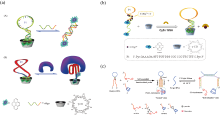


| [1] |
Amabilino, D. B.; Gale, P. A. Chem. Soc. Rev. 2017, 46, 2376.
doi: 10.1039/c7cs90037f pmid: 28443886 |
| [2] |
Liu, Z.-C.; Nalluri, S. K. M.; Stoddart, J. F. Chem. Soc. Rev. 2017, 46, 2459.
|
| [3] |
You, L.; Zha, D.-J.; Anslyn, E. V. Chem. Rev. 2015, 115, 7840.
|
| [4] |
Jiao, Y.; Zhang, X. Acta Chim. Sinica 2018, 76, 659 (in Chinese).
doi: 10.6023/A18070273 |
|
(焦阳, 张希, 化学学报, 2018, 76, 659.)
doi: 10.6023/A18070273 |
|
| [5] |
Lou, X.-Y.; Song, N.; Yang, Y.-W. Molecules 2017, 22, 1640.
|
| [6] |
Wang, N.-P.; Zhang, Q.-P.; Zhang, Y.-H.; Chen, H.-Y. Acta Chim. Sinica 2003, 61, 597 (in Chinese).
|
|
(王南平, 张其平, 张跃华, 陈洪渊, 化学学报, 2003, 61, 597.)
|
|
| [7] |
Li, Y.-X.; Liu, Y. Acta Chim. Sinica 2023, 81, 928 (in Chinese).
|
|
(李永雪, 刘育, 化学学报, 2023, 81, 928.)
doi: 10.6023/A23040171 |
|
| [8] |
Liu, J.; Lan, Y.; Yu, Z.-Y.; Tan, C. S.; Parker, R. M.; Abell, C. Scherman, O. A. Acc. Chem. Res. 2017, 50, 208.
|
| [9] |
Pinalli, R.; Pedrini, A.; Dalcanale, E. Chem. Soc. Rev. 2018, 47, 7006.
|
| [10] |
Jiang, C.-Y.; Song, Z.-R.; Yu, L.-L.; Ye, S.-J.; He, H. Trends Anal. Chem. 2020, 133, 116086.
|
| [11] |
Wu, L.-L.; Wang, Y.-D.; Xu, X.; Liu, Y.-L.; Lin, B.-Q.; Zhang, M.-X.; Zhang, J.-L.; Wan, S.; Yang, C.-Y.; Tan, W.-H. Chem. Rev. 2021, 121, 12035.
|
| [12] |
Micura, R.; Höbartner, C. Chem. Rev. 2020, 49, 7331.
|
| [13] |
Liu, J.-W.; Cao, Z.-H.; Lu, Y. Chem. Rev. 2009, 109, 1948.
|
| [14] |
Samanta, D.; Ebrahimi, S. B.; Mirkin, C. A. Adv. Mater. 2020, 32, e1901743.
|
| [15] |
Li, L.; Xu, S.-J.; Yan, H.; Li, X.-W.; Yazd, H. S.; Li, X.; Huang, T.; Cui, C.; Jiang, J.-H.; Tan, W.-H. Angew. Chem. Int. Ed. 2021, 60, 2221.
|
| [16] |
Tan, W.-F.; He, J.-Q.; Deng, J.-L.; Yang, X.-W.; Cui, L.-J.; Ran, R.-Z.; Du, G.-W.; Jiang, X.-Q. Sci. Rep. 2018, 8, 3309.
|
| [17] |
Kim, K.; Lee, C. H.; Park, C. B. Chem. Soc. Rev. 2020, 49, 5446.
|
| [18] |
Mandal, S.; Li, Z.; Chatterjee, T.; Khanna, K.; Montoya, K.; Dai, L.-H.; Petersen, C.; Li, L.-D.; Tewari, M.; Alexander, J. B.; Walter, N. G. Acc. Chem. Res. 2021, 54, 388.
|
| [19] |
Launonen, I. M.; Lyytikäinen, N.; Casado, J.; Anttila, E. A.; Szabó, A.; Haltia, U. M.; Jacobson, C. A.; Lin, J. R.; Maliga, Z.; Howitt, B.; Strickland, K. C.; Santagata, S.; Elias, K.; D'Andrea, A. D.; Konstantinopoulos, P. A.; Sorger, P. K.; Färkkilä, A. Nat. Commun. 2022, 13, 835.
doi: 10.1038/s41467-022-28389-3 pmid: 35149709 |
| [20] |
Chang, D.-R.; Zakaria, S.; Esmaeili, S. S.; Chang, Y.-Y.; Filipe, C. D. M.; Soleymani, L.; Brennan, J. D; Liu, M.; Li, Y.-F. Acc. Chem. Res. 2021, 54, 3540.
|
| [21] |
Khoo, A.; Liu, L. Y.; Nyalwidhe, J. O.; Semmes, O. J.; Vesprini, D.; Downes, M. R.; Boutros, P. C.; Liu, S. K.; Kislinger, T. Nat. Rev. Urol. 2021, 18, 707.
|
| [22] |
Li, M.; Yin, F.-F.; Song, L.; Mao, X.-H.; Li, F.; Fan, C.-H.; Zuo, X.-L.; Xia, Q. Chem. Rev. 2021, 121, 10469.
|
| [23] |
Wei, X.-W.; Zhuang, L.-J.; Li, H.-B.; He, C.-J.; Wan, H.; Hu, N.; Wang, P. Small 2020, 16, e2005828.
|
| [24] |
Das, J.; Kelley, S. O. Angew. Chem. Int. Ed. 2020, 59, 2554.
|
| [25] |
Minopoli, A.; Della, V. B.; Lenyk, B.; Gentile, F.; Tanner, J. A.; Offenhäusser, A.; Mayer, D.; Velotta, R. Nat. Commun. 2020, 11, 6134.
doi: 10.1038/s41467-020-19755-0 pmid: 33262332 |
| [26] |
Tang, Y.; Gao, L.; Feng, W.; Guo, C.; Yang, Q.-F.; Li, F.; Le, X. C. Chem. Soc. Rev. 2021, 50, 11844.
|
| [27] |
Madhurantakam, S.; Muthukumar, S.; Prasad, S. ACS Omega 2022, 7, 12467.
doi: 10.1021/acsomega.2c00638 pmid: 35474766 |
| [28] |
Deng, C. L.; Murkli, S. L.; Isaacs, L. D. Chem. Soc. Rev. 2020, 49, 7516.
|
| [29] |
Bidar, N.; Oroojalian, F.; Baradaran, B.; Eyvazi, S.; Amini, M.; Jebelli, A.; Samad, H. S.; Paria, P. P.; Mokhtarzadeh, A.; Guardia, M. L. Trac-trend. Anal. Chem. 2020, 131, 116021.
|
| [30] |
Bhalla, N.; Jolly, P.; Formisano, N.; Estrela, P. Essays Biochem. 2016, 60, 1.
|
| [31] |
Tan, W.-H.; Wang, K.-M.; Drake, T. J. Curr. Opin. Chem. Biol. 2004, 8, 547.
|
| [32] |
Shi, H.; He, X.-X.; Yang, X.-H.; Wang, K.-M.; Wang, Q.; Guo, Q.-P.; Huo, X.-Q. Sci. China Chem. 2010, 53, 704.
|
| [33] |
Caputo, T. M.; Battista, E.; Netti, P. A.; Causa, F. ACS Appl. Mater. Interfaces 2019, 11, 17147.
|
| [34] |
Zhang, Z.; Xiang, X.; Huang, F.-H.; Zheng, M.-M., Xia, X.-Y.; Han, L. Sensor. Actuat. B-chem. 2018, 273, 159.
|
| [35] |
Cui, L.; Ke, G.-L.; Lin, X.-Y.; Song, Y.-L.; Zhang, H.-M.; Guan, Z.-C.; Zhu, Z.; Yang, C. J. Methods 2013, 63, 202.
|
| [36] |
Bidar, N.; Amini, M.; Oroojalian, F.; Behzad, B.; Samad, H. S.; Shahbazi, M. A.; Mahmoud, H.; Ahad, M.; Michael, R. H.; Miguel, G. Trac-trend. Anal. Chem. 2021, 134, 276.
|
| [37] |
Zheng, J.; Li, J.-S.; Gao, X.-X.; Jin, J.-Y.; Wang, K.-M.; Tan, W.-H.; Yang, R.-H. Anal. Chem. 2010, 82, 3914.
doi: 10.1021/ac1004713 pmid: 20387827 |
| [38] |
Zhang, Q.-E.; Deng, T.; Li, J.-S.; Xu, W.-J.; Shen, G.-L.; Yu, R.-Q. Biosens. Bioelectron. 2015, 68, 253.
doi: S0956-5663(15)00005-6 pmid: 25590970 |
| [39] |
Harris, D. C.; Saks, B. R.; Jayawickramarajah, J. J. Am. Chem. Soc. 2011, 133, 7676.
|
| [40] |
He, L.-L.; Yang, X.-H.; Wang, K.-M.; Wang, Q.; Zhao, F.; Huang, J.; Liu, J.-B. Chem. Commun. (Camb) 2014, 50, 7803.
|
| [41] |
Stoltenburg, R.; Reinemann, C.; Strehlitz, B. Biomol. Eng. 2007, 24, 381.
pmid: 17627883 |
| [42] |
Fang, X.-H.; Tan, W.-H. Acc. Chem. Res. 2010, 43, 48.
|
| [43] |
Tuerk, C.; Gold, L. Science 1990, 249, 505.
doi: 10.1126/science.2200121 pmid: 2200121 |
| [44] |
Keefe, A. D.; Pai, S.; Ellington, A. Nat. Rev. Drug Discov. 2010, 9, 537.
|
| [45] |
Wang, R.-W.; Zhu, G.-Z.; Mei, L.; Xie, Y.; Ma, H.-B.; Ye, M.; Qing, F.-L.; Tan, W.-H. J. Am. Chem. Soc. 2014, 136, 2731.
|
| [46] |
Hicke, B. J.; Stephens, A. W.; Gould, T.; Chang, Y. F.; Lynott, C. K.; Heil, J.; Borkowski, S.; Hilger, C. S.; Cook, G.; Warren, S.; Schmidt, P. G. J. Nucl. Med. 2006, 47, 668.
|
| [47] |
Shangguan, D.-H.; Li, Y.; Tang, Z.; Cao, Z. C.; Chen, H. W.; Mallikaratchy, P.; Sefah, K.; Yang, C. J.; Tan, W. Proc. Natl. Acad. Sci. U. S. A. 2006, 103, 11838.
|
| [48] |
Tan, W.-H.; Donovan, M. J.; Jiang, J.-H. Chem. Rev. 2013, 113, 2842.
|
| [49] |
Kuai, H.; Zhao, Z.-L.; Mo, L.-T.; Liu, H.; Hu, X.-X.; Fu, T.; Zhang, X.-B.; Tan, W.-H. J. Am. Chem. Soc. 2017, 139, 9128.
|
| [50] |
Jiang, Y.; Pan, X.-S.; Chang, J.; Niu, W.-J.; Hou, W.-J.; Kuai, H.; Zhao, Z.-L.; Liu, J.; Wang, M.; Tan, W.-H. J. J. Am. Chem. Soc. 2018, 140, 6780.
doi: 10.1021/jacs.8b03442 pmid: 29772170 |
| [51] |
Mao, Q.-X.; Wang, L.-C.; Xue, D.-D.; Lin, X.-X.; Sun, F.; Xu, P.-C.; Chen, J.-R.; Li, W.-Y.; Li, X.-C.; Yan, F.; Hu, C. Anal. Chem. 2024, 96, 2022.
|
| [52] |
Shetty, D.; Khedkar, J. K.; Park, K. M.; Kim, K. Chem. Soc. Rev. 2015, 44, 8747.
|
| [53] |
Tian, T.; Song, Y.-Y.; Wei, L.; Wang, J.-Q.; Fu, B.-S.; He, Z.-Y.; Yang, X. R.; Wu, F.; Xu, G.-H.; Liu, S. M.; Li, C.-G.; Wang, S.-R.; Zhou, X. Nucleic Acids Res. 2017, 45, 2283.
doi: 10.1093/nar/gkx025 pmid: 28115627 |
| [54] |
Chen, Y.-Y.; Huang, Z.-H.; Xu, J. F.; Sun, Z.-W.; Zhang, X. ACS Appl. Mater. Interfaces 2016, 8, 22780.
|
| [55] |
Chen, Y.-Y.; Huang, Z.-H.; Zhao, H.-Y.; Xu, J. F.; Sun, Z.-W.; Zhang, X. ACS Appl. Mater. Interfaces 2017, 9, 8602.
|
| [56] |
Zhou, X.; Su, X.-Y.; Pathak, P.; Vik, R.; Vinciguerra, B.; Isaacs, L.; Jayawickramarajah, J. J. Am. Chem. Soc. 2017, 139, 13916.
|
| [57] |
Ihara, T.; Uemura, A.; Futamura, A.; Shimizu, M.; Baba, N.; Nishizawa, S.; Teramae, N.; Jyo, A. J. Am. Chem. Soc. 2009, 131, 1386.
|
| [58] |
Yang, C.; Spinelli, N.; Perrier, S.; Defrancq, E.; Peyrin, E. Anal. Chem. 2015, 87, 3139.
|
| [59] |
Schmidt, B.; Barner, K. C. Angew. Chem. Int. Ed. 2017, 56, 8350.
|
| [60] |
Liang, Y.; Li, E.; Wang, K.-Y.; Guan, Z.-J.; He, H.-H.; Zhang, L.-L.; Zhou, H.-C.; Huang, F.-H.; Fang, Y. Chem. Soc. Rev. 2022, 51, 8378.
|
| [61] |
Albert, S. K.; Thelu, H. V. P.; Golla, M.; Krishnan, N.; Varghese, R. Nanoscale 2017, 9, 5425.
doi: 10.1039/c6nr08370f pmid: 28300237 |
| [62] |
Li, H.-Y.; Peng, E.-W.; Zhao, F.; Li, J.; Xue, J.-M. Pharmaceutics 2021, 13, 1884.
|
| [63] |
Zhao, F.; Yin, H.; Zhang, Z.-X.; Li, J. Biomacromolecules 2013, 14, 476.
|
| [64] |
He, L.-L.; Shi, K.-Q.; Liu, X.-L.; Wang, Y.; Song, L.-L.; Wu, D.; Wu, Y.-J.; Xiong, Y.-M.; Huang, P.-L. Sensor. Actuat. B-chem. 2023, 393, 134126.
|
| [65] |
Liu, P.; Sun, S.; Guo, X.-C.; Yang, X.-H.; Huang, J.; Wang, K.-M.; Wang, Q.; Liu, J.-B.; He, L.-L. Anal. Chem. 2015, 87, 2665.
|
| [66] |
Wang, D. G.; Fan, J. B.; Siao, C. J.; Berno, A.; Young, P.; Sapolsky, R.; Ghandour, G.; Perkins, N.; Winchester, E.; Spencer, J.; Kruglyak, L.; Stein, L.; Hsie, L.; Topaloglou, T.; Hubbell, E.; Robinson, E.; Mittmann, M.; Morris, M. S.; Shen, N.; Kilburn, D.; Rioux, J.; Nusbaum, C.; Rozen, S.; Hudson, T. J.; Lipshutz, R.; Chee, M.; Lander, E. S. Science 1998, 280, 1077.
doi: 10.1126/science.280.5366.1077 pmid: 9582121 |
| [67] |
Yeh, H. C.; Sharma, J.; Shih, IeM.; Vu, D. M.; Martinez, J. S.; Werner, J. H. A. J. Am. Chem. Soc. 2012, 134, 11550.
|
| [68] |
Irizarry, K.; Kustanovich, V.; Li, C.; Brown, N.; Nelson, S.; Wong, W.; Lee, C. J. Nat. Genet. 2000, 26, 233.
doi: 10.1038/79981 pmid: 11017085 |
| [69] |
Guo, Y.-H.; Xu, P.; Hu, H.; Zhou, X.-D.; Hu, J.-M. Talanta 2013, 114, 138.
|
| [70] |
Liu, G.; Lao, R.-J.; Xu, L.; Xu, Q.; Li, L.-Y.; Zhang, M.; Song, S.-P.; Fan, C.-H. Biosens. Bioelectron. 2013, 42, 516.
|
| [71] |
Ihara, T.; Wasano, T.; Nakatake, R.; Arslan, P.; Futamura, A.; Jyo, A. Chem. Commun. (Camb) 2011, 47, 12388.
|
| [72] |
Zou, Z.; Qing, Z.-H.; He, X.-X.; Wang, K.-M.; He, D.-G.; Shi, H.; Yang, X.; Qing, T.-P.; Yang, X.-X. Talanta 2014, 125, 306.
|
| [73] |
Guo, B.-Y.; Sheng, Y.-Y.; Zhou, K.; Liu, Q.-S.; Liu, L.; Wu, H.-C. Angew. Chem. Int. Ed. 2018, 57, 3602.
|
| [74] |
Xu, J.; Gao, Y.-F.; Li, B.-X.; Jin, Y. Biosens. Bioelectron. 2016, 80, 91.
|
| [75] |
Yang, H.; Duan, Z.-Z.; Liu, F.-B.; Zhao, Z.-Y.; Liu, S.-M. ACS Macro Lett. 2023, 12, 295.
doi: 10.1021/acsmacrolett.2c00763 pmid: 36779651 |
| [76] |
Yu, Z.-Z.; Wang, M.-M.; Pan, W.; Wang, H.-Y.; Li, N.; Tang, B. Chem. Sci. 2017, 8, 4896.
|
| [77] |
Gu, P.-L.; Li, Y.; Li, L.-Y.; Deng, S.-Y.; Zhu, X.-K.; Song, Y.; Song, E.-Q.; Tan, W.-H. ACS Nano 2023, 17, 24384.
|
| [78] |
Cui, R.; Wang, F.; Meng, X.-Y.; Zhou, R.-A.; Sun, Z.-G.; Cheng, Y.; Zhu, H.-Q.; Wang, Y. Adv. Healthc. Mater. 2024, 13, e2401885.
|
| [1] | 王丹钰, 郭子涵, 郭梦珂, 易桦, 黄梦雨, 段捷, 张开翔. DNA纳米花生物医学研究进展概述[J]. 化学学报, 2024, 82(6): 677-689. |
| [2] | 王博, 蔡向东, 肖建喜. 肿瘤特异性多肽探针及其在生物成像中的应用[J]. 化学学报, 2024, 82(3): 367-376. |
| [3] | 李兰英, 陶晴, 闻艳丽, 王乐乐, 郭瑞妍, 刘刚, 左小磊. 多聚腺嘌呤DNA探针及其生物传感应用★[J]. 化学学报, 2023, 81(6): 681-690. |
| [4] | 朱子煜, 梁阿新, 浩天瑞霖, 唐珊珊, 刘淼, 解炳腾, 罗爱芹. 生物传感器在新冠病毒检测中的应用[J]. 化学学报, 2023, 81(3): 253-263. |
| [5] | 朱诗敏, 黄鑫, 韩勰, 刘思敏. N^C^N型Pt(II)配合物与大环主体葫芦[10]脲的识别及发光性质研究[J]. 化学学报, 2022, 80(8): 1066-1070. |
| [6] | 刘超, 田飞, 邓瑾琦, 孙佳姝. 基于微流控热泳的生物传感技术※[J]. 化学学报, 2022, 80(5): 679-689. |
| [7] | 浩天瑞霖, 朱子煜, 蔡艳慧, 王微, 王祯, 梁阿新, 罗爱芹. 基于共价有机框架的电化学生物传感器在生物样品检测中的应用[J]. 化学学报, 2022, 80(11): 1524-1535. |
| [8] | 师瑶, 夏乾峰, 何政清, 鞠熀先. 登革热病毒检测的生物传感技术[J]. 化学学报, 2022, 80(1): 69-79. |
| [9] | 李佳欣, 李蓓, 王纪康, 何蕾, 赵宇飞. 水滑石(LDHs)及其衍生物在生物医药领域的研究进展[J]. 化学学报, 2021, 79(3): 238-256. |
| [10] | 廖妮, 钟霞, 梁文斌, 袁若, 卓颖. ECL金属-有机框架(MOF)生物传感平台用于肿瘤细胞分泌H2O2的测定[J]. 化学学报, 2021, 79(10): 1257-1264. |
| [11] | 樊蕾, 江群英, 潘敏, 王文晓, 张丽, 刘晓庆. 基于模拟酶-天然酶级联反应的双模式传感平台用于生物标志物的超灵敏检测[J]. 化学学报, 2020, 78(5): 419-426. |
| [12] | 金鑫, 王晓英. 口腔癌相关唾液肿瘤生物标志物的分析检测研究进展[J]. 化学学报, 2019, 77(4): 340-350. |
| [13] | 熊麟, 凡勇, 张凡. 稀土纳米晶用于近红外区活体成像和传感研究进展[J]. 化学学报, 2019, 77(12): 1239-1249. |
| [14] | 焦阳, 张希. 超分子自由基:构筑、调控与功能[J]. 化学学报, 2018, 76(9): 659-665. |
| [15] | 胡正利, 杜冀晖, 应佚伦, 彭岳一, 曹婵, 龙亿涛. 纳米孔道单分子检测结直肠癌MicroRNAs[J]. 化学学报, 2017, 75(11): 1087-1090. |
| 阅读次数 | ||||||
|
全文 |
|
|||||
|
摘要 |
|
|||||
