

化学学报 ›› 2025, Vol. 83 ›› Issue (11): 1414-1423.DOI: 10.6023/A25050180 上一篇 下一篇
所属专题: “中国青年化学家”合辑
综述
何璐, 王硕, 陈宇辉*( )
)
投稿日期:2025-05-19
发布日期:2025-07-21
作者简介: |
陈宇辉, 2009年本科毕业于复旦大学化学系, 2014年博士毕业于英国圣安德鲁斯大学, 随后在牛津大学从事博士后工作, 2017年入职南京工业大学任教授, 研究集中于原位电化学光谱/质谱表征和锂氧电池反应机制. 在原位电化学差分质谱和锂氧电池中媒介体催化电极反应等方面积累了丰富经验, 并取得多项研究成果, 在Nat. Catal.、Nat. Energy、Nat. Mater.、Nat. Chem.及Nat. Commum.等期刊发表论文50余篇. 现兼任Energy Mater.编委、SusMat和Chin. Chem. Lett.青年编委. |
★“中国青年化学家”专辑.
基金资助:
He Lu, Wang Shuo, Chen Yuhui*()
Received:2025-05-19
Published:2025-07-21
Contact:
*E-mail: cheny@njtech.edu.cn
About author:★For the VSI “Rising Stars in Chemistry”.
Supported by:文章分享
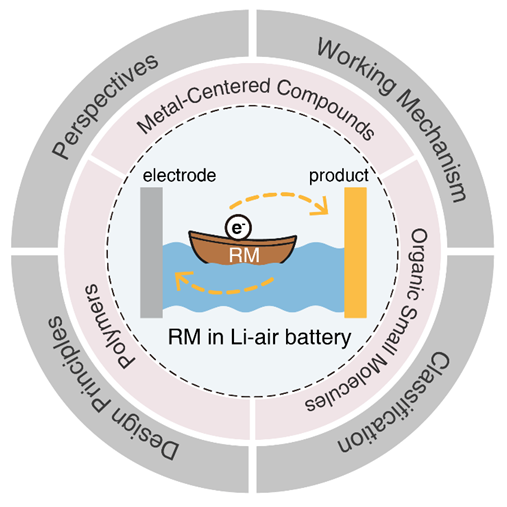
锂-空气电池是发展先进储能系统中的重要电池体系, 具有极高比能量. 然而, 锂-空气电池在正极侧仍面临着电极动力学缓慢、过电位高和电解液分解副反应等问题. 为克服上述问题, 研究者引入多种催化策略, 其中氧化还原媒介体分子催化剂的出现解决了“固-固”界面接触问题, 可有效地提高锂-空气电池的电化学性能. 聚焦于锂-空气电池的研究现状和关键挑战, 系统阐述了该体系中媒介体催化的作用机制及其应用, 进一步探讨了理想媒介体的设计要点与技术难点, 最后对该领域提出了展望.
何璐, 王硕, 陈宇辉. 媒介体催化在锂-空气电池中的应用与挑战★[J]. 化学学报, 2025, 83(11): 1414-1423.
He Lu, Wang Shuo, Chen Yuhui. Applications and Challenges of Redox-Mediated Catalysis in Lithium-Air Batteries★[J]. Acta Chimica Sinica, 2025, 83(11): 1414-1423.





| [1] |
doi: 10.1016/j.scib.2022.11.027 |
| [2] |
doi: 10.1016/j.matt.2019.05.008 |
| [3] |
doi: 10.1021/acsenergylett.7b00119 |
| [4] |
|
| [5] |
doi: 10.1002/aenm.v6.9 |
| [6] |
doi: 10.1002/cjoc.v39.1 |
| [7] |
doi: 10.1002/adfm.v23.8 |
| [8] |
doi: 10.6023/A20070290 |
|
(于越, 张新波, 化学学报, 2020, 78, 1434.)
doi: 10.6023/A20070290 |
|
| [9] |
doi: 10.3866/PKU.WHXB202305059 |
| [10] |
doi: 10.1002/aenm.v9.21 |
| [11] |
doi: 10.1039/D2TA05756E |
| [12] |
doi: 10.1007/s41918-020-00085-0 |
| [13] |
doi: 10.1007/s42114-022-00500-8 |
| [14] |
doi: 10.6023/A14110787 |
|
(王瀛, 张丽敏, 胡天军, 化学学报, 2015, 73, 316.)
doi: 10.6023/A14110787 |
|
| [15] |
doi: 10.1007/s41918-018-0002-3 |
| [16] |
|
| [17] |
doi: 10.1039/D0CS01507E |
| [18] |
|
| [19] |
doi: 10.1002/bte2.v2.2 |
| [20] |
|
| [21] |
doi: 10.1038/nature25984 |
| [22] |
doi: 10.1002/adma.v29.48 |
| [23] |
doi: 10.1063/1.3663385 |
| [24] |
doi: 10.1039/D5CC00013K |
| [25] |
doi: 10.1002/aenm.v10.40 |
| [26] |
|
| [27] |
doi: 10.1038/nenergy.2016.66 |
| [28] |
doi: 10.1038/nenergy.2017.118 |
| [29] |
doi: 10.1002/anie.v58.36 |
| [30] |
doi: 10.1002/aenm.v12.12 |
| [31] |
doi: 10.1002/aenm.v10.27 |
| [32] |
doi: 10.1002/aenm.v12.7 |
| [33] |
doi: 10.1016/j.cclet.2019.11.046 |
| [34] |
doi: 10.1038/nmat4629 |
| [35] |
|
| [36] |
doi: 10.1002/anie.v53.15 |
| [37] |
doi: 10.1016/j.electacta.2016.03.161 |
| [38] |
doi: 10.1038/nchem.1646 |
| [39] |
|
| [40] |
doi: 10.1039/C9CC02596K |
| [41] |
doi: 10.1002/cjoc.v41.3 |
| [42] |
doi: 10.1021/acsami.1c09688 |
| [43] |
doi: 10.1016/j.cej.2022.138400 |
| [44] |
doi: 10.1016/j.cclet.2024.110186 |
| [45] |
doi: 10.1021/acs.jpcc.8b00109 |
| [46] |
|
| [47] |
doi: 10.1021/acsami.1c24153 |
| [48] |
doi: 10.1021/acs.jpcc.1c02026 |
| [49] |
|
| [50] |
doi: 10.1021/acsami.7b14279 |
| [51] |
doi: 10.1038/s41557-023-01203-3 |
| [52] |
doi: 10.1038/nchem.2132 |
| [53] |
doi: 10.1038/nenergy.2016.128 |
| [54] |
doi: 10.1038/nchem.2101 pmid: 25411888 |
| [55] |
doi: 10.1021/acs.nanolett.1c04445 |
| [56] |
doi: 10.1038/ncomms12925 |
| [57] |
|
| [58] |
doi: 10.1038/s41467-023-36276-8 |
| [59] |
|
| [60] |
doi: 10.1002/anie.v60.30 |
| [61] |
doi: 10.1021/jacs.6b01821 |
| [62] |
doi: 10.1038/s41467-018-03204-0 |
| [63] |
doi: 10.1038/s41929-022-00752-z |
| [64] |
|
| [65] |
doi: 10.6023/A20030085 |
|
(张静, 汤功奥, 曾誉, 王保兴, 刘力玮, 吴强, 杨立军, 王喜章, 胡征, 化学学报, 2020, 78, 572.)
doi: 10.6023/A20030085 |
|
| [66] |
doi: 10.1021/ja501877e |
| [67] |
doi: 10.1021/acs.jpclett.3c01087 |
| [68] |
doi: 10.1021/acsami.2c04332 |
| [69] |
doi: 10.1021/acs.inorgchem.8b01002 |
| [70] |
doi: 10.1021/acs.jpcc.6b02932 |
| [71] |
doi: 10.31635/ccschem.020.202000313 |
| [72] |
doi: 10.1039/D0TA09627J |
| [73] |
doi: 10.1021/ja508400m |
| [74] |
doi: 10.1039/C5CP04505C |
| [75] |
doi: 10.1021/acsami.1c22621 |
| [76] |
doi: 10.1039/D3EE02880A |
| [77] |
doi: 10.1002/adma.v29.41 |
| [78] |
doi: 10.1021/acs.jpcc.5b11692 |
| [79] |
doi: 10.1002/anie.v56.29 |
| [80] |
doi: 10.1002/anie.v59.13 |
| [81] |
doi: 10.1016/j.jmst.2021.10.009 |
| [82] |
doi: 10.31635/ccschem.020.202000284 |
| [83] |
|
| [84] |
doi: 10.1016/j.cej.2025.160983 |
| [85] |
doi: 10.1021/acsenergylett.6b00619 |
| [86] |
doi: 10.1002/aenm.v15.3 |
| [87] |
doi: 10.1021/acscatal.0c01469 |
| [88] |
doi: 10.1038/s41557-023-01268-0 pmid: 37414882 |
| [89] |
doi: 10.1002/adma.v37.15 |
| [90] |
doi: 10.1002/cjoc.v41.3 |
| [91] |
doi: 10.1021/acsami.4c21918 |
| [92] |
doi: 10.1002/adfm.v34.16 |
| [93] |
doi: 10.1016/j.cclet.2023.108469 |
| [94] |
|
| [95] |
doi: 10.1039/D3FD00137G |
| [96] |
doi: 10.1021/jacs.7b11007 |
| [97] |
|
| [1] | 顾大明, 张传明, 顾硕, 张音, 王余, 强亮生. 锂-空气电池性能的影响因素及研究进展[J]. 化学学报, 2012, 70(20): 2115-2122. |
| 阅读次数 | ||||||
|
全文 |
|
|||||
|
摘要 |
|
|||||
