

化学学报 ›› 2026, Vol. 84 ›› Issue (1): 160-172.DOI: 10.6023/A25080292 上一篇 下一篇
综述
黄静a,*( ), 赵乐妍a,b, 徐勃c
投稿日期:2025-08-28
发布日期:2025-10-16
作者简介: |
黄静, 博士, 南京理工大学环境与生物工程学院副教授, 硕士生导师. 主要从事基于量子点的光伏器件和发光器件的研究, 尤其在发光太阳能聚光器-光伏组件方面的研究. |
 |
赵乐妍, 2025年南京理工大学在读硕士研究生, 主要从事铜铟硫量子点基发光太阳能聚光器的制备与应用研究. |
 |
徐勃, 博士, 南京理工大学化学与化工学院教授, 博士生导师. 主要研究方向为能源光电材料与器件, 聚焦于光伏电池与发光显示等领域. |
基金资助:
Jing Huanga,*(), Leyan Zhaoa,b, Bo Xuc
Received:2025-08-28
Published:2025-10-16
Contact:
* E-mail: jinghuang@njust.edu.cn
Supported by:文章分享
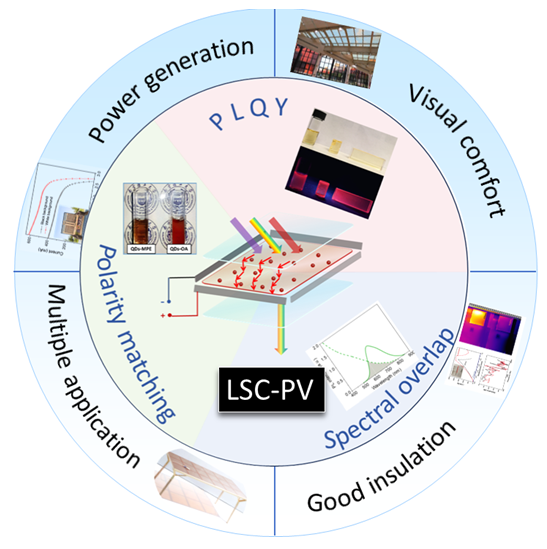
透明光伏凭借其高透光特性可隐形集成于建筑及各种生活场景中, 能为高密度城市节能减排提供创新解决方案. 然而该技术在大规模应用前, 仍需解决一些关键技术问题, 包括在维持高视觉舒适度的基础上提升大面积器件的能量转换效率, 同步优化器件稳定性与成本控制. 为了应对这些技术挑战, 本综述重点探讨了发光太阳能聚光器-光伏(LSC-PV)组件这一种新型透明光伏的技术特点, 包括高太阳光利用率, 简便的制作工艺, 以及灵活的产品设计. 面对大面积LSC-PV效率限制的技术瓶颈, 本综述通过对LSC的光学效率影响因素的分析, 介绍了通过合成或者合成后修饰提高LSC内发光材料的荧光量子产率的方法, 同时讨论通过抑制发光材料在聚合物基质中的吸收-荧光光谱重叠系数提高LSC器件的波导效率的策略, 以获得高效率的LSC-PV组件. 最后, 通过介绍LSC与其他功能器件的联用技术, 表明透明光伏技术以及基于LSC-PV类型的透明光伏技术可通过持续的技术迭代与系统优化, 成为实现“双碳”战略目标的重要技术路径.
黄静, 赵乐妍, 徐勃. 基于发光太阳能聚光器的透明光伏技术: 效率瓶颈、材料设计与前景展望[J]. 化学学报, 2026, 84(1): 160-172.
Jing Huang, Leyan Zhao, Bo Xu. Transparent Photovoltaics Based on Luminescent Solar Concentrators: Efficiency Bottlenecks, Material Design, and Future Prospects[J]. Acta Chimica Sinica, 2026, 84(1): 160-172.
| TPV | Active area/cm2 | AVT/% | PCE/% | LUE/% | Ref. |
|---|---|---|---|---|---|
| c-Si | 36 | 20 | 12.2 | 2.44 | [ |
| a-Si | 0.25 | 29.3 | 6.41 | 1.88 | [ |
| CIGS | 0.25 | 18.6 | 6.46 | 1.20 | [ |
| CIGS | — | 12.3 | 10.5 | 1.29 | [ |
| CdTe | — | 43 | 0.41 | 0.18 | [ |
| OPV | 1.05 | 38.7 | 12.95 | 5.00 | [ |
| Perovskite | 0.1 | 22 | 14.21 | 3.13 | [ |
| Dye-Sensitized Solar Cell | 14 | 26 | 8.7 | 2.26 | [ |
| CuInS2/ZnS QDs-LSC | 81 | 54 | 3.56 | 1.24 | [ |
| CuInS2/ZnS QDs-LSC | 841 | 51 | 1.36 | 0.42 | [ |
| TPV | Active area/cm2 | AVT/% | PCE/% | LUE/% | Ref. |
|---|---|---|---|---|---|
| c-Si | 36 | 20 | 12.2 | 2.44 | [ |
| a-Si | 0.25 | 29.3 | 6.41 | 1.88 | [ |
| CIGS | 0.25 | 18.6 | 6.46 | 1.20 | [ |
| CIGS | — | 12.3 | 10.5 | 1.29 | [ |
| CdTe | — | 43 | 0.41 | 0.18 | [ |
| OPV | 1.05 | 38.7 | 12.95 | 5.00 | [ |
| Perovskite | 0.1 | 22 | 14.21 | 3.13 | [ |
| Dye-Sensitized Solar Cell | 14 | 26 | 8.7 | 2.26 | [ |
| CuInS2/ZnS QDs-LSC | 81 | 54 | 3.56 | 1.24 | [ |
| CuInS2/ZnS QDs-LSC | 841 | 51 | 1.36 | 0.42 | [ |
| [1] |
|
| [2] |
International Energy Agency IEA. World Energy Outlook 2023: CC BY 4.0, Paris: International Energy Agency, 2023: 1-355.
|
| [3] |
新华网宁夏频道. 沙漠变“蓝海”绿洲. (2024-05-31) [2024-07-11]. http://www.nx.xinhuanet.com/.
|
| [4] |
国家能源局. 常州天合光能建成中国农村“连片屋顶光伏发电村”. (2014-01-10) [2024-07-05]. https://www.nea.gov.cn/2014-01/10/c_133034389.htm.
|
| [5] |
doi: 10.1039/C8EE00154E |
| [6] |
doi: 10.1016/j.energy.2020.119567 |
| [7] |
doi: 10.3390/su12041654 |
| [8] |
|
| [9] |
龙焱能源科技. 看光伏与建筑的“跨界”联动: 中国西部科技创新港7号楼. (2023-06-19) [2024-07-18]. http://www.advsolarpower.com/case/case-info/7/291.
|
| [10] |
doi: 10.1016/j.joule.2019.11.008 |
| [11] |
doi: 10.1021/acsnano.8b08577 |
| [12] |
doi: 10.1016/j.renene.2016.10.078 |
| [13] |
doi: 10.1038/s41560-017-0016-9 |
| [14] |
|
| [15] |
doi: 10.1016/j.solener.2019.02.003 |
| [16] |
doi: 10.1016/j.nanoen.2020.105729 |
| [17] |
doi: 10.1016/j.tsf.2017.04.036 |
| [18] |
doi: 10.1002/adma.v34.41 |
| [19] |
doi: 10.1021/acsenergylett.4c01149 |
| [20] |
doi: 10.1039/D0SE01345E |
| [21] |
doi: 10.1039/D4EE02603A |
| [22] |
doi: 10.3390/su10124523 |
| [23] |
doi: 10.1063/1.4738896 |
| [24] |
doi: 10.1021/acsenergylett.6b00167 |
| [25] |
doi: 10.1016/j.egypro.2011.06.154 |
| [26] |
doi: 10.1016/j.solmat.2017.01.017 |
| [27] |
doi: 10.1016/j.joule.2018.04.005 |
| [28] |
doi: 10.1016/j.nanoen.2016.10.044 |
| [29] |
doi: 10.1088/1361-6528/aa6f4b |
| [30] |
doi: 10.1038/natrevmats.2017.72 |
| [31] |
doi: 10.1039/D3EE00331K |
| [32] |
doi: 10.1002/aenm.v11.12 |
| [33] |
doi: 10.1002/adma.v28.3 |
| [34] |
doi: 10.1039/D0EE02235G |
| [35] |
doi: 10.1039/D2NH00360K |
| [36] |
doi: 10.1038/s41566-017-0070-7 |
| [37] |
doi: 10.1038/nnano.2015.178 |
| [38] |
doi: 10.1038/s41467-023-39509-y |
| [39] |
doi: 10.3788/co. |
|
(李红博, 尹坤, 中国光学 2017, 10, 555.)
|
|
| [40] |
doi: 10.1002/aenm.v2.1 |
| [41] |
doi: 10.1021/acs.jpclett.2c02666 |
| [42] |
doi: 10.1002/anie.v56.4 |
| [43] |
doi: 10.1021/acsphotonics.2c00633 |
| [44] |
doi: 10.1021/acsami.2c01350 |
| [45] |
doi: 10.1002/aenm.v10.36 |
| [46] |
doi: 10.1016/j.enbuild.2015.12.022 |
| [47] |
doi: 10.1364/OPTICA.6.001046 |
| [48] |
doi: 10.1016/j.joule.2019.06.005 |
| [49] |
doi: 10.37188/CJL.20240171 |
|
(白静静, 许凤利, 李鹏炬, 李歆, 徐文军, 翟燕, 发光学报, 2024, 45, 1724.)
|
|
| [50] |
doi: 10.1002/solr.v4.9 |
| [51] |
doi: 10.1002/pssr.v2:6 |
| [52] |
doi: 10.1364/OL.37.003087 pmid: 22859094 |
| [53] |
doi: 10.1016/j.joule.2020.08.006 |
| [54] |
doi: 10.1002/adfm.v30.4 |
| [55] |
doi: 10.1021/acs.nanolett.8b03966 |
| [56] |
doi: 10.1016/j.joule.2020.01.003 |
| [57] |
doi: 10.1002/adom.v13.28 |
| [58] |
|
| [59] |
doi: 10.1039/D1EE02554F |
| [60] |
doi: 10.1021/acsanm.0c00958 |
| [61] |
doi: 10.1021/acsenergylett.7b01346 |
| [62] |
doi: 10.1021/acsphotonics.6b00485 |
| [63] |
doi: 10.37188/CJL.20230173 |
|
(张培, 柴鑫毅, 李少君, 任林娇, 郑一博, 秦自瑞, 张吉涛, 张庆芳, 姜利英, 发光学报, 2023, 44, 1990.)
|
|
| [64] |
doi: 10.1021/acsphotonics.8b01346 |
| [65] |
doi: 10.1021/acsenergylett.9b01224 |
| [66] |
doi: 10.1038/nphoton.2014.54 |
| [67] |
doi: 10.1002/aenm.v8.12 |
| [68] |
doi: 10.1021/acs.jchemed.7b00742 |
| [69] |
doi: 10.1002/adsu.v9.3 |
| [70] |
doi: 10.7567/JJAP.57.08RD10 |
| [71] |
doi: 10.1021/jacs.3c10657 |
| [72] |
doi: 10.1002/aenm.v14.16 |
| [73] |
doi: 10.1038/s41467-025-57369-6 |
| [1] | 魏永巨,康志敏,戚秀菊,张玉平,刘翠格. 铝试剂的荧光光谱与荧光量子产率[J]. 化学学报, 2001, 59(10): 1619-1622. |
| 阅读次数 | ||||||
|
全文 |
|
|||||
|
摘要 |
|
|||||
