

化学学报 ›› 2026, Vol. 84 ›› Issue (3): 316-323.DOI: 10.6023/A25090327 上一篇 下一篇
研究论文
赵颖a, 李修刚b,*( ), 卢章辉a,*()
投稿日期:2025-09-28
发布日期:2026-01-12
基金资助:
Zhao Yinga, Li Xiugangb,*(), Lu Zhang-Huia,*()
Received:2025-09-28
Published:2026-01-12
Contact:
*E-mail: xiugangli@foxmail.com;
luzh@jxnu.edu.cn
Supported by:文章分享
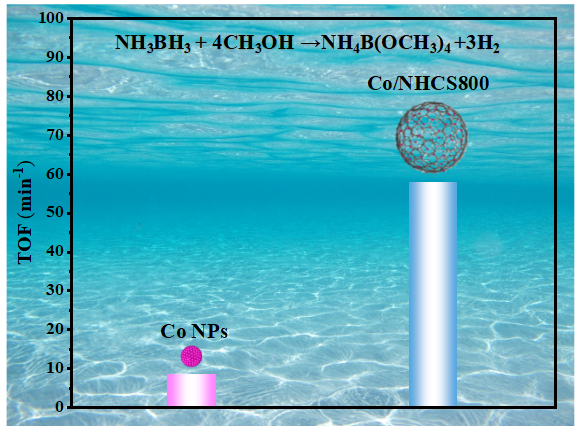
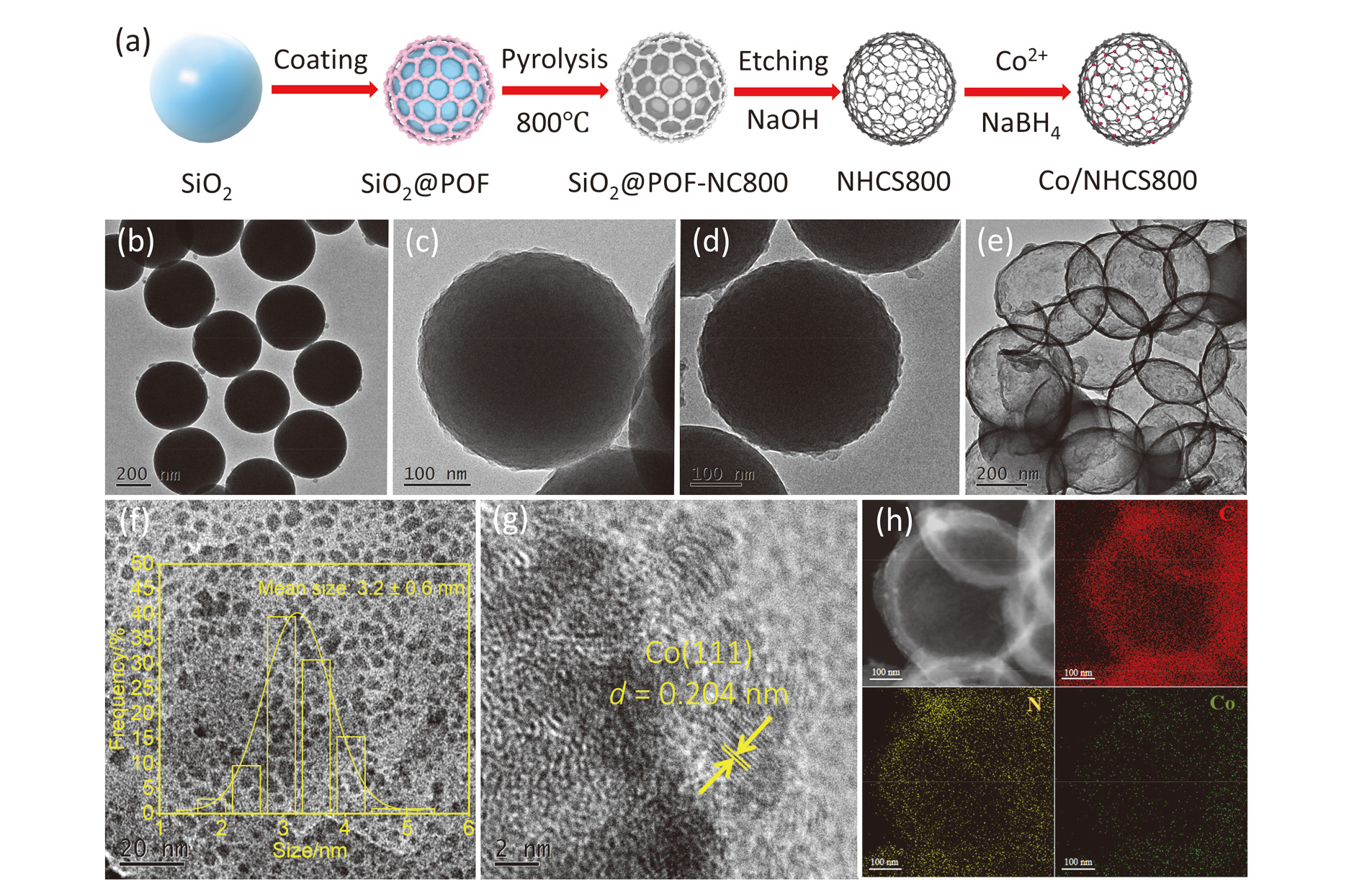
氮掺杂中空碳材料因其较低的密度、较高的比表面积、高效的传质性能以及丰富的氮物种等结构优势, 被认为是一种极具潜力的催化剂载体, 能够有效稳定并分散金属活性中心. 本研究以二氧化硅(SiO2)纳米球为硬模板, 首次采用溶剂热法在模板表面构建卟啉基有机框架(POFs)包覆层, 再通过高温热解结合碱刻蚀处理, 成功合成出具有中空结构的氮掺杂碳球(NHCS). 通过系统研究热解温度对材料物理和化学性质的影响, 发现800 ℃热解所得NHCS800样品具有最优的结构稳定性以及最丰富的表面缺陷位点. 通过简单的浸渍还原法, 将Co纳米粒子均匀分散在载体表面, 制得Co/NHCS800催化剂. 表征结果显示, 催化剂中钴纳米粒子的平均尺寸约为2.5 nm, 显著小于无载体存在时形成的钴颗粒. 在催化氨硼烷醇解制氢反应中, Co/NHCS800表现出优异的催化性能, 其转换频率(TOF)值高达57.9 min−1. 该高催化性能可归因于载体较大的比表面积、金属纳米粒子的高度分散性以及氮物种与金属间存在的强电子转移效应.
赵颖, 李修刚, 卢章辉. 氮掺杂中空碳球负载钴纳米粒子催化氨硼烷制氢[J]. 化学学报, 2026, 84(3): 316-323.
Zhao Ying, Li Xiugang, Lu Zhang-Hui. N-doped Hollow Carbon Spheres Supported Co Nanoparticles for Hydrogen Production from Ammonia Borane[J]. Acta Chimica Sinica, 2026, 84(3): 316-323.
| [1] |
|
| [2] |
doi: 10.1039/b900595a |
| [3] |
doi: 10.1126/science.1103197 pmid: 15310892 |
| [4] |
doi: 10.1039/c2ee22937d |
| [5] |
doi: 10.1016/j.ijhydene.2006.11.022 |
| [6] |
|
| [7] |
doi: 10.1016/j.ijhydene.2009.01.002 |
| [8] |
doi: 10.6023/A21030126 |
|
(张安琪, 姚淇露, 卢章辉, 化学学报, 2021, 79, 885.)
doi: 10.6023/A21030126 |
|
| [9] |
doi: 10.1016/j.ijhydene.2017.12.105 |
| [10] |
doi: 10.1016/j.matlet.2018.11.074 |
| [11] |
doi: 10.1016/j.cattod.2010.09.019 |
| [12] |
doi: 10.1016/j.jallcom.2007.08.077 |
| [13] |
doi: 10.1021/acssuschemeng.9b04480 |
| [14] |
doi: 10.1002/advs.v6.10 |
| [15] |
doi: 10.1002/cssc.v12.2 |
| [16] |
doi: 10.1007/s11426-024-2132-1 |
| [17] |
doi: 10.1016/j.apcatb.2009.10.013 |
| [18] |
doi: 10.1021/jacs.5b04029 |
| [19] |
doi: 10.1016/j.apcatb.2015.08.038 |
| [20] |
doi: 10.1002/anie.v58.51 |
| [21] |
doi: 10.1021/jacs.1c00578 |
| [22] |
doi: 10.1016/j.chempr.2018.01.004 |
| [23] |
|
| [24] |
doi: 10.1016/j.cej.2024.154593 |
| [25] |
|
| [26] |
doi: 10.1021/jacs.4c09611 |
| [27] |
doi: 10.1021/acscatal.4c03380 |
| [28] |
|
| [29] |
doi: 10.1039/D5QI00253B |
| [30] |
doi: 10.6023/A18070301 |
|
(李月, 姜宇晨, 蒋平平, 杜盛郁, 姜就胜, 冷炎, 化学学报, 2019, 77, 66.)
doi: 10.6023/A18070301 |
|
| [31] |
doi: 10.6023/A22120481 |
|
(徐斌, 韦秀芝, 孙江敏, 刘建国, 马隆龙, 化学学报, 2023, 81, 239.)
doi: 10.6023/A22120481 |
|
| [32] |
doi: 10.1039/D3SC05851D |
| [33] |
|
| [34] |
doi: 10.1002/adma.v36.21 |
| [35] |
doi: 10.1007/s12598-023-02330-z |
| [36] |
doi: 10.1021/jacs.5c09153 |
| [37] |
doi: 10.1002/anie.201100637 pmid: 21591036 |
| [38] |
doi: 10.1002/anie.v51.38 |
| [39] |
doi: 10.1021/nn404439r |
| [40] |
|
| [41] |
doi: 10.6023/A23110490 |
|
(周何鑫, 崔青云, 胡雪敏, 杨文秀, 田肖, 王硕, 化学学报, 2024, 82, 503.)
|
|
| [42] |
|
|
(李修刚, 博士论文,江西师范大学,南昌, 2022.)
|
|
| [43] |
doi: 10.1039/C7GC03710D |
| [44] |
doi: 10.1016/j.apsusc.2020.145740 |
| [45] |
doi: 10.1021/acscatal.0c03034 |
| [46] |
doi: 10.1039/c3nr01723k |
| [47] |
doi: 10.1002/anie.v47:18 |
| [1] | 田野, 张博尧, 陈俊宇, 姬梦鑫, 任浩, 匙玉华. MoSi2N4/ZrS2(HfS2) II型异质结调节电子传输用于光催化制氢的研究[J]. 化学学报, 2025, 83(5): 498-509. |
| [2] | 周何鑫, 崔青云, 胡雪敏, 杨文秀, 田肖, 王硕. 金属有机框架衍生氮掺杂碳限域钴原子簇催化硝基化合物转移加氢[J]. 化学学报, 2024, 82(5): 503-510. |
| [3] | 解众舒, 薛中鑫, 许子文, 李倩, 王洪宇, 李维实. 石墨相氮化碳的共轭交联修饰及其对可见光催化产氢性能的影响[J]. 化学学报, 2022, 80(9): 1231-1237. |
| [4] | 王金格, 周伟, 李佳轶, 丁雅妮, 高继慧. 脉冲电催化的研究进展及性能强化机制[J]. 化学学报, 2022, 80(11): 1555-1568. |
| [5] | 蒋博龙, 崔艳艳, 史顺杰, 姜楠, 谭伟强. 双金属氮化物NiMoN析氢催化剂制备及其电解海水析氢性能的研究[J]. 化学学报, 2022, 80(10): 1394-1400. |
| [6] | 吴浅耶, 张晨曦, 孙康, 江海龙. 一种可溶性卟啉MOF的微波辅助合成及其光催化性能[J]. 化学学报, 2020, 78(7): 688-694. |
| [7] | 邹少爽, 陶占良, 陈军. 氨基络合物制备氨硼烷及放氢性能研究[J]. 化学学报, 2011, 69(18): 2117-2122. |
| [8] | 刘利, 崔文权, 梁英华, 邱发礼. Ce掺杂K2La2Ti3O10催化剂的可见光高效催化制氢的研究[J]. 化学学报, 2010, 68(03): 211-216. |
| [9] | 夏福婷,朱华,薛英,郭勇,谢代前. 3-甲基环状乙撑磷酸二酯醇解的反应途径研究[J]. 化学学报, 2009, 67(9): 937-944. |
| [10] | 王添辉,李越湘,彭绍琴,吕功煊,李树本. 铂修饰的稀土掺杂TiO2的光催化制氢活性[J]. 化学学报, 2005, 63(9): 797-801. |
| [11] | 吴玉琪,吕功煊,李树本. CoO改性TiO2光催化从水析氢光电化学行为研究[J]. 化学学报, 2005, 63(8): 671-676. |
| [12] | 张新荣, 姚成漳, 王路存, 曹勇, 戴维林, 范康年, 吴东, 孙予罕. 甲醇水蒸气重整制氢的高效碳纳米管改性Cu/ZnO/Al2O3催化剂[J]. 化学学报, 2004, 62(21): 2191-2194. |
| [13] | 邵瑞链,杨光富,苗伟时,杨敏华,成俊然. 2-氯-2-氧代(硫代)-1, 3, 2-二氧磷杂环己烷的甲醇解及其开环 异构化反应[J]. 化学学报, 1998, 56(9): 920-924. |
| [14] | 梁永武,安兴民. 羰基四(对磺酸基苯基)卟啉钌(II)的合成及光解水产氢的研究[J]. 化学学报, 1986, 44(9): 964-967. |
| 阅读次数 | ||||||
|
全文 |
|
|||||
|
摘要 |
|
|||||
