

化学学报 ›› 2026, Vol. 84 ›› Issue (5): 659-666.DOI: 10.6023/A26010033 上一篇 下一篇
所属专题: “框架材料化学”合集
研究论文
张伟宏, 马亚男, 方翰, 薛东旭*( )
)
投稿日期:2026-01-30
发布日期:2026-04-03
作者简介:★“框架材料化学”专辑
基金资助:
Weihong Zhang, Yanan Ma, Han Fang, Dongxu Xue*()
Received:2026-01-30
Published:2026-04-03
Contact:
* E-mail: xuedx@snnu.edu.cn
About author:★ For the VSI “Chemistry of Framework Materials”.
Supported by:文章分享
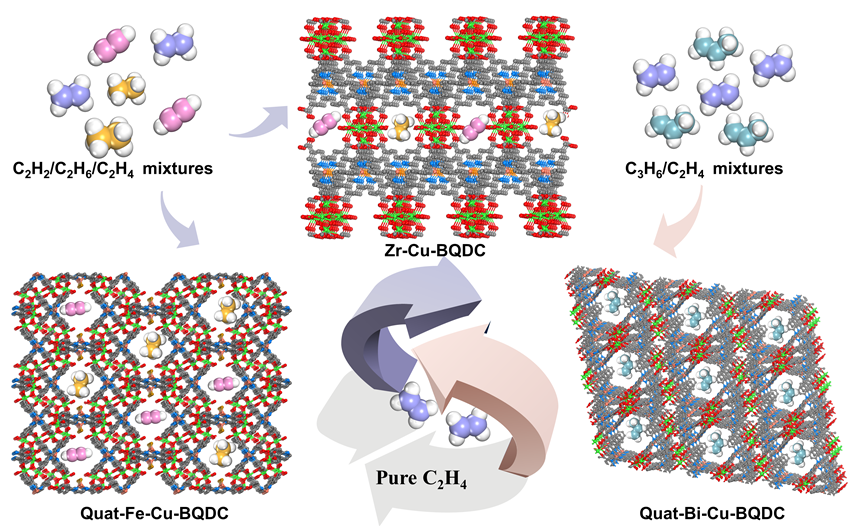
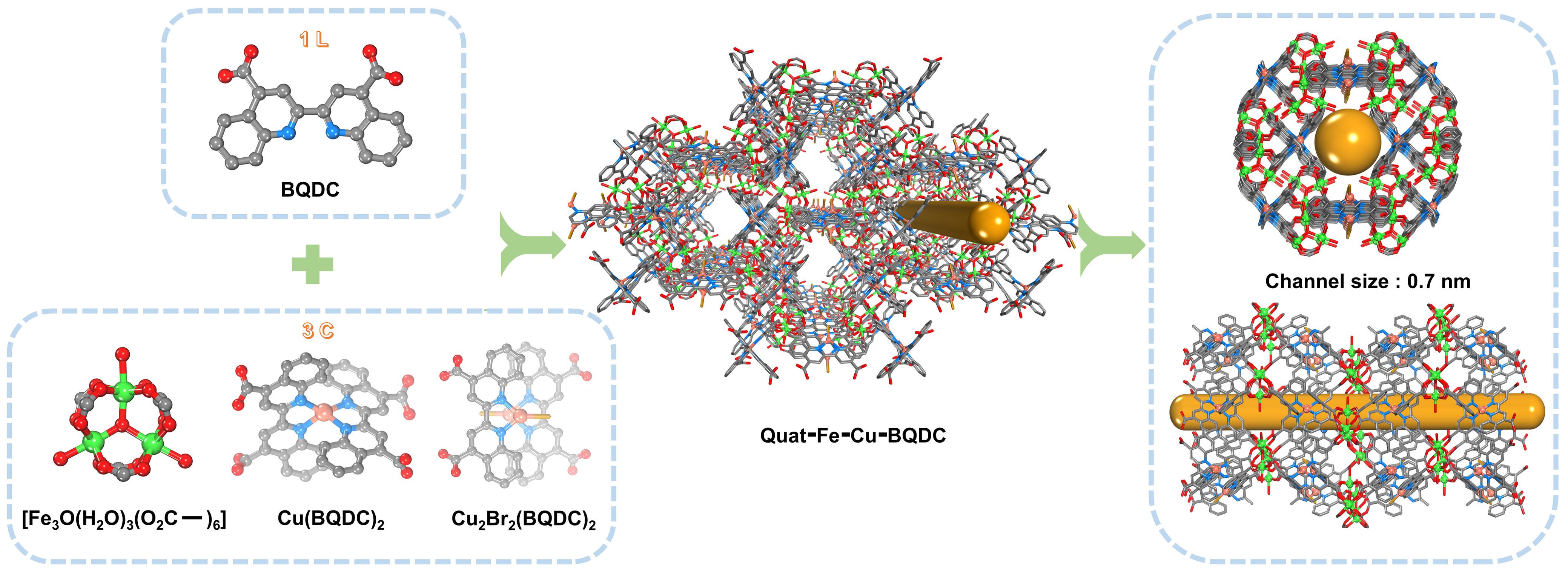
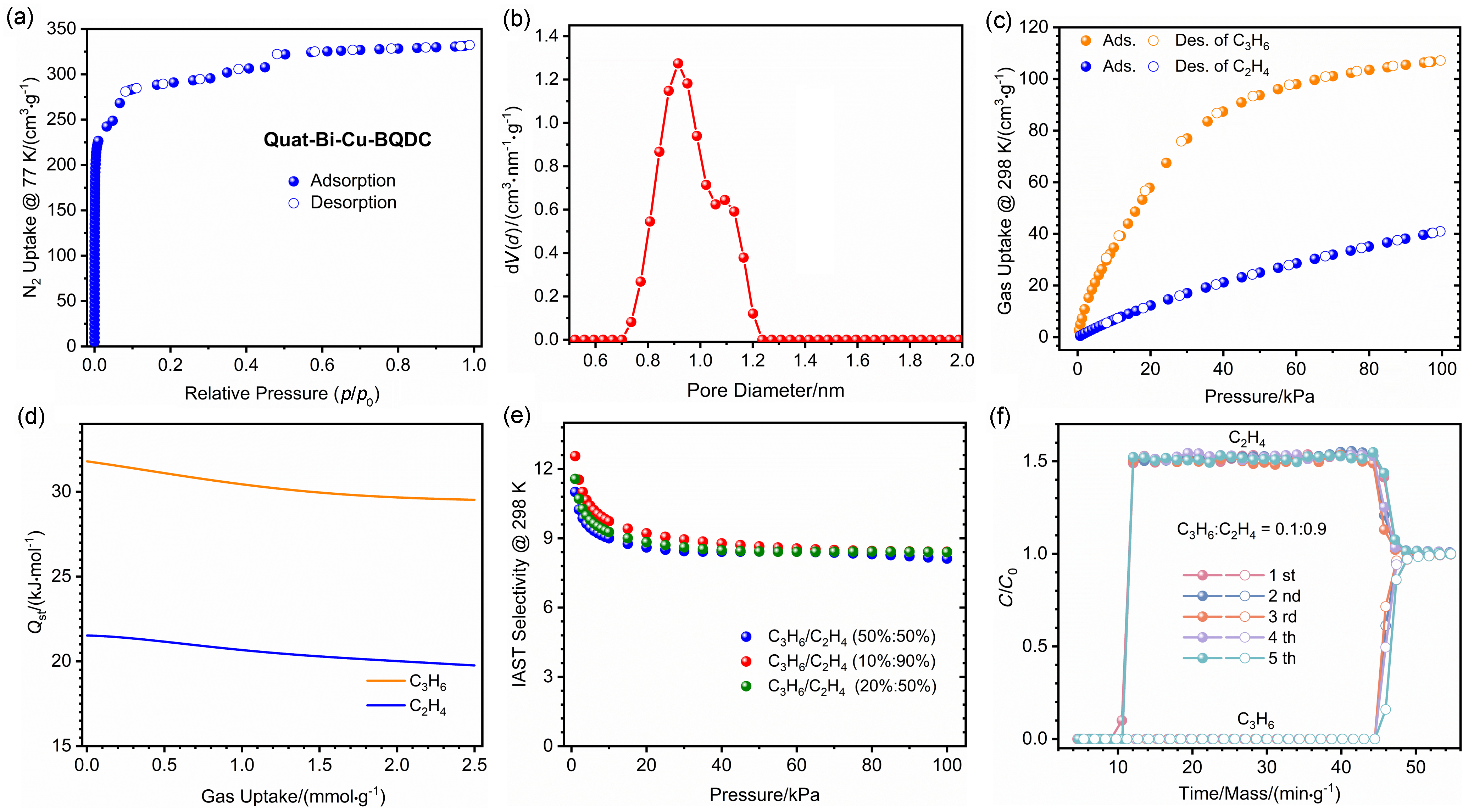
一步法纯化乙烯在工业生产中具有重要意义, 而多组分金属有机框架的可控构筑为C2烃类气体分离及甲醇制烯烃(MTO)产物提纯提供了富有前景的解决方案. 本工作采用2,2'-联喹啉-4,4'-二甲酸(H2BQDC)与CuBr原位配位形成金属配体单元Cu(BQDC)2, 进而将其分别与ZrOCl2、Fe3O(OAc)6(H2O)3及Bi(NO3)3•9H2O通过溶剂热反应组装, 成功制备了三例结构明确的多组分金属有机框架材料: Zr-Cu-BQDC、Quat-Fe-Cu-BQDC和Quat-Bi-Cu-BQDC. 系统研究表明, 三种材料因其组成与孔道化学环境的差异, 分别对C2H2/C2H6/C2H4三元混合物和MTO典型组分C3H6/C2H4展现出优异的吸附选择性. 单组分气体吸附、理想吸附溶液理论(IAST)预测以及动态柱穿透实验共同验证了这些材料在常温常压下实现乙烯一步高效纯化的可行性. 本工作不仅发展了基于金属配体策略的多组分金属有机框架合成方法, 也为面向工业需求的烯烃分离材料设计提供了新思路.
张伟宏, 马亚男, 方翰, 薛东旭. 面向乙烯一步纯化的多组分金属有机框架: 金属配体导向合成与C2混合气高效分离★[J]. 化学学报, 2026, 84(5): 659-666.
Weihong Zhang, Yanan Ma, Han Fang, Dongxu Xue. Multi-Component Metal-Organic Frameworks for One-Step Ethylene Purification: Metalloligand-Directed Synthesis and High-Efficiency Separation of C2 Mixed Gas★[J]. Acta Chimica Sinica, 2026, 84(5): 659-666.



| [1] |
doi: 10.1021/ie401157c |
| [2] |
doi: 10.1039/D3GC03858K |
| [3] |
|
| [4] |
doi: 10.1016/j.isci.2023.107701 |
| [5] |
doi: 10.1021/cbe.4c00102 |
| [6] |
doi: 10.1038/532435a |
| [7] |
doi: 10.1039/D1CS01036K |
| [8] |
doi: 10.1016/j.trechm.2019.02.012 |
| [9] |
doi: 10.1016/j.ces.2023.118449 |
| [10] |
|
| [11] |
|
| [12] |
doi: 10.1021/cr200190s |
| [13] |
doi: 10.1016/j.chempr.2019.10.012 |
| [14] |
doi: 10.1002/cjoc.v43.8 |
| [15] |
doi: 10.1021/cr300014x |
| [16] |
doi: 10.1039/C4CS90059F |
| [17] |
doi: 10.1039/C9CS00250B |
| [18] |
doi: 10.1126/science.ads7866 pmid: 39509491 |
| [19] |
doi: 10.1002/anie.v62.44 |
| [20] |
doi: 10.1038/s41578-020-0225-x |
| [21] |
doi: 10.6023/A25040117 |
|
(高春, 张松涛, 庞欢, 化学学报, 2025, 83, 962.)
doi: 10.6023/A25040117 |
|
| [22] |
doi: 10.6023/A24110333 |
|
(王跃, 邹莹, 张元, 郑舒婕, 王恒宇, 刘天赋, 李仁富, 化学学报, 2025, 83, 45.)
doi: 10.6023/A24110333 |
|
| [23] |
doi: 10.6023/A25040140 |
|
(吴子林, 张璐, 陈杨, 李晋平, 李立博, 化学学报, 2025, 83, 917.)
doi: 10.6023/A25040140 |
|
| [24] |
doi: 10.1126/science.1181761 |
| [25] |
doi: 10.1021/ic500434a |
| [26] |
doi: 10.1021/acs.inorgchem.4c01812 |
| [27] |
doi: 10.1039/D3QI00103B |
| [28] |
doi: 10.1002/cjoc.v43.6 |
| [29] |
doi: 10.1002/chem.v11:12 |
| [30] |
doi: 10.1038/s41578-021-00287-y |
| [31] |
doi: 10.1016/j.ccr.2019.02.022 |
| [32] |
doi: 10.1039/D3DT01668D |
| [33] |
doi: 10.1021/jacs.7b01320 |
| [34] |
doi: 10.1002/anie.v57.49 |
| [35] |
doi: 10.1002/anie.v60.20 |
| [36] |
doi: 10.1021/jacs.0c11247 |
| [37] |
doi: 10.1039/D5SC06836C |
| [38] |
doi: 10.1002/anie.v64.38 |
| [39] |
doi: 10.1002/anie.v62.51 |
| [40] |
doi: 10.1039/D3TA01598J |
| [41] |
doi: 10.1002/chem.v24.9 |
| [42] |
doi: 10.1021/acs.cgd.7b00086 |
| [43] |
doi: 10.1002/anie.v60.30 |
| [44] |
doi: 10.1039/D2TA08977G |
| [45] |
doi: 10.1021/acs.chemmater.6b00443 |
| [46] |
doi: 10.1002/anie.v63.15 |
| [47] |
doi: 10.1039/d5dt00971e pmid: 40492921 |
| [48] |
doi: 10.1021/acs.cgd.4c00282 |
| [49] |
|
| [50] |
doi: 10.1016/j.cej.2023.143056 |
| [51] |
doi: 10.1016/j.cej.2024.152442 |
| [1] | 吴子林, 张璐, 陈杨, 李晋平, 李立博. 乙烷选择性金属有机框架材料的结构设计与分离应用★[J]. 化学学报, 2025, 83(8): 917-936. |
| [2] | 杨磊, 吴宇静, 吴选军, 蔡卫权. 面向C4烯烃混合物吸附分离的真实金属-有机骨架材料高通量筛选[J]. 化学学报, 2021, 79(4): 520-529. |
| [3] | 刘治鲁, 李炜, 刘昊, 庄旭东, 李松. 金属有机骨架的高通量计算筛选研究进展[J]. 化学学报, 2019, 77(4): 323-339. |
| [4] | 张贺, 李国良, 张可刚, 廖春阳. 金属有机骨架材料在吸附分离研究中的应用进展[J]. 化学学报, 2017, 75(9): 841-859. |
| [5] | 刘蓓, 唐李兴, 廉源会, 李智, 孙长宇, 陈光进. 互穿结构及混合配体对金属-有机骨架材料分离性能的影响[J]. 化学学报, 2013, 71(06): 920-928. |
| [6] | 乐英红,唐颐,高滋. HZSM-5沸石孔口改性及其择形分离性能[J]. 化学学报, 1996, 54(3): 248-252. |
| 阅读次数 | ||||||
|
全文 |
|
|||||
|
摘要 |
|
|||||
