

化学学报 ›› 2026, Vol. 84 ›› Issue (7): 1025-1032.DOI: 10.6023/A26040098 上一篇 下一篇
研究通讯
刘腾a,*( ), 郭易江a, 田冰倩a, 吴建萍a, 何江波b,*()
投稿日期:2026-04-02
发布日期:2026-06-09
基金资助:
Teng Liua,*(), Yijiang Guoa, Bingqian Tiana, Jianping Wua, Jiangbo Heb,*()
Received:2026-04-02
Published:2026-06-09
Contact:
* E-mail: 15288404381@163.com;
hejiangbo@kmu.edu.cn
Supported by:文章分享
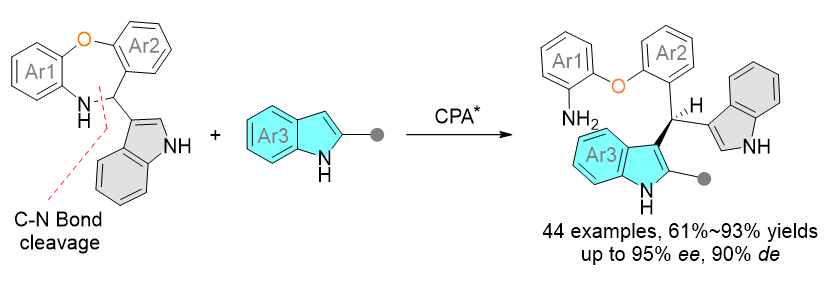
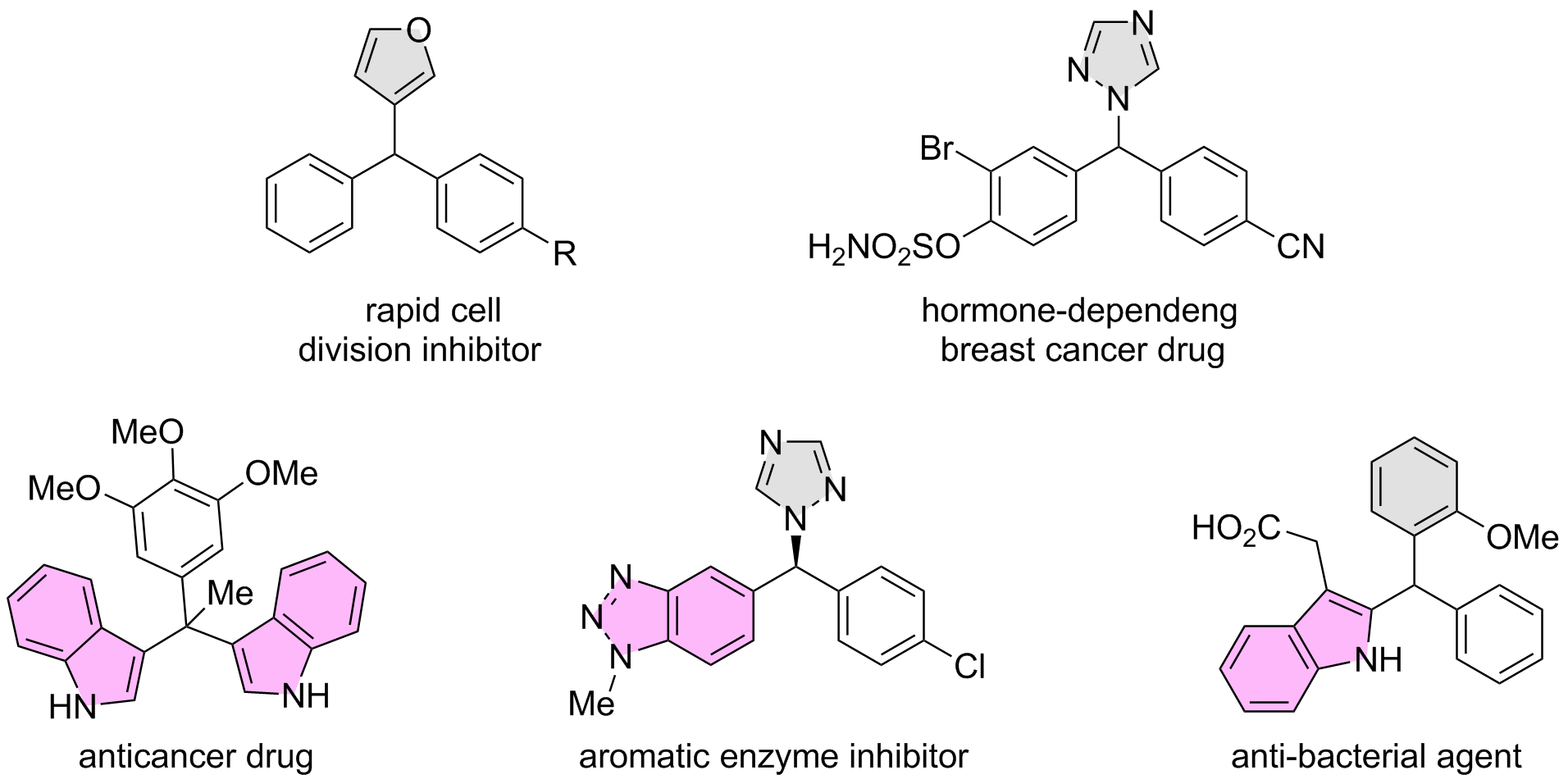
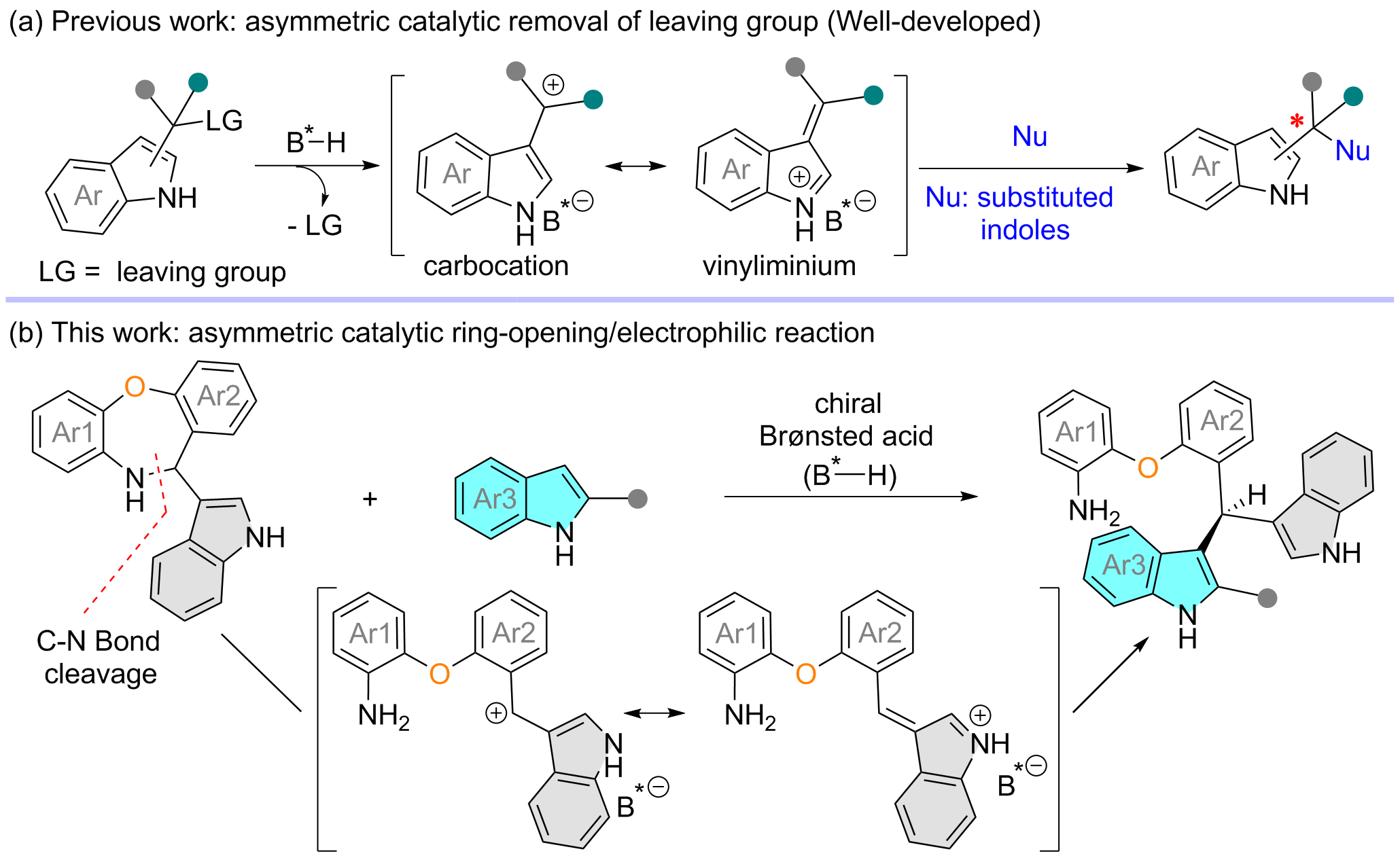
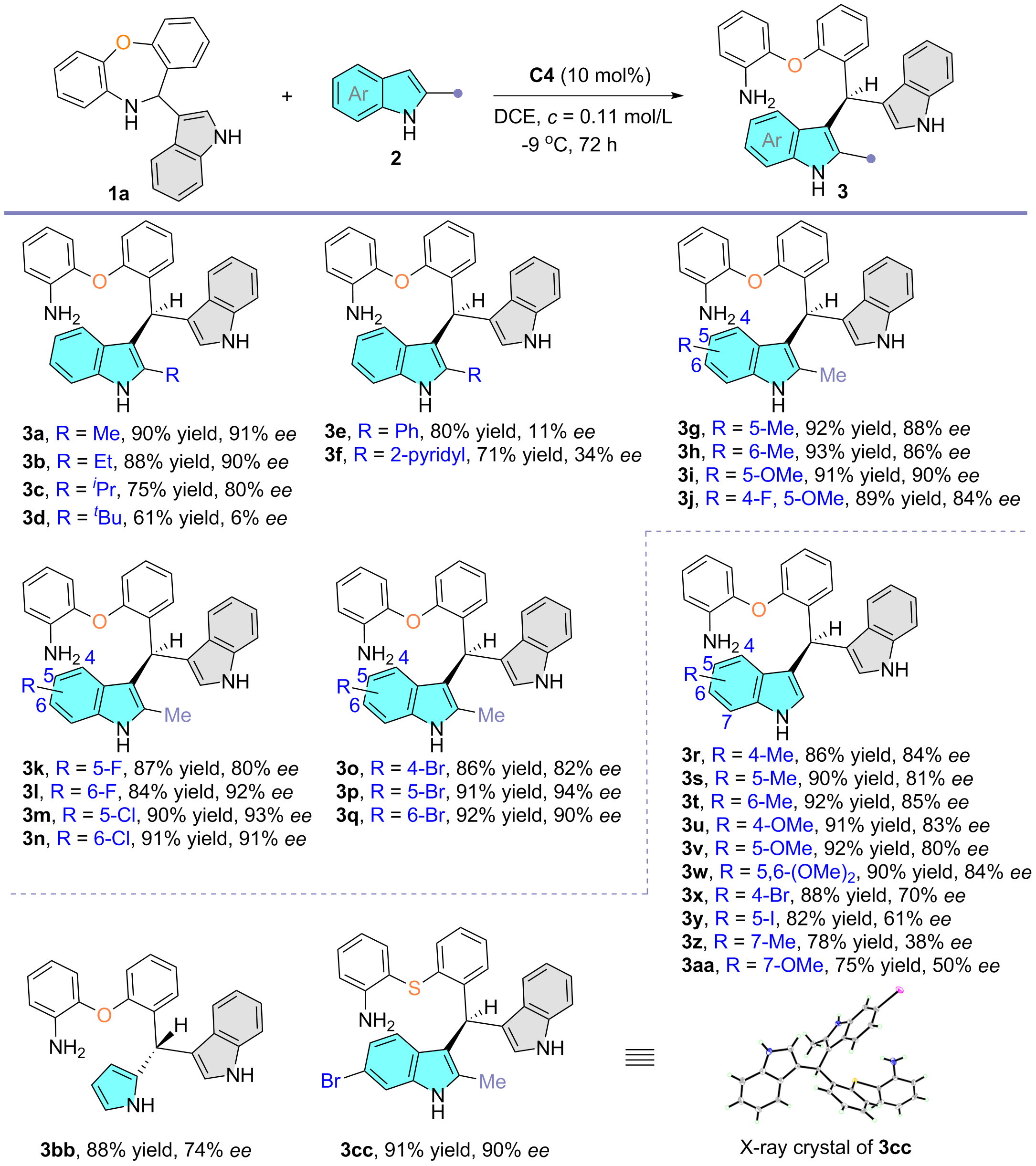
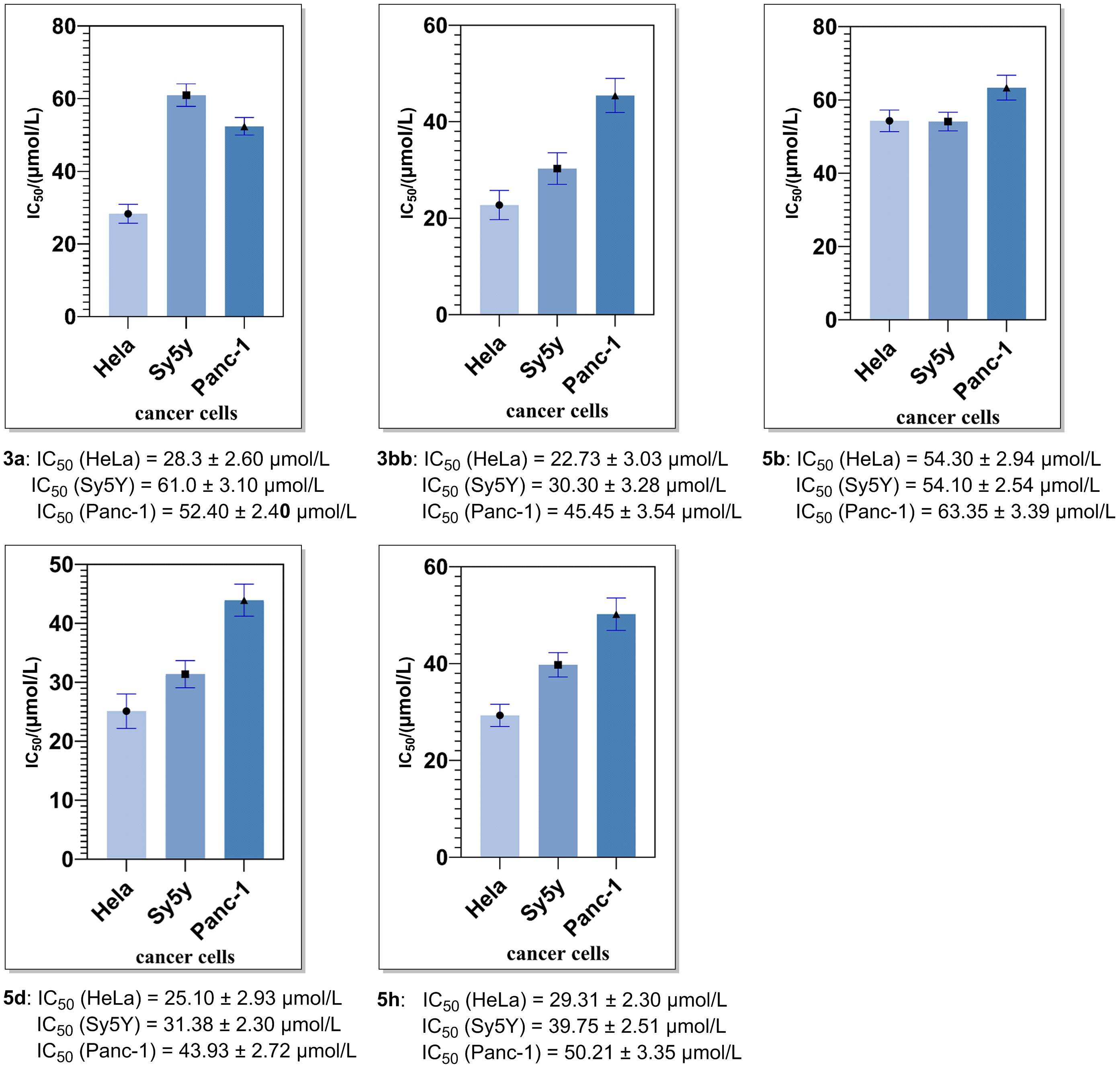
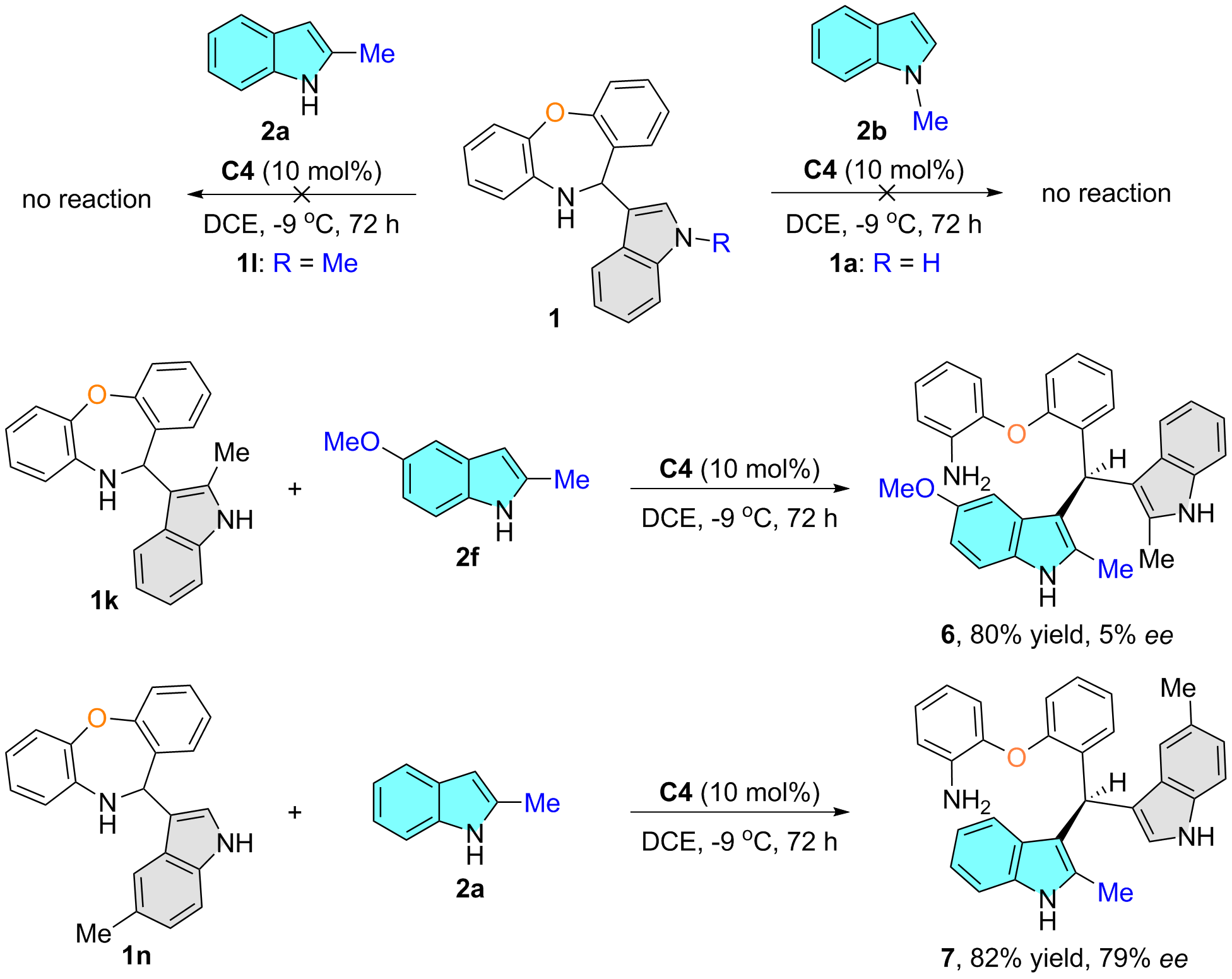
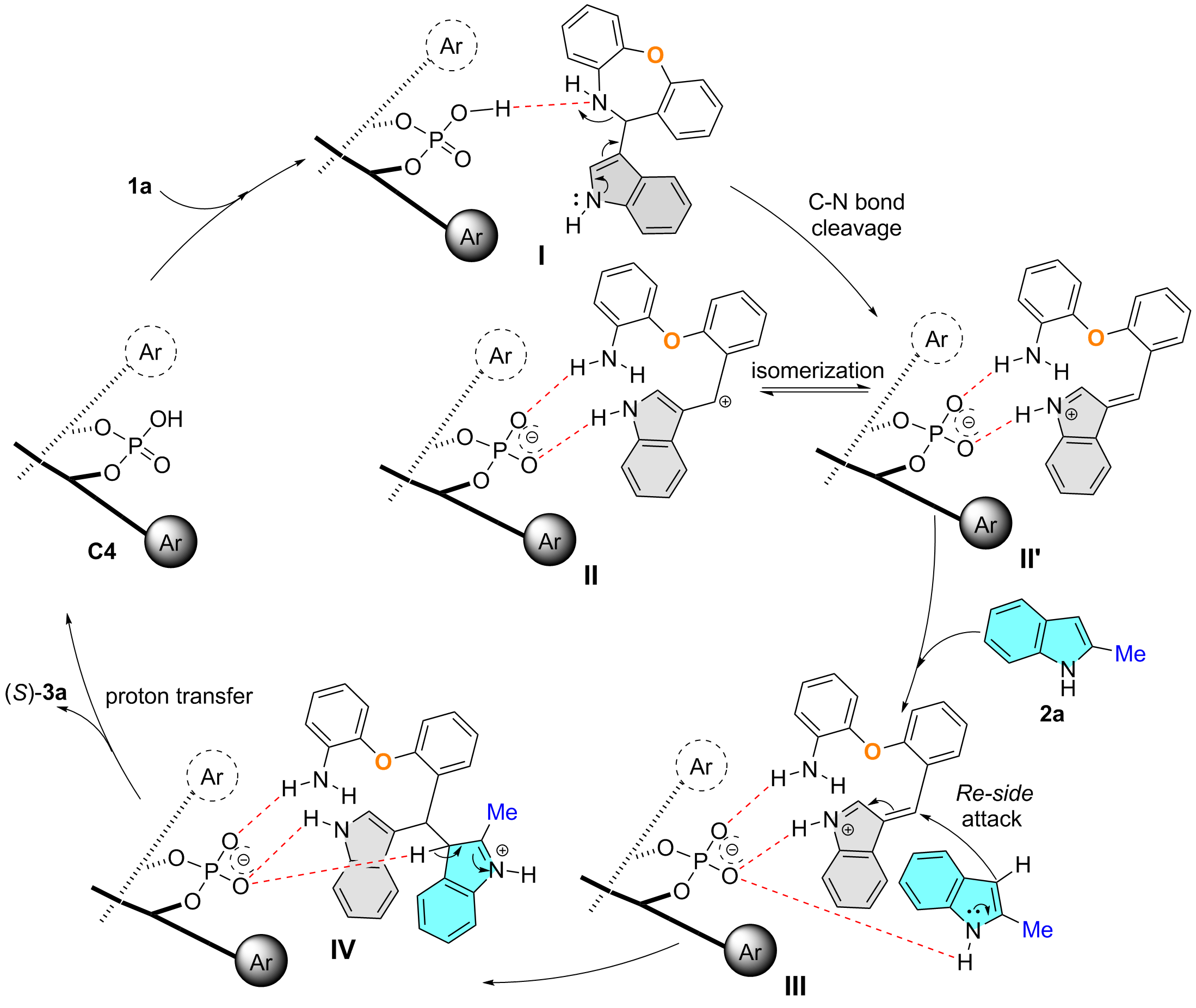
手性三芳基甲烷在医药和材料科学领域有着重要应用. 目前, 手性α,α-双吲哚三芳基甲烷分子的构建主要依赖于反应物中的离去基团, 其不对称合成和反应原子经济性仍存在一定限制. 本工作利用易得且具有合成应用潜力七元环氧氮杂䓬作为前体化合物, 在手性膦酸催化下实现C—N键断键开环后与亲核吲哚发生不对称亲电反应, 以优秀的立体选择性、产率(高达95% ee, 90% de, 61%~93%产率)和100%原子经济性合成一系列结构多样化的α,α-双吲哚三芳基甲烷. 生物活性测试表明, 产物对人类宫颈癌细胞(HeLa)、人骨髓神经母细胞瘤细胞(Sy5Y)及胰腺癌细胞(Panc-1)生长均表现出明显抑制效果, 展现出良好的抗癌活性.
刘腾, 郭易江, 田冰倩, 吴建萍, 何江波. 手性膦酸对映选择性催化开环/亲电反应合成α,α-双吲哚三芳基甲烷[J]. 化学学报, 2026, 84(7): 1025-1032.
Teng Liu, Yijiang Guo, Bingqian Tian, Jianping Wu, Jiangbo He. Chiral Phosphonic Acid-Catalyzed Enantioselective Ring-Opening/ Electrophilic Reaction to Access α,α-Bisindole Triarylmethanes[J]. Acta Chimica Sinica, 2026, 84(7): 1025-1032.
| Entry | Solvent (mL) | Additive | X (mol%) | Yieldb/% | eec/% |
|---|---|---|---|---|---|
| 1 | DCE (0.1) | — | 10 | 85 | 87 |
| 2 | DCE (0.2) | — | 10 | 88 | 88 |
| 3 | DCE (0.3) | — | 10 | 90 | 91 |
| 4 | DCE (0.4) | — | 10 | 90 | 88 |
| 5 | DCE (0.5) | — | 10 | 88 | 89 |
| 6 | DCE (0.8) | — | 10 | 86 | 84 |
| 7d | DCE (0.3) | 3 Å MS | 10 | 83 | 62 |
| 8d | DCE (0.3) | 4 Å MS | 10 | 84 | 65 |
| 9d | DCE (0.3) | 5 Å MS | 10 | 84 | 60 |
| 10d | DCE (0.3) | Na2SO4 | 10 | 85 | 88 |
| 11d | DCE (0.3) | MgSO4 | 10 | 85 | 87 |
| 12 | DCE (0.3) | — | 5 | 80 | 89 |
| 13 | DCE (0.3) | — | 15 | 90 | 90 |
| 14 | DCE (0.3) | — | 20 | 90 | 90 |
| Entry | Solvent (mL) | Additive | X (mol%) | Yieldb/% | eec/% |
|---|---|---|---|---|---|
| 1 | DCE (0.1) | — | 10 | 85 | 87 |
| 2 | DCE (0.2) | — | 10 | 88 | 88 |
| 3 | DCE (0.3) | — | 10 | 90 | 91 |
| 4 | DCE (0.4) | — | 10 | 90 | 88 |
| 5 | DCE (0.5) | — | 10 | 88 | 89 |
| 6 | DCE (0.8) | — | 10 | 86 | 84 |
| 7d | DCE (0.3) | 3 Å MS | 10 | 83 | 62 |
| 8d | DCE (0.3) | 4 Å MS | 10 | 84 | 65 |
| 9d | DCE (0.3) | 5 Å MS | 10 | 84 | 60 |
| 10d | DCE (0.3) | Na2SO4 | 10 | 85 | 88 |
| 11d | DCE (0.3) | MgSO4 | 10 | 85 | 87 |
| 12 | DCE (0.3) | — | 5 | 80 | 89 |
| 13 | DCE (0.3) | — | 15 | 90 | 90 |
| 14 | DCE (0.3) | — | 20 | 90 | 90 |
| [1] |
(a)
doi: 10.1021/cr200201z |
|
(b)
doi: 10.1021/cr078234p |
|
|
(c)
|
|
|
(刘绍璞, 刘忠芳, 李明, 化学学报, 1995, 53, 1185.)
|
|
|
(d)
doi: 10.6023/cjoc202109026 |
|
|
(刘冬兰, 许海燕, 杭懿, 陆鸿飞, 有机化学, 2022, 42, 796.) .
doi: 10.6023/cjoc202109026 |
|
|
(e)
|
|
|
(李中贤, 王俊伟, 赵俊宏, 赵灿方, 刘小培, 余学军, 有机化学, 2014, 34, 485.)
doi: 10.6023/cjoc201310035 |
|
|
(f)
doi: 10.6023/cjoc202000084 |
|
|
(林进, 孙伟, 有机化学, 2020, 40, 4367.)
doi: 10.6023/cjoc202000084 |
|
| [2] |
(a)
|
|
(b)
doi: 10.1016/j.tet.2006.04.081 |
|
|
(c)
doi: 10.1016/j.bmcl.2007.10.083 |
|
|
(d)
doi: 10.1039/C4RA01341G |
|
| [3] |
doi: 10.1021/jm00258a014 pmid: 4214926 |
| [4] |
doi: 10.1016/j.bmc.2004.07.058 |
| [5] |
Selected recent examples: (a)
doi: 10.1021/jacs.5c14810 |
|
(b)
doi: 10.1021/jacs.4c16811 |
|
|
(c)
doi: 10.1021/acs.orglett.5c01823 |
|
|
(d)
doi: 10.1021/acscatal.5c03050 |
|
|
(e)
doi: 10.1039/D5OB01738F |
|
|
(f)
doi: 10.1039/D5OB00532A |
|
| [6] |
(a)
doi: 10.1002/anie.v62.37 |
|
(b)
doi: 10.1021/acs.orglett.3c02476 |
|
|
(c)
doi: 10.1039/D1SC05174A |
|
|
(d)
doi: 10.1039/C4CC03605K |
|
|
(e)
doi: 10.1021/acs.orglett.2c04109 |
|
|
(f)
doi: 10.6023/cjoc201711045 |
|
|
(伍平, 吴迦勒, 王静怡, 梅光建, 有机化学, 2018, 38, 1251.)
doi: 10.6023/cjoc201711045 |
|
| [7] |
doi: 10.1021/ol403680c |
| [8] |
doi: 10.1002/ejoc.v2010:1 |
| [9] |
(a)
doi: 10.1021/acs.orglett.5c00192 |
|
(b)
doi: 10.1002/ejoc.v28.8 |
|
|
(c)
doi: 10.1039/C9GC00989B |
|
|
(d)
doi: 10.1002/ajoc.v14.11 |
|
| [10] |
CCDC 2441272 of compound 3cc contains the supplementary crystallographic data for this paper.
|
| [11] | |
| [12] |
(a)
doi: 10.1002/adsc.v358.12 |
|
(b)
|
|
|
(c)
doi: 10.1002/adsc.v368.6 |
| [1] | 覃其品, 李秋明, 张菊梅, 谭明雄, 梁宏. 8-羟基喹啉修饰的铂(II)多吡啶配合物的合成及体内外抗癌活性评价[J]. 化学学报, 2026, 84(1): 109-118. |
| [2] | 赵添堃, 王鹏, 姬明宇, 李善家, 杨明俊, 蒲秀瑛. Salan钛双齿配合物的Sonogashira合成后修饰反应研究[J]. 化学学报, 2021, 79(11): 1385-1393. |
| [3] | 陈凑喜, 李学强, 李天才, 周学章. 新型18β-甘草次酸氨基二硫代甲酸酯衍生物的合成及抗癌活性研究[J]. 化学学报, 2012, 70(07): 852-858 . |
| [4] | 史艳萍, 陈宝泉, 麻静, 刘玉明, 李彩文. 2-(2-取代-1,3,4-噻二唑-5-基)-苯并异硒唑-3(2H)-酮衍生物的合成及体外抗癌活性[J]. 化学学报, 2011, 69(21): 2561-2566. |
| [5] | 孟晨鹏, 王舜, 张克军, 金辉乐, 陈锡安, 胡茂林, 熊静. 2-(5-氟尿嘧啶-1-乙酰基)氨基-1,5-戊二酸二甲酯手性异构体与双链/G-四链体DNA相互作用的电化学研究[J]. 化学学报, 2011, 69(10): 1173-1178. |
| [6] | 李美容, 蔡晓庆, 朱易峰, 刘宽冠, 胡茂林. 5-氟尿嘧啶光敏性偶联衍生物的合成、表征及抗癌活性研究[J]. 化学学报, 2011, 69(04): 425-430. |
| [7] | 覃江克, 韩留玉, 兰文丽, 唐煌, 苏桂发, 戴支凯, 徐庆. 呋喃并呫吨酮衍生物的合成与生物活性研究[J]. 化学学报, 2009, 67(22): 2597-2606. |
| [8] | 任云峰, 成康民, 刘贵锋, 孙艳红, 沈玉梅. β-榄香烯三羰基铼配合物的合成、放射化学合成及抗癌活性研究[J]. 化学学报, 2008, 66(4): 459-464. |
| [9] | 尹 萍 胡茂林 严小威 王 舜 缪 谦 常雪琴 赵克俭. 四种5-氟尿嘧啶二肽衍生物的合成、晶体结构和抗癌活性[J]. 化学学报, 2008, 66(14): 1693-1699. |
| [10] | 宋宝安,陈才俊,杨松,金林红,薛伟, 张素梅,邹志辉,胡德禹,刘刚. 2-取代硫醚-5-(3,4,5-三甲氧基苯基)-1,3,4-噻二唑类化合物的合成、结构与体外抗癌活性[J]. 化学学报, 2005, 63(18): 1720-1726. |
| [11] | 卢文贯, 陶家洵, 王大奇. 二正丁基锡(Ⅳ)双(二茂铁硫代甲酸酯)配合物的合成、结构表征及其体外抗癌活性研究[J]. 化学学报, 2004, 62(2): 160-164. |
| [12] | 吴谊群,陈耐生,黄金陵. 八烷氧基萘酞菁锌的激发三重态性质及光动力抗癌活性[J]. 化学学报, 2001, 59(4): 619-622. |
| [13] | 杨华,王春明,贾忠建,师彦平. 千里光中四个新倍半萜的结构[J]. 化学学报, 2001, 59(10): 1686-1690. |
| [14] | 宋相志,刘广,杨屹,沈丽春,章士伟. 分化诱导剂的合成及晶体结构[J]. 化学学报, 2001, 59(10): 1633-1638. |
| [15] | 张静,孙润广,齐浩,王永昌. 脂肪酸甲胺铂配合物的结构表征及磁场对其抗癌活 性的影响[J]. 化学学报, 2000, 58(6): 704-712. |
| 阅读次数 | ||||||
|
全文 |
|
|||||
|
摘要 |
|
|||||
