

化学学报 ›› 2026, Vol. 84 ›› Issue (9): 1428-1434.DOI: 10.6023/A26040116 上一篇 下一篇
研究论文
徐乔良, 安光辉*( ), 李光明*()
投稿日期:2026-04-09
发布日期:2026-05-15
通讯作者:
安光辉, 李光明
基金资助:
Qiaoliang Xu, Guanghui An*(), Guangming Li*()
Received:2026-04-09
Published:2026-05-15
Contact:
Guanghui An, Guangming Li
Supported by:文章分享
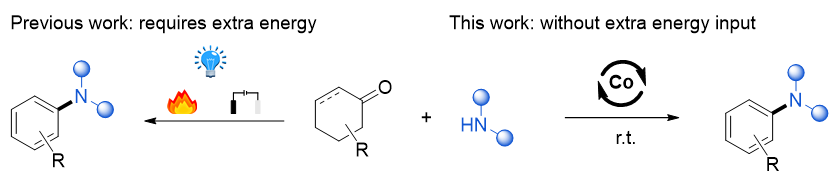
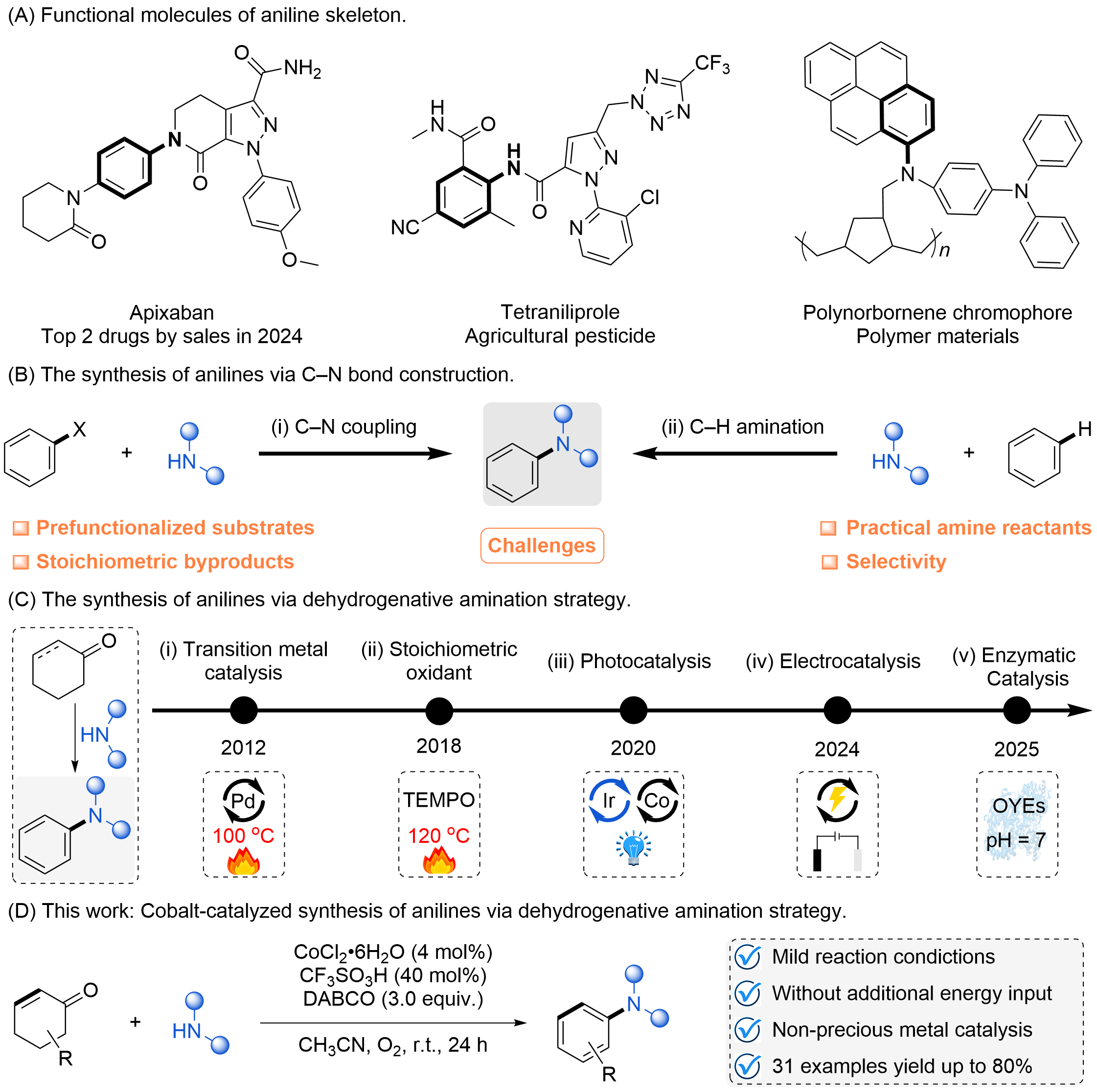
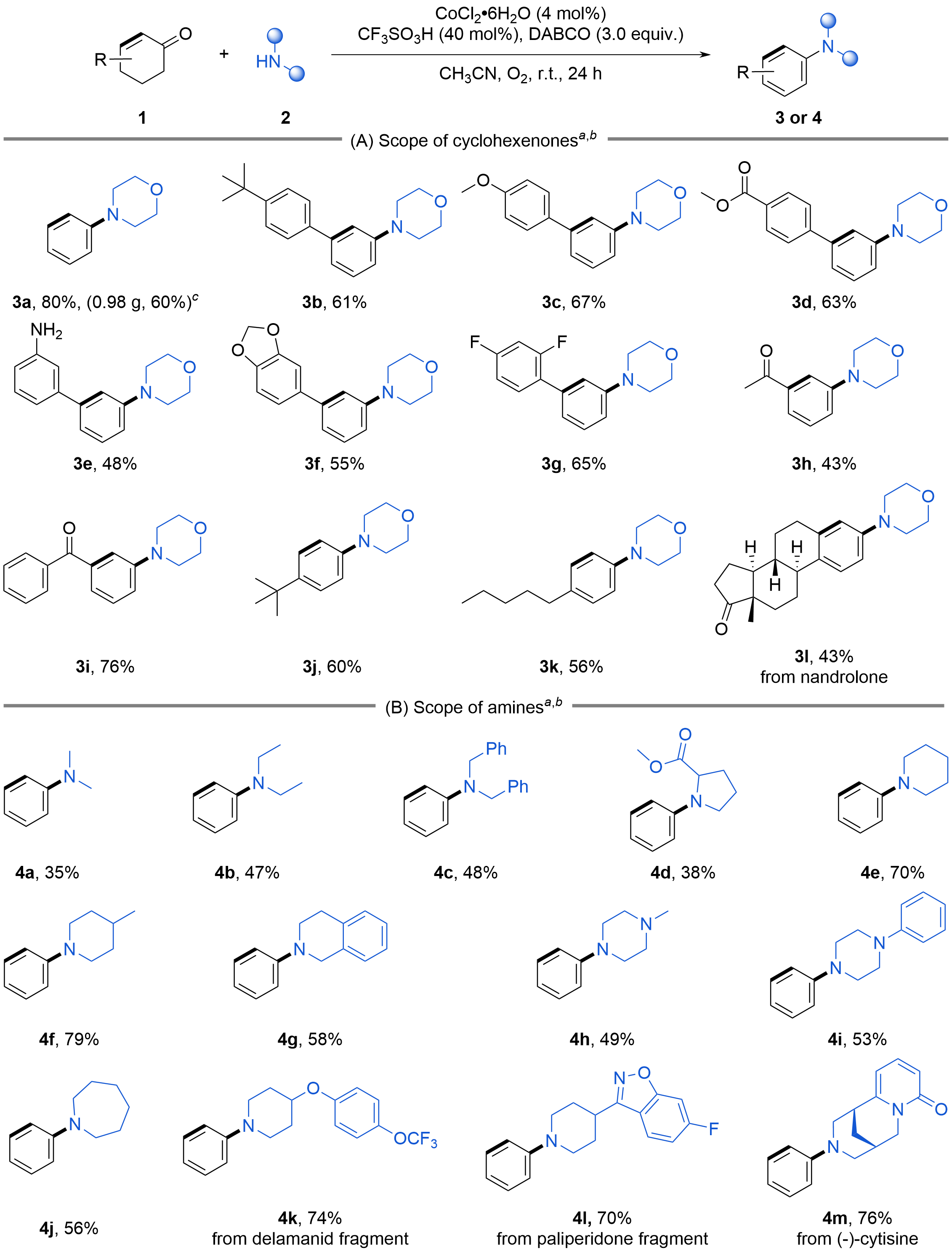
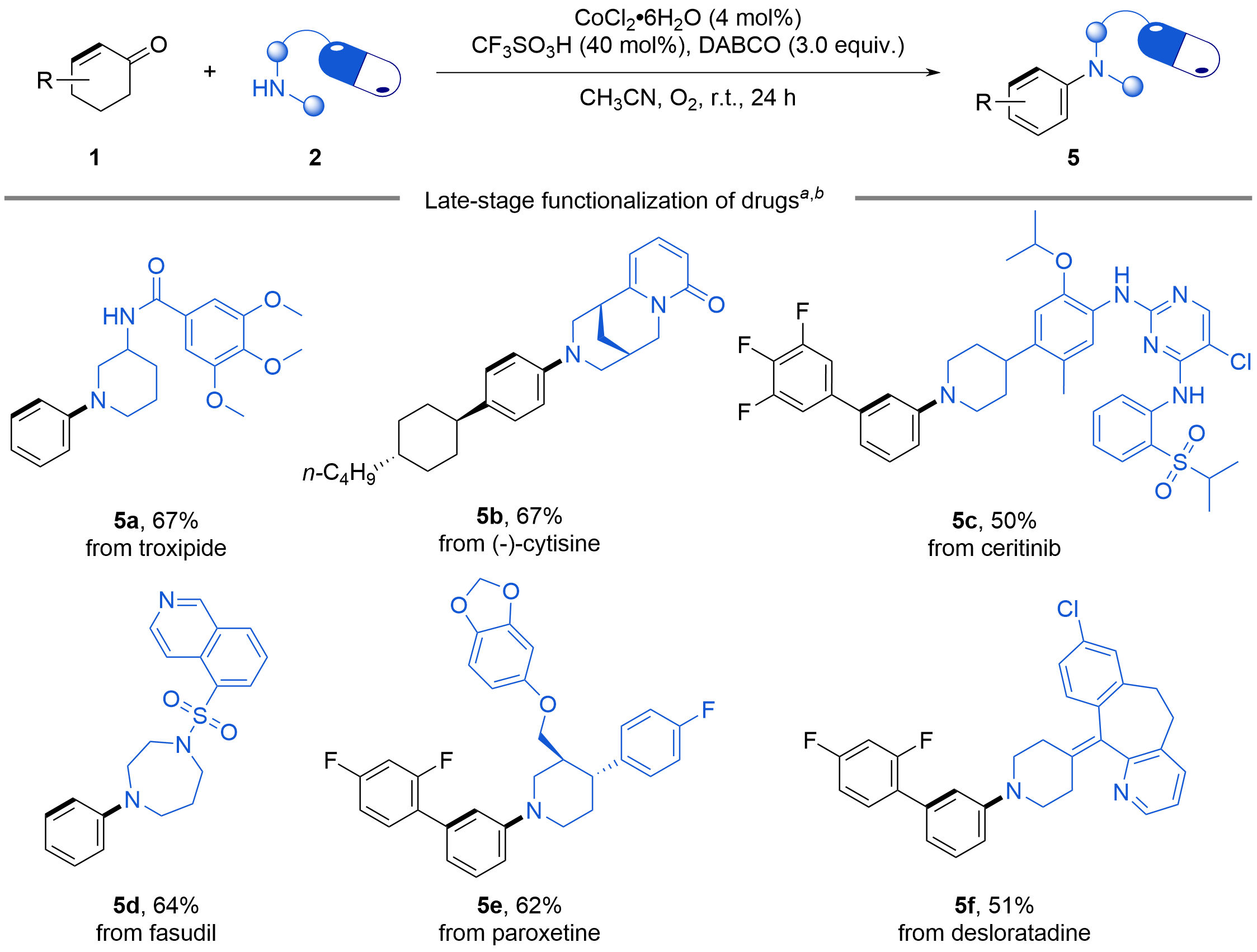
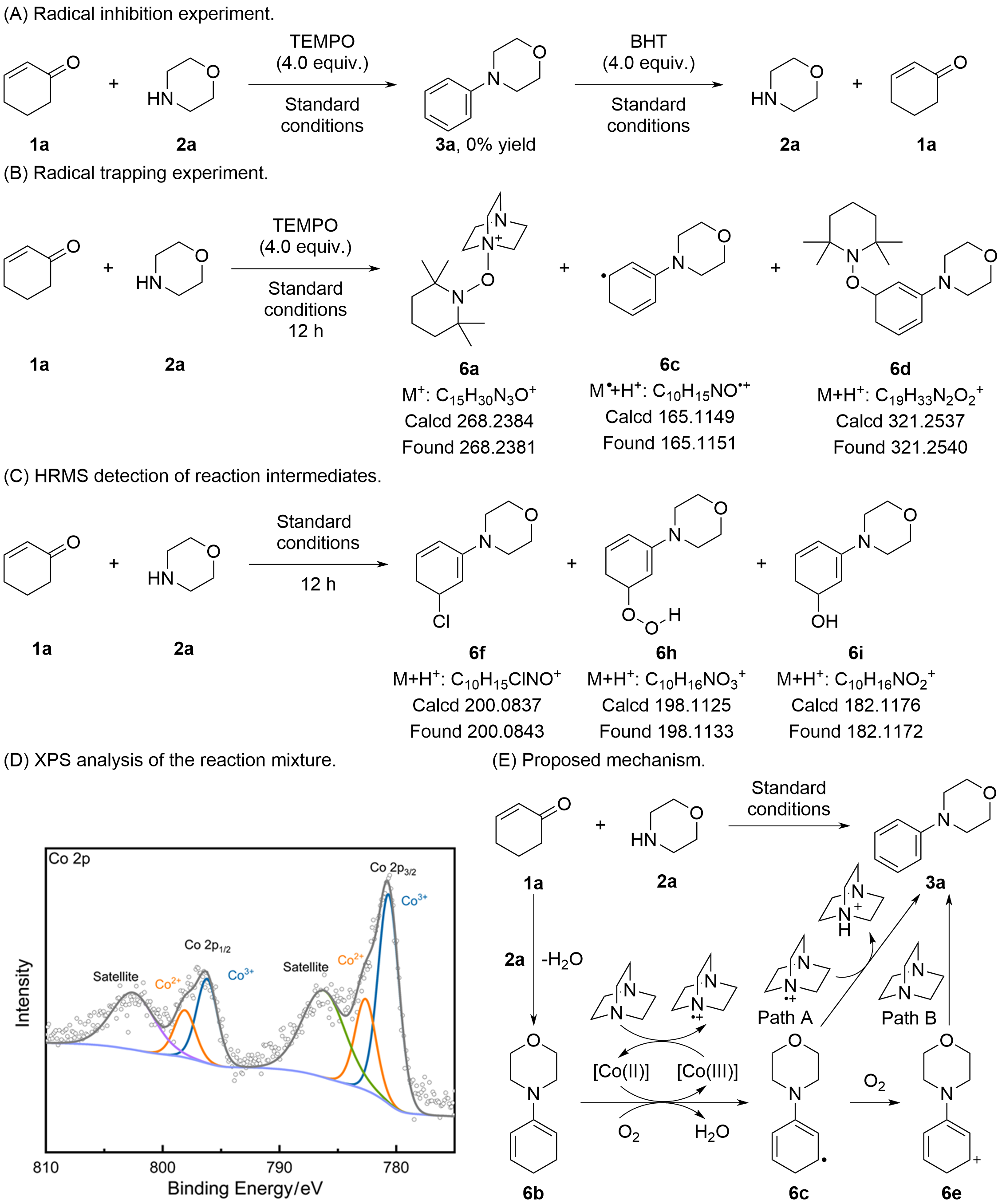
苯胺及其衍生物在药物化学、生命科学和先进材料的发展中发挥着重要作用. 除传统硝化/还原、C—N交叉偶联以及芳烃C—H胺化等苯胺合成方法外, 脱氢胺化同样是构建苯胺类化合物的高效策略. 但脱氢胺化合成苯胺不可避免地需要高温、贵金属催化剂、化学计量的氧化剂或额外能量输入. 本研究使用绿色可持续的O2作为氧化剂, 廉价的CoCl2•6H2O为催化剂, 在室温条件下实现环己烯酮脱氢胺化合成苯胺. 该方法无需贵金属催化剂、反应条件温和、操作简单、绿色环保、具有良好的底物普适性. 此外, 通过X射线光电子能谱(XPS)与高分辨质谱(HRMS)分析, 阐明了该脱氢胺化反应的可能机理路径. 后续还通过药物分子后期官能化, 进一步验证了该方法的实际应用潜力.
徐乔良, 安光辉, 李光明. 钴催化环己烯酮脱氢胺化策略合成苯胺[J]. 化学学报, 2026, 84(9): 1428-1434.
Qiaoliang Xu, Guanghui An, Guangming Li. Cobalt-Catalyzed Synthesis of Anilines from Cyclohexenones via Dehydrogenative Amination Strategy[J]. Acta Chimica Sinica, 2026, 84(9): 1428-1434.
| Entry | Deviation from standard conditions | Yieldb/% |
|---|---|---|
| 1 | None | 80 |
| 2 | Without CoCl2•6H2O | n.d. |
| 3 | Without DABCO | n.d. |
| 4 | Under Ar atmosphere | n.d. |
| 5 | Under Air atmosphere | 60 |
| 6 | Co(OAc)2 instead of CoCl2•6H2O | 78 |
| 7 | CoBr2 instead of CoCl2•6H2O | 65 |
| 8 | Co(dmgH)2(DMAP)Cl instead of CoCl2•6H2O | 39 |
| 9 | Pd(OAc)2 instead of CoCl2•6H2O | n.d. |
| 10 | Quinuclidine instead of DABCO | 55 |
| 11 | Et3N instead of DABCO | 20 |
| 12 | Cs2CO3 instead of DABCO | n.d. |
| 13 | p-TsOH•H2O instead of CF3SO3H | 65 |
| 14 | TFA instead of CF3SO3H | 63 |
| 15 | HOAc instead of CF3SO3H | 61 |
| 16 | Without CF3SO3H | 58 |
| Entry | Deviation from standard conditions | Yieldb/% |
|---|---|---|
| 1 | None | 80 |
| 2 | Without CoCl2•6H2O | n.d. |
| 3 | Without DABCO | n.d. |
| 4 | Under Ar atmosphere | n.d. |
| 5 | Under Air atmosphere | 60 |
| 6 | Co(OAc)2 instead of CoCl2•6H2O | 78 |
| 7 | CoBr2 instead of CoCl2•6H2O | 65 |
| 8 | Co(dmgH)2(DMAP)Cl instead of CoCl2•6H2O | 39 |
| 9 | Pd(OAc)2 instead of CoCl2•6H2O | n.d. |
| 10 | Quinuclidine instead of DABCO | 55 |
| 11 | Et3N instead of DABCO | 20 |
| 12 | Cs2CO3 instead of DABCO | n.d. |
| 13 | p-TsOH•H2O instead of CF3SO3H | 65 |
| 14 | TFA instead of CF3SO3H | 63 |
| 15 | HOAc instead of CF3SO3H | 61 |
| 16 | Without CF3SO3H | 58 |
| [1] |
(a)
doi: 10.1021/acs.jmedchem.9b00803 |
|
(b)
doi: 10.1016/j.cej.2024.152530 |
|
|
(c)
doi: 10.1021/jf403739e |
|
|
(d)
doi: 10.1038/s41557-018-0021-z |
|
|
(e)
doi: 10.1039/C6CS00555A |
|
|
(f)
doi: 10.6023/A24020062 |
|
|
(彭红超, 陈胜, 阎斌, 化学学报, 2024, 82, 797.)
doi: 10.6023/A24020062 |
|
|
(g)
doi: 10.6023/A20050191 |
|
|
(罗潇, 焦宁, 化学学报, 2020, 78, 758.)
doi: 10.6023/A20050191 |
|
|
(h)
|
|
|
(i)
doi: 10.1021/acscatal.5c02808 |
|
|
(j)
doi: 10.1038/s41467-023-39633-9 |
|
|
(k)
doi: 10.1021/jacs.4c17425 |
|
|
(l)
doi: 10.1007/s11426-025-2665-x |
|
|
(m)
doi: 10.1002/cjoc.v36.10 |
|
|
(n)
|
|
|
(o)
doi: 10.6023/A25090323 |
|
|
(汪庆辉, 任正, 张凯, 周东营, 樊健, 化学学报, 2026, 84, 248.)
doi: 10.6023/A25090323 |
|
|
(p)
doi: 10.6023/A25120425 |
|
|
(赵红艳,
doi: 10.6023/A25120425 |
|
|
(q)
doi: 10.6023/A24120388 |
|
|
(张蒙茜, 张玉莹, 秦家轩, 冯霄, 李雪艳, 畅通, 杨海英, 化学学报, 2025, 83, 132.)
doi: 10.6023/A24120388 |
|
| [2] |
(a)
doi: 10.6023/cjoc202401010 |
|
(王家晟, 王泽树, 何卫民, 叶龙武, 有机化学, 2024, 44, 1786.)
doi: 10.6023/cjoc202401010 |
|
|
(b)
|
|
|
(c)
doi: 10.1016/S1872-2067(22)64162-7 |
|
|
(d)
doi: 10.1039/D2GC04843D |
|
|
(e)
doi: 10.1002/cjoc.v41.13 |
|
|
(f)
doi: 10.1002/cjoc.v43.24 |
|
|
(g)
doi: 10.1002/cjoc.v44.11 |
|
|
(h)
doi: 10.6023/cjoc202510028 |
|
|
(i)
doi: 10.1016/j.cclet.2022.06.048 |
|
|
(j)
doi: 10.1039/D0SC05409G |
|
|
(k)
|
|
| [3] |
doi: 10.1021/ed1003806 |
| [4] |
(a)
doi: 10.1039/C8OB02750A pmid: 32627787 |
|
(b)
doi: 10.1039/c9cs00735k pmid: 32627787 |
|
| [5] |
(a)
doi: 10.1021/ja981662f |
|
(b)
doi: 10.1126/science.1226458 |
|
|
(c)
doi: 10.1038/s41586-025-09627-2 |
|
|
(d)
doi: 10.1021/ar8000298 |
|
|
(e)
doi: 10.1002/anie.v48:38 |
|
|
(f)
|
|
|
(g)
doi: 10.1002/cjoc.v38.8 |
|
| [6] |
(a)
doi: 10.1021/ja00092a058 pmid: 31166642 |
|
(b)
doi: 10.1021/ar9600650 pmid: 31166642 |
|
|
(c)
doi: 10.1021/ar970282g pmid: 31166642 |
|
|
(d)
doi: 10.1002/anie.201904795 pmid: 31166642 |
|
| [7] |
(a)
doi: 10.1016/S0040-4039(96)02116-8 |
|
(b)
doi: 10.1021/ja001305g |
|
|
(c)
doi: 10.1021/acs.chemrev.9b00491 |
|
| [8] |
(a)
doi: 10.1126/science.aaf8713 pmid: 29063646 |
|
(b)
doi: 10.1002/anie.201709523 pmid: 29063646 |
|
|
(c)
doi: 10.1021/acs.chemrev.6b00644 pmid: 29063646 |
|
|
(d)
doi: 10.1038/s41557-019-0254-5 pmid: 29063646 |
|
|
(e)
doi: 10.1039/D3GC02126B pmid: 29063646 |
|
|
(f)
doi: 10.1038/s41929-024-01140-5 pmid: 29063646 |
|
|
(g)
doi: 10.1038/s44160-025-00890-9 pmid: 29063646 |
|
|
(h)
pmid: 29063646 |
|
| [9] |
doi: 10.1126/science.1204183 |
| [10] |
doi: 10.1021/ol302568b |
| [11] |
doi: 10.1021/ol3027279 pmid: 23067013 |
| [12] |
doi: 10.1021/ol3002442 |
| [13] |
doi: 10.1038/s41467-018-07534-x |
| [14] |
doi: 10.1038/s41586-020-2539-7 |
| [15] |
doi: 10.1021/acs.orglett.1c04129 |
| [16] |
|
| [17] |
doi: 10.1039/D2RA00724J |
| [18] |
doi: 10.1021/acs.chemrev.2c00797 pmid: 37285604 |
| [19] |
|
| [20] |
(a)
doi: 10.2174/0113852728313865240528073519 pmid: 10814153 |
|
(b)
doi: 10.1021/jacs.6b09690 pmid: 10814153 |
|
|
(c)
doi: 10.1021/ja01091a044 pmid: 10814153 |
|
|
(d)
pmid: 10814153 |
|
|
(e)
doi: 10.1002/app.v114:3 pmid: 10814153 |
|
| [21] |
(a)
doi: 10.1016/0039-6028(76)90026-1 |
|
(b)
|
| [1] | 顾正洋, 纪顺俊. 钴催化异腈参与的偶联反应研究进展[J]. 化学学报, 2018, 76(5): 347-356. |
| [2] | 杨文书,房鼎业,相宏伟,李永旺. 钍含量对Co/HMS催化剂结构和费托合成的影响[J]. 化学学报, 2005, 63(2): 157-162. |
| 阅读次数 | ||||||
|
全文 |
|
|||||
|
摘要 |
|
|||||
