[1] Ku K. H.; Lee Y. J.; Yi G.-R.; Jang S. G.; Schmidt B. V.; Liao K.; Klinger D.; Hawker C. J.; Kim B. J.,Shape-tunable biphasic Janus particles as pH-responsive switchable surfactants.Macromolecules 2017, 50 (23), 9276-9285.
[2] Liu F.; Li Y.; Huang Y.; Tsyrenova A.; Miller K.; Zhou L.; Qin H.; Jiang S.,Activation and assembly of plasmonic-magnetic nanosurfactants for encapsulation and triggered release.Nano Lett. 2020, 20 (12), 8773-8780.
[3] Kim J. W.; Lee D.; Shum H. C.; Weitz D. A.,Colloid surfactants for emulsion stabilization.Adv. Mater. 2008, 20 (17), 3239-3243.
[4] Yang J.; Wang J.; Liu Y.; Li H.; Lin Z.,Stimuli-responsive Janus mesoporous nanosheets towards robust interfacial emulsification and catalysis.Materials Horizons 2020, 7 (12), 3242-3249.
[5] Duan Y.; Zhao X.; Sun M.; Hao H.,Research advances in the synthesis, application, assembly, and calculation of Janus materials.Ind. Eng. Chem. Res. 2021, 60 (3), 1071-1095.
[6] Cao J.; Zhou T.; Xu Y.; Qi Y.; Jiang W.; Wang W.; Sun P.; Li A.; Zhang Q.,Oriented assembly of anisotropic nanosheets into ultrathin flowerlike superstructures for energy storage.ACS Nano 2021, 15 (2), 2707-2718.
[7] Zhang Y.; Li L.; Wang R.; Liu J.; Lin Z.; Li G.; Liu H.; Lei Y.; Xiong Y.; Zhao Y.; Xue L.Fish Skin‐Inspired Janus Hydrogel Coating for Drag Reduction Chin. J. Chem. 2024, 42, 867-872.
[8] Bravo L.,Polyphenols: chemistry, dietary sources, metabolism, and nutritional significance.Nutr. Rev. 1998, 56 (11), 317-333.
[9] Zhou J.; Lin Z.; Ju Y.; Rahim M. A.; Richardson J. J.; Caruso F.,Polyphenol-mediated assembly for particle engineering.Acc. Chem. Res. 2020, 53 (7), 1269-1278.
[10] Guan X.; Zhang B.; Wang Z.; Han Q.; An M.; Ueda M.; Ito Y.,Natural polyphenol tannin-immobilized composites: rational design and versatile applications. Journal of Materials Chemistry B 2023, 11 (21), 4619-4660.
[11] Shin M.; Park E.; Lee H.,Plant-inspired pyrogallol-containing functional materials.Adv. Funct. Mater. 2019, 29 (43), 1903022.
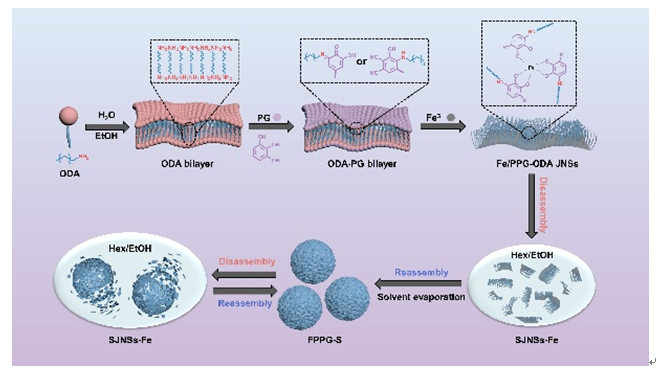
[12] Li D.; Xiong Y.; Liu Z.; Liu X.; Wang Y.; Sun M.; Zhao N.; Jia X.,Solvent-mediated biomimetic reversible assembly of supraparticles from polyphenol Janus nanosheets.Journal of Colloid and Interface Science 2026, 715, 140264.
[13] Jin B.; Shen J.; Gou X.; Peng R.; Chu S.; Dong H.,Synthesis, Characterization, thermal stability and sensitivity properties of new energetic polymers-PVTNP-g-GAPs crosslinked polymers.Polymers 2016, 8 (1), 10.
[14] Nair K. P.; Breedveld V.; Weck M.,Complementary hydrogen-bonded thermoreversible polymer networks with tunable properties.Macromolecules 2008, 41 (10), 3429-3438.
[15] Podsiadlo P.; Kaushik A. K.; Arruda E. M.; Waas A. M.; Shim B. S.; Xu J.; Nandivada H.; Pumplin B. G.; Lahann J.; Ramamoorthy A.,Ultrastrong and stiff layered polymer nanocomposites.Science 2007, 318 (5847), 80-83.
[16] Ritchie R. O.,The conflicts between strength and toughness.Nat. Mater. 2011, 10 (11), 817-822.
[17] Giesa T.; Buehler M. J.,Nanoconfinement and the Strength of Biopolymers.Annual Review of Biophysics 2013, 42 (1), 651-673.
[18] Wang H.-C.; Grolman J. M.; Rizvi A.; Hisao G. S.; Rienstra C. M.; Zimmerman S. C., pH-triggered release from polyamide microcapsules prepared by interfacial polymerization of a simple diester monomer.ACS macro letters 2017, 6 (3), 321-325.
[19] Sanchez-Ballester, N. M.; Soulairol, I.; Bataille, B.; Sharkawi, T., Flexible heteroionic calcium-magnesium alginate beads for controlled drug release.Carbohydr. Polym. 2019, 207, 224-229.
[20] Lobel B. T.; Baiocco D.; Al-Sharabi, M.; Routh, A. F.; Zhang, Z.; Cayre, O. J., Current challenges in microcapsule designs and microencapsulation processes: a review.ACS Appl. Mater. Interfaces 2024, 16 (31), 40326-40355.
[21] Yan G.; Chen G.; Peng Z.; Shen Z.; Tang X.; Sun Y.; Zeng X.; Lin L.,The Cross-Linking Mechanism and Applications of Catechol-Metal Polymer Materials.Advanced Materials Interfaces 2021, 8 (19), 2100239.
[22] Kim S.; Regitsky A. U.; Song J.; Ilavsky J.; McKinley, G. H.; Holten-Andersen, N., In situ mechanical reinforcement of polymer hydrogels via metal-coordinated crosslink mineralization.Nat. Commun. 2021, 12 (1), 667.
[23] Cheng Z.; Yan M.; Cao L.; Huang J.; Cao X.; Yuan D.; Chen Y.,Design of nitrile rubber with high strength and recycling ability based on Fe3+-catechol group coordination.Ind. Eng. Chem. Res. 2019, 58 (9), 3912-3920.
[24] Liu Y.; Li Z.; Zhang Z.; Wang J.; Sun L.; Xie T.,Thermal-driven self-healing waterborne polyurethane with robust mechanical properties based on reversible phenol-carbamate network and Fe3+-catechol coordination bond.Prog. Org. Coat. 2021, 153, 106153.
[25] Zhou Z.; Liu T.; Zhou W.; Chen H.; Bian Y.; Gong S.; Shi S. Q.; Li J.,A strong and biodegradable wood particles-based bioplastic modified by synergistically dynamic cross-linking with tannic acid and Fe3+.Composites Part B: Engineering 2022, 247, 110349.
[26] Li D.; Zhang S.; Sheng W.; Zhang Q.; Liu Z.; Li R.; Liu X.; Meng C.; Li C.; Li M.; Jia, X. ACS Appl. Nano Mater.2023, 6, 8290-8301.
[27] Soyekwo F.; Zhang Q.; Gao R.; Qu Y.; Lv R.; Chen M.; Zhu A.; Liu Q.,Metal in situ surface functionalization of polymer-grafted-carbon nanotube composite membranes for fast efficient nanofiltration.Journal of Materials Chemistry A 2017, 5 (2), 583-592.
[28] Deng Y.; Dong Y.; Wang G.; Sun K.; Shi X.; Zheng L.; Li X.; Liao S.,Well-defined ZIF-derived Fe-N codoped carbon nanoframes as efficient oxygen reduction catalysts.ACS Appl. Mater. Interfaces 2017, 9 (11), 9699-9709.
[29] Xu J.; Cao S.; Zhong M.; Ren S.; Chen X.; Li W.; Wang C.; Wang Z.; Lu X.; Lu X.,Rational design of bimetal phosphide embedded in carbon nanofibers for boosting oxygen evolution.J. Colloid Interface Sci. 2024, 657 (000), 8.
[30] Heeley E. L.; Hughes D. J.; El Aziz, Y.; Taylor, P. G.; Bassindale, A. R., Linear long alkyl chain substituted POSS cages: the effect of alkyl chain length on the self-assembled packing morphology.Macromolecules 2013, 46 (12), 4944-4954.
[31] Man T.; Wang Z.; Xing Y.; Ma K.; Nong Z.; Lu S.Multifunctional Integrated Composite Coatings Based on both Grafted-ZnO and Single-walled Carbon Nanotubes. Acta Chim. Sinica 2024, 82, 1142-1149.
[32] Yang Q.-M.; Liu Y.-C.; Chen L.-X.; Yang P.,Study on the Amyloid-like Fibrinogen-based Nanofilm. Acta Polym. Sin. 2020, 51(8), 890-900.
[33] Yang F.; Li M.; Xiong J.; Lv X.; Ma X.; Chen W.; Yang P.,Amyloid-Like Protein Coating as a Barrier Against Plasticizer Leaching. CCS Chem. 2025, 7(2), 493-506.
[34] Bai J.-W.; Liu W.; Wen B.; Lei Z.-L.; Li C.; Ren H.; Yang P.,Synergistic Functional Group Interactions for Stable Interfacial Adhesion: Insights from Amyloid-inspired Polymers. Chinese J. Polym. Sci. 2025, 43(7), 1096-1104. |