

化学学报 ›› 2025, Vol. 83 ›› Issue (12): 1551-1560.DOI: 10.6023/A25070252 上一篇 下一篇
研究论文
刘文素, 江莎*( ), 王渝童, 谢林林, 张登翔, 谭力伟, 汪永杰
投稿日期:2025-07-11
发布日期:2025-09-28
基金资助:
Wensu Liu, Sha Jiang*(), Yutong Wang, Linlin Xie, Dengxiang Zhang, Liwei Tan, Yongjie Wang
Received:2025-07-11
Published:2025-09-28
Contact:
* E-mail: jiangsha@cqupt.edu.cn
Supported by:文章分享

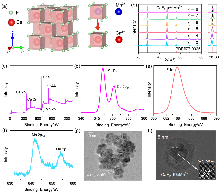
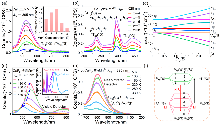
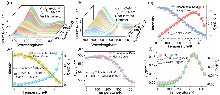
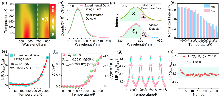
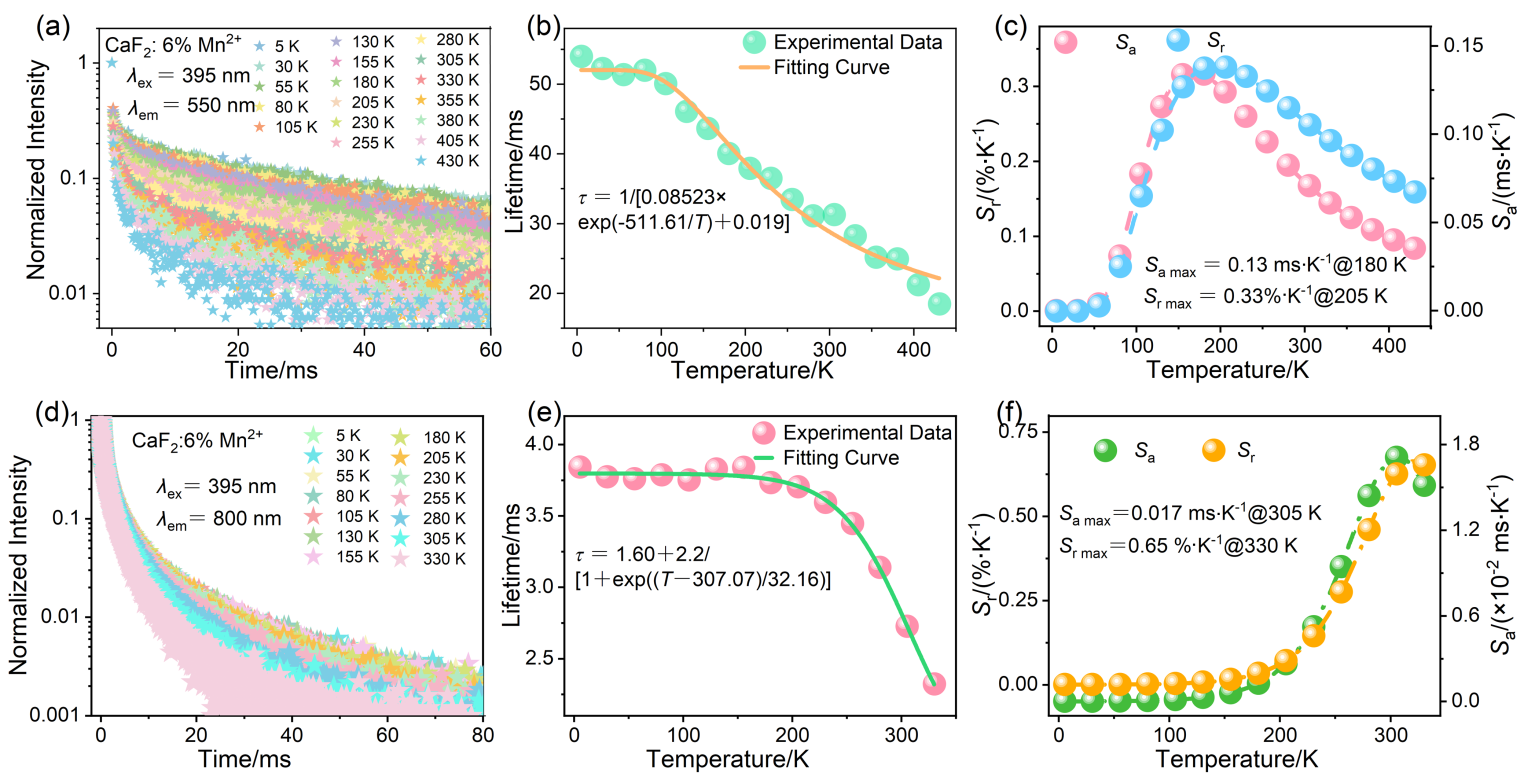
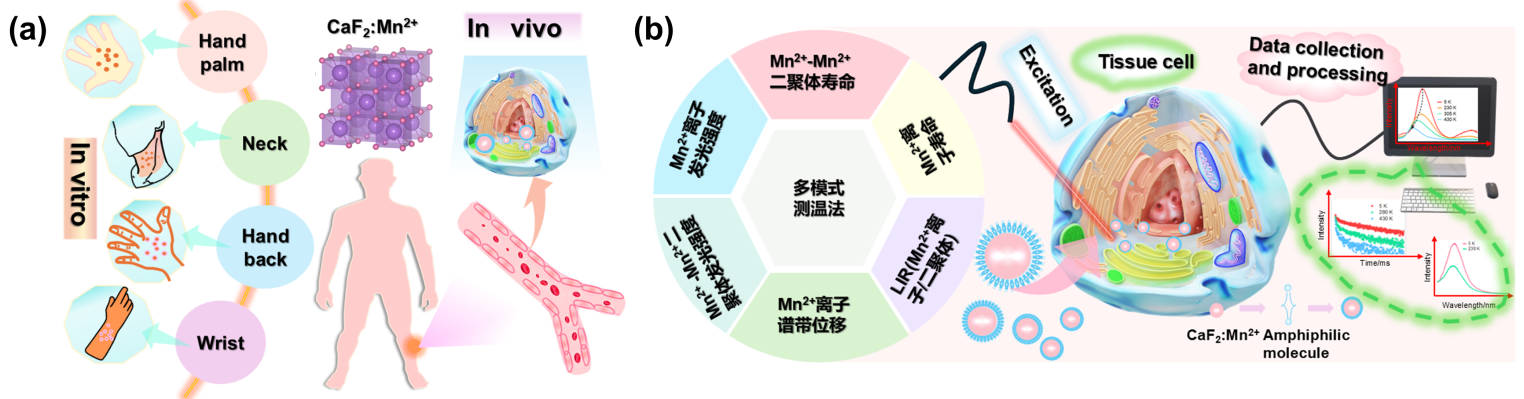
近年来, 基于无机纳米材料的光学测温技术因其高灵敏度、非接触测量和良好的生物相容性等优势, 在生物医学温度传感领域展现出重要应用前景. 本研究通过溶剂热法成功制备了CaF2:Mn2+纳米颗粒, 并系统研究了其温度依赖的光学特性. 实验结果表明: 该纳米颗粒的发光强度、发射峰位置和荧光寿命均表现出显著的温度响应特性. 进一步研究发现: 在近红外第一生物窗口内(650~950 nm), CaF2:Mn2+纳米颗粒呈现出Mn2+-Mn2+二聚体的特征发射(680~950 nm), 且其热猝灭效应强于Mn2+离子的发光. 基于上述实验结果, 建立了基于CaF2:Mn2+纳米颗粒的多模式光学温度传感策略. 其中, Mn2+-Mn2+二聚体发光强度、发光强度比(Mn2+离子/Mn2+-Mn2+二聚体)和Mn2+-Mn2+二聚体寿命模式在生理温度内(300~330 K)表现出最佳测温性能, 其相对灵敏度分别为2.82%•K−1 (330 K)、0.79%•K−1 (305 K)和0.65%•K−1 (330 K), 这为生物测温提供了可靠的多模式测量方案. 本研究不仅证实了CaF2:Mn2+纳米颗粒在生物温度传感领域中的应用潜力, 更为开发新型高灵敏度的生物测温探针提供了重要理论参考和实验依据.
刘文素, 江莎, 王渝童, 谢林林, 张登翔, 谭力伟, 汪永杰. Mn2+离子/二聚体差异化热响应的CaF2纳米探针实现多模式光学测温[J]. 化学学报, 2025, 83(12): 1551-1560.
Wensu Liu, Sha Jiang, Yutong Wang, Linlin Xie, Dengxiang Zhang, Liwei Tan, Yongjie Wang. CaF2 Nanoprobes with Mn2+ Ions/Dimers Exhibiting Differential Thermal Responses for Multimodal Optical Thermometry[J]. Acta Chimica Sinica, 2025, 83(12): 1551-1560.




| [1] |
doi: 10.1016/j.ccr.2024.216196 |
| [2] |
doi: 10.1021/acs.inorgchem.4c05370 |
| [3] |
doi: 10.1002/lpor.v19.4 |
| [4] |
doi: 10.1038/s41467-024-46727-5 |
| [5] |
doi: 10.1016/j.jre.2023.10.010 |
| [6] |
doi: 10.1002/adma.v35.36 |
| [7] |
doi: 10.6023/A17070341 |
|
(秦天依, 曾毅, 陈金平, 于天君, 李嫕, 化学学报, 2017, 75, 1164.)
doi: 10.6023/A17070341 |
|
| [8] |
doi: 10.6023/A23040108 |
|
(马天骄, 李瑾, 马晓东, 姜学松, 化学学报, 2023, 81, 749.)
doi: 10.6023/A23040108 |
|
| [9] |
doi: 10.6023/A23050242 |
|
(温哥华, 温都日娜, 陈秀梅, 麻秀芳, 翁果果, 韦依凡, 鲍松松, 谢小吉, 胡淑贤, 郑丽敏, 化学学报, 2023, 81, 1311.)
doi: 10.6023/A23050242 |
|
| [10] |
doi: 10.1038/s41592-020-0957-y |
| [11] |
doi: 10.1039/D3QI01864D |
| [12] |
doi: 10.1016/j.ceramint.2024.06.385 |
| [13] |
doi: 10.1016/j.physb.2023.415298 |
| [14] |
doi: 10.1016/j.jssc.2006.05.011 |
| [15] |
doi: 10.1016/j.jlumin.2025.121185 |
| [16] |
pmid: 26682406 |
| [17] |
doi: 10.1021/acs.chemmater.8b00806 |
| [18] |
doi: 10.1016/j.jlumin.2023.120143 |
| [19] |
doi: 10.1021/acs.inorgchem.2c00690 pmid: 36102851 |
| [20] |
|
|
(周全新, 夏志国, 硅酸盐学报, 2022, 50, 3103.)
|
|
| [21] |
doi: 10.1002/adom.v12.36 |
| [22] |
doi: 10.1016/j.jlumin.2021.118241 |
| [23] |
doi: 10.1016/j.jlumin.2015.05.014 |
| [24] |
doi: 10.1016/j.nimb.2011.12.015 |
| [25] |
doi: 10.1016/0022-2313(81)90027-2 |
| [26] |
doi: 10.1007/s40843-018-9288-4 |
| [27] |
doi: 10.1002/adom.v7.24 |
| [28] |
doi: 10.1039/D4TC00890A |
| [29] |
doi: 10.1021/acs.chemmater.4c00548 |
| [30] |
doi: 10.1038/s41467-022-29881-6 |
| [31] |
doi: 10.1002/adom.v11.5 |
| [32] |
doi: 10.1002/advs.v2.7 |
| [33] |
doi: 10.1021/acs.inorgchem.4c03935 |
| [34] |
doi: 10.1002/smll.v21.17 |
| [35] |
doi: 10.1364/OL.43.000835 |
| [36] |
doi: 10.1021/acs.chemmater.9b03886 |
| [37] |
doi: 10.1016/j.jlumin.2023.120300 |
| [38] |
doi: 10.1021/acs.inorgchem.5c00728 |
| [39] |
|
| [40] |
doi: 10.1021/acs.inorgchem.0c02118 |
| [41] |
doi: 10.1002/advs.v11.7 |
| [42] |
doi: 10.1021/acs.chemrev.1c00644 |
| [43] |
doi: 10.1021/jp502825p |
| No related articles found! |
| 阅读次数 | ||||||
|
全文 |
|
|||||
|
摘要 |
|
|||||
