

化学学报 ›› 2026, Vol. 84 ›› Issue (8): 1355-1364.DOI: 10.6023/A26070258 上一篇 下一篇
综述
陈雪娇a, 刘小琦a, 魏麟骄a,b, 白鹏a,*( ), 阎子峰a,*()
投稿日期:2026-07-22
发布日期:2026-08-26
作者简介: |
陈雪娇, 中国石油大学(华东)化学化工学院2022级博士研究生. 主要研究方向为无机非金属多孔材料的制备及其在丙烷脱氢中的应用. |
 |
刘小琦, 中国石油大学(华东)重质油国家重点实验室博士研究生. 主要研究方向为长寿命水系锌离子电池的设计与电化学机理研究. |
 |
魏麟骄, 中国石油大学(华东)博士研究生, 山东石油化工学院讲师. 2012年获广西大学应用化学专业学士学位, 2016年获中国石油大学(华东)化学工程专业硕士学位. 主要研究方向为分子筛催化材料与水系锌离子电池. |
 |
白鹏, 中国石油大学(华东)化学工程学院教授, 博士生导师. 2009~2012年在新加坡科技研究局(A*STAR)下属的化学与工程科学研究院(ICES)任I级科学家. 长期从事高性能氧化铝粉体的制备、改性及催化性能研究, 尤其在氧化铝孔结构、晶相、结构缺陷、微观形貌、表面酸性调变等方面做了系统深入的探索. 近年来主持和参与国家自然科学基金重大项目、国家重点研发计划、国家自然科学基金青年基金、山东省自然科学基金面上基金、新加坡教育部和科技局科技研发项目等多个项目. |
 |
阎子峰, 中国石油大学(华东)重质油全国重点实验室教授. 于兰州大学化学系获得学士、硕士学位, 于中国科学院兰州化学物理研究所获得博士学位. 目前为中国石油大学(华东)二级教授, 同时兼任中国化学会催化委员会委员、中国化学会分子筛委员会委员、中国化工学会理事及山东省化学化工学会常务理事兼催化专业委员会主任委员. 二十多年来, 主持承担30余项国家/山东省重点研发项目、国家自然科学基金重点项目等国家、省部级重大研究课题和攻关项目, 承担5项与Shell、KACST 等的国际合作项目, 先后实现多项技术的工业化. 主要研究方向为催化材料与催化剂的结构设计、定向合成及催化应用, 新型电极材料及新能源领域应用研究. |
★“纪念兰州大学化学学科创建80周年”专辑
基金资助:
Xuejiao Chena, Xiaoqi Liua, Linjiao Weia,b, Peng Baia,*(), Zifeng Yana,*()
Received:2026-07-22
Published:2026-08-26
Contact:
E-mail: About author:★For the VSI “Celebration of 80th Anniversary of Chemistry in Lanzhou University”
Supported by:文章分享
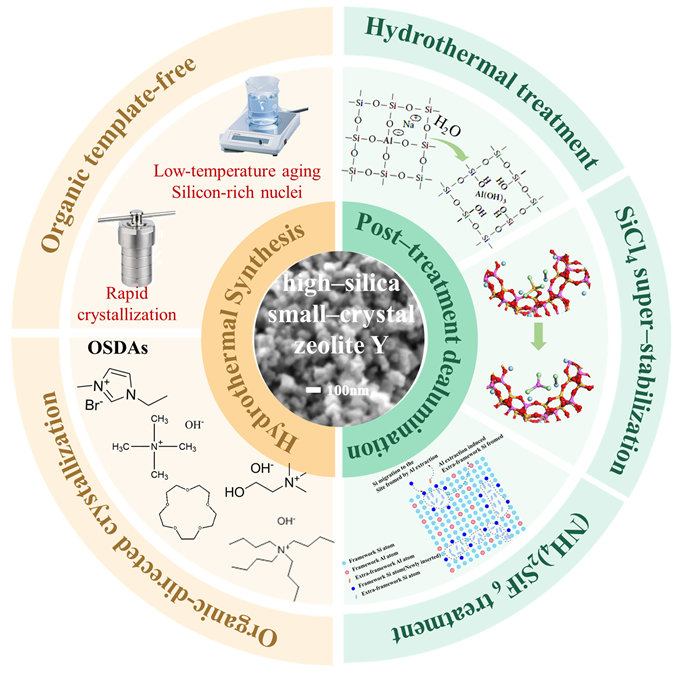
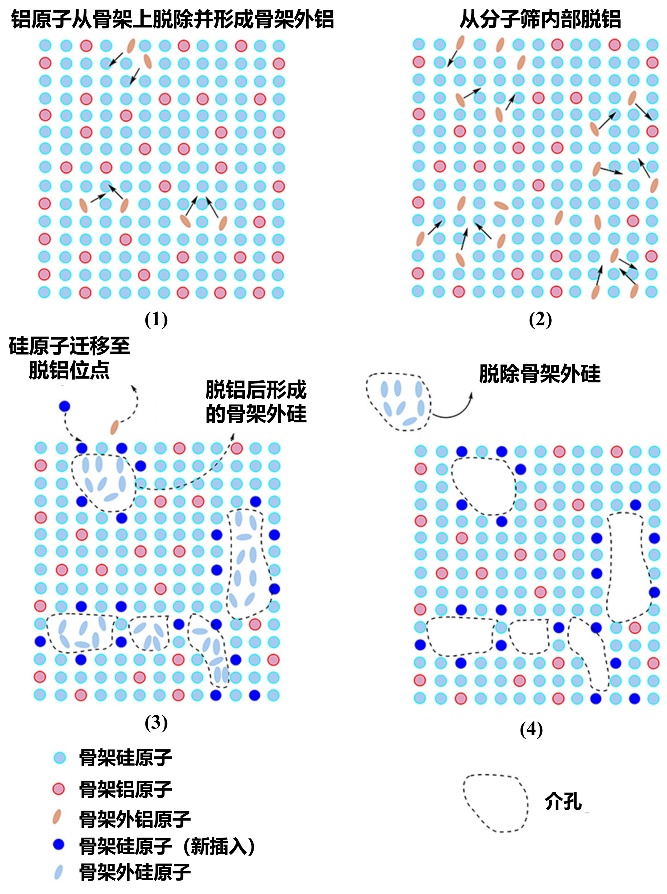
小晶粒(<1 μm), 尤其是纳米级(<100 nm) Y型分子筛, 因其独特的拓扑结构和优异的催化性能, 在石油炼制等领域具有巨大的商业潜力. 然而, 如何在纳米尺度下协同优化晶粒尺寸与骨架硅铝比(SAR, SiO2/Al2O3物质的量比), 以兼顾高效传质与高水热稳定性, 仍是该领域面临的核心科学难题. 本综述重点介绍高硅小晶粒和纳米Y型分子筛的合成策略、脱铝机理及脱铝对材料性能的影响. 直接合成和后处理改性法的比较分析表明, 直接合成受到成核动力学和经济可行性的限制, 后处理脱铝仍是实现高硅铝比的主要工业方法. 此外, 本综述还深入分析了高温蒸汽诱导的骨架重组、SiCl4同晶取代以及利用NH4SiF6液相脱铝-补硅的微观反应机制. 纳米Y型分子筛的后处理面临着特殊挑战: 高温蒸汽处理很容易引起晶粒聚合与结构坍塌. 气相超稳定法补硅效率较高, 但由于SiCl4具有强腐蚀性, 对设备提出了严苛的要求. 类似地, 由于脱铝和补硅过程之间的动力学不平衡, 氟硅酸铵法会面临孔道堵塞和表面硅富集等问题. 此外, 本综述系统地阐明了脱铝过程对分子筛物化性质的双重影响. 具体来说, 适度的脱铝能诱导晶胞参数的各向异性收缩并提高酸强度, 而过度的脱铝往往会产生结构缺陷和骨架外铝(EFAl)物质. 因此, 未来的研究应集中在精确控制高硅纳米Y型分子筛的结晶过程和脱铝动力学上, 促进晶体尺寸与水热稳定性的协同优化, 推进高硅纳米Y型分子筛的工业化应用.
陈雪娇, 刘小琦, 魏麟骄, 白鹏, 阎子峰. 高硅小晶粒Y型分子筛的合成研究进展★[J]. 化学学报, 2026, 84(8): 1355-1364.
Xuejiao Chen, Xiaoqi Liu, Linjiao Wei, Peng Bai, Zifeng Yan. Advances in Synthesizing High-Silica Small-Crystal Zeolite Y★[J]. Acta Chimica Sinica, 2026, 84(8): 1355-1364.
| [1] |
|
| [2] |
doi: 10.3390/inorganics11010022 |
| [3] |
doi: 10.1006/jcat.2001.3184 |
| [4] |
doi: 10.1039/c5cs00376h pmid: 26382875 |
| [5] |
doi: 10.1039/c2cy00309k |
| [6] |
doi: 10.3390/w14020137 |
| [7] |
|
|
(薛景航, 秦波, 高杭, 柳伟, 现代化工, 2022, 42, 25.)
doi: 10.16606/j.cnki.issn0253-4320.2022.06.006 |
|
| [8] |
doi: 10.1039/c3ra41862f |
| [9] |
doi: 10.1021/ie403486x |
| [10] |
doi: 10.1021/acs.energyfuels.6b03421 |
| [11] |
|
|
(董鹏, 朱琳, 骆龙华, 李铁森, 王延海, 王婵, 崔勍焱, 施杰, 岳源源, 科学通报, 2024, 69, 2718.)
|
|
| [12] |
doi: 10.1002/anie.v49.52 |
| [13] |
|
|
(王娟, 王林英, 朱大丽, 崔文浩, 王义峰, 田鹏, 刘中民, 高等学校化学学报, 2021, 42, 1.)
doi: 10.7503/cjcu20200419 |
|
| [14] |
|
| [15] |
|
| [16] |
doi: 10.1007/s10934-008-9200-4 |
| [17] |
doi: 10.1002/anie.201702672 pmid: 28771911 |
| [18] |
doi: 10.1016/j.micromeso.2012.03.016 |
| [19] |
doi: 10.1016/S1387-1811(98)00195-4 |
| [20] |
|
| [21] |
|
| [22] |
doi: 10.1016/j.micromeso.2021.111248 |
| [23] |
|
| [24] |
|
|
(熊晓云, 李彩今, 于红, 黄世英, 梁德声, 肖丰收, 李守贵, 高等学校化学学报, 2007, 28, 1634.)
|
|
| [25] |
|
|
(甄铁丽, 张树强, 王宁, 硅酸盐通报, 2007, 26, 482.)
|
|
| [26] |
doi: 10.1126/science.aaf1559 |
| [27] |
doi: 10.1002/anie.v59.39 |
| [28] |
doi: 10.1016/S0144-2449(05)80310-0 |
| [29] |
doi: 10.1002/anie.202109163 pmid: 34478216 |
| [30] |
doi: 10.1016/j.micromeso.2023.112614 |
| [31] |
doi: 10.1016/j.micromeso.2026.114045 |
| [32] |
doi: 10.1016/S1387-1811(98)00041-9 |
| [33] |
doi: 10.1016/j.micromeso.2005.04.009 |
| [34] |
doi: 10.1039/c3cc43974g |
| [35] |
doi: 10.1016/j.micromeso.2014.10.049 |
| [36] |
doi: 10.1016/S1872-2067(18)63167-5 |
| [37] |
doi: 10.1016/j.micromeso.2022.112196 |
| [38] |
doi: 10.1021/jacs.4c18522 |
| [39] |
doi: 10.1002/adma.v32.26 |
| [40] |
doi: 10.1016/S1872-2067(21)64043-3 |
| [41] |
doi: 10.1039/D2SC06010H |
| [42] |
|
| [43] |
doi: 10.1002/cctc.v16.3 |
| [44] |
doi: 10.1088/2053-1591/ab0eff |
| [45] |
doi: 10.1139/v64-223 |
| [46] |
doi: 10.1016/S0144-2449(82)80042-0 |
| [47] |
doi: 10.1016/0926-860X(95)00092-5 |
| [48] |
doi: 10.1016/j.micromeso.2005.09.032 |
| [49] |
doi: 10.1039/D5CC00510H |
| [50] |
doi: 10.1002/aic.v69.9 |
| [51] |
doi: 10.1039/D5CS00319A |
| [52] |
doi: 10.1016/j.micromeso.2023.112570 |
| [53] |
|
| [54] |
|
| [55] |
|
| [56] |
|
| [57] |
|
| [58] |
doi: 10.1021/ie990568k |
| [59] |
|
|
(韩果, 孙晓艳, 樊宏, 高闯, 王继锋, 石化技术与应用, 2015, 33, 208.)
|
|
| [60] |
doi: 10.1016/j.jcat.2010.12.013 |
| [61] |
doi: 10.1016/j.micromeso.2017.07.046 |
| [62] |
doi: 10.3390/catal12060640 |
| [63] |
|
|
(于政敏, 陈玉晶, 孙晓艳, 樊宏飞, 精细石油化工, 2022, 39, 22.)
|
|
| [64] |
doi: 10.1016/0021-9517(91)90128-Q |
| [65] |
doi: 10.1134/S0965544119050116 |
| [66] |
doi: 10.1016/S0926-3373(02)00199-6 |
| [67] |
doi: 10.1038/nmat4173 |
| [68] |
|
| [69] |
doi: 10.1016/S0022-0248(02)01321-0 |
| [70] |
|
|
(常彦斌, 王健, 崔杏雨, 陈树伟, 李瑞丰, 石油学报(石油加工), 2016, 32, 477.)
|
|
| [71] |
doi: 10.1016/j.micromeso.2009.07.026 |
| [72] |
doi: 10.1039/C9RA03324F |
| [73] |
doi: 10.1021/acs.cgd.6b01564 |
| [74] |
doi: 10.1007/s10971-018-4850-4 |
| [75] |
doi: 10.1016/S1387-1811(03)00271-3 |
| [76] |
doi: 10.1016/j.cplett.2020.137412 |
| [77] |
|
|
(晁自胜, 林海强, 陈国周, 吴延华, 万惠霖, 高等学校化学学报, 2001, 22, 10.)
|
|
| [78] |
doi: 10.1039/D6CC00666C |
| [79] |
|
|
(郭燕妮, 秦波, 潘梦, 杜艳泽, 崔杏雨, 李瑞丰, 石油学报(石油加工), 2018, 34, 270.)
|
|
| [80] |
doi: 10.1016/j.micromeso.2004.06.018 |
| [81] |
doi: 10.1007/s10450-005-5406-9 |
| [82] |
doi: 10.1021/acscatal.3c05517 |
| [83] |
|
|
(张海瑞, 石茂才, 赵亮, 辽宁化工, 2022, 51, 527.)
|
|
| [84] |
|
| [85] |
|
| [86] |
doi: 10.1016/0021-9517(92)90014-9 |
| [87] |
doi: 10.1021/ic50169a032 |
| [88] |
doi: 10.1016/0927-6513(95)00038-B |
| [89] |
doi: 10.1016/j.micromeso.2013.11.034 |
| [90] |
doi: 10.1002/cctc.v17.16 |
| [91] |
doi: 10.1016/j.micromeso.2014.02.040 |
| [92] |
doi: 10.1002/anie.v60.51 |
| [93] |
doi: 10.1016/j.apcata.2008.11.033 |
| [94] |
doi: 10.1016/j.jcat.2016.04.021 |
| [95] |
doi: 10.1039/C6CY01841F |
| [96] |
doi: 10.1021/ja907696h |
| [1] | 王学伟, 韦奇, 洪志发, 李群艳, 聂祚仁. 三氟丙基修饰的有机-无机杂化二氧化硅膜制备、氢气分离及水热稳定性能[J]. 化学学报, 2012, 70(24): 2529-2535. |
| [2] | 何秋平,程晓维,鄢浩,龙英才. 天然CXN沸石分子筛水热稳定性研究 I. 水热稳定性影响因素[J]. 化学学报, 2009, 67(18): 2060-2066. |
| [3] | 罗永明, 侯昭胤, 郑小明. 低浓度液体酸介质中快速合成SBA-15分子筛[J]. 化学学报, 2007, 65(15): 1481-1486. |
| [4] | 杨恒权, 张高勇, 周卯星, 朱银燕, 洪昕林. 氯苄基官能化和氯苄基甲基双官能化介孔分子筛MCM-41的合成与表征[J]. 化学学报, 2004, 62(7): 641-648. |
| [5] | 郑均林, 张晔, 吴东, 孙予罕. MFI沸石前驱体和硅酸钠共组装制备水热稳定的管状介孔分子筛[J]. 化学学报, 2004, 62(14): 1357-1361. |
| [6] | 崔峻,高滋. 含镍Y沸石的硫化及加氢脱硫性能[J]. 化学学报, 1996, 54(9): 838-845. |
| 阅读次数 | ||||||
|
全文 |
|
|||||
|
摘要 |
|
|||||
