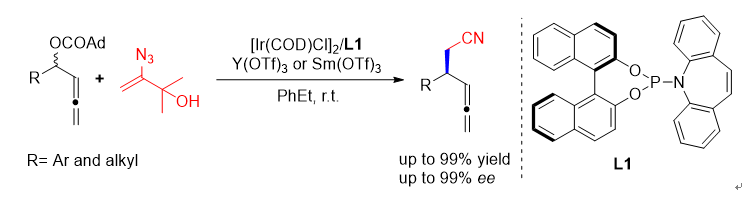
[1] The reviews: a) F. F. Fleming, Nat. Prod. Rep., 1999, 16, 597; b) F. F. Fleming, L. Yao, P. C. Ravikumar, L. Funk, B. C. Shook, J. Med. Chem., 2010, 53, 7902.
[2] For selected examples, see: a) A. M. C. H. van den Nieuwendijk, A. B. T. Ghisaidoobe, H. S. Overkleeft, J. Brussee, A. van der Gen, Tetrahedron, 2004, 60, 10385; b) M. Gao, D.-X. Wang, Q.-Y. Zheng, M.-X. Wang, J. Org. Chem., 2006, 71, 9532; c) M. Gao, D.-X. Wang, Q.-Y. Zheng, Z.-T. Huang, M.-X. Wang, J. Org. Chem., 2007, 72, 6060; d) X. Jiang, C. Fu, S. Ma, Chem. Eur. J., 2008, 14, 9656; e) X. Jiang, C. Fu, S. Ma, Eur. J. Org. Chem., 2010, 687; f) S. Sanjaya, S. Chiba, Tetrahedron, 2011, 67, 590; g) Q.-Q. Xu, Q.-L. Hou, W. Liu, H.-J. Wang, W.-W. Liao, Org. Lett., 2016, 18, 3854; h) T. Iwata, F. Inagaki, C. Mukai, Angew. Chem. Int. Ed., 2013, 52, 11138. i) J. Hou, G. Yang, Z. Chai, J. Org. Chem., 2022, 87, 453
[3] For selected examples, see: a) A. Toró, P. Nowak, P. Deslongchamps, J. Am. Chem. Soc., 2000, 122, 4526; b) K, Partogyan-Halim, L. Besson, D. J. Aitken, H.-P. Husson, Eur. J. Org. Chem., 2003, 268; c) D. F. Taber, J.-M. Joerger, J. Org. Chem., 2007, 72, 3454; d) S. Förster, G. Helmchen, Synlett, 2008, 6, 831; e) S. V. Pronin, M. G. Tabor, D. J. Jansen, R. A. Shenvi, J. Am. Chem. Soc., 2012, 134, 2012; f) C. Wang, Z. Wang, X. Xie, X. Yao, G. Li, L. Zu, Org. Lett., 2017, 19, 1828; g) Y. Kleiner, P. Hammann, J. Becker, A. Bauer, C. Poverlein, S. M. M. Schuler, J. Org. Chem., 2020, 85, 13108.
[4] The review: R. López, C. Palomo, Angew. Chem. Int. Ed., 2015, 54, 13170.
[5] F. F. Fleming, W. Liu, S. Ghosh, O. W. Steward, Angew. Chem. Int. Ed., 2007, 46, 7098.
[6] Selected reviews: a) G. Helmchen, A. Dahnz, P. Dubon, M. Schelwies, R. Weihofen, Chem. Commun., 2007, 675. b) W.-B. Liu, J.-B. Xia, S.-L. You, Iridium-Catalyzed Asymmetric Allylic Substitutions. In Transition Metal Catalyzed Enantioselective Allylic Substitution in Organic Synthesis; Kazmaier, U., Ed.; Topics in Organometallic Chemistry 38; Springer: Berlin, Heidelberg, 2011. c) C.-X. Zhuo, C. Zheng, S.-L. You, Acc. Chem. Res., 2014, 47, 2558. d) J. Qu, G. Helmchen, Acc. Chem. Res., 2017, 50, 2539. e) L. Wan, L. Tian, J. Liu, D. Niu, Synlett, 2017, 28, 2051. f) S. E. Shockley, J. C. Hethcox, B. M. Stoltz, Synlett, 2018, 29, 2481; g) S. L. Rossler, D. A. Petrone, E. M. Carreira, Acc. Chem. Res., 2019, 52, 2657; h) Q. Cheng, H.-F. Tu, C. Zheng, J.-P. Qu, G. Helmchen, S.-L. You, Chem. Rev., 2019, 119, 1855.
[7] Selected examples: a) M. Sawamura, M. Sudoh, Y. Ito, J. Am. Chem. Soc.,1996,118, 3309; b) C. Gnamm, S. Forster, N. Miller, K. Brodner, G. Helmchen, Synlett, 2007, 2007, 790; c) L. M. Stanley, C. Bai, M. Ueda, J. F. Hartwig, J. Am. Chem. Soc., 2010, 132, 8918; d) B. M. Trost, J. R. Miller, C. M. Hoffman, Jr., J. Am. Chem. Soc., 2011, 133, 8165; e) B. W. H. Turnbull, P. A. Evans, J. Am. Chem. Soc., 2015, 137, 6156; f) Y. Wang, Y.-N. Xu, G.-S. Fang, H.-J. Kang, Y. Gu, S.-K. Tian, Org. Biomol. Chem., 2015, 13, 5367; g) J. C. Hethcox, S. E. Shockley, B. M. Stoltz, Org. Lett., 2017, 19, 1527; h) J. C. Hethcox, S. E. Shockley, B. M. Stoltz, Angew. Chem. Int. Ed., 2018, 57, 8664; i) N. J. Adamson, K. C. E. Wilbur, S. J. Malcolmson, J. Am. Chem. Soc., 2018, 140, 2761; j) C. P. Grugel, B. Breit, Chem. Eur. J., 2018, 24, 15223. k) A. Matsunami, K. Takizawa, S. Sugano, Y. Yano, H. Sato, R. Takeuchi, J. Org. Chem., 2018, 83, 12239. l) S. Park, N. J. Adamson, S. J. Malcolmson, Chem. Sci., 2019, 10, 5176; m) S. Ghorai, S. Ur Rehman, W.-B. Xu, W.-Y. Huang, C. Li, Org. Lett., 2020, 22, 3519; n) C. Shen, X. Cheng, L. Wei, C.-J. Wang, Chem. Sci., 2021, 12, 15882; o) P. Roy, S. Mukherjee, Org. Lett., 2023, 25, 4520.
[8] M.-J. Tom, P. A. Evans, J. Am. Chem. Soc., 2020, 142, 11957.
[9] M. Sun, L. Wei, C. Li, J. Am. Chem. Soc., 2023, 145, 3897.
[10] a) Q. Li, C. Fu, S. Ma, Angew. Chem. Int. Ed., 2012, 51, 11783; b) X. Huang, S. Wu, W. Wu, P. Li, C. Fu, S. Ma, Nature Commun., 2016, 7, 12382; c) Hirokazu Tsukamoto, Kazuya Ito, Takayuki Doi, Chem. Commun., 2018, 54, 5102. d) H. Tsukamoto, T. Konno, K. Ito, T. Doi, Org. Lett., 2019, 21, 6811.
[11] S. Kezuka, K. Kanemoto, R. Takeuchi, Tetrahedron Lett., 2004, 45, 6403.
[12] a) D. A. Petrone, M. Isomura, I. Franzoni, S. L. Rössler, E. M. Carreira, J. Am. Chem. Soc., 2018, 140, 4697; b) M. Isomura, D. A. Petrone, E. M. Carreira, J. Am. Chem. Soc., 2019, 141, 4738; c) M. Isomura, D. A. Petrone, E. M. Carreira, J. Am. Chem. Soc., 2021, 143, 3323; d) A. Chakrabarty, S. Mukherjee, Angew. Chem. Int. Ed., 2022, 61, e202115821; e) S. Ghosh, A. Changotra, D. A. Petrone, M. Isomura, E. M. Carreira, R. B. Sunoj, J. Am. Chem. Soc., 2023, 145, 2884.
[13] Selected reviews: a) N. Jung, S. Brase, Angew. Chem. Int. Ed., 2012, 51, 12169; b) B. Hu, S. G. DiMagno, Org. Biomol. Chem., 2015, 13, 3844; c) J. Fu, G. Zanoni, E. A. Anderson, X. Bi, Chem. Soc. Rev., 2017, 46, 7208; d) H. Hayashi, A. Kaga, S. Chiba, J. Org. Chem., 2017, 82, 11981.
[14] For the formal cycloaddition of vinyl azides, see: a) A. Kaga, D. A. Gandamana, S. Tamura, M. Demirelli, S. Chiba, Synlett, 2017; 28, 1091; b) E. López, L. A. López, Angew. Chem. Int. Ed., 2017, 56, 5121; c) R. Dey, P.l Banerjee, Org. Lett., 2017, 19, 304; c) N. Thirupathi, F. Wei, C.-H. Tung, Z. Xu, Nat. Commun., 2019, 10, 3158; d) Z. Zhong, Z. Xiao, X. Liu, W. Cao, X. Feng, Chem. Sci., 2020, 11, 11492; e) T. Nakanishi, J. Kikuchi, A. Kaga, S. Chiba, M. Terada, Chem. Eur. J., 2020, 26, 8230. f) S. Li, H. Lu, Z. Xu, F. Wei, Org. Chem. Front., 2021, 8, 1770; 1770; g) Z. Zhong, L. Ning, Y. Lu, J. Tan, L. Lin, X. Feng, Sci. China Chem., 2023, 799; For nucleophilic addition/Schmidt rearrangement of vinyl azides, see: h) F.-L. Zhang, Y.-F. Wang, G. H. Lonca, X. Zhu, S. Chiba, Angew. Chem. Int. Ed., 2014, 53, 4390; Angew. Chem., 2014, 126, 4479; i) F.-L. Zhang, X. Zhu, S. Chiba, Org. Lett., 2015, 17, 3138; j) Z. Zhang, R. K. Kumar, G. Li, D. Wu, X. Bi, Org. Lett., 2015, 17, 6190; k) C. Lin, Y. Chen, B. Huang, Y. Liu, S. Cui, J. Org. Chem., 2017, 82, 3950; l) F. Rasool, A. Ahmed, N. Hussaim, S. K. Yousuf, D. Mukherjee, Org. Lett., 2018, 20, 4036; m) D. K. Das, V. K. Kannaujiya, M. M. Sadhu, S. K. Ray, V. K. Singh, J. Org. Chem., 2019, 84, 15865. n) M. Han, M. Yang, R. Wu, Y. Li, T. Jia, Y Gao, H.-L. Ni, P. Hu, B.-Q. Wang, P. Cao, J. Am. Chem. Soc., 2020, 142, 13398. o) A. Chakrabarty, S. Mukherjee, Org. Lett., 2020, 22, 7752.
[15] Selected reviews: a) S. L. Rössler, D. A. Petrone, E. M. Carreira, Acc. Chem. Res., 2019, 52, 2657; b) T. Sawano, R. Takeuchi, Catal. Sci. Technol., 2022, 12, 4100.
[16] The 2-azidoallyl alcohols were prepared by hydroazidation of ethynyl carbinols: a) Z. Liu, J. Liu, L. Zhang, P. Liao, J. Song, X. Bi, Angew. Chem. Int. Ed., 2014, 53, 5305; b) Z. Liu, P. Liao, X. Bi, Org. Lett., 2014, 16, 3668.
[17] For the review, see: a) H. Gröger, Y. Asano, J. Org. Chem., 2020, 85, 6243; for selected examples, see: b) C. Czekelius, E. M. Carreira, Angew. Chem. Int. Ed., 2005, 44, 612; c) S. Breitler, E. M. Carreira, J. Am. Chem. Soc., 2015, 137, 5296; d) T. Betke, P. Rommelmann, K. Oike, Y. Asano, H. Gröger, Angew. Chem. Int. Ed., 2017, 56,12361; e) A. W. Schuppe, G. M. Borrajo-Calleja, S. L. Buchwald, J. Am. Chem. Soc., 2019, 141, 18668; f) X. Li, C. You, J. Yang, S. Li, D. Zhang, H. Lv, X. Zhang, Angew. Chem. Int. Ed., 2019, 58, 10928; g) H. Zhang, Y. Luo, C. Zhu, S. Dong, X. Liu, X. Feng, Org. Lett., 2020, 22, 5217.
[18] During the preparation of this manuscript, Mukherjee et al. published a similar work. A. Chakrabarty, S. Mukherjee, Org. Lett., 2025, 27, 8752.
[19] For details, see the Supporting Information.
[20] A. Lumbroso, N. Abermila, B. Breit, Chem. Sci., 2012, 3, 789.
[21] M. S. Taylor, D. N. Zalatan, A. M. Lerchner, E. N. Jacobsen, J. Am. Chem. Soc., 2005, 127, 1313. |