研究论文

硅藻土辅助制备有序介孔碳及其电催化性能

  • 梁滢 ,
  • 俞瀚 ,
  • 黄清明 ,
  • 张新奇 ,
  • 俞建长
展开
  • 福州大学材料科学与工程学院 福州 350108

收稿日期: 2012-06-29

  网络出版日期: 2012-08-21

基金资助

项目受福建省自然科学基金(No. 2008J0146)资助.

Diatomite-Assisted Synthesis of Ordered Mesoporous Carbon and Its Application in Fuel Cells

  • Liang Ying ,
  • Yu Han ,
  • Huang Qingming ,
  • Zhang Xinqi ,
  • Yu Jianchang
Expand
  • College of Materials Science and Engineering, Fuzhou University, Fuzhou 350108

Received date: 2012-06-29

  Online published: 2012-08-21

Supported by

Project supported by the Fujian Province Natural Science Fund (No. 2008J0146).

摘要

以共聚物F127 为软模板, 酚醛树脂为碳源, 引入硅藻土充当暂态支架, 在不同硅藻土与酚醛树脂质量比下, 用蒸发自组装法合成有序介孔碳材料. 利用XRD, TEM, N2 吸附-脱附对其结构进行表征, 结果显示, 与单一软模板相比,在硅藻土辅助下获得的介孔碳材料不仅具有高度有序的孔道, 还具有更大的比表面积(717~773 m2·g-1)和孔径(3.9~11.3 nm). 依据原料比例与介孔碳结构两者间的变化规律, 初步探讨了硅藻土在制备中所起的辅助作用. 采用微波多元醇还原法制备介孔碳载Pt 电催化剂, 在甲醇溶液中进行循环伏安测试, 发现比表面积的增大有利于碳材料的电催化性能提高, 当硅藻土与酚醛树脂的比例为0.5 时, 制备出的有序介孔碳比表面积最大, 载Pt 后呈现的正向氧化峰电流也最大.

本文引用格式

梁滢 , 俞瀚 , 黄清明 , 张新奇 , 俞建长 . 硅藻土辅助制备有序介孔碳及其电催化性能[J]. 化学学报, 2012 , 70(18) : 1939 -1944 . DOI: 10.6023/A12060362

Abstract

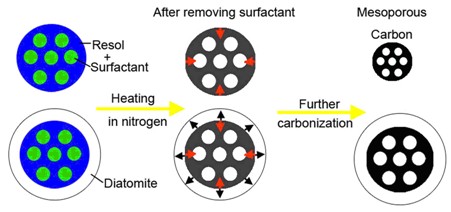
Ordered mesoporous carbon has the promising development and potential in catalysis, because of its large amount of uniform pore size and high surface area. In this paper, ordered mesoporous carbon has been successfully synthesized via evaporation-induced self-assembly (EISA) method, using triblock copolymer Pluronic F127 as a soft template, resol as a carbon precursor and diatomaceous earth as the transient scaffolds. Diatomite is a kind of special biomaterial with 3D precision of tens of nanometers and of low price. Diatomite shells not only maintain the intact structure of the ordered mesoporous carbon, but also increase its aperture diameter and surface area to a certain degree, during the carbonization between 600℃ to 800℃. When the samples were calcined in nitrogen, the features of diatomite could effectively reduce shrinkage ratio of sample structure, keeping the precursor fluid firmly adsorbed on the surface of diatom shells. The resulting materials were characterized by X-ray diffraction, transmission electron microscopy and N2 adsorption-desorption, etc. The results showed all the samples had highly ordered mesoporous structure. Under the support of diatomite, both of the specific surface area (717~773 m2·g-1) and pore sizes (3.9~11.3 nm) of the mesoporous carbon have become much larger, which could be controlled by adjusting the ratio of diatomite to resol. The influence of the diatomite on the structure of the mesoporous carbon was discussed in the paper. Furthermore, we used the as-prepared ordered mesoporous carbon to load Pt nanoparticles. The Pt/carbon catalysts were prepared by microwave-assisted heating process with ethylene glycol as reductant. The electrocatalytic activity of carbon supported Pt nanoparticles was verified by cyclic voltammetry in CH3OH solution. We found the carbon materials with much larger specific surface areas had higher electrocatalytic activity. When the ratio of diatomite to resol was 0.5, the specific surface area of the sample was the largest, and the corresponding Pt/carbon showed the highest peak current of methanol oxidation.

参考文献

[1] Tang, S. H.; Sun, G. Q.; Qi, J.; Sun, S. G.; Guo, J. S.; Xin, Q.; Haarberg, G. M. Chin. J. Catal. 2010, 31, 12. (唐水花, 孙公权, 齐静, 孙世国, 郭军松, 辛勤, Geir Martin Haarberg, 催化学报, 2010, 31, 12.)

[2] Joo, S. H.; Choi, S. J.; Oh, I.; Kwak, J.; Liu, Z.; Terasaki, O.; Ryoo, R. Nature 2001, 412, 169.   

[3] Chai, G. S.; Yoon, S. B.; Yu, J. S.; Choi, J. H.; Sung, Y. E. J. Phys. Chem. B 2004, 108, 7074.

[4] Wu, W.; Cao, J. M.; Chen, Y.; Lu, T.-H. Chin. J. Catal. 2007, 28, 17. (吴伟, 曹洁明, 陈煜, 陆天虹, 催化学报, 2007, 28, 17.)

[5] Xu, Q. J.; Li, J. G.; Li, Q. X. Acta Phys-Chim. Sin. 2011, 27, 1881. (徐群杰, 李金光, 李巧霞, 物理化学学报, 2011, 27, 1881.)

[6] Cui, X.; Shi, J.; Zhang, L.; Ruan, M.; Gao, J. Carbon 2009, 47, 186.   

[7] Ryoo, R.; Joo, S. H.; Jun, S. J. Phys. Chem. B 1999, 103, 7743.

[8] Kruk, M.; Jaroniec, M.; Ryoo, R.; Joo, S. H. J. Phys. Chem. B 2000, 104, 7960.

[9] Lee, J.; Yoon, S.; Oh, S. M.; Shin, C. H.; Hyeon, T. Adv. Mater. 2000, 12, 359.

[10] Zhou, H.; Fan, T.; Zhang, D. ChemSusChem 2011, 4, 1344.   

[11] Losic, D.; Mitchell, J. G.; Voelcker, N. H. Adv. Mater. 2009, 21, 2947.   

[12] Liu, D.; Yuan, P.; Tan, D.; Liu, H.; Fan, M.; Yuan, A.; Zhu, J.; He, H. Langmuir 2010, 26, 18624.   

[13] Holmes, S. M.; Graniel-Garcia, B. E.; Foran, P.; Hill, P.; Roberts, E.; Sakakini, B. H.; Newton, J. M. Chem. Commun. 2006, 2662.   

[14] Tang, J.; He, J. P.; Wang, T.; Guo, Y. X.; Xue, H. R. Acta Chim. Sinica 2011, 69, 1751. (汤静, 何建平, 王涛, 郭云霞, 薛海荣, 化学学报, 2011, 69, 1751.)

[15] Zhou, J. H.; He, J. P.; Ji, Y. J.; Dang, W. J.; Liu, X. L.; Zhao, G. W.; Zhang, C. X.; Zhao, J. S.; Fu, Q. B.; Hu, H. P. Electrochim. Acta 2007, 52, 4691.   

[16] Liu, H. J.; Wang, X. M.; Cui, W. J.; Dou, Y. Q.; Zhao, D. Y.; Xia, Y. Y. J. Mater. Chem. 2010, 20, 4223.

[17] Gaddis, C. S.; Sandhage, K. H. J. Mater. Res. 2004, 19, 2541.

[18] Meng, Y.; Gu, D.; Zhang, F.; Shi, Y.; Yang, H.; Li, Z.; Yu, C.; Tu, B.; Zhao, D. Angew. Chem. 2005, 117, 7215.   

[19] Huang, Y.; Cai, H.; Feng, D.; Gu, D.; Deng, Y.; Tu, B.; Wang, H.; Webley, P. A.; Zhao, D. Chem. Commun. 2008, 2641.   

[20] Zheng, S. L.; Wang, L. J.; Shu, F.; Chen, J. T. J. Chin. Ceram. Soc. 2007, 34, 1382. (郑水林, 王利剑, 舒锋, 陈俊涛, 硅酸盐学报, 2007, 34, 1382.)

[21] Jiang, Y. Z.; Jia, S. Y. Non-Ferr. Min. Metall. 2011, 27, 31. (姜玉芝, 贾嵩阳, 有色矿冶, 2011, 27, 31.)

[22] Chai, G. S.; Shin, I. S.; Yu, J. S. Adv. Mater. 2004, 16, 2057.   

[23] Pérez-Cabero, M.; Puchol, V.; Beltrán, D.; Amorós, P. Carbon 2008, 46, 297.   

[24] Wang, Y.; Liu, Z.; Han, B.; Huang, Y.; Yang, G. Langmuir 2005, 21, 10846.   

[25] Kwon, H. B.; Lee, C. W.; Jun, B. S.; Yun, J.; Weon, S. Y.; Koopman, B. Resour. Conservat. Recycl. 2004, 41, 75.   

[26] Meng, Y.; Gu, D.; Zhang, F.; Shi, Y.; Cheng, L.; Feng, D.; Wu, Z.; Chen, Z.; Wan, Y.; Stein, A. Chem. Mater. 2006, 18, 4447.

文章导航

/