研究论文

D-半胱氨酸自组装膜对D-或L-天冬氨酸结晶行为的影响

  • 洪传敏 ,
  • 王海水
展开
  • 华南理工大学化学与化工学院 广州 510640

收稿日期: 2014-03-17

  网络出版日期: 2014-05-23

基金资助

项目受国家自然科学基金(No.20873136)资助.

Effect of D-Cysteine Self-assembled Monolayers on the Crystallization and Growth of D- or L-Aspartic Acid

  • Hong Chuanmin ,
  • Wang Haishui
Expand
  • School of Chemistry & Chemical Engineering, South China University of Technology, Guangzhou 510640

Received date: 2014-03-17

  Online published: 2014-05-23

Supported by

Project supported by the National Natural Science Foundation of China (No.20873136).

摘要

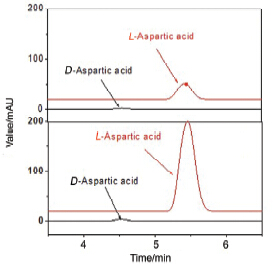
在相同的实验条件下,研究了D-半胱氨酸自组装膜对D-或L-天冬氨酸结晶行为的影响.实验结果表明,不同手性的天冬氨酸在D-半胱氨酸自组装膜提供的手性模板环境下表现出某些令人感兴趣的结晶特点.在自组装膜的诱导作用下,D-或L-天冬氨酸都沿着[100]方向择优生长.然而,显微镜图象和高效液相色谱(HPLC)结果都表明,D-或L-天冬氨酸在D-半胱氨酸自组装膜上的结晶数量却有明显不同,L-天冬氨酸的结晶数量远远大于D-天冬氨酸的结晶数量.D-和L-天冬氨酸分子存在镜面对称关系,与D-半胱酸自组装膜接近过程中,空间位阻的差别造成了L-或D-天冬氨酸结晶数量的显著差异.

本文引用格式

洪传敏 , 王海水 . D-半胱氨酸自组装膜对D-或L-天冬氨酸结晶行为的影响[J]. 化学学报, 2014 , 72(6) : 739 -742 . DOI: 10.6023/A14030188

Abstract

For amino acid, chirality is the most important feature as enantiomers have vastly different biomedicine effects and applications.Thus the research of chiral distinction is of great significance.In this paper, self-assembled monolayers (SAMs) were prepared by D-cysteine attaching to gold (111) surface and D-cysteine SAMs were used as the chiral template to induce the crystallization of D- or L-aspartic acid.Metallographic Microscope, X-ray diffraction (XRD) and High Performance Liquid Chromatography (HPLC) were carried out to characterize the crystals grown on the SAMs.The experimental results revealed that SAMs have significant effects on the crystallization habit and nucleation rate of aspartic acid enantiomers.When the crystals were grown on SAMs, the predominant nucleating planes were (100) for both D- and L-aspartic acid.Hydrogen bond between cysteine and aspartic acid (100) plane was the main force.Moreover, XRD results of D- and L-aspartic acid crystals show great difference in the peak strength.Micrographic images and HPLC curves demonstrate that a large quantity of L-aspartic acid crystals were obtained while only a small quantity of D-aspartic acid appeared.L-aspartic acids have much more nucleation sites on chiral SAMs.The above results indicated that the nucleation rate of D-aspartic acid was low.In contrast, the nucleation rate of L-aspartric acid on D-cysteine SAMs was rather effective.D- and L-aspartic acid have the nearly identical solubility, therefore, the chiral environment introduced by D-cysteine SAMs leads to the different crystallization rate of aspartic acid enantiomers.The space hinder between D-aspartic acid and D-cysteine molecules may be the key point, which lowers the nucleation rate of D-aspartic acid.

参考文献

[1] Ulman, A.Chem.Rev.1996, 96, 1533.
[2] Ma, X.L.; Yang, H.F.; Sun, X.J.; Zhu, J.; Ji, J.H.; Zhen, Y.Q.Acta Chim.Sinica 2007, 65, 1617.(马晓玲, 杨海峰, 孙晓靖, 朱筠, 纪佳华, 郑雅琴, 化学学报, 2007, 65, 1617.)
[3] Wang, X.F.; Ingall, E.; Lai, B.; Stack, A.G.Cryst.Growth Des.2010, 10, 798.
[4] Ejgenberg, M.; Mastai, Y.Chem.Commun.2011, 47, 12161.
[5] Dressler, D.H.; Mastai, Y.Cryst.Growth Des.2007, 7, 847.
[6] Singh, A.; Lee, I.S.; Kim, K.; Myerson, A.S.CrystEngComm 2011, 13, 24.
[7] Zhang, X.Z.; Yan, L.J.; Zhang, Z.H.; Yan, F.F.; Dou, J.; Li, Y.S.; Zheng, X.J.Acta Chim.Sinica 2010, 68, 931.(冯孝中, 闫立军, 张治红, 闫福丰, 豆君, 李彦山, 郑先君, 化学学报, 2010, 68, 931.)
[8] Toworfe, G.K.; Composto, R.J.; Shapiro, I.M.; Ducheyne, P.Biomaterials 2006, 27, 631.
[9] Cabrera, T.M.; Friguglietti, L.M.; King, C.M.; Larson-Mekler, A.E.; Graham, C.E.; Gurney, R.W.Cryst.Growth Des.2007, 7, 2436.
[10] Freeman, C.L.; Harding, J.H.; Duffy, D.M.Langmuir 2008, 24, 9607.
[11] Ouyang, J.M.; Chen, D.Z.Prog.Chem.2005, 17, 563.(欧阳健明, 陈德志, 化学进展, 2005, 17, 563.)
[12] Nazmutdinov, R.R.; Zhang, J.D.; Zinkicheva, T.T.; Manyurov, I.R.; Ulstrup, J.Langmuir 2006, 22, 7556.
[13] Lee, T.; Lin, Y.K.Cryst.Growth Des.2010, 10, 1652.
[14] Yun, Z.H.; Lv, H.T.Amino Acids & Biotic Resources 1996, 18, 4.(云自厚, 吕海涛, 氨基酸和生物资源, 1996, 18, 4.)
[15] Oaki, Y.; Imai, H.Langmuir 2007, 23, 5466.
[16] Wang, J.H.; Wang, J.D.; Liu, J.S.; Wang, S.; Pei, J.J.Chem.Eng.Data 2010, 55, 1735.
[17] Shin, T.; Kim, K.N.; Lee, C.W.J.Phys.Chem.B 2003, 107, 11674.
[18] Mateo-Marti, E.; Rogero, C.Langmuir 2010, 26, 4113.
[19] Kühnle, A.; Linderoth, T.R.; Besenbacher, F.J.Am.Chem.Soc.2003, 125, 14680.
[20] Dressler, D.H.; Mastai, Y.Chirality 2007, 19, 358.
[21] Singh, A.; Myerson, A.S.J.Pharm.Sci.2010, 99, 3931.
[22] Benešová, T.; Honzátko, A.; Pilin, A.; Votruba, J.; Flieger, M.J.Sep.Sci.2004, 27, 330.
文章导航

/