
基于碳量子点的稳定高效全色随机激光
收稿日期: 2018-02-01
网络出版日期: 2018-04-08
基金资助
项目受国家自然科学基金(重点项目No.21233003,面上项目No.21573019)和中央高校基本科研业务费专项资金资助.
Highly Efficient and Stable Full-Color Random Lasing Emission Based on Carbon Quantum Dots
Received date: 2018-02-01
Online published: 2018-04-08
Supported by
Project supported by the National Natural Science Foundation of China (Key program, No. 21233003; General Program, No. 21573019), and the Fundamental Research Funds for the Central Universities.
郗梓帆 , 袁方龙 , 王子飞 , 李淑花 , 范楼珍 . 基于碳量子点的稳定高效全色随机激光[J]. 化学学报, 2018 , 76(6) : 460 -466 . DOI: 10.6023/A18020048
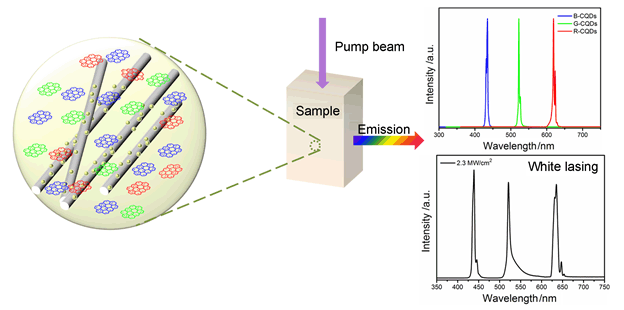
The emerging fluorescent carbon quantum dots (CQDs) have shown enormous potentials in optoelectronic applications owing to their outstanding characteristics, such as tunable stable fluorescence emission, low cost, and environment-friendliness. However, the fluorescence of most reported CQDs is dominated by surface defects, which are in general energy dissipative, hard to support lasing emission. We have previously reported the bandgap emission CQDs from blue to red with a quantum yield (QY) over 50%, which is the highest value reported for bandgap emission CQDs. The bandgap transitions in CQDs were further confirmed by size-dependent optical properties through tansmission electron microscopy (TEM), which show uniform distribution nanoparticles with averge sizes of about 1.95, 2.41, 5.0 nm for blue, green and red CQDs, and their typical high-resolution TEM (HRTEM) images further indicates that most of the CQDs exhibit uniform atomic arrangements with high degree of crystallinity. By taking advantage of the high QY of CQDs, monochrome CQDs-based random lasing with low excitation threshold have been realized by using Au-Ag bimetallic porous nanowires as scatterers for the first time. The Au-Ag bimetallic porous nanowires possess a rough surface with Au nanoparticles and abundant nanogaps, leading to the extremely broadband surface plasmonic resonance peaks over the whole visible spectral range, which is benefit for efficient random lasing. The thresholds of the monochrome CQDs-based random lasers reached about 0.27, 0.21, 0.58 MW/cm2 for blue, green and red, respectively. The full width at half maximum (FWHM) of the monochrome CQDs-based random lasers reached about 2.5, 1.9, 2.3 nm for blue, green and red, which is even comparable to the well-developed semiconductor QDs-based random lasers. The obtained random lasers show substantial stable emission color, which is of great significance for lasing display and lighting technology. Furthermore, white lasing with a CIE coordinate at (0.32, 0.33) was first demonstrated by combining red, green, blue fluorescent CQDs. This work does serve the purpose of understanding and providing significant opportunities for further improvements of CQDs-based lasers.
Key words: carbon quantum dots; bandgap emission; random lasing; full-color; white laser
[1] Hill, M. T.; Gather, M. C. Nat. Photonics 2014, 8, 908.
[2] Luan, F.; Gu, B.; Gomes, A. S. L; Yong, K. T.; Wen, S. C.; Prasad, P. N. Nano Today 2015, 10, 168.
[3] Wiersma, D. Nat. Phys. 2008, 4, 359.
[4] Wiersma, D. Nature 2000, 406, 132.
[5] Wang, Y.; Duan, Z. J.; Qiu, Z.; Zhang, P.; Wu, J. W.; Zhang, D. K.; Xiang, T. X. Sci. Rep. 2017, 7, 8385.
[6] Polson, R. C.; Vardeny, Z. V. Appl. Phys. Lett. 2004, 85, 1289.
[7] Fan, F.; Turkdogan, S.; Liu, Z. C.; Shelhammer, D.; Ning, C. Z. Nat. Nanotechnol. 2015, 10, 796.
[8] Liu, Z. C.; Yin, L. J.; Ning, H.; Yang, Z. Y.; Tong, L. M.; Ning, C. Z. Nano Lett. 2013, 13, 4945.
[9] Lu, Y. J.; Wang, C. Y.; Kim, J.; Chen, H. Y.; Lu, M. Y.; Chen, Y. C.; Chang, W. H.; Chen, L. J.; Stockman, M. I.; Shih, C. K.; Gwo, S. Nano Lett. 2014, 14, 4381.
[10] Cai, P.; Jia, Y.; Feng, X. Y.; Li, J.; Li, J. B. Chin. J. Chem. 2017, 35, 881.
[11] Huang, L.; Li, Z. C.; Huang, S. Q.; Reiss, P.; Li, L. Acta Chim. Sinica 2017, 75, 300(in Chinese). (李志春, 黄寿强, Peter Reiss, 李良, 化学学报, 2017, 75, 300.)
[12] Shao, Y. B.; Yue, J. L.; Sun, S.; Xia, H. Chin. J. Chem. 2017, 35, 73.
[13] Li, C. L.; Zang, Z. G.; Han, C.; H, Z. P.; Tang, X. S.; Du, J.; Leng, Y. X.; Sun, K. Nano Energy 2017, 40, 195.
[14] Li, Y. J; Lv, Y. C.; Zou, C. M.; Zhang, W.; Yao, J. N.; Zhao, Y. S. J. Am. Chem. Soc. 2016, 138, 2122.
[15] Veldhuis, S. A.; Boix, P. P.; Yantara, N.; Li, M. J.; Sum, T. Z.; Mathews, N.; Mhaisalkar, S. G. Adv. Mater. 2016, 28, 6804.
[16] Rauter, P.; Capasso, F. Laser Photonics Rev. 2015, 11, 565.
[17] Li, T. F.; Li, Y. W.; Xiao, L.; Yu, H. T.; Fan, L. Z. Acta Chim. Sinica 2014, 72, 227(in Chinese). (李腾飞, 李昳玮, 肖璐, 余洪涛, 范楼珍, 化学学报, 2014, 72, 227.)
[18] Du, F. K.; Xu, J. S.; Zeng, F.; Wu, S, Z. Acta Chim. Sinica 2016, 74, 241(in Chinese). (杜方凯, 徐江生, 曾钫, 吴水珠, 化学学报, 2016, 74, 241.)
[19] Li, S. H.; Zhou, S. X.; Li, Y. C.; Li, X. H.; Zhu, J.; Fan, L. Z.; Yang, S. H. ACS Appl. Mater. Interfaces 2017, 9, 22332.
[20] Liu, Y. T.; Zhou, S. X.; Fan, L. Z.; Fan, H. Microchim. Acta 2016, 183, 2605.
[21] Xie, R. B.; Wang, Z. F.; Yu, H. T.; Fan, Z. T.; Yuan, F. L.; Li, Y. C.; Li, X. H.; Fan, L. Z.; Fan, H. Electrochim. Acta 2016, 201, 220.
[22] Guo, R. H.; Zhou, S. X.; Li, Y. C.; Li, X. H.; Fan, L. Z.; Voelcker, N. H. ACS Appl. Mater. Interfaces 2015, 7, 23958.
[23] Li, S. H.; Li, Y. C.; Gao, J.; Zhu, J.; Fan, L. Z.; Li, X. H. Anal. Chem. 2014, 86, 1021.
[24] Fan, Z. T.; Zhou, S. X.; Garcia, C.; Fan, L. Z.; Zhou, J. B. Nanoscale 2017, 9, 4928.
[25] Yuan, F. L.; Ding, L.; Li, Y. C.; Li, X. H.; Fan, L. Z.; Zhou, S. X.; Fang, D. C.; Yang, S. H. Nanoscale 2015, 7, 11727
[26] Fan, Z. T.; Li, S. H.; Yuan, F. L.; Fan, L. Z. RSC Adv. 2015, 5, 19773.
[27] Yuan, F. L.; Li, S. H.; Fan, Z. T.; Meng, X. Y.; Fan, L. Z.; Yang, S. H. Nano Today 2016, 11, 565.
[28] Xie, R. B.; Wang, Z. F.; Liu, Y. T.; Fan, L. Z.; Li, Y. C.; Li, X. H.; Anal. Methods 2016, 8, 4001.
[29] Pan, L. L.; Sun, S.; Zhang, A. D.; Jiang, K.; Zhang, L.; Dong, C. Q.; Huang, Q.; Wu, A. G.; Lin, H. W. Anal. Methods 2012, 4, 58.
[30] Wang, Z. F.; Yuan, F. L.; Li, X. H.; Li, Y. C.; Zhong, H. Z.; Fan, L. Z.; Yang, S. H. Adv. Mater. 2017, 29, 1702910.
[31] Yuan, F. L.; Wang, Z. B.; Li, X. H.; Li, Y. C.; Tan, Z. A.; Fan, L. Z.; Yang, S. H. Adv. Mater. 2017, 29, 1604436.
[32] Xie, W. J.; Fu, Y. Y.; Ma, H.; Zhang, M.; Fan, L. Z. Acta Chim. Sinica 2012, 70, 2169(in Chinese). (谢文菁, 傅英懿, 马红, 张沫, 范楼珍, 化学学报, 2012, 70, 2169.)
[33] Zhang, M.; Bai, L. L.; Shang, W. H.; Xie, W. J.; Ma, H.; Fu, Y. Y.; Fang, D. C.; Sun, H.; Fan, L. Z.; Han, M.; Liu, C. M.; Yang, S. H. J. Mater. Chem. 2012, 22, 7461.
[34] Fan, Z. T.; Li, Y. C.; Li, X. H.; Fan, L. Z.; Zhou, S. X.; Fang, D. C.; Yang, S. H. Carbon 2014, 70, 149.
[35] Tan, X. Y.; Li, Y. C.; Li, X. H.; Zhou, S. X.; Yang, S. H. Chem. Commun. 2015, 51, 2544.
[36] Shi, X. Y.; Wang, Y. R.; Wang, Z. N.; Wei, S. J.; Sun, Y. Y.; Liu, D. H.; Zhou, J.; Zhang, Y. Y.; Shi, J. W. Adv. Optical Mater. 2014, 2, 88.
[37] Chen, R.; Utama, M. I. B.; Peng, Z. P.; Peng, B.; Xiong, Q. H.; Sun, H. D. Adv. Mater. 2011, 23, 1404.
/
| 〈 |
|
〉 |

