
羟基和氨基取代偕胺肟用于海水提铀的理论研究
收稿日期: 2024-08-07
网络出版日期: 2024-10-10
基金资助
中国海水提铀技术创新联盟创新发展基金(CNNC-CXLM-202216); 中国海水提铀技术创新联盟创新发展基金(CNNC-CXLM-202204); 国家自然科学基金(U2067212); 国家杰出青年科学基金(21925603)
Theoretical Study of Hydroxyl- and Amino-substituted Amidoxime Ligands for Extraction of Uranium from Seawater
Received date: 2024-08-07
Online published: 2024-10-10
Supported by
Innovation Development Fund of China Seawater Uranium Extraction Technology Innovation Alliance(CNNC-CXLM-202216); Innovation Development Fund of China Seawater Uranium Extraction Technology Innovation Alliance(CNNC-CXLM-202204); National Natural Science Foundation of China(U2067212); National Science Fund for Distinguished Young Scholars(21925603)
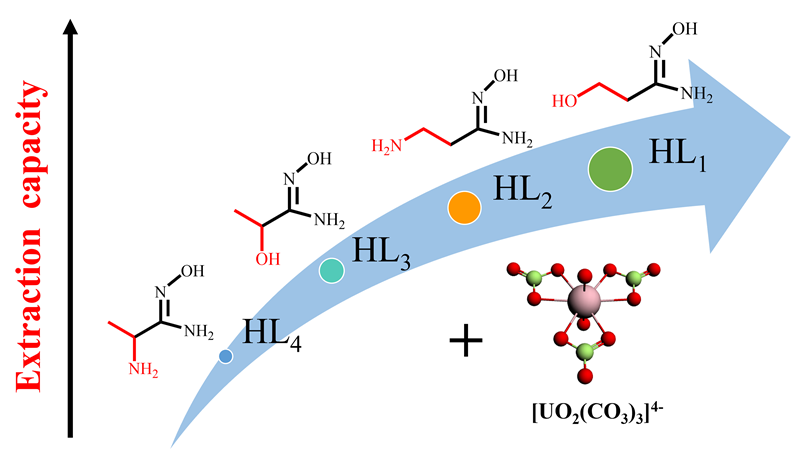
偕胺肟配体对铀酰离子具有较强的配位能力, 在海水提铀领域备受关注. 研究发现偕胺肟配体中引入氨基和羟基等基团能够提高其对铀酰离子的萃取能力. 为了从理论上探究氨基和羟基取代的偕胺肟衍生物用于海水提铀的萃取机理, 本工作采用密度泛函理论(DFT)方法系统研究了四种偕胺肟类配体(HL1: β-羟基-N-羟基丙脒; HL2: β-氨基-N-羟基丙脒; HL3: α-羟基-N-羟基丙脒; HL4: α-氨基-N-羟基丙脒)及其与铀酰离子形成的单取代、双取代、三取代配合物的结构、成键性质以及热力学稳定性. 研究结果表明, 与未修饰的偕胺肟(HAO)配体相比, HL1在水溶液中更容易与[UO2(CO3)3]4−发生取代反应, 可能是一种能够应用于海水提铀的潜在配体. 本工作为高效海水提铀吸附基团的设计与开发提供了理论线索.
黄伊晨 , 聂长明 , 王聪芝 , 陈树森 , 宋艳 , 李昊 , 石伟群 . 羟基和氨基取代偕胺肟用于海水提铀的理论研究[J]. 化学学报, 2024 , 82(10) : 1050 -1057 . DOI: 10.6023/A24080234
As the main fuel for the operation of nuclear power plants, uranium is mainly supplied through terrestrial mining. However, terrestrial uranium resources are insufficient and unevenly distributed, and the mining process is prone to environmental pollution. In contrast, seawater contains about 4.5 billion tons of uranium, which is 1000 times the total amount of terrestrial uranium resources. If utilized effectively, it could meet the demand for nuclear energy for thousands of years. However, it is extremely difficult to extract uranium from seawater. At present, the most effective and economical method for extracting uranium from seawater is the adsorption method, and the key lies in the development of highly selective, low-cost, simple and durable adsorbent materials. The amidoxime ligands have attracted extensive attention in the field of uranium extraction from seawater because of their better coordination capacity to uranyl cations. It was found that the introduction of hydroxyl and amino groups into amidoxime ligands could improve their adsorption capacity for uranyl cations. In order to investigate the extraction mechanism of hydroxyl- and amino-substituted amidoxime derivatives with uranyl cations, the present work systematically investigates the structures, bonding properties, and thermodynamic stabilities of four amidoxime ligands (HL1: N',3-dihydroxypropionamidine; HL2: 3-amino-N'-hydroxypropionamidine; HL3: N',2-dihydroxypropio- namidine; HL4: 2-amino-N'-hydroxypropionamidine) and its mono-, di-, and tri-substituted uranyl complexes by density functional theory (DFT). The results show that the presence of hydrogen bonding enhances the stability of the uranyl complexes, and the L2− ligand has stronger covalent interaction with the uranyl cations compared to the other three ligands. However, the relatively high dissociation energy of the HL2 ligand leads the HL1 ligand to be more susceptible from substitution reactions with [UO2(CO3)3]4− compared to HL2. Comparing with unmodified amidoxime (HAO) ligands, HL1 may be a potential ligand that can be applied to seawater uranium extraction. The present work provides theoretical clues for the design and development of adsorption groups for efficient seawater extraction of uranium.
| [1] | Ahmed, B.; Ahmad, Z.; Ihsan, A.; Khan, M. A.; Fazal, T. Sep. Purif. Technol. 2024, 338 126507. |
| [2] | Xu, H.; Wang, C.-Z.; Liu, S.-R.; Shi, W.-Q. Acta Chim. Sinica 2024, 82 458 (in Chinese). |
| [2] | (徐晗, 王聪芝, 刘峙嵘, 石伟群, 化学学报, 2024, 82 458.) |
| [3] | Zhang, X.; Zhang, L.; Bo, T.; Huang, S.; Huang, Z.; Shi, W. Chin. Chem. Lett. 2022, 33 3527. |
| [4] | Zhu, Y.-J.; Xu, Y.; Jian, M.-P.; Li, H.-Y.; Wang, C.-C. Chem. Ind. Eng. Prog. 2023, 42 3029 (in Chinese). |
| [4] | (朱雅静, 徐岩, 简美鹏, 李海燕, 王崇臣, 化工进展, 2023, 42 3029.) |
| [5] | Tian, G.-X.; Liu, T.-T.; Yang, S.-L. At. Energy Sci. Technol. 2023, 57 1 (in Chinese). |
| [5] | (田国新, 刘婷婷, 杨素亮, 原子能科学技术, 2023, 57 1.) |
| [6] | Tang, X.-R.; Huang, P.-L.; Ruan, H.-M.; Tang, L.; Gong, X.; Duan, T.; Chen, S.-S; He, R.; Zhu, W.-K. J. Nucl. Radiochem. 2023, 45 267 (in Chinese). |
| [6] | (唐兴睿, 黄鹏玲, 阮昊明, 唐丽, 龚翔, 段涛, 陈树森, 何嵘, 竹文坤, 核化学与放射化学, 2023, 45 267.) |
| [7] | Zhang, D.; Fang, L.; Liu, L. J.; Zhao, B.; Hu, B. W.; Yu, S. J.; Wang, X. K. Sep. Purif. Technol. 2023, 320 124204. |
| [8] | Tang, N.; Liang, J.; Niu, C. G.; Wang, H.; Luo, Y.; Xing, W. L.; Ye, S. J.; Liang, C.; Guo, H.; Guo, J. Y.; Zhang, Y. F.; Zeng, G. M. J. Mater. Chem. A 2020, 8 7588. |
| [9] | Feng, L.; Wang, H.; Feng, T.; Yan, B.; Yu, Q.; Zhang, J.; Guo, Z.; Yuan, Y.; Ma, C.; Liu, T.; Wang, N. Chin. J. Chem. 2022, 61, e202101015. |
| [10] | Xie, Y.; Liu, Z.; Geng, Y.; Li, H.; Wang, N.; Song, Y.; Wang, X.; Chen, J.; Wang, J.; Ma, S.; Ye, G. Chem. Soc. Rev. 2023, 52 97. |
| [11] | Li, Y.; Zheng, Y. J.; Ahamd, Z.; Zhu, L. X.; Yang, J. J.; Chen, J. P.; Zhang, Z. P. Coord. Chem. Rev. 2023, 491 215234. |
| [12] | Li, L.-Y.; Wen, J.; Hu, S.; Wang, X.-L. J. Nucl. Radiochem. 2022, 44 15 (in Chinese). |
| [12] | (李璐琰, 文君, 胡胜, 汪小琳, 核化学与放射化学, 2022, 44 15.) |
| [13] | Li, Z.-M.; Niu, Y.-Q.; Su, Y.-T.; Song, Y.; Wang, F.-J.; Gou, Y.-F.; Wang, H.-Z.; Chen, H.-S. J. Nucl. Radiochem. 2022, 44 233 (in Chinese). |
| [13] | (李子明, 牛玉清, 宿延涛, 宋艳, 王凤菊, 勾阳飞, 王海珍, 陈树森, 核化学与放射化学, 2022, 44 233.) |
| [14] | Liu, Z.-Y.; Xie, Y.; Wang, Y.-F.; Hu, T.-Y.; Ye, G.; Chen, J. Tsinghua Univ. (Sci. & Technol.) 2021, 61 23 (in Chinese). |
| [14] | (刘泽宇, 谢忆, 王一凡, 胡铜洋, 叶钢, 陈靖, 清华大学学报(自然科学版), 2021, 61 23.) |
| [15] | Sun, B.; Liu, Q.; Gao, Y.; Han, L.; Zhang, R.; Zhang, C.; Jia, X. Ind. Chem. Mater. 2024, 2 154. |
| [16] | Yi, T.; Cen, Z.; Ji, Y.; Huang, J.; Liang, M.; Liu, S. -H Adv. Funct. Mater. 2024, 2404220. |
| [17] | Wang, C. Z.; Lan, J. H.; Wu, Q. Y.; Luo, Q.; Zhao, Y. L.; Wang, X. K.; Chai, Z. F.; Shi, W. Q. Inorg. Chem. 2014, 53 9466. |
| [18] | Qin, Z.; Ren, Y.; Shi, S.; Yang, C.; Yu, J.; Wang, S.; Jia, J.; Yu, H.; Wang, X. L. RSC Adv. 2017, 7 18639. |
| [19] | Luan, X. F.; Wang, C. Z.; Wu, Q. Y.; Lan, J. H.; Chai, Z. F.; Xia, L. S.; Shi, W. Q. J. Phys. Chem. A 2022, 126 406. |
| [20] | Feng, J.; He, G.-Q.; Wei, Y.-X.; Duan, T.; Zhou, J. New Chem. Mater. 2022, 50 7 (in Chinese). |
| [20] | (冯健, 何桂强, 魏艳霞, 段涛, 周建, 化工新型材料, 2022, 50 7.) |
| [21] | Vukovic, S.; Watson, L. A.; Kang, S. O.; Custelcean, R.; Hay, B. P. Inorg. Chem. 2012, 51 3855. |
| [22] | Abney, C. W.; Mayes, R. T.; Piechowicz, M.; Lin, Z.; Bryantsev, V. S.; Veith, G. M.; Dai, S.; Lin, W. Energy Environ. Sci. 2016, 9 448. |
| [23] | Chi, F.-T.; Li, P.; Xiong, J.; Hu, S.; Gao, T.; Xia, X.-L.; Wang, X.-L. Chinese Physics B 2012, 21 093102. |
| [24] | Wang, Y.; Jiang, Y.; Zhang, Y.; Liu, X.; Sun, S.; Qin, S.; Huang, J.; Chen, B. Chemosphere 2023, 343 140257. |
| [25] | Xia, X.; Liao, Z.; Deng, J.; Yang, G.; Nie, X.; Ma, C.; Cheng, W.; Pan, N.; Zhang, W.; Dong, F. Environ. Pollut. 2024, 344 123269. |
| [26] | Yu, B.; Zhang, L.; Ye, G.; Liu, Q.; Li, J.; Wang, X.; Chen, J.; Xu, S.; Ma, S. Nano Res. 2020, 14 788. |
| [27] | Sun, Q.; Aguila, B.; Perman, J.; Ivanov, A. S.; Bryantsev, V. S.; Earl, L. D.; Abney, C. W.; Wojtas, L.; Ma, S. Nat. Commun. 2018, 9 1644. |
| [28] | Alexandratos, S. D.; Zhu, X.; Florent, M.; Sellin, R. Ind. Eng. Chem. Res. 2016, 55 4208. |
| [29] | Li, B.; Liu, J.; Chen, S.; Song, Y.; Liu, Q.; Yu, J.; Chen, R.; Zhu, J.; Li, R.; Wang, J. Desalination 2024, 586 117894. |
| [30] | Zhen, D.; Liu, C.; Deng, Q.; Li, L.; Grimes, C. A.; Yang, S.; Cai, Q.; Liu, Y. ACS Appl. Mater. Interfaces 2024, 16 27804. |
| [31] | Zhang, J.; Glezakou, V.-A. Int. J. Quantum Chem. 2021, 121, e26553. |
| [32] | Zhang, J.; Dolg, M. Phys. Chem. Chem. Phys. 2016, 18 3003. |
| [33] | Zhang, J.; Dolg, M. Phys. Chem. Chem. Phys. 2015, 17 24173. |
| [34] | Zhang, J. J. Chem. Phys. 2022, 156 204108. |
| [35] | Vanommeslaeghe, K.; Hatcher, E.; Acharya, C.; Kundu, S.; Zhong, S.; Shim, J.; Darian, E.; Guvench, O.; Lopes, P.; Vorobyov, I.; Mackerell Jr., A. D. J. Comput. Chem. 2010, 31 671. |
| [36] | Pomogaev, V.; Tiwari, S. P.; Rai, N.; Goff, G. S.; Runde, W.; Schneider, W. F.; Maginn, E. J. Phys. Chem. Chem. Phys. 2013, 15 15954. |
| [37] | Frisch, M. J.; Trucks, G. W.; Schlegel, H. B.; Scuseria, G. E.; Robb, M. A.; Cheeseman, J. R.; Scalmani, G.; Barone, V.; Petersson, G. A.; Nakatsuji, H.; Li, X.; Caricato, M.; Marenich, A. V.; Bloino, J.; Janesko, B. G.; Gomperts, R.; Mennucci, B.; Hratchian, H. P.; Ortiz, J. V.; Izmaylov, A. F.; Sonnenberg, J. L.; Williams; Ding, F.; Lipparini, F.; Egidi, F.; Goings, J.; Peng, B.; Petrone, A.; Henderson, T.; Ranasinghe, D.; Zakrzewski, V. G.; Gao, J.; Rega, N.; Zheng, G.; Liang, W.; Hada, M.; Ehara, M.; Toyota, K.; Fukuda, R.; Hasegawa, J.; Ishida, M.; Nakajima, T.; Honda, Y.; Kitao, O.; Nakai, H.; Vreven, T.; Throssell, K.; Montgomery Jr., J. A.; Peralta, J. E.; Ogliaro, F.; Bearpark, M. J.; Heyd, J. J.; Brothers, E. N.; Kudin, K. N.; Staroverov, V. N.; Keith, T. A.; Kobayashi, R.; Normand, J.; Raghavachari, K.; Rendell, A. P.; Burant, J. C.; Iyengar, S. S.; Tomasi, J.; Cossi, M.; Millam, J. M.; Klene, M.; Adamo, C.; Cammi, R.; Ochterski, J. W.; Martin, R. L.; Morokuma, K.; Farkas, O.; Foresman, J. B.; Fox, D. J. Gaussian 16, Revision B. 01, Gaussian Inc., Wallingford, CT, 2016. |
| [38] | Ustynyuk, Y. A.; Alyapyshev, M. Y.; Babain, V. A.; Ustynyuk, N. A. Russ. Chem. Rev. 2016, 85 917. |
| [39] | Su, L.; Wu, Q.; Wang, C.; Lan, J.; Shi, W. Chin. Chem. Lett. 2024, 35 109402. |
| [40] | Su, L.-L.; Wu, Q.-Y.; Wang, C.-Z.; Lan, J.-H.; Shi, W.-Q. Inorg. Chem. 2024, 63 9478. |
| [41] | Andrae, D.; H?u?ermann, U.; Dolg, M.; Stoll, H.; Preu?, H. Theor. Chim. Acta 1991, 78 247. |
| [42] | Dolg, M.; Wedig, U.; Stoll, H.; Preuss, H. J. Chem. Phys. 1987, 86 866. |
| [43] | Moellmann, J.; Grimme, S. J. Phys. Chem. C 2014, 118 7615. |
| [44] | Andzelm, J.; K?lmel, C.; Klamt, A. J. Chem. Phys. 1995, 103 9312. |
| [45] | Baldridge, K.; Klamt, A. J. Chem. Phys. 1997, 106 6622. |
| [46] | Barone, V.; Cossi, M. J. Phys. Chem. A 1998, 102 1995. |
| [47] | Cossi, M.; Rega, N.; Scalmani, G.; Barone, V. J. Comput. Chem. 2003, 24 669. |
| [48] | Luan, X.-F.; Wang, C.-Z.; Xia, L.-S.; Shi, W.-Q. Acta Chim. Sinica 2022, 80 708 (in Chinese). |
| [48] | (栾雪菲, 王聪芝, 夏良树, 石伟群, 化学学报, 2022, 80 708.) |
| [49] | Luan, X.-F.; Wang, C.-Z.; Wu, Q.-Y.; Lan, J.-H.; Chai, Z.-F.; Xia, L.-S.; Shi, W.-Q. Dalton Trans. 2022, 51 11381. |
| [50] | Camaioni, D. M.; Schwerdtfeger, C. A. J. Phys. Chem. A 2005, 109 10795. |
| [51] | Reed, A. E.; Curtiss, L. A.; Weinhold, F. Chem. Rev. 2002, 88 899. |
| [52] | Lu, T. J. Chem. Phys. 2024, 161 082503. |
| [53] | Lu, T.; Chen, F. J. Comput. Chem. 2012, 33 580. |
| [54] | Politzer, P.; Murray, J. S. Reviews in Computational Chemistry, Vol. 2, Eds.: Kenny, B. L.; Donald, B. B., Wiley, New York, 1991, pp. 273-303. |
| [55] | Bader, R. F. W.; Matta, C. F. Inorg. Chem. 2001, 40 5603. |
| [56] | Lu, T.; Chen, Q. J. Comput. Chem. 2022, 43 539. |
| [57] | Xu, H.; Wang, C.-Z.; Wu, Q.-Y.; Lan, J.-H.; Chai, Z.-F.; Liu, Z.-R.; Shi, W.-Q. J. Mol. Liq. 2024, 399 124411. |
| [58] | Clark, T.; Hennemann, M.; Murray, J. S.; Politzer, P. J. Mol. Model. 2007, 13 291. |
| [59] | Wiberg, K. B. J. Am. Chem. Soc. 2002, 90 59. |
| [60] | Reed, A. E.; Weinstock, R. B.; Weinhold, F. J. Chem. Phys. 1985, 83 735. |
| [61] | Espinosa, E.; Alkorta, I.; Elguero, J.; Molins, E. J. Chem. Phys. 2002, 117 5529. |
| [62] | Spencer, S.; Gagliardi, L.; Handy, N. C.; Ioannou, A. G.; Skylaris, C.-K.; Willetts, A.; Simper, A. M. J. Phys. Chem. A 1999, 103 1831. |
| [63] | Neuefeind, J.; Soderholm, L.; Skanthakumar, S. J. Phys. Chem. A 2004, 108 2733. |
| [64] | Cao, Z.; Balasubramanian, K. J. Chem. Phys. 2005, 123 114309. |
| [65] | Grimme, S. J. Chem. Phys. 2006, 124 034108. |
| [66] | Schwabe, T.; Grimme, S. Phys. Chem. Chem. Phys. 2007, 9 3397. |
| [67] | Biczysko, M.; Panek, P.; Scalmani, G.; Bloino, J.; Barone, V. J. Chem. Theory Comput. 2010, 6 2115. |
/
| 〈 |
|
〉 |

