


1 引言
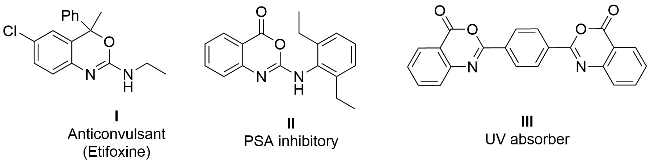
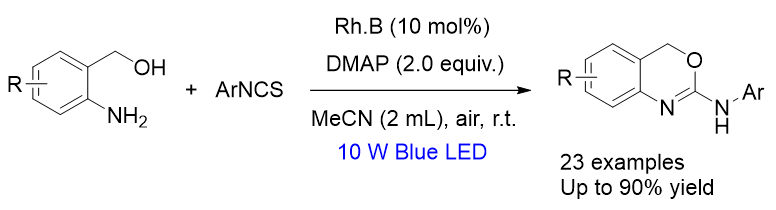
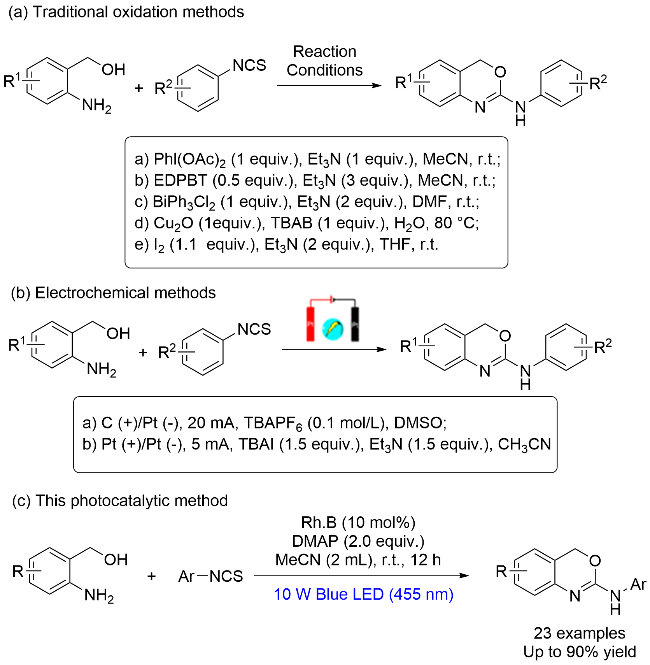
尤其是2-氨基-1,3-苯并噁嗪骨架, 因其在药物前体与功能材料中的多重应用价值[5-11], 近年来备受关注. 目前, 该类骨架的合成主要通过2-氨基苯甲醇与异硫氰酸酯反应实现, 涉及的氧化脱硫试剂包括高价碘 (III)[12]、1,1'-(乙烷-1,2-二基) 二吡啶双三溴化物(EDPBT)[13]、二氯化三苯基铋[14]、氧化亚铜[15]、单质碘[16]及过氧化氢[17](图2a). 尽管部分方法合成效率较高, 但普遍存在依赖化学计量氧化剂、使用有毒有害试剂(如铋、碘化物)等不足. 因此, 亟待开发一种高效经济、环境友好且稳定可靠的合成策略, 以突破现有2-氨基- 1,3-苯并噁嗪制备的技术瓶颈.
2 结果与讨论
2.1 反应体系的优化
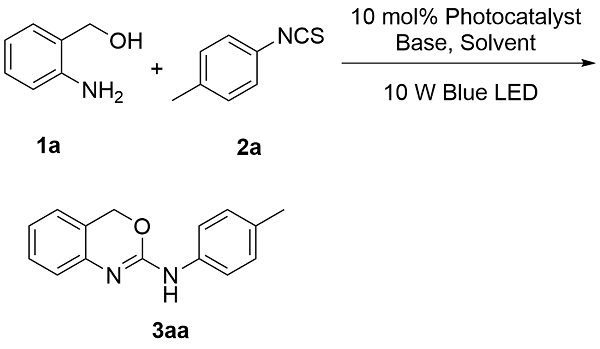
为探究2-氨基-1,3-苯并噁嗪(3aa)的光催化合成最佳反应条件, 本研究以2-氨基苯甲醇(1a)与对甲苯异硫氰酸酯(2a)为模板底物进行条件筛选(表1). 初始反应体系采用10 mol%的罗丹明B (Rh.B)为光催化剂、4-二甲氨基吡啶(DMAP)为碱、N,N-二甲基甲酰胺(DMF)为溶剂, 在室温条件下经10 W蓝色LED光源照射12 h, 目标产物3aa的产率为41%(表1, Entry 1). 通过溶剂筛选实验(表1, Entries 2~7), 依次考察了二甲基亚砜(DMSO)、1,2-二氯乙烷(DCE)、乙醇(EtOH)、乙腈(MeCN)、甲苯(Toluene)和1,4-二氧六环(1,4-dioxane)的替代效果, 结果显示乙腈(MeCN)为最佳溶剂, 产率提升至85%. 随后系统评估不同碱的影响(表1, Entries 8~14), 包括1,8-二氮杂二环十一碳-7-烯(DBU)、氢氧化钾(KOH)、叔丁醇钾(t-BuOK)、1,5-二氮杂二环[4.3.0]壬-5-烯(DBN)、碳酸钾(K2CO3)、三乙胺(Et3N)和磷酸三钠(Na3PO4), 最终确认4-二甲氨基吡啶(DMAP)仍为最优碱. 进一步筛选光催化剂(表1, Entries 15~18), 对比曙红Y (Eosin Y)、玫瑰红(Rose Bengal)、三(2,2'-联吡啶)二氯化钌([Ru(bpy)3]Cl2)和亚甲基蓝(Methylene Blue)的效果, 发现罗丹明B的综合性能最佳. 控制实验表明: 光照是该体系的关键因素, 无光照时产率低于5%; 未添加Rh.B时产率降至10%, 证实其光催化必要性(表1, Entries 19~20).
表1 2-氨基-1,3-苯并噁嗪合成反应条件的优化aTable 1 Optimization of reaction conditions for the synthesis of 2-amino-1,3-benzoxazinesa |
| Entry | Photocatalyst | Solvent | Base | Yield/% |
|---|---|---|---|---|
| 1 | Rh.B | DMF | DMAP | 41 |
| 2 | Rh.B | DMSO | DMAP | 50 |
| 3 | Rh.B | DCE | DMAP | 36 |
| 4 | Rh.B | EtOH | DMAP | 30 |
| 5 | Rh.B | MeCN | DMAP | 85 |
| 6 | Rh.B | Toluene | DMAP | 71 |
| 7 | Rh.B | 1,4-Dioxane | DMAP | 53 |
| 8 | Rh.B | MeCN | DBU | 45 |
| 9 | Rh.B | MeCN | KOH | 50 |
| 10 | Rh.B | MeCN | t-BuOK | 47 |
| 11 | Rh.B | MeCN | DBN | 50 |
| 12 | Rh.B | MeCN | K2CO3 | 78 |
| 13 | Rh.B | MeCN | Et3N | 75 |
| 14 | Rh.B | MeCN | Na3PO4 | 78 |
| 15 | Eosin Y | MeCN | DMAP | 48 |
| 16 | Rose Bengal | MeCN | DMAP | 61 |
| 17 | [Ru(bpy)3]Cl2 | MeCN | DMAP | 26 |
| 18 | Methylene Blue | MeCN | DMAP | 81 |
| 19b | Rh.B | MeCN | DMAP | <5 |
| 20 | – | MeCN | DMAP | 10 |
a Reaction conditions: 1a (0.2 mmol), 2a (0.24 mmol), photocatalyst (0.02 mmol), base (0.4 mmol), solvent (2.0 mL), open air, r.t., 12 h. b Without light. |
2.2 反应底物的拓展
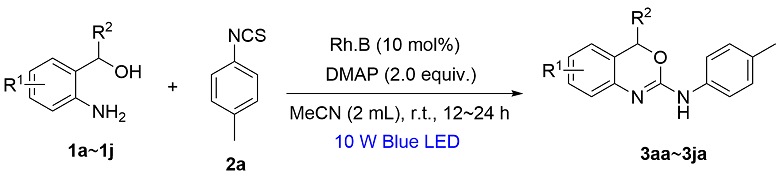
在确定最优反应条件后, 本研究系统评估了底物结构的普适性. 首先, 针对2-氨基苯甲醇的苯环取代基进行拓展(表2). 与未取代的模板底物(1a)相比, 含卤素取代基的底物(1b~1e)在12 h反应时间内转化不完全, 但延长反应至24 h后可实现原料完全转化, 目标产物(3ba~3ea)产率达60%~70%. 进一步分析取代基效应发现, 苯环对位/邻位甲基取代的底物(1f和1g)可顺利生成产物(3fa和3ga), 产率稳定于中等水平; 而当醇羟基α位引入甲基(1h)时, 产物3ha的产率显著下降至45%, 推测该位点甲基引发的空间位阻抑制了环化进程. 最后对含强吸电子基团(硝基)的底物(1i)进行了尝试, 然而反应并未成功. 这一结果表明, 该反应受电子效应的影响较为显著, 吸电子效应会对该反应的发生起到不利作用. 此外, 当使用烷基类氨基醇(1j)或烷基异硫氰酸酯(2n)进行反应时, 未能观察到目标环化产物的生成, 这可能是由于形成的烷基硫脲中间体活性较低, 难以进一步发生氧化脱硫和环化反应所致.
表2 2-氨基苯甲醇的适用范围aTable 2 Scope of 2-aminobenzyl alcoholsa |
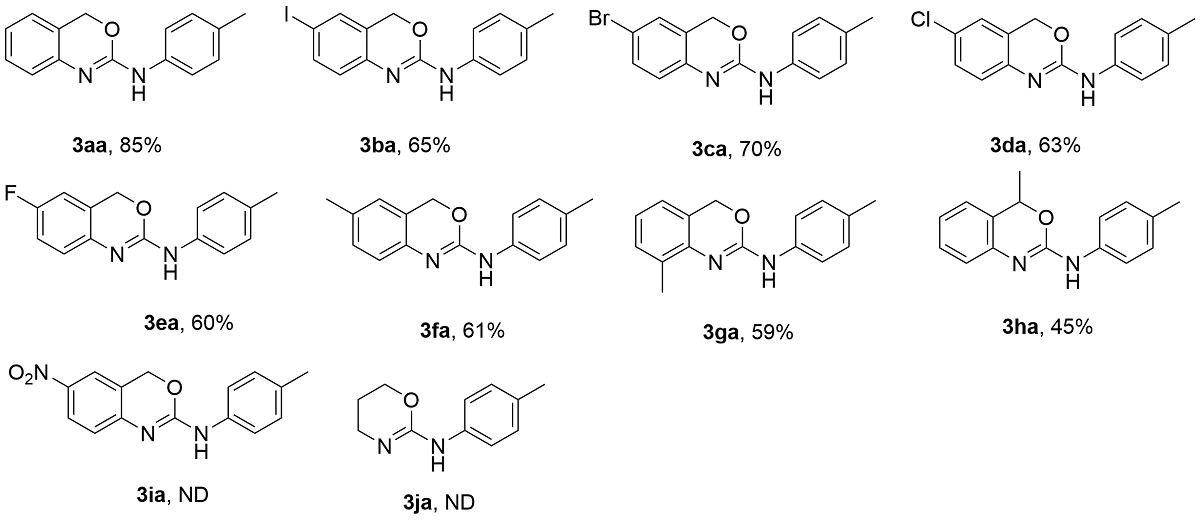 |
a Reaction conditions: 1 (0.2 mmol), 2a (0.24 mmol), DMAP (0.4 mmol), Rh.B (0.02 mmol), MeCN (2.0 mL), open air, r.t., 12~24 h. ND=Not Detected. |
随后, 系统研究了异硫氰酸酯底物的适用范围(表3), 结果表明该反应对各类取代基均表现出良好的兼容性. 含强吸电子基团(硝基、氰基)的异硫氰酸酯能以84%和75%的产率分别得到产物3ab和3ac, 而供电子基团(甲氧基、甲基)取代的底物同样以75%~80% (3ad~3af)的产率顺利转化, 并且苯基异硫氰酸酯也可以75%的产率得到产物3ag. 值得注意的是, 萘基取代的异硫氰酸酯表现出优异的反应活性, 产物3ah产率高达90%, 但吡啶杂环取代的底物产率略降至74%. 此外, 卤素取代的异硫氰酸酯(氟、氯、溴、碘)均能以70%~80%的产率得到目标产物, 这为后续通过交叉偶联反应进一步修饰苯并噁嗪骨架提供了便利. 整体而言, 不同电子性质和结构特征的异硫氰酸酯在该反应中均能高效转化为目标产物.
表3 异硫氰酸酯的适用范围aTable 3 Scope of isothiocyanatesa |

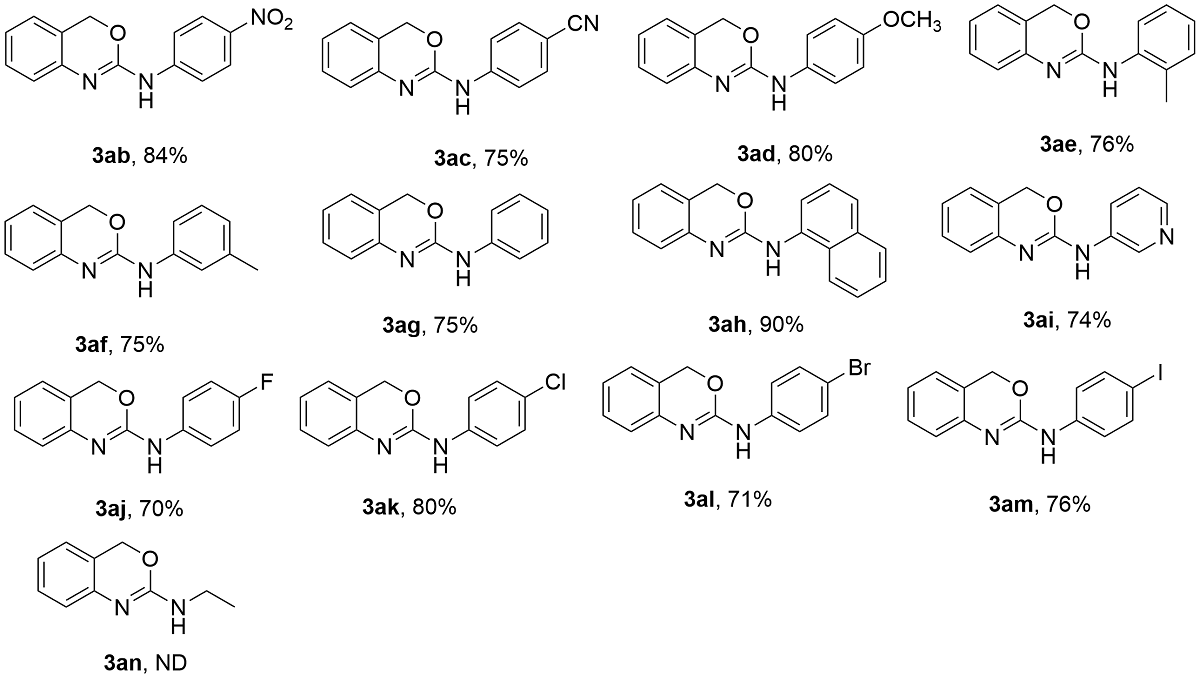 |
a Reaction conditions: 1a (0.2 mmol), 2 (0.24 mmol), DMAP (0.4 mmol), Rh.B (0.02 mmol), MeCN (2.0 mL), open air, r.t., 12 h. ND=Not Detected. |
2.3 反应机理的探究
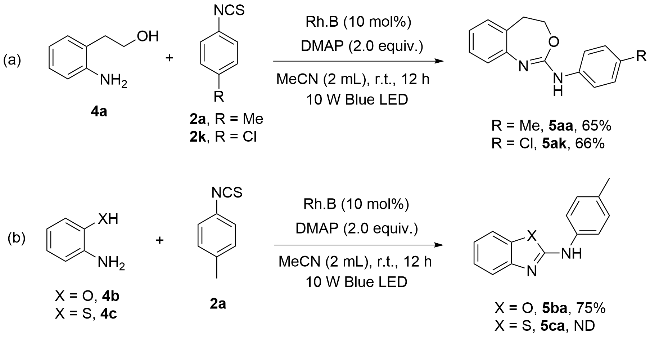
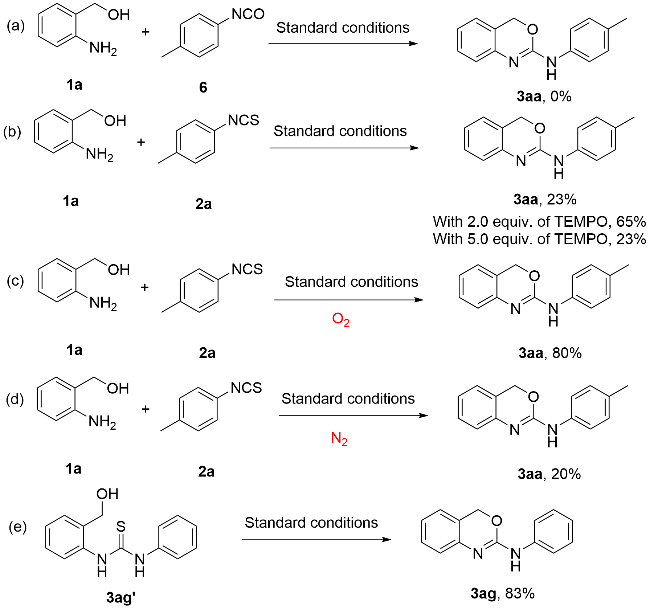
为深入探究反应机理, 我们设计并开展了一系列对照实验(图4). 首先, 在最优反应条件下, 将对甲苯异硫氰酸酯替换为对甲苯异氰酸酯(图4a), 结果未检测到目标产物3aa的生成, 这一结果确证了异硫氰酸酯中硫原子的关键作用[30-31]. 其次, 我们尝试在体系中加入2.0 equiv.的自由基捕获剂2,2,6,6-四甲基哌啶-1-氧自由基(TEMPO)时, 产物产率降低至65%; 当TEMPO提升至5.0 equiv.时, 反应产率显著降低至23%(图4b), 表明该反应可能经历自由基中间体过程. 之后, 通过气体保护实验发现, 在氧气氛围中反应可保持80%的产率(图4c), 而在氮气氛围下产率则急剧下降至20%(图4d), 这充分证明分子氧在催化循环中发挥着不可或缺的作用. 为验证反应是否经过硫脲中间体, 将分离得到的中间体3ag'作为底物, 在标准反应条件下进行转化, 成功以83%的收率获得目标产物3ag (图4e).
2.4 反应机理的提出


3 结论
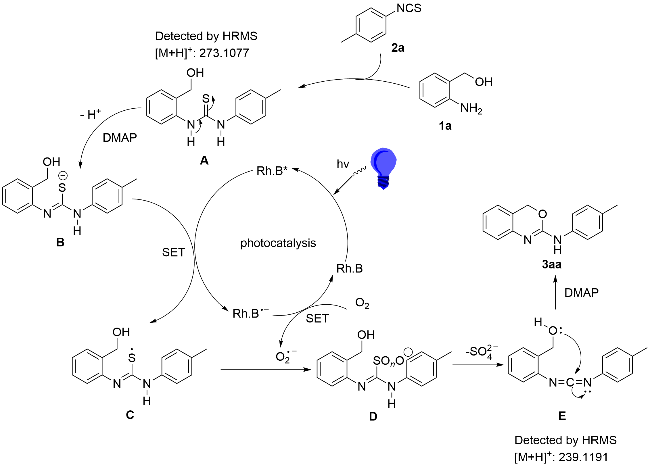
本研究开发了一种基于罗丹明B的光催化脱硫环化策略, 成功实现了2-氨基-1,3-苯并噁嗪的高效合成. 该反应在室温条件下以分子氧为氧化剂, 通过光催化产生的超氧自由基介导硫脲中间体的脱硫环化过程, 以最高90%的产率构建目标产物. 该方法具有条件温和、环境友好等优势, 对卤素、萘环及杂环等官能团展现出良好的兼容性, 为苯并噁嗪类化合物的绿色合成提供了新思路. 机理研究表明, 该反应通过单电子转移过程实现C—N和C—O键的协同构建, 为杂环化合物的光催化合成开辟了新途径.
4 实验部分
以化合物3aa的合成操作为例: 在试管中依次加入2-氨基苯甲醇(24.6 mg, 0.2 mmol)、罗丹明B (9.6 mg, 0.02 mmol)、对甲基异硫氰酸苯酯(35.8 mg, 0.24 mmol)及乙腈(2 mL). 反应体系在10 W蓝色LED (λmax=455 nm)照射下室温搅拌反应, 薄层色谱(TLC)监测反应进程. 反应完成后, 减压浓缩除去溶剂, 粗产物经硅胶柱层析(洗脱剂: V(石油醚)∶V(乙酸乙酯)=10∶1)纯化, 得到白色固体产物3aa (40.5 mg, 收率85%).
(Cheng, B.)