


1 引言
目前, 在UVA荧光粉中, 最常见的激活剂包括 Eu2+、Bi3+、Ce3+和Pb2+等. 例如: Kunghatkar等[13]制备了UVA荧光粉BaAlBO3F2:Eu2+, 在258 nm激发下可发射出357 nm的紫外光, Hosseini等[11]制备了UVA荧光粉K4SrGe3O9:Bi3+, 在304 nm激发下的发射峰位于353 nm处, 半高宽为46 nm, 量子产量为46%, 荧光寿命为477 ns. 刘等[5]制备了长余辉荧光粉Y3Ga3MgSiO12:Bi3+, 在254 nm激发下的发射峰位于324 nm, 并可与TiO2复合应用在光催化领域. Hu等[3]制备了UVA荧光粉LaB3O6:Ce3+, 在333 nm激发下于 358 nm和 380 nm处呈现连续双发射峰, 荧光寿命约为 10 ns, 在150 ℃时的发光强度仍可达室温时的73.71%. Liang等[14]开发了UVA长余辉荧光粉Sr2MgGe2O7:Pb2+, 在280 nm的激发下的发射峰位于370 nm, 余辉时间可持续超过12 h. 该材料在经历高能辐射(250~310 nm)激发后, 经过一段时间静置, 其长余辉性能可通过低能光(可见光或近红外光)刺激得以恢复.
近年来, 硼酸盐因其结构多样性、反应温度低、德拜温度高等优点, 作为荧光粉的基质材料受到了越来越多的重视[15-17]. 如Ba3Sc2(BO3)4:Eu2+[18]、Ba2Sc2((BO3)2- B2O5):Ce3+[19]、Ba3Y2B6O15:Bi3+[20]、M2B5O9Cl:Eu2+ (M=Sr, Ca)[21]、Sr[B8O11(OH)4]:Eu2+[22]、Ca[B8O11(OH)4]: Eu2+[23]、CsZn2B3O7:Eu2+[24]等. 另外, 硼酸盐晶体材料具有相对较高的高能(激光或者紫外)损伤阈值, 因此在选择UVA荧光粉的基质方面, 硼酸盐晶体材料会是一个不错的选择[13].
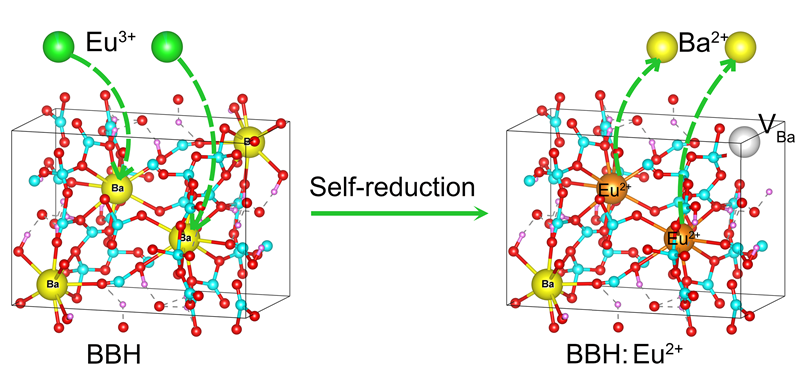
近年来, 在一些Eu2+激活荧光粉的制备过程中, 无需还原性气氛, 仅通过一些特殊基质中化合价不同的离子取代法即可将Eu3+还原成Eu2+, 此方法也称为自还原法[25]. 常见的自还原基质包括硼酸盐、硅酸盐、铝酸盐、磷酸盐等. 近些年报道的一些利用自还原法制备Eu2+激活的荧光粉如下: Ba2MgSi2O7:Eu2+/3+[26]、CaAl12O19: Eu2+/3+[27]、Ba2AlB4O9Cl:Eu2+[28]、Ba1-xZn1-yP2O7:xEu2+/3+, yMg[29]、SrAl2Si2O8:Eu2+/3+、Sr2SiO4:Eu2+/3+、SrAl2O4: Eu2+/3+[30]、BaMgP2O7:Eu2+/3+[319].
上述自还原方法一般需要较高的温度(高于900 ℃), 可称为高温自还原法, 且制备的荧光粉自还原效果有时并不理想, 其荧光光谱中出现Eu3+和Eu2+共存的现象, 发光效率和色纯度都不高. 针对上述问题, 本研究引入了一种低温(低于350 ℃)自还原法, 选择硼酸盐(Ba[B8O11(OH)4], BBH)为基质材料, 成功制备了在277 nm激发下仅有Eu2+特征光谱, 而无Eu3+特征光谱的UVA荧光粉(Ba[B8O11(OH)4]:Eu2+, BBH:Eu2+), 通过特征X射线衍射(XRD)、扫描电镜(SEM)、元素分析、光致激发和发射光谱、漫反射(DRS)及荧光衰减曲线等测试方法对该样品进行了测试和表征.
2 结果与讨论
2.1 物相组成与结构分析
如图1a所示, 将实验所得样品的XRD谱图与BBH标准模拟卡的数据进行对比, 结果显示所测样品的XRD图谱与模拟卡片的衍射峰位置高度一致, 且未出现其他物相或杂峰, 表明所获得的样品为目标产物, 证实已成功制备出纯相的BBH:xEu2+ (x=0.5%, 1%, 2%, 4%, 6%). BBH属于单斜晶系, 空间群为P21/n, 晶胞参数a=0.79080 nm, b=1.39393 nm, c=1.00472 nm, β=90.003°, V=1.1076 nm3 [32]. 采用Topas软件对Ba[B8O11(OH)4]:6%Eu2+晶体结构进行了精修. 图1b展示了XRD精修过程中获得的实验观测曲线、模拟曲线、差异曲线以及布拉格衍射峰位置. 最终的晶体结构参数及关键R因子分别汇总于表1. 精修结果表明, 轮廓残差(Rp)为6.59%, 加权轮廓因子(Rwp)为8.27%, 拟合优度(Chi2)为1.94, 说明拟合结果具有较高的可信度. 在BBH中只存在一种类型的Ba2+晶格位点. 而Eu2+的离子半径(rEu2+=0.117 nm, CN=9)小于Ba2+的离子半径(rBa2+=0.135 nm, CN=9), 因此, 发生格位取代时, 晶胞参数略有降低(详见表1). 图1c为BBH:Eu2+的晶体结构示意图(c方向观察)以及Ba/Eu和B的配位环境图. Ba/Eu2+位于四个[BO3]平面三角形和五个[BO4]四面体单元形成的大的三维(3D)三角形洞穴中. Ba/Eu2+被9个氧原子包围, 形成一个9配位的[BaO9]多面体. 此外, BBH中缺乏具有氧化性的离子, 结合刚性的[BO4]四面体框架与柔性的[BO3]三角形框架所构成的结构特征, 为基质材料内部自还原现象的发生提供了理想的化学环境. 沿c轴方向观察, BBH中存在较大的空隙, 晶胞内部原子排列不够紧密.
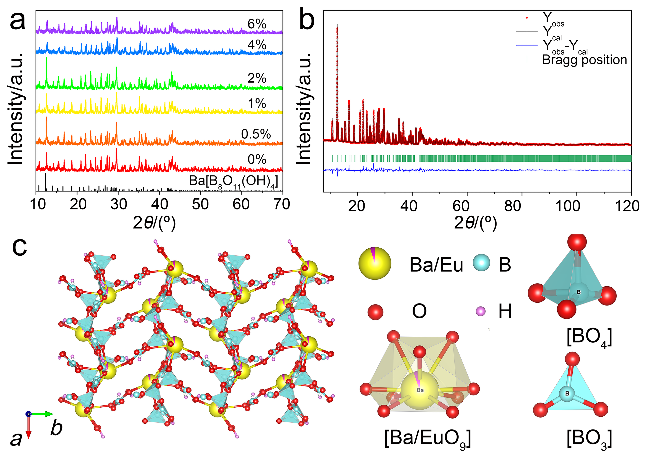
图1 (a) BBH:xEu2+ (x=0.5%, 1%, 2%, 4%, 6%)的XRD谱图; (b) BBH:6%Eu2+的结构精修图; (c) BBH的晶体结构(c方向观察)以及Ba和B的配位环境图Figure 1 (a) The XRD patterns of BBH:xEu2+ (x=0.5%, 1%, 2%, 4%, 6%); (b) the refined XRD pattern of BBH:6%Eu2+; (c) typical crystal structure of BBH (seen from c orientation), and the coordination environments of Ba and B atoms |
表1 BBH的晶胞参数与BBH:6%Eu的XRD结构精修参数对比Table 1 Comparison of the unit cell parameters of BBH with those of the XRD structure refinement parameters of BBH:6%Eu |
| Parameter | Value | |
|---|---|---|
| Formula | BBH | BBH:6%Eu |
| Crystal System | monoclinic | |
| Space Group | P21/n | |
| a/nm | 0.79080 | 0.790788 |
| b/nm | 1.39393 | 1.39391 |
| c/nm | 1.00472 | 1.004253 |
| V/nm3 | 1.1076 | 1.105876 |
| β/(o) | 90.003 | 90.147 |
| Rp | — | 6.59 |
| Rwp | 8.27 | |
| Chi2 | 1.94 | |
图2a, 2b为BBH:Eu2+的扫描电镜图谱. 从图中可以看出该荧光粉颗粒分布均匀, 大小均一, 且为较规则的长六边形片状形貌. 采用Nanomeasure软件对BBH:Eu2+样品的长度和宽度分别进行了统计分析, 结果显示其平均长度为1.39±0.31 μm, 平均宽度为0.68±0.17 μm(见支持信息图S1). 图2c为BBH:6%Eu2+的能谱图. 图中可以看出仅存在Ba、B、O、Eu、C和Cu元素, 其中的C和Cu来自铜网和碳支撑膜, H元素太轻检测不到. 图2d~2h为BBH:6%Eu2+的表面元素分析图. 可观察到Ba、B、O、Eu几种元素均匀分布在BBH:6%Eu2+的表面上.
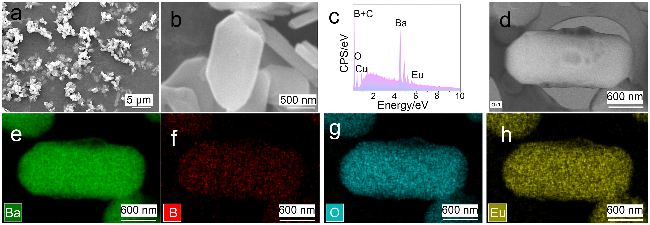
图3a为BBH的热重分析图. 从图中可以看出, 该样品在温度高于300 ℃时开始失重, 420 ℃时失重速率最大, 520 ℃时失重过程基本完成, 总失重质量比为7.36%, 推测其释放了两个H2O分子, 该数值与失去两个结晶水的理论失重量(7.67%)基本一致. 在740 ℃虽无失重, 但是差示扫描量热(DSC)显示有明显的吸热峰, 表明在此温度下BBH发生了相变. 上述结果表明, BBH具有较高的结构热稳定性. 采用密度泛函理论(DFT)方法计算了BBH的带隙宽度, 结果如图3b所示. BBH的价带顶与导带底均位于布里渊区Γ点, 表明该材料为直接带隙半导体, 且具有较大的带隙宽度(5.55 eV). 若发光材料基质的带隙较小, Eu2⁺的激发态d轨道可能接近基质导带, 从而引发温度诱导的光电离或电荷转移过程, 进而影响荧光粉的热稳定性. 因此, 具有较大带隙的基质材料通常有利于提升荧光粉的荧光热稳定性. 但荧光热稳定性由多种因素决定, 具体情况应具体分析. 图3c展示了BBH的总态密度(TDOS)和部分态密度(PDOS). 结果显示, BBH的导带主要由Ba的4d轨道以及B和O的2p轨道构成, 其中Ba的4d轨道和B的2p轨道贡献较为显著; 其价带则主要由H的1s轨道、O和B的2p轨道以及Ba的4d轨道组成, 其中O的2p轨道贡献最大. 图3d为BBH和BBH:6%Eu2+的漫反射光谱图. 通常情况下, 样品的漫反射谱线应低于标准样品BaSO4的基线, 但BBH和BBH:6%Eu2+在400 nm以下波长范围内谱线明显高于基线, 未出现漫反射的倒峰, 表明该材料为一种紫外高反射荧光粉, 这可能与其层状晶体结构有关. 图3e和图3f分别为BBH:Eu2+的X射线光电子能谱(XPS)全谱图及Eu的精细谱图, 谱图中所有元素的出锋位置都经过C 1s的出锋位置(284.8 eV)校正过. 全谱图显示, BBH:Eu2+样品中仅含有Ba、B、O、C和Eu几种元素, 表明其具有较高的纯度. 对Eu的精细谱进行高斯拟合分析, 结果显示, 在1124.96 eV和1152.91 eV处的两个峰分别对应Eu2+的3d5/2和3d3/2轨道能级; 而在1135.39 eV和1165.42 eV处的两个峰则分别归属于Eu3+的3d5/2和3d3/2轨道能级[18,22]. 根据XPS对Eu2+和Eu3+的峰面积拟合结果, Eu2+的相对含量为39.2%, Eu3+的相对含量为60.8%. Eu2+特征峰的出现表明样品制备过程中存在自还原现象.
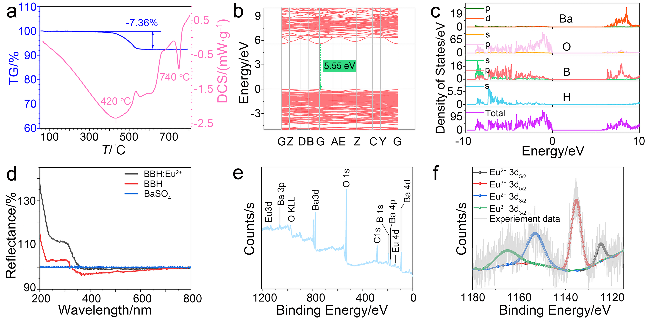
图3 (a) BBH的热重分析曲线; (b)基于DFT计算的BBH带隙值结果; (c)总态密度(TDOS)与部分态密度(PDOS)图; (d) BBH、BBH:Eu²⁺及参考样品BaSO4的漫反射光谱图; (e) BBH:Eu的XPS全谱; (f) Eu的XPS精细谱及其高斯拟合结果Figure 3 (a) Thermogravimetric analysis (TGA) curve of BBH; (b) Band gap values of BBH from DFT calculations; (c) Total and partial density of states (TDOS/PDOS) of BBH; (d) Diffuse reflectance spectra of BBH, BBH:Eu2+ and reference sample BaSO4; (e) XPS full spectrum of BBH:Eu; (f) XPS fine spectrum of Eu and corresponding Gaussian fitting results |
2.2 荧光性能分析
图4a为BBH:xEu2+ (x=0.5%, 1%, 2%, 4%, 6%)的激发光谱图. 在385 nm的检测波长下, 激发光谱在220 nm到360 nm之间具有宽的发射带, 最大出峰位置在277 nm, 可归属于Eu2+的4f65d1→4f7之间的电子跃迁[33-34]. 图4b为BBH:xEu2+ (x=0.5%, 1%, 2%, 4%, 6%)的发射光谱图. 在277 nm的激发下, 发射光谱于350到440 nm, 在385 nm达到峰值, 可归属于Eu2+的4f7→4f65d1之间的电子跃迁[35]. 其半峰宽为35 nm, 属于窄带发射. 在多数情况下, 简单的局域配位环境有利于形成简化的离子杂化轨道. 在此类结构中, 激活剂所需占据的晶体学位点种类较少, 可有效抑制因周围晶体场不均一而引起的发射光谱展宽. 此外, 当激活剂周围的配体或元素种类较为单一时, 更易实现窄带发射. 这是因为不同元素或配体可能引入差异化的电子态和化学键长, 导致不同程度的晶体场分裂, 从而加剧发射带宽的扩展. 因此, 具备较少晶体学位置和均一配位环境的材料更有利于实现窄带发射[23,36-37]. 根据BBH的晶体结构分析, Ba2+仅有一种晶格位点, 其配位原子也仅为氧离子. 该结构特征为Eu2+提供了均匀的晶体场环境, 因而BBH:Eu2+表现出明显的窄带发射特性. 另外, 发射光谱的发光强度随着掺杂离子浓度的增加呈先增大后减小的趋势, 当Eu2+掺杂浓度为2%时发光强度最强. 主要是因为随着Eu2+浓度的增大, 激活离子间的距离会小于临界距离, 就会产生能量转移, 最终将能量转移到猝灭中心(杂质离子或缺陷), 使原本可用于发光的能量以非辐射形式耗散, 发光强度反而减小, 这种现象即为浓度猝灭[38-39].
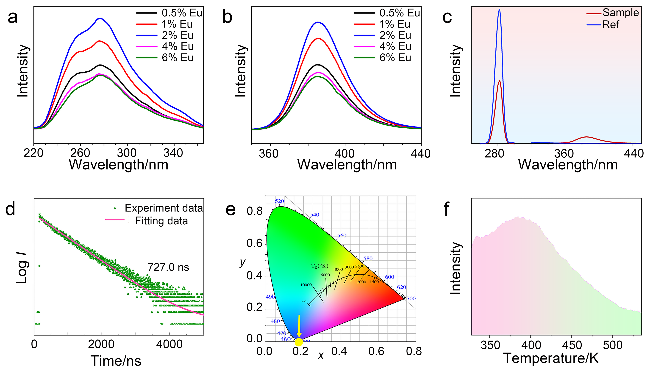
在280 nm激发条件下, 615 nm处几乎无法观测到Eu3+的发射峰(见支持信息图S2a). 当以615 nm为监测波长测得的激发光谱中, 可在240 nm(电荷转移带, CTB)和394 nm (⁷F₀→⁵L₆跃迁)处观察到两个明显的Eu3+特征激发峰(见支持信息图S2b). 在采用Eu3+电荷转移带激发(240 nm)时, 615 nm处(5D0→7F2)可检测到其特征发射峰, 但强度远低于Eu2+在385 nm处的发射峰(见支持信息图S2c). 当使用394 nm激发时, Eu3+的发射峰更为明显, 但整体发光强度仍较弱(见支持信息图S2d). 上述结果表明, 尽管XPS分析证实样品中Eu3+含量较高, 其确实存在, 但由于其发光来源于宇称禁阻的f-f电子跃迁, 辐射跃迁概率低, 导致发光效率低下, 因而发光强度显著低于Eu2+. 上述结果证实自还原过程已进行完全. 在280 nm激发下, 发射峰强度最高的BBH: 2%Eu2+的内量子产率为34.6%, 外量子产率为15.7%, 如图4c所示.
由于荧光粉在实际应用过程中不可避免地会暴露于空气中的氧气和水蒸气, 其化学稳定性对白光LED照明器件的性能可靠性至关重要. 为此, 我们将BBH:Eu2+样品在高湿度环境(相对湿度95%, 雨天条件)中暴露24 h, 以评估其环境稳定性. 结果表明, 经过24 h高湿度环境暴露后, BBH:Eu2+荧光粉的XRD图谱与荧光发射强度均与原始样品高度一致(见支持信息图S3a, 3b), 证明该材料在常规大气环境中具备优异的化学稳定性.
图4d为BBH:2%Eu2+在277 nm激发与385 nm监测下的荧光衰减曲线. 可用单指数函数(1)拟合:
$I{{I}_{0}}exp\left( \frac{t}{\tau } \right)$
其中, I为t时刻的荧光强度, I0为初始荧光强度, τ为荧光寿命, 其荧光寿命为727.0 ns. 单指数拟合说明Eu2+取代了BBH中的一种Ba2+晶格格位.
图4e为BBH:2%Eu2+的CIE色坐标图, 其CIE色坐标为(x=0.165, y=0.021), 依据下列公式(2)进行色纯度的计算:
$\text{Color purity}\frac{\sqrt{{{\left( x{{x}_{i}} \right)}^{2}}{{\left( y{{y}_{i}} \right)}^{2}}}}{\sqrt{{{\left( {{x}_{d}}{{x}_{i}} \right)}^{2}}{{\left( {{y}_{d}}{{y}_{i}} \right)}^{2}}}}$
其中x, y表示样品的CIE色坐标, xi, yi表示白色光源的CIE色坐标, xd, yd则为光源主波长的色坐标. 代入公式计算, 可得该荧光粉的紫光色纯度为97.22%.
$E\frac{{{T}_{m}}}{500}$
其中, E为缺陷能级, Tm为热释光的峰值, 单位是开尔文(K). 由于TL光谱分布较宽, 表明该样品中的缺陷能级(VBa)应呈连续分布, 位于0.646~1.046 eV范围内, 其中缺陷能级密度最大值出现在约0.77 eV处. 据上述分析结果, 推断自还原机理, 当2个Eu3+进入晶格, 为了保持电荷平衡, 会取代3个Ba2+的位置. 这就产生了1个带2个负电荷的VBa(-2)阳离子空位缺陷和2个带1个正电荷的EuBa(+1)格位位置, 再经过热刺激作用, VBa(-2)阳离子空位缺陷运动到EuBa(+1)格位位置附近, 就可以将2个正电荷的EuBa(+1)格位位置还原成2个不带电荷的EuBa(0)格位位置, 即Eu3+被还原成了Eu2+. 整个过程可用公式(4~6)[21-23]表示:
2Eu3++3Ba2+→VBa(-2)+2EuBa(+1)
VBa(-2)→VBa+2e
2EuBa(+1)+2e→2EuBa(0)
还原后的Eu2+处在BBH内阴离子基形成的空腔中, 这样能够有效阻止Eu2+在空气中被氧化. 因此, Eu2+可以在晶格中稳定存在.
2.3 热稳定性分析
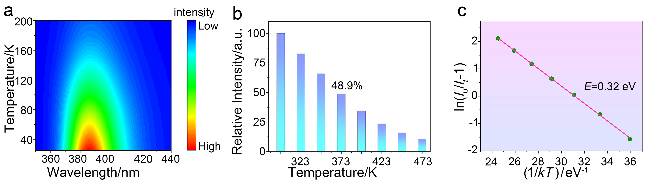
$\ln \left( \frac{{{I}_{0}}}{{{I}_{T}}}1 \right)\frac{{{E}_{a}}}{kT}$
方程(7)中, I0表示室温下测得的初始荧光强度, IT表示不同温度下测得的荧光强度, k为玻尔兹曼常数(8.62 ×10⁻⁵ eV•K-1), Ea表示热猝灭活化能. 通过拟合ln(I0/IT–1)与1/(kT)的线性关系, 所得直线的斜率即为–Ea, 从而可计算出BBH:Eu2+ 的热猝灭活化能Ea为0.32 eV, 如图5(c)所示. 上述结果表明BBH:Eu2+的热稳定性较差, 需要进一步提升.
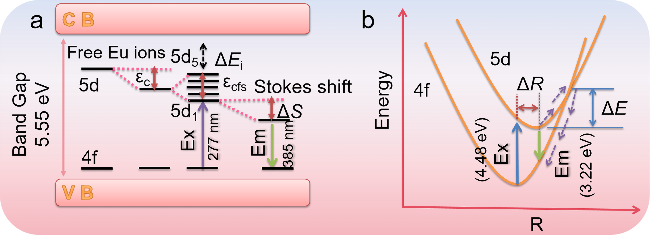
通常, 荧光粉的热猝灭机理主要有两种解释[43-45]: 热激活电离和热激活交叉弛豫, 如图6a, 6b所示. 图6a为热激活电离机理的示意图. 当基质的带隙值较小时, 在高温条件下, 激发态5d电子波函数与导带(CB)波函数之间会发生有效地耦合. 这种耦合促进了电子从激发态5d能级向导带的转移. 导带中的电子能量主要通过两种非辐射途径耗散: (1)以热的形式发生非辐射跃迁; (2)被基质晶格中的缺陷或杂质所捕获. 上述过程都会导致荧光的热猝灭现象. 然而, 通过DFT计算得出的BBH带隙值为5.55 eV, 属于宽带隙半导体材料. 因此, 该材料通过热激活电离机理发生热猝灭的可能性不高. 图6b展示了热激活交叉弛豫机理. 温度升高增强晶格振动, 导致结构松弛并产生更多热激活声子. 激发态电子与这些声子相互作用, 能量达到基态(4f)与激发态(5d)之间的交叉点后, 不再发生辐射跃迁, 而是克服活化能Ea实现非辐射跃迁回到基态. Ea越高, 热稳定性通常越强. 本研究中, BBH:Eu2+的Ea为0.32 eV, 属较高值, 理论上应具良好热稳定性, 但实验结果不理想, 因其热稳定性还受电子-声子耦合作用显著影响. 在该机理下, 高热稳定性材料需具有较小的位移坐标(ΔR), 可通过斯托克斯位移(激发与发射光谱的偏移)估算. 斯托克斯位移与黄-里斯参数密切相关, 反映电子-声子耦合强度: 位移越大, 位移坐标(ΔR)越大, 耦合越强, 热稳定性越差[46-48]. BBH:Eu2+的斯托克斯位移达10127 cm-1 (108 nm), 表明其ΔR大、电子-声子耦合强, 因而热稳定性差. 综上, BBH:Eu2+热稳定性不佳的主要原因是较大的斯托克斯位移, 其热猝灭机制以热激活交叉弛豫为主.


3 结论
本研究采用低温自还原法成功制备了高效UVA荧光粉Ba[B8O11(OH)4]:Eu2+. 该材料呈现出规则的长六边形片状微观结构, 且Eu元素均匀分布其中. 通过对其荧光性能进行表征, 结果表明在277 nm激发下, 其发射峰位于385 nm处, 半峰宽为35 nm, 呈现紫光发射. 当Eu2+掺杂浓度为2%时, 发光强度达到最大值. 此外, 该材料表现出高达97.22%的色纯度、727 ns的荧光寿命以及34.6%的量子产率. 基于热释光谱(TL)、X射线光电子能谱(XPS)及荧光光谱分析结果, 进一步探讨并阐明了其自还原反应机制. 并通过变温荧光研究了其热稳定性, 分析了其热猝灭机制主要是热激活交叉弛豫. 以上研究表明, BBH:Eu2+是一种具有应用潜力的UVA发光材料, 同时该低温自还原合成策略也为开发其他高性能荧光粉提供了新的技术路径.
4 实验部分
4.1 样品制备
首先按化学计量比分别称取H3BO3、BaCl2和Eu2O3三种试剂, 然后将上述试剂在玛瑙研钵中充分研磨10 min. 研磨均匀后的样品转移至刚玉坩埚中, 并将坩埚放入法兰式不锈钢反应釜内, 密封后置于马弗炉中, 在 350 ℃下煅烧12 h. 反应结束后, 待炉温自然冷却至室温. 所得产物用热水洗涤, 并抽滤, 随后依次使用蒸馏水和无水乙醇多次洗涤, 最后在烘箱中于80 ℃干燥6 h, 获得最终样品.
4.2 样品表征
X射线衍射图谱采用丹东浩元仪器有限公司生产的DX-2700BH型粉末衍射仪进行测定, 测试范围为 5°~70°. 晶体结构精修所用的高精度XRD数据则通过布鲁克公司的D8 Advance衍射仪采集, 测试角度范围为5°~120°, 并使用Topas软件对晶体结构进行精修分析. X射线光电子能谱(XPS)测试在AXIS ULTRA型号仪器(Kratos Analytical Ltd.)上完成, 用于确认Eu2⁺的价态信息. 材料的漫反射光谱(DRS)在Lambda 1050 UV/Vis-NIR分光光度计(PerkinElmer, 美国)上测定, 以分析其光学吸收特性. 扫描电镜图像由日立公司生产的SU8200型扫描电子显微镜获取. 光致发光的激发与发射光谱通过Hitachi公司的F-7000荧光光谱仪测定, 激发光源为150 W氙灯. 热释光谱测试采用广州仪通兴仪器仪表有限公司生产的FJ-427A1型微机热释光剂量仪进行, 升温速率为2 K/s, 测试温度区间为323~573 K, 辐照波长为254 nm, 预辐照时间为5 min. 样品的荧光衰减曲线及量子产率数据则在爱丁堡仪器公司FLS1000系统上完成测量.