


1 引言
氮杂环化合物作为重要的结构单元, 在医药、功能材料、农用化学品及染料工业等领域展现出广泛应用价值, 发展前景广阔[1-5]. 目前, 这类化合物的合成主要依赖于硝化反应[6]、芳香亲核取代[7]以及过渡金属催化的偶联反应[8]等策略. 其中, 金属催化C—N偶联反应因其优异的底物兼容性和操作简便性, 已成为构建C—N键的重要方法[9-13]. 在各类金属催化剂中, Pd催化剂因反应条件温和、官能团耐受性优异而被广泛使用[14-16], 但其高昂的成本和对有毒膦配体的依赖限制了工业化应用. 因此, Fe[17-18]、Co[19]、Ni[20-21]和Cu[22-25]等廉价过渡金属催化剂成为研究热点. 特别是铜配合物催化剂, 通过铜活性中心与氨基酸[26]、吡啶氮氧化物[27]、蚕丝蛋白[28]等配体的协同作用, 展现出高效的催化性能. 然而, 这类均相催化体系固有的催化剂回收困难、重复使用性差和反应后分离纯化复杂等问题, 严重制约了其工业化应用[29]. 为解决这些问题, 研究者开发了多种异相催化体系(如CuO纳米颗粒[30]、RGO/Cu[31]、Cu+-蒙脱土[32]等), 但仍存在催化效率不足和金属浸出等挑战. 因此, 开发高效、稳定的C—N偶联催化体系具有重要的现实意义.
金属-有机框架材料(MOFs)凭借可调的孔隙结构和超高比表面积, 在催化领域展现出独特优势[33-35]. 在C—N偶联反应方面, MOFs的开放金属位点被证明是关键活性中心. 2013年, Li等[36]首次通过二维[Cu(ima)2]n MOF实现了N-芳基咪唑类化合物的高效合成. 2019年, Duan课题组[37]通过设计混合配体双(3,5-二羧基苯基)吡啶和双(3,5-二羧基苯基)甲基吡啶构建了光响应型Zn-MOF催化剂, 系统研究了光子强度与MOF催化活性的构效关系. 2022年, Rasaily团队[38]则通过一维Cu-MOF中的不饱和位点, 对分子间和分子内C—N偶联均实现了优异的催化活性和立体选择性, 获得了99%立体选择性的四氢喹啉产物. 然而, 目前MOFs中开放金属位点的构建主要依赖于配位缺陷工程, 难以实现对活性位点均一性的精准控制[39]. 此外, 该领域的研究普遍集中于通过有机配体设计来调控金属中心的电子结构, 却在很大程度上忽视了孔道传质效率对催化反应效率的关键影响. 传统MOFs的微孔(<2 nm)导致大分子底物传质受阻, 而复杂的合成条件(如严格的前驱体比例、溶剂热控制)进一步限制了其工业化应用.
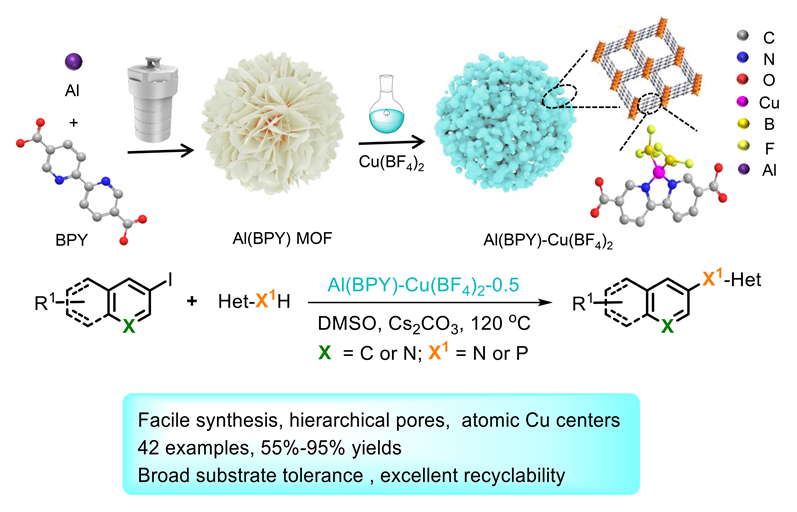
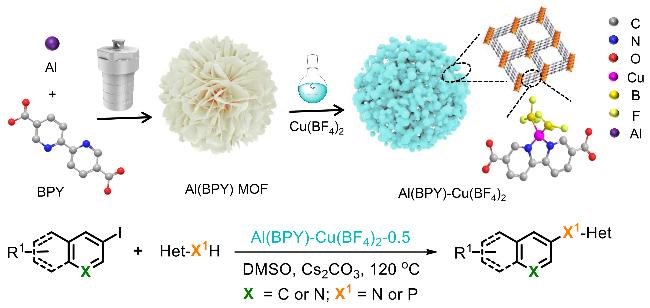
基于本课题组[40-44]在绿色催化和MOF设计方面的研究基础, 本研究开发了一种原位刻蚀策略, 以Al(BPY) MOF为前驱体, 一步构建了多级孔道结构与单位点铜活性中心(图1). 通过同步辐射X射线吸收谱(XAS)和球差校正电镜(HAADF-STEM)证实了铜物种以单原子形式均匀分布于MOF骨架中, 并基于不同孔径MOF的催化性能对比, 揭示了多级孔结构对C—N偶联反应转化率的显著调控作用. 所制备的Al(BPY)- Cu(BF4)2催化剂对底物的转化率可达93%, 且展示出优异的可循环性. 本研究阐明了多级孔道传质与铜单原子配位微环境的协同催化机制, 同时建立了多级孔MOF中“孔道传质-金属配位环境-催化活性”的定量构效关系, 为设计高效异相催化体系提供了新范式.
2 结果与讨论
2.1 Al(BPY)-Cu(BF4)2的结构及形貌调控
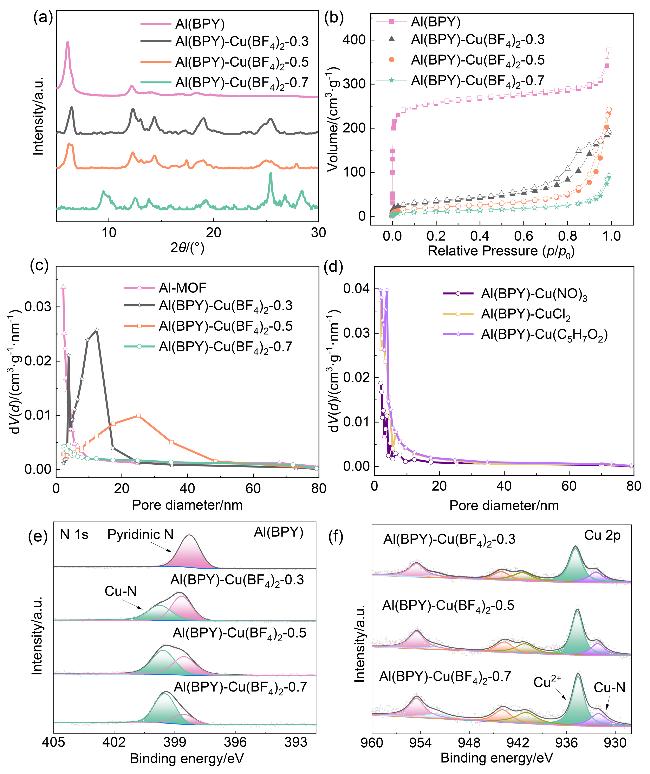
以2,2'-联吡啶-5,5-二羧酸(BPY)作为双齿氮配体, AlCl3为金属前驱体, 通过水热法制备了微孔Al(BPY) MOF. 随后, 以Cu(BF4)2作为双功能修饰剂, 通过液相浸渍法在实现分级多孔构筑的同时引入催化活性位点.通过调控Cu(BF4)2的负载量, 制备了Cu质量分数分别为3.67%、6.73%和9.56%的系列样品Al(BPY)- Cu(BF4)2-x (x=0.3, 0.5, 0.7). X射线衍射(XRD)分析表明, Al(BPY)-Cu(BF4)2保留了母体的特征衍射峰[45], 同时在2θ=19°、25.5°和28°处出现了新衍射峰, 证实了新的晶相形成(图2a). N2吸附-脱附测试表明(图2b), 随着Cu(BF4)2负载量增加, 比表面积从原始样品的996 m2/g显著下降至x=0.7样品的38 m²/g. 这种梯度递减的比表面积变化(支持信息表S1)直接证实了Cu(BF4)2对MOF孔隙空间的有效占据. 进一步的孔径分布分析(图2c)表明, 通过调控Cu(BF4)2的引入量, 可以协同调控材料中微孔与介孔的比例以及介孔的尺寸. 随着Cu(BF4)2负载量增加, 介孔在孔结构中占比显著提升, 同时介孔尺寸分布向大孔径方向偏移. 值得注意的是, 当Cu(BF4)2负载量过高(如x=0.7样品)时, 材料骨架结构发生明显坍塌, 这一现象与其比表面积的急剧降低相吻合. 对比实验发现, 其他铜盐(Cu(NO3)2、CuCl2等)修饰的样品仍保持微孔特征(图2d, 支持信息图S1, S2和表S2), 这一现象凸显了$\text{BF}_{4}^{-}$阴离子在孔道调控中的独特作用. 通过红外光谱进一步探究了其内在机制. 如支持信息图S3所示, 随着Cu(BF4)2负载量的增加, Al(BPY)- Cu(BF4)2中COOR基团在1599 cm⁻¹处的对称振动峰逐渐发生红移, 表明COO⁻与Al3+间的配位状态发生改变. 值得注意的是, 在使用Cu(NO3)2等其他铜盐修饰的样品中并未观察到类似的红移现象, 进一步印证了$\text{BF}_{4}^{-}$在调控材料配位环境中的关键作用. 为深入揭示修饰过程的化学机制, 开展了X射线光电子能谱(XPS)研究(图2e, 2f, 支持信息图S4). N 1s谱中(图2e), 原始样品在398.7 eV处的吡啶氮峰在修饰后出现399.8 eV的新特征峰, 证实了Cu2⁺-吡啶氮配位作用的形成[46]. Cu 2p谱中934.7 eV (Cu2⁺)和932.2 eV (Cu—N)双峰(图2f)表明金属位点成功锚定[47]. 原始Al(BPY)的Al 2p XPS谱图显示单一特征峰(结合能74.2 eV), 归属于典型的Al—O—C配位键(支持信息图S4). 经Cu(BF4)2修饰后, Al 2p能谱发生显著变化, 解卷积拟合揭示出三个特征峰, 其结合能分别位于74.2 eV、75.8 eV和78.5 eV. 这种峰分裂现象明确表明Al3⁺离子的配位环境发生了重构, 形成了多重化学态. 分析认为, 该现象源于$\text{BF}_{4}^{-}$阴离子与COOR之间的竞争配位效应. $\text{BF}_{4}^{-}$会优先与Al(BPY) MOF二级结构单元中的配位-OH基团作用, 首先形成F···H—O氢键, 随后进一步转化为Al—F键. 该过程导致原有的Al3⁺—COOR配位键发生解离, 从而在Al(BPY)骨架内诱发结构缺陷, 最终实现介孔结构的定向构筑.
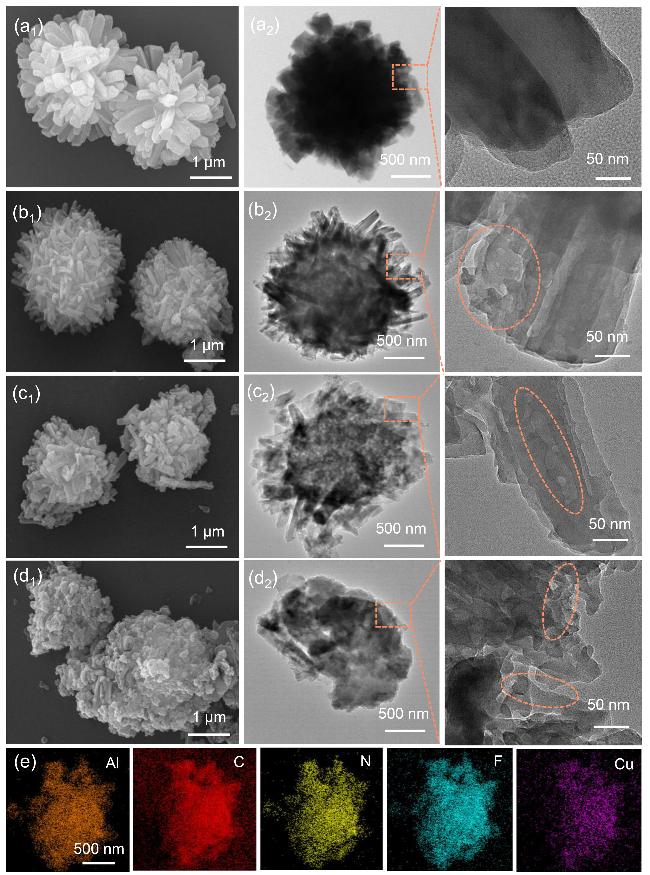
为了进一步研究Cu(BF4)2负载量对Al(BPY)的影响规律, 开展了系统的形貌表征分析. 扫描电镜(SEM)分析表明(图3a1~3d1), 原始Al(BPY)呈现规整的花状微球形貌, 而随着Cu(BF4)2负载量增加, 样品形貌发生显著变化: 从表面局部刻蚀(图3b1)到刻蚀区域扩展(图3c1), 最终导致微球结构完全坍塌(图3d1), 这一演变过程与氮气吸附结果高度吻合. 透射电镜(TEM)表征进一步显示(图3a2~3d2), Cu(BF4)2负载量的增加不仅使微球内部中空结构扩大, 同时促进了边缘区域不规则介孔的形成. 元素面分布分析(图3e)证实Al、C、N、Cu、F元素均匀分布, 验证了Cu(BF4)2在骨架中的均匀修饰.
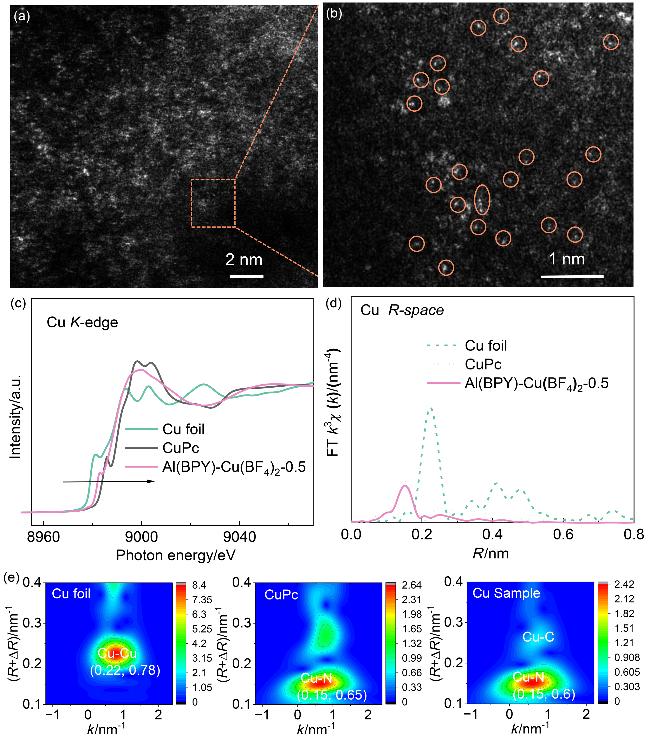
为精确解析Cu物种的原子级存在状态, 采用HAADF-STEM对材料进行了表征. 如图4a, 4b所示, 橙色圆圈标记的孤立亮点清晰可辨, 证实Cu以单原子形式均匀分散于MOF骨架中. 进一步通过X射线吸收光谱(XAS)研究了铜单原子的电子结构与配位微环境: X射线吸收近边结构(XANES)谱显示(图4c), Al(BPY)-Cu(BF4)2的吸收边位置与酞菁铜(CuPc)标准样品高度吻合, 表明铜物种主要以+2价态存在; 扩展X射线吸收精细结构(EXAFS)谱中(图4d), 0.153 nm处出现的特征峰归属于Cu—N配位作用[48], 而0.224 nm处未检测到Cu—Cu金属键信号, 证实了Cu的单原子分散特性(支持信息表S3). 小波变换分析(图4e)表明, 样品在0.6 nm⁻1处观察到的强度最大值归属于Cu—N配位键, 该位置略低于CuPc的C—N (0.65 nm⁻1), 且明显区别于Cu箔中Cu—Cu金属键对应的信号位置(0.78 nm⁻1), 进一步证实了Cu单原子位点的成功构建[49]. 综上所述, 通过Cu(BF4)2浸渍可同步构建多级孔结构与原子级分散活性位点. 基于材料形貌演变(SEM/TEM)与原子尺度结构(HAADF-STEM/XAS)的协同分析, 揭示了该方法的双重调控机制: 一方面, $\text{BF}_{4}^{-}$阴离子通过竞争配位诱导Al—O—C键断裂, 实现介孔结构的定向构筑; 另一方面, Cu2+与吡啶氮位点的特异性配位作用, 确保了金属活性位点的原子级分散.
2.2 Al(BPY)-Cu(BF4)2催化C—N偶联的性能研究
为系统研究Al(BPY)-Cu(BF4)2在Ullmann C—N偶联反应中的催化性能及其构效关系, 我们选用碘苯与咪唑为模型底物进行反应评估. 在二甲基亚砜(DMSO)作为溶剂, NaOH作为碱的条件下, Al(BPY)-Cu(BF4)2-0.5催化剂表现出优异催化活性, 可实现81%的1-苯基咪唑(3a)产率(图5a). 对照实验明确证实催化活性源自Cu²⁺位点: 未负载Cu的Al(BPY)及空白实验仅生成痕量产物(支持信息表S1). 值得注意的是, 相较于Cu(NO3)2、CuCl2和Cu(acac)2修饰的样品, Cu(BF4)2修饰催化剂表现出显著增强的活性, 这归因于其独特分级多孔结构优势——优化的孔径分布不仅提供了高效传质通道, 更显著提升了活性位点的可及性. 催化活性与Cu(BF4)2负载量呈现典型的火山型曲线关系: Al(BPY)-Cu(BF4)2-0.5表现出最优性能, 而负载量过低(0.3)或过高(0.7)均导致活性下降. 结构-活性分析表明: Al(BPY)-Cu(BF4)2-0.3的活性受限源于介孔发育不充分与活性位点不足; 而Al(BPY)-Cu(BF4)2-0.7则因过量负载引发的骨架坍塌导致活性位点包埋. 通过系统筛选反应参数(图5b, 5c, 支持信息表S4), 确定最优条件为: Cs2CO3为碱, DMSO为溶剂, n(咪唑)∶n(碘苯)=1.2, 120 ℃反应16 h. 该条件下, 7 mg催化剂Al(BPY)-Cu(BF4)2-0.5可获得93%的收率. 与已报道的同类催化剂相比(支持信息表S5), 本催化剂在反应活性方面展现出显著优势, 体现出良好的应用潜力.
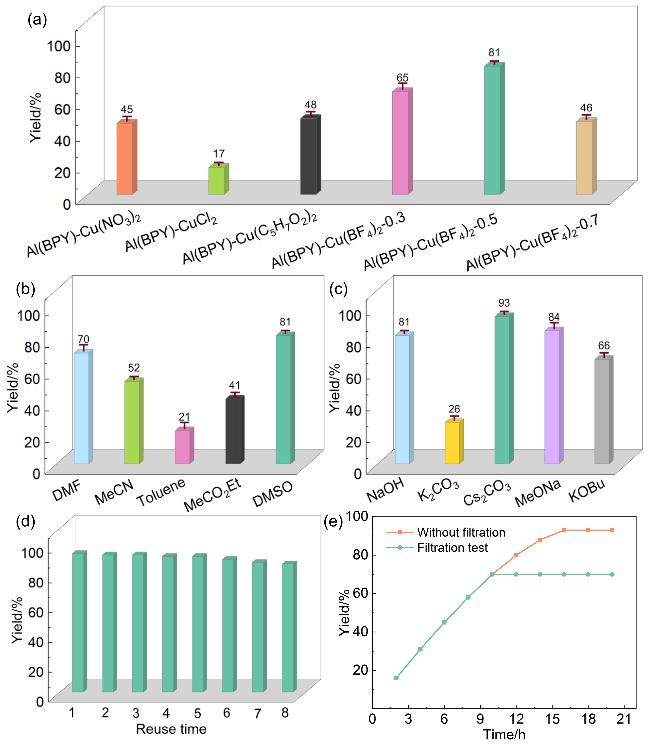
稳定性测试结果证实, Al(BPY)-Cu(BF4)2-0.5催化剂展现出优异的循环稳定性. 在连续8次反应循环后, 其催化活性仍维持在初始活性的94%以上(图5d). 另外, 浸出实验表明, 当反应进行10 h后移除催化剂, 反应转化率未见明显变化(图5e). 同时, 电感耦合等离子体质谱(ICP-MS)检测结果显示反应滤液中的铜含量<0.2 mg/L, 充分证明铜活性位点牢固锚定在MOF骨架中. 循环使用8次后的催化剂, 其XRD谱图未发生明显变化, 且Al、N、Cu元素的XPS特征峰结合能也基本保持不变(支持信息图S5), 共同表明Al(BPY)- Cu(BF4)2-0.5在催化反应中能够保持其晶型结构与表面电子环境的稳定性.
2.3 底物扩展
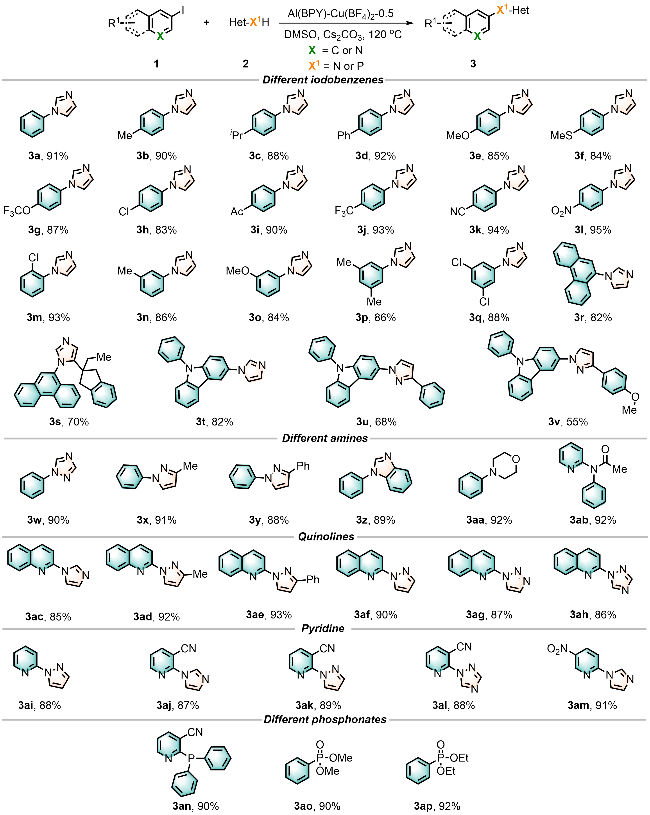
本研究系统评估了Al(BPY)-Cu(BF4)2-0.5催化体系在Ullmann C—N偶联反应中的底物适用性(图6). 在优化条件下(支持信息表S4, Entry 21), 该催化剂展现出卓越的普适性. 对于碘苯类底物, 无论取代基为强供电子基(-OMe、-SMe)或吸电子基(-NO2、-CF3), 均能以55%~95%的产率合成目标产物(3a~3v). 值得注意的是, 邻位和间位取代底物(3m~3o)的产率均保持在80%以上,显示出优异的位阻耐受性. 在复杂分子体系方面, 二取代芳基碘苯(3p, 3q)能够以优异的收率获得目标产物; 然而, 对于体积较大的菲基及N-苯基咔唑基碘化物(3r~3v), 其收率出现一定程度下降(55%~82%), 分析认为这应归因于催化剂孔道结构对传质过程的限制. 值得一提的是, α2肾上腺素能受体拮抗剂阿替美唑在该催化体系中也实现了顺利转化(3s), 进一步彰显了该方法在药物分子后期官能团化中的良好应用前景. 此外, 氮杂环类底物(3w~3ab)同样表现出高反应活性, 其中非芳香氮杂环(如吗啉(3aa)、2-乙酰胺基吡啶(3ab))的产率达92%, 突破了传统体系对芳香胺的限制. 特别值得关注的是, 该体系成功实现了吡啶及喹啉类化合物(3ac~3am)的高效偶联(85%~93%), 以及含P—H键底物的C—P偶联(3an~3ap, 90%~92%), 后者是MOF基催化剂的首例报道. 综上, 通过对42种底物的系统研究证实, Al(BPY)-Cu(BF4)2催化体系兼具优异的电子效应和空间位阻耐受性, 不仅突破了传统催化体系的限制, 实现了非芳香胺的高效偶联, 更开创了MOF催化C—P偶联的新方法.
2.4 反应机理
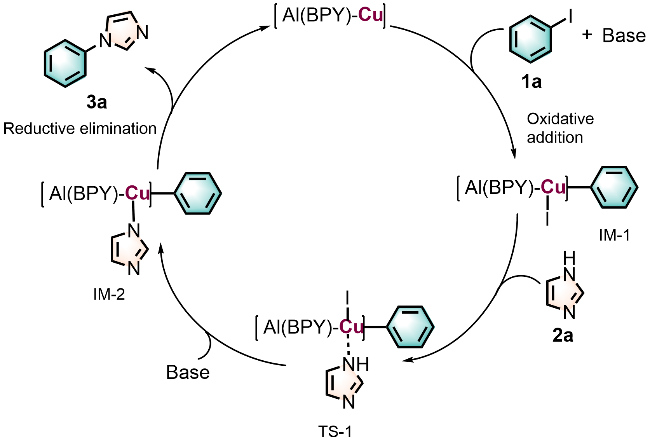
基于实验结果及相关文献报道[50-53], 我们提出了Al(BPY)-Cu(BF4)2催化Ullmann C—N偶联反应的机理路线(图7). 首先, 在碱性条件下, 芳基碘化物通过氧化加成与Cu(II)活性中心作用, 形成六配位铜(III)中间体IM-1; 随后, 氮杂环化合物通过N—H键与IM-1的强配位作用形成过渡态TS-1. 过渡态TS-1在碱辅助下完成去质子化过程, 生成六配位铜络合物中间体IM-2; 最后, 中间体IM-2经历还原消除反应, 生成产物3a, 并再生催化剂Al(BPY)-Cu(BF4)2. 根据材料表征及上述催化机理分析, Al(BPY)-Cu(BF4)2对Ullmann C—N偶联的高催化活性源于以下协同效应: (1)材料的分级孔道结构通过介孔通道显著提升了底物传质效率, 同时大幅增加了活性位点的可及性; (2)原子级分散的Cu位点能够与芳基碘苯形成活性中间体, 并通过强配位作用活化杂原子X—H键, 从而有效促进C—N偶联反应. 这种“传质增强-配位活化”的协同作用为开发高效异相偶联催化剂提供了新的设计思路.


3 结论
本研究创新性地采用Cu(BF4)2介导的原位刻蚀与功能化协同策略, 一步精准构筑了兼具多级孔道结构与原子级分散铜活性中心的高效C—N偶联催化剂. 系统表征证实: $\text{BF}_{4}^{-}$阴离子通过竞争配位诱导介孔形成, 同时Cu²⁺与吡啶氮位点特异性配位形成单原子活性中心(HAADF-STEM/XAS验证). 在一系列样品中, Al(BPY)-Cu(BF4)2-0.5因优化平衡孔道结构与活性位点暴露率, 在Ullmann C—N偶联反应中展现出卓越性能, 成功实现了42种底物的高效转化(含电子/位阻敏感底物、非芳香胺及含P—H化合物), 突破了传统均相催化剂的限制. 同时该催化剂表现出优异稳定性(8次循环后活性保持率>94%, ICP-MS检测Cu浸出<0.2 mg/L). 综合分析, 其高性能源于分级孔道提升的传质效率与单原子Cu位点配位活化作用的协同机制, 该“孔道传质-金属配位”协同模型为多级孔单原子催化剂设计提供了新范式.
4 实验部分
首先, 将151 mg AlCl3•6H2O和306 mg 2,2'-联吡啶- 5,5'-二羧酸溶解于10 mL N,N-二甲基甲酰胺溶液. 然后,将混合溶液转移至水热反应釜, 120 ℃反应24 h. 冷却后, 离心收集并用N,N-二甲基甲酰胺(DMF)、甲醇洗涤. 所得产物于甲醇溶液中浸渍3 d(每日更换新鲜溶剂), 随后于80 ℃真空中干燥12 h, 得到Al(BPY) MOF. 将100 mg Al(BPY) MOF和Cu(BF4)2的混合物分散在2 mL乙腈中, 在室温下搅拌12 h. 反应结束后, 通过离心收集蓝色粉末, 然后用乙腈和乙醇各洗涤3次, 置于80 ℃真空中干燥12 h. 据Al(BPY)与Cu(BF4)2的物质的量比, 获得的样品分别表示为Al(BPY)-Cu(BF4)2-x (x=0.3, 0.5或0.7). 采用相同方法合成了Al(BPY)-Cu(NO3)2、Al(BPY)-CuCl2和Al(BPY)-Cu(C5H7O2)2对比样品: 将100 mg Al(BPY) MOF分别与Cu(NO3)2或CuCl2(物质的量比1∶0.5)在2 mL乙腈中反应12 h, 而Cu(C5H7O2)2体系则改用三氯甲烷作为溶剂. 所有产物经离心洗涤后, 80 ℃真空干燥12 h备用.
在10 mL耐压反应管中依次加入碘苯(0.3 mmol)、氮杂环化合物(0.36 mmol)、Al(BPY)-Cu(BF4)2 (7 mg), Cs2CO3 (1.2 equiv.), DMSO (1 mL). 将反应体系密封后置于油浴中, 120 ℃恒温搅拌反应16 h. 待反应结束冷却至室温, 并用乙酸乙酯(20 mL×3)萃取. 合并的有机层依次用去离子水(10 mL)和饱和食盐水(10 mL)洗涤, 无水硫酸钠干燥后减压浓缩. 粗产物通过硅胶柱层析(洗脱剂: 乙酸乙酯/石油醚梯度体系)纯化, 获得目标偶联产物.
(Cheng, B.)