
研究展望

动态智能的中空结构多功能体系

  • 赵德偲 ,
  • 康乃馨 ,
  • 王丹
展开
  • a中国科学院过程工程研究所 生物药制备与递送全国重点实验室 北京市海淀区中关村北二街1号 100190;
    b中国科学院大学 北京市石景山区玉泉路19号 100049;
    c深圳大学 化学与环境工程学院 广东省深圳市学苑大道1066号 518071
赵德偲,中国科学院过程工程研究所副研究员。2022年于中国科学院过程工程研究所获得工学博士学位。主要从事中空多壳层结构生物材料的设计合成及应用研究,近五年以第一/通讯作者在Nat. Commun.、Angew. Chem. Int. Ed.、Adv. Mater.等期刊发表论文。王丹,深圳大学特聘教授。从事无机多功能结构体系的合成化学研究。获国家基金委杰出青年基金,国务院特殊津贴专家,中组部万人计划科技创新领军人才,科技部中青年科技创新领军人才等。现任中国化学会会士、英国皇家化学会会士、国际溶剂热水热协会理事。在Nature, Nat. Rev. Chem., Nat. Energy, Nat. Chem., Nat. Communications, Chem, J. Am. Chem. Soc., Angew. Chem. Int. Ed., Adv. Mater., Energy Environ. Sci.等期刊发表学术论文250余篇,SCI他引2.3万余次,H 因子 81,连续6年入选科睿唯安高被引科学家。

收稿日期: 2025-09-18

  网络出版日期: 2025-11-12

基金资助

国家自然科学基金(52202354),生化工程国家重点实验室开放基金(2023KF-04)

Dynamic intelligent multi-functional system based on hollow structure

  • Decai Zhao ,
  • Naixin Kang ,
  • Dan Wang
Expand
  • aState Key Laboratory of Biopharmaceutical Preparation and Delivery, Institute of Process Engineering, Chinese Academy of Sciences, 1 North 2nd Street, Zhongguancun, Beijing, 100190 P. R. China;
    bUniversity of Chinese Academy of Sciences, 19A Yuquan Road, Beijing, 100049 P.R. China;
    cShenzhen University, 1066 Xueyuan Road, Nanshan District, Shenzhen, Guangdong, 518071 P.R. China

Received date: 2025-09-18

  Online published: 2025-11-12

Supported by

NSFC(52202354), Open Funding Project of the State Key Laboratory of Biochemical Engineering & Key Laboratory of Biopharmaceutical Preparation and Delivery (No. 2023KF-04).

摘要

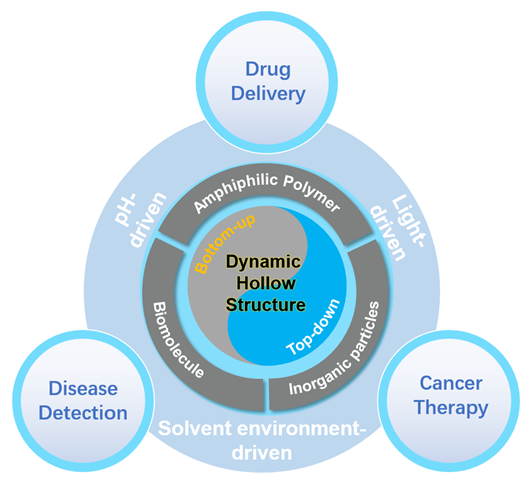
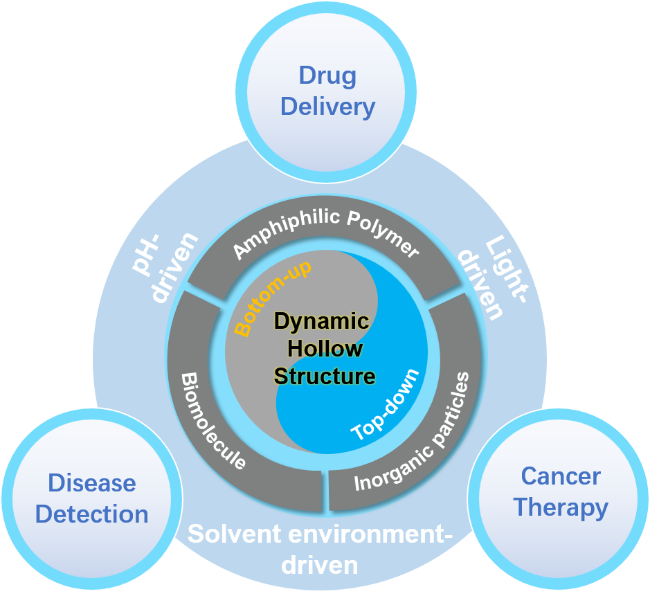
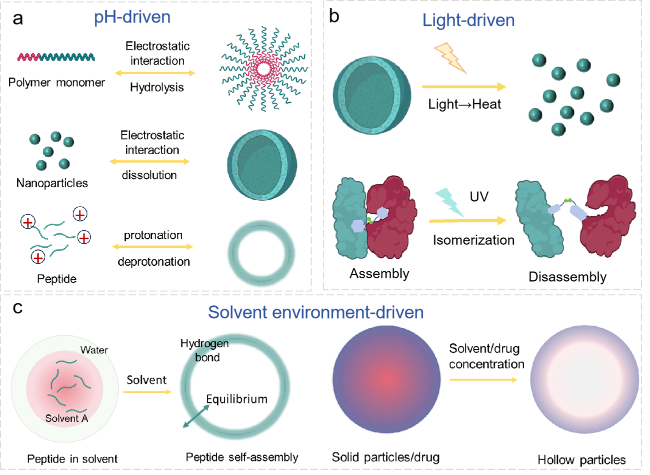
生命体的动态演变过程为多级动态组装材料的研究带来了重要启发。动态智能的中空结构凭借其空腔构造的多样性、壳壁组成的丰富性以及表面修饰的多功能性等特性,在生物医药领域展现出极具潜力的应用前景。本文梳理了动态中空结构多功能体系的实现策略,按照自上而下和自下而上两种路径分类,总结该体系的动态基元和驱动机制;此外,阐述了其在药物递送、疾病检测及疾病治疗三大领域的具体应用;最后对动态智能的中空多壳层结构的设计优化和未来应用方向进行了展望。

本文引用格式

赵德偲 , 康乃馨 , 王丹 . 动态智能的中空结构多功能体系[J]. 化学学报, 0 : 1 -1 . DOI: 10.6023/A25090315

Abstract

The dynamic evolution of living organisms has inspired extensive research on multi-level dynamic assembly materials, a cutting-edge direction in materials chemistry that bridges fundamental science and practical applications. Driven by dynamic chemistry, these materials rely on covalent and non-covalent interactions to gain intelligent properties like stimulus responsiveness, structural reversibility and self-healing, strongly supporting their great potential in biomedicine, especially in precise diagnosis and targeted therapy. Hollow structures, featuring unique spatial configurations, high volume ratio cavities and modifiable surfaces properties, are inspired by natural systems like cells and blood vessels. It naturally fulfills indispensable functions of protection, loading and transportation. Through elaborate internal space design, researchers have further constructed multi-core, multi-shell, and multi-compartment structures, significantly expanding the hollow structure's functional boundaries and application scenarios, and endowing it with irreplaceable advantages in drug delivery, energy conversion and storage. Combining these advantages, dynamic intelligent hollow materials have emerged as a prominent research hotspot in biomedicine, while facing critical challenges. Their design demands establishing clear structure-activity relationships to achieve controllable fabrication of multi-level structures and precise regulation of size and morphology. Additionally, these materials must integrate core functions including targeting, theranostics and self-healing, while balancing in vivo stability, biocompatibility and metabolic safety, and effectively resolving the controllability and long-term efficacy of dynamic evolution under complex and dynamic physiological environments. This review presents systematic strategies for constructing multifunctional systems with dynamic hollow structures, focusing on the systematic summary of dynamic building blocks (e.g., polymers, inorganic nanoparticles, biological macromolecules) and driving forces (including pH, light and solvent environment), classified into top-down and bottom-up approaches. Furthermore, applications of dynamic hollow structures in drug delivery, disease detection, and cancer treatment are discussed in detail. Finally, the review provides a forward-looking perspective on the rational design and synthesis of hollow multishelled structure, as well as their application prospects in hierarchical targeted therapy, pulsed drug release, and theragnostic integration, aiming to guide the development of next-generation advanced biomaterials.

参考文献

[1] Lee S.; Sim K.; Moon S. Y.; Choi J.; Jeon Y.; Nam J.-M.; Park S.-J. Adv. Mater. 2021, 33 2007668.
[2] Zheng N.; Xu Y.; Zhao Q.; Xie T. Chem.Rev. 2021, 121, 1716.
[3] Wang S.; Urban M. W. Nat. Rev. Mater. 2020, 5, 562.
[4] Zhao D.; Wei Y.; Xiong J.; Gao C.; Wang D. Adv. Funct. Mater. 2023, 33, 2300681.
[5] Webber M. J.; Tibbitt M. W. Nat. Rev. Mater. 2022, 7, 541.
[6] Zhang Q.; Qu D.-H.; Feringa B. L.; Tian H. J. Am. Chem. Soc. 2022, 144, 2022.
[7] Song N.; Chu Y.; Li S.; Dong Y.; Fan X.; Tang J.; Guo Y.; Teng G.; Yao C.; Yang D. Sci. Adv.2023, 9, eadi3602
[8] Boahen E. K.; Pan B.; Kweon H.; Kim J. S.; Choi H.; Kong Z.; Kim D. J.; Zhu J.; Ying W. B.; Lee K. J.; Kim D. H. Nat. Commun. 2022, 13, 7699.
[9] Zhang L.; Zou Y.; Xu Z.; Liu, Y. Chem. J.Chinese U. 2023, 44, 20230134.
[10] Li Z.; Xu K.; Qin L.; Zhao D.; Yang N.; Wang D.; Yang Y. Adv.Mater. 2023, 35, 2203890.
[11] Wang J.; Wan J.; Yang N.; Li Q.; Wang D. Nat. Rev. Chem. 2020, 4, 159.
[12] Xiong J.; Shang L.; Zhao D.; Wang D. Sci.China Mater. 2024, 67, 2540.
[13] Du. S.; Wang. Y.; Wang, F.; Wang, T.; Zhan, L.; Liu, M. Chin. Chem. Lett. 2024, 25, 109256.
[14] Wei Y.; Cui S.; Yu L.; Ding J. Macromolecules 2023, 56, 2619.
[15] Jamshid K.; Zhong F.; Zhang W.; Hong C. Acta Chim Sinica 2022, 80, 913.
[16] Xia Y.;Trung Dac, N.; Yang, M.; Lee, B.; Santos, A.; Podsiadlo, P.; Tang, Z.; Glotzer, S. C.; Kotov, N. A. Nat Nanotechnol. 2011, 6, 580.
[17] Belluati A.; Jimaja S.; Chadwick R. J.; Glynn C.; Chami M.; Happel D.; Guo C.; Kolmar H.; Bruns N. Nat.Chem. 2023, 16, 564.
[18] Li H.; Cheng C.; Yang Z.; Wei J. Nat.Commun. 2022, 13, 6466.
[19] Xie X.; Sun T.; Xue J.; Miao Z.; Yan Xu.; Fang W.; Li Q.; Tang R.; Lu Y.; Tang L.; Zha Z.; He T. Adv. Funct. Mater. 2020, 30, 2000511.
[20] Chen X.; Liu X.; Khan M.; Yan Z.; Cao D.; Duan S.; Fu L.; Wang W. Research 2024, 7, 0490.
[21] Li F.; Liu Y.; Dong Y.; Chu Y.; Song N.; Yang D. J. Am. Chem. Soc.2022, 144, 4667.
[22] Li H.; Qian X.; Mohanram H.; Han X.; Qi H.; Zou G.; Yuan F.; Miserez A.; Liu T.; Yang Q.; Gao H.; Yu J. Nat.Nanotechnol. 2024, 19, 1114.
[23] Li R.; Khiman M.; Sheng L.; Sun J. Acta Chim Sinica 2020, 78, 1235.
[24] Yang Z.; Peng Y.; Qiu L.Chinese Chem. Lett. 2018, 29, 1839.
[25] Wang X.; Gao P.; Wang J.; Yang Y.; You Y.; Wu D. CCS Chem. 2021, 3, 127.
[26] Yang M.; Chan H.; Zhao G.; Bahng J. H.; Zhang P.; Kral P.; Kotov N. A. Nat. Chem. 2017, 9, 287.
[27] Wu C.; Li Z.; Bai Y.; To D.; Myung N. V.; Yin Y. Aggregate 2021, 3, e146.
[28] Yu B.; Liu J.; Cui Z.; Wang C.; Chen P.; Wang C.; Zhang Y.; Zhu X.; Zhang Z.; Li S.; Pan J.; Xie M.; Shen H.; Cao L. Nat.Chem. 2025, DOI: s41557-025-01929-2.
[29] Kundu P. K.; Samanta D.; Leizrowice R.; Margulis B.; Zhao H.; Boerner M.; Udayabhaskararao T.; Manna D.; Klajn R. Nat.Chem. 2015, 7, 646.
[30] Zou J.; He J.; Wang X.; Wang Y.; Wu C.; Shi M.; Jiang H.; Wu Z.; Liu J.; Zhang W. J. Control Release 2022, 351, 341.
[31] Zhang S.; Chu Z.; Yin C.; Zhang C.; Lin G.; Li Q. J. Am. Chem. Soc. 2013, 135, 5709.
[32] Yan B.-B.; Zhao Y.; Li M.; Li K.; Dong L.; Yang S.-Y.; Luo Z.; Yu S.-H.Nano Lett. 2022, 22, 9181.
[33] Wang H.; Zhao D.; Yang N.; Wang D. Chem.J. Chinese U. 2023, 44, 20220237.
[34] Wang S.; Guo X.; Xiu W.; Liu Y.; Ren L.; Xiao H.; Yang F.; Gao Y.; Xu C.; Wang L. Sci. Adv.2020, 6, eaaz8204.
[35] Xie L.; Yan M.; Liu T.; Gong K.; Luo X.; Qiu B.; Zeng J.; Liang Q.; Zhou S.; He Y.; Zhang W.; Jiang Y.; Yu Y.; Tang J.; Liang K.; Zhao D.; Kong B. J. Am. Chem. Soc.2022, 144, 1634.
[36] Lian M.; Xue Z.; Qiao X.; Liu C.; Zhang S.; Li X.; Huang C.; Song Q.; Yang W.; Chen X.; Wang T. Chem 2019, 5, 2378.
[37] Wang Z.; Zeng Y.; Wang Y.; Chen C. Chem. Res. Chin. Univ. 2024, 40, 564.
[38] Li J.; Koo K. M.; Wang Y.; Trau M. Small 2019, 15, 1904689.
[39] Kim J.; Lee S.; Kim Y.; Choi M.; Lee I.; Kim E.; Yoon. C.; Pu, K.; Kang, H.; Kim, J. Nat. Rev. Mater. 2023, 8, 710.
[40] Xie Y.; Qin Z.; Qian, M; Ren T.; Yuan L. Chem. Res. Chin. Univ. 2024, 40, 190.
[41] Ren H.; Zeng X.; Zhao X.; Hou D.; Yao H.; Yaseen M.; Zhao L.; Xu W.; Wang H.; Li L. Nat.Commun. 2022, 13, 418.
[42] Yang S.; Cao Y.; Wang S.; Li Y.; Shi J. Chem. Res. Chinese U. 2022, 38, 99.
[43] Cao M.; Xing X.; Shen X.; Ouyang J.; Na. N. Chem. Res. Chin. Univ. 2024, 40, 202.
[44] Yang G.; Phua S. Z.F.; Lim, W. Q.; Zhang, R.; Feng, L.; Liu, G.; Wu, H.; Bindra, A. K.; Jana, D.; Liu, Z.; Zhao, Y. Adv. Mater. 2019, 31, 1901513.
[45] Liu X.; Chen Y.; Li H.; Huang N.; Jin Q.; Ren K.; Ji J. ACS Nano 2013, 7, 6244.
[46] Yu W.; Liu R.; Zhou Y.; Gao H. ACS Central Sci. 2020, 6, 100.
[47] Wang S.; Huang P.; Chen X. Adv.Mater. 2016, 28, 7340.
[48] Mao Q.; Fang J.; Wang A.; Zhang Y.; Cui C.; Ye S.; Zhao Y.; Feng Y.; Li J.; Shi, H., Angew. Chem. Int.Edit. 2021, 60, 23805.
[49] Gao J.; Qin H.; Wang F.; Liu L.; Tian H.; Wang H.; Wang S.; Ou J.; Ye Y.; Peng F.; Tu Y. Nat.Commun. 2023, 14, 4867.
[50] Mao D.; Wang C.; Li W.; Zhou L.; Liu J.; Zheng Z.; Zhao Y.; Cao A.; Wang, S.; Huang, J.; Huo, F.; Chen, H.; Mai, L.; Yu, R.; Wang, L.; Lu, Y.; Yu, C.; Yang, Q.; Yang, Z.; Zeng, H.; Zhao, H.; Tang, Z.; Zhao, D.; Wang, D. Chem Res Chin Univ, 2024, 40, 346.
[51] Mao D.; Wan J.; Wang J.; Wang D. Adv.Mater. 2019, 31, 1802874
[52] Wei Y.; Cheng Y.; Zhao D.; Feng Y.; Wei P.; Wang J.; Ge W.; Wang D. Angew. Chem. Int. Edit. 2023, 62, e202302621.
[53] Zhao D.; Wei Y.; Jin Q.; Yang N.; Yang Y.; Wang D. Angew. Chem. Int. Edit. 2022, 61, 2206807.
[54] Zhao D.; Yang N.; Wei Y.; Jin Q.; Wang Y.; He H.; Yang Y.; Han B.; Zhang S.; Wang D. Nat.Commun. 2020, 11, 4450.
[55] Sarmadi M.; Ta C.; VanLonkhuyzen A. M.; De Fiesta D. C.; Kanelli M.; Sadeghi I.; Behrens A. M.; Ingalls B.; Menon N.; Daristotle J. L.; Yu J.; Langer R.; Jaklenec, A. Sci. Adv.2022, 8, eabn5315.
文章导航

/