研究论文

钠硫电池中多硫化钠中间产物超快共振拉曼特征信号的理论解析

  • 赵宝国 ,
  • 李展 ,
  • 马慧芳 ,
  • 任浩
展开
  • a中国石油大学(华东), 材料科学与工程学院, 山东省智能能源材料重点实验室, 山东青岛, 266580
    b山东科技大学, 电子信息工程学院, 青岛太赫兹技术重点实验室, 山东青岛, 266590

收稿日期: 2025-09-15

  网络出版日期: 2025-11-24

Ultrafast Resonance Raman Characteristics of Sodium Polysulfides in Sodium-Sulfur Battery: An ab initio Assessment

  • Baoguo Zhao ,
  • Zhan Li ,
  • Huifang Ma ,
  • Hao Ren
Expand
  • aShandong Key Laboratory of Intelligent Energy Materials, School of Materials Science and Engineering, China University of Petroleum (East China), Qingdao 266580, Shandong, China
    bQingdao Key Laboratory of Terahertz Technology, College of Electronic and Information Engineering, Shandong University of Science and Technology, Qingdao 266590, Shandong, China

Received date: 2025-09-15

  Online published: 2025-11-24

Supported by

National Science Foundation of China (22473114, 62305196, U23B2087), and Shandong Provincial Natural Science Foundation of China (ZR2023MB034).

摘要

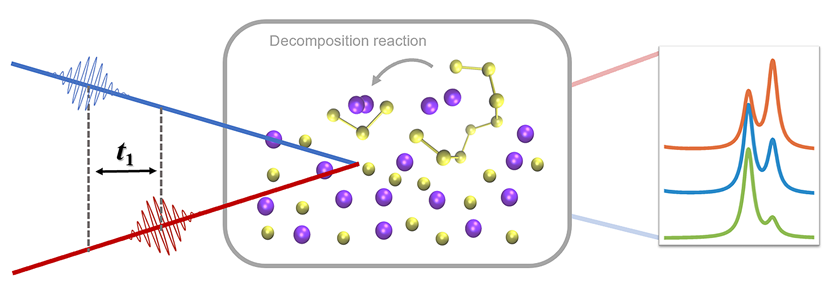
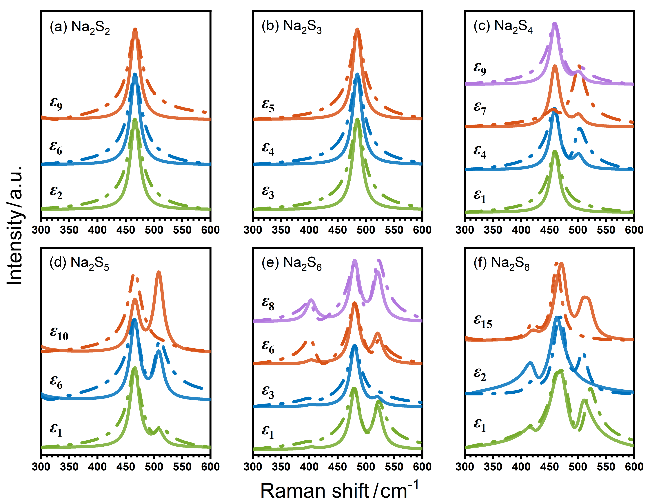
钠硫电池作为极具潜力的储能装置, 其发展长期受能量转化过程中穿梭效应的制约. 工作状态的钠硫电池内部存在多个级联的氧化还原反应, 产物为多种溶于电解质溶液的钠硫化合物. 各类多硫化钠中间体在正负极间的扩散迁移是穿梭效应的主导因素. 目前关于穿梭效应的微观机制, 包括导致活性物质流失的具体化学物种及其氧化还原反应动力学机理仍不明确. 由于多硫化钠具有极快的反应动力学和高度动态的结构演化行为, 传统表征手段难以表征其瞬态过程. 本文基于高精度量子化学从头计算, 研究了多种多硫化钠中间产物的共振拉曼和超快共振拉曼光谱. 结合了共振拉曼光谱在化学键尺度上的空间分辨能力和超快光谱在飞秒尺度上的时间分辨能力, 具备在钠硫电池工作过程中捕捉多硫化钠光谱特征的潜力. 计算结果表明, 不同多硫化钠中间体的共振拉曼信号同时具有激发波长选择性和电子振动耦合选择性, 其特征显著、易于区分. 本工作为多硫化钠中间体的高时空分辨、实时及原位表征提供了理论依据和参考, 为穿梭效应理论机制的研究提供借鉴.

本文引用格式

赵宝国 , 李展 , 马慧芳 , 任浩 . 钠硫电池中多硫化钠中间产物超快共振拉曼特征信号的理论解析[J]. 化学学报, 0 : 0 . DOI: 10.6023/A25090312

Abstract

Sodium-sulfur batteries (NaSBs) are promising alternative to lithium-sulfur batteries due to their high theoretical energy density, low cost, and abundant raw materials. However, their practical development is significantly hindered by the polysulfide shuttle effect. This effect arises from soluble sodium polysulfide (NaPS) intermediates formed during cycling, which migrate between electrodes, causing irreversible sulfur loss and rapid capacity fade. Understanding the specific chemical species of these NaPS intermediates and their rapid reaction dynamics is essential for mitigating the shuttle effect and improving battery stability. Unfortunately, conventional analytical techniques lack the temporal resolution to capture the fast structural changes and reaction kinetics involved. To address this challenge, we propose utilizing ultrafast resonance Raman spectroscopy. Spontaneous resonance Raman (spRR) significantly enhances detection sensitivity for target molecules by matching the excitation light frequency to specific electronic transitions. By employing ultrafast broadband laser pulses, this approach can be extended to stimulated resonance Raman (stRR), achieving the necessary femtosecond time resolution to track NaPS evolution with high selectivity and spatial-temporal precision. Through high-accuracy ab initio quantum chemical calculations, we calculate and analyze the resonance Raman spectral signatures of key NaPS intermediates. Our results reveal distinct spectral fingerprints and their selective enhancement under specific excitation energies. These insights provide a deeper understanding of NaPS conversion dynamics and establish a foundation for real-time, in-situ monitoring of polysulfide species during battery operation. This work advances the fundamental knowledge required to develop efficient and stable NaSBs for future energy storage.

参考文献

[1] J.-M. Tarascon, M. Armand, nature 2001, 414, 359.
[2] J. Huang, Y. Zhu, Y. Feng, Y. Han, Z. Gu, R. Liu, D. Yang, K. Chen, X. Zhang, W. Sun,Wuli Huaxue XuebaoActa Phys.-Chim. Sin. 2022, 38, 2208008.
[3] H. CHEN, H. LI, Y. XU, M. CHEN, L. WANG, X. DAI, D. XU, X. TANG, X. LI, Y. HU,Energy Storage Sci. Technol. 2023, 12, 1516.
[4] L. Ma, Y. Lv, J. Wu, Y. Chen, Z. Jin,Adv. Energy Mater. 2021, 11, 2100770.
[5] M. Armand, J.-M. Tarascon, nature 2008, 451, 652.
[6] J. B. Goodenough, K.-S. Park, J. Am. Chem. Soc. 2013, 135, 1167.
[7] S. Singsen, S. Suthirakun, P. Hirunsit, P. B. Balbuena, J. Phys. Chem. C 2022, 126, 16615.
[8] L. Wang, T. Wang, L. Peng, Y. Wang, M. Zhang, J. Zhou, M. Chen, J. Cao, H. Fei, X. Duan, Natl. Sci. Rev.2022, 9, nwab050.
[9] Y. Zhu, B. Liu, W. Liang, H. Xu,ACTA Chim. Sin. 2025, 83, 861.
[10] Q. Li, C. Geng, L. Wang, Q.-H. Yang, W. Lv, Renewables 2023, 1, 374.
[11] L. P. Wang, L. Yu, X. Wang, M. Srinivasan, Z. J. Xu, J. Mater. Chem. A 2015, 3, 9353.
[12] S. Ohno, W. Zeier, Nat. Energy 2022, 7, 686.
[13] X. Yu, A. Manthiram, ChemElectroChem 2014, 1, 1275.
[14] H. Ren, Z. Wang, S. Guo, W. Guo, G. Tian, B. Tian, J. Chem. Phys. 2021, 155.
[15] J. Chen, D. H. Chua, P. S. Lee, Small Methods 2020, 4, 1900648.
[16] J. Z. Hu, N. R. Jaegers, M. Y. Hu, K. T. Mueller, J. Phys. Condens. Matter 2018, 30, 463001.
[17] Q. Gu, J. A. Kimpton, H. E. Brand, Z. Wang, S. Chou,Adv. Energy Mater. 2017, 7, 1602831.
[18] X. Liu, D. Wang, G. Liu, V. Srinivasan, Z. Liu, Z. Hussain, W. Yang,Nat. Commun. 2013, 4, 2568.
[19] J. Xie, J. Li, W. Mai, G. Hong, Nano Energy 2021, 83, 105780.
[20] H. Ren, J. D. Biggs, S. Mukamel, J. Raman Spectrosc. 2013, 44, 544.
[21] H. Ren, Z. Lai, J. D. Biggs, J. Wang, S. Mukamel,Phys. Chem. Chem. Phys. 2013, 15, 19457.
[22] S. Duan, G. Tian, Y. Luo,Chem. Soc. Rev. 2024, 53, 5083.
[23] Z. Ma, B. Yao, D. Chu, Z. Xie, S. Duan, G. Tian, Phys. Rev. B 2025, 112, 125417.
[24] S. Deng, J. Yang, Y. Shao, Q. Ou, Z. Shuai, ChemPhotoChem 2024, 8, e202400117.
[25] H. Ren, J. Jiang, S. Mukamel, J. Phys. Chem. B 2011, 115, 13955.
[26] S. A. Oladepo, K. Xiong, Z. Hong, S. A. Asher, J. Handen, I. K. Lednev,Chem. Rev. 2012, 112, 2604.
[27] D. Buhrke, P. Hildebrandt,Chem. Rev. 2019, 120, 3577.
[28] L. Zhao, Y. Tao, Y. Zhang, Y. Lei, W. Lai, S. Chou, H. Liu, S. Dou, Y. Wang,Adv. Mater. 2024, 36, 2402337.
[29] E. L. Gray, J.-I. Lee, Z. Li, J. Moloney, Z. J. Yang, M. Chhowalla, ACS Nano 2025, 19, 8939.
[30] W. Gao, Y. Lu, X. Xiong, Z. Luo, Y. Yu, Y. Lu, S. Ullah, T. Wang, Y. Ma, Y. Zhong,Chem. Eng. J. 2024, 498, 155230.
[31] B. Tian, Y. Fang, S. Lei, K. Xu, C. He, S. Li, H. Ren,Chin. Chem. Lett. 2023, 34, 108144.
[32] K.-K. Lee, K. Park, H. Lee, Y. Noh, D. Kossowska, K. Kwak, M. Cho, Nat. Commun. 2017, 8, 14658.
[33] T. Kaewmaraya, T. Hussain, R. Umer, Z. Hu, X. Zhao,Phys. Chem. Chem. Phys. 2020, 22, 27300.
[34] K. Momma, F. Izumi,Appl. Crystallogr. 2008, 41, 653.
[35] T. Hussain, T. Kaewmaraya, Z. Hu, X. S. Zhao,ACS Appl. Nano Mater. 2022, 5, 12637.
[36] T. D. Kühne, M. Iannuzzi, M. Del Ben, V. V. Rybkin, P. Seewald, F. Stein, T. Laino, R. Z. Khaliullin, O. Schütt, F. Schiffmann, J. Chem. Phys. 2020, 152.
[37] M. Frisch, G. Trucks, H. B. Schlegel, G. E. Scuseria, M. A. Robb, J. R. Cheeseman, G. Scalmani, V. Barone, B. Mennucci, G. Petersson, Inc Wallingford CT 2009, 121, 150.
[38] Y. Shao, Y. Mei, D. Sundholm, V. R. I.Kaila, J. Chem. Theory Comput. 2020, 16, 587.
[39] D. Rappoport, F. Furche, J. Chem. Phys. 2010, 133.
[40] D. Jacquemin, V. Wathelet, E. A. Perpete, C. Adamo, J. Chem.Theory Comput. 2009, 5, 2420.
[41] R. L. Martin, J. Chem. Phys. 2003, 118, 4775.
[42] X. Mu, Y. Guo, Y. Li, Z. Wang, Y. Li, S. Xu, J. Raman Spectrosc. 2017, 48, 1196.
[43] T. Lu, J. Chem. Phys. 2024, 161.
[44] T. Lu, F. Chen, J. Comput. Chem. 2012, 33, 580.
[45] W. Humphrey, A. Dalke, K. Schulten, J. Mol. Graph. 1996, 14, 33.
[46] H. Ma, J. Liu, W. Liang, J. Chem.Theory Comput. 2012, 8, 4474.
[47] S. Duan, G. Tian, Y. Luo, J. Chem.Theory Comput. 2016, 12, 4986.
[48] A. Manian, R. Shaw, I. Lyskov, W. Wong, S. Russo, J. Chem. Phys. 2021, 155.
[49] Z. Li, Z. Hu, Y. Jiang, Q. Yuan, H. Sun, X.-B. Wang, Z. Sun, J. Chem. Phys. 2019, 150.
[50] D. S. Hall, J. Self, J. Dahn, J. Phys. Chem. C 2015, 119, 22322.
[51] R. Payne, I. E. Theodorou, J. Phys. Chem. 1972, 76, 2892.
文章导航

/