


1 引言
尽管防冰材料的开发取得了一定进展, 但在实际应用中仍面临较大的挑战: 疏水表面的制备通常仅依赖材料化学组成的简单改性, 在压力、蒸发、撞击或外力干扰下表面可能会丧失原有疏水性[5-6]; 超疏水表面依赖微纳结构实现超疏水性, 但易受机械损伤, 导致防冰性能难以长期维持[7-10]; SLIPS通过在多孔基底中注入润滑剂(如石蜡、氟化油)来显著降低冰黏附强度, 但润滑剂易因重力、流体冲刷或脱冰过程而流失, 影响耐久 性[11-12]. 凝胶作为柔软的半固体材料, 具备优异的液体储存能力, 因而在防冰领域展现出巨大潜力[13-15]. 如聚二甲基硅氧烷(PDMS)基有机凝胶因其低模量和低表面能成功实现了低/超低冰黏附强度, 但其网络强度不足, 导致其中的润滑剂易在使用中流失, 耐久性较差, 且在风机叶片、飞机前缘等需要承受机械应力的实际应用中, 易发生变形和损坏, 限制了其实际应用[16-18]. 因此, 开发兼具高机械强度、高耐久性和优异抗结冰性能的有机凝胶, 仍面临较大挑战.
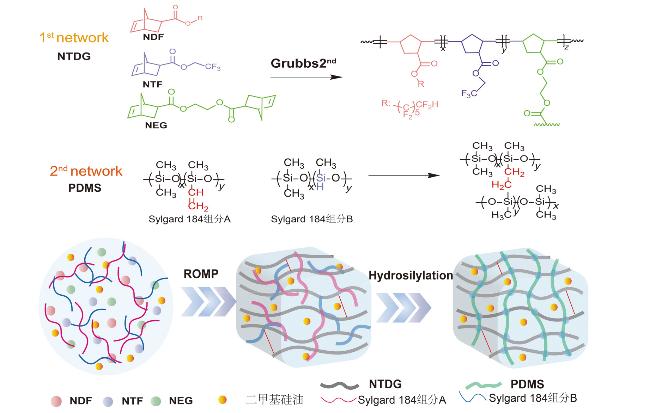
本工作以降冰片烯基三氟乙酯(NTF)、降冰片烯基十二氟庚酯(NDF), 二降冰片烯基乙二醇酯(NEG)分别为第一网络的单体和交联剂, Sylgard184 A和B组分为第二网络的单体, 二甲基硅油为功能添加剂, 通过开环易位聚合(ROMP)和硅氢加成反应成功制备了一系列二甲基硅油含量可调的含氟降冰片烯/PDMS双网络有机凝胶(NTDG/PDMS). 通过测试其机械性能、防冰性能、凝胶稳定性和耐摩擦性, 揭示了结构对性能的影响机制, 为兼具高机械强度、高耐久性和优异防冰性能的有机凝胶的开发提供科学依据.
2 结果与讨论
2.1 NTDG/PDMS有机凝胶的制备
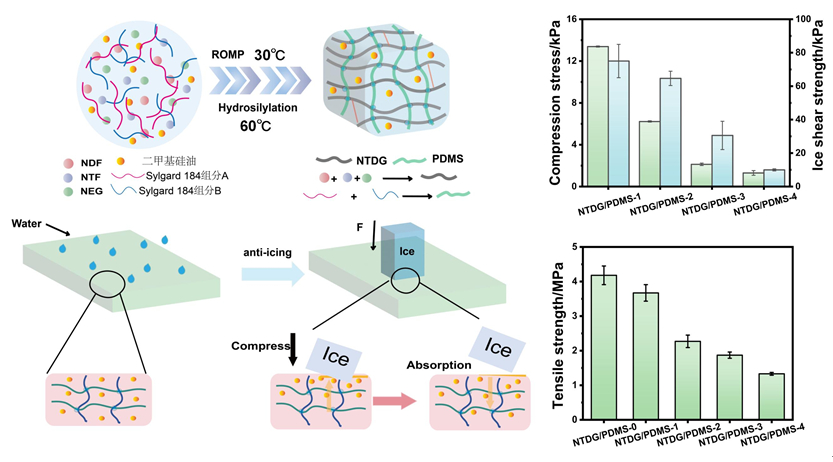
NTDG/PDMS双网络凝胶的制备过程如图1所示, 以降冰片烯基三氟乙酯(NTF)、降冰片烯基十二氟庚酯(NDF), 二降冰片烯基乙二醇酯(NEG)分别为第一网络的单体和交联剂, 通过开环易位聚合(ROMP)制备第一个网络; Sylgard184 A和B组分为第二网络的单体, 通过硅氢加成反应制备第二网络, 二甲基硅油为分散介质, 制备一系列不同二甲基硅油含量的含氟降冰片烯/PDMS双网络有机凝胶(NTDG/PDMS).
2.2 NTDG/PDMS有机凝胶的结构和表面形貌表征
首先合成NDF、NTF单体和NEG交联剂, 如图2a所示, NDF、NTF和NEG的1H NMR中, 化学位移5.6~6.3为降冰片烯环上双键-HC=CH-的特征峰, δ 1.8、2.8~3.3为降冰片烯环上-CH的质子峰, δ 1.3~1.5为降冰片烯环上-CH2-的质子峰. NTF和NDF的1H NMR中, δ 4.4~4.6分别为NTF中-O-CH2-CF3和NDF中-O-CH2-CF2-的特征峰; NEG的1H NMR中, δ 4.2为-O-CH2-CH2-O-的质子峰, 结果表明成功合成了NDF、NTF和NEG聚合单体和交联剂.
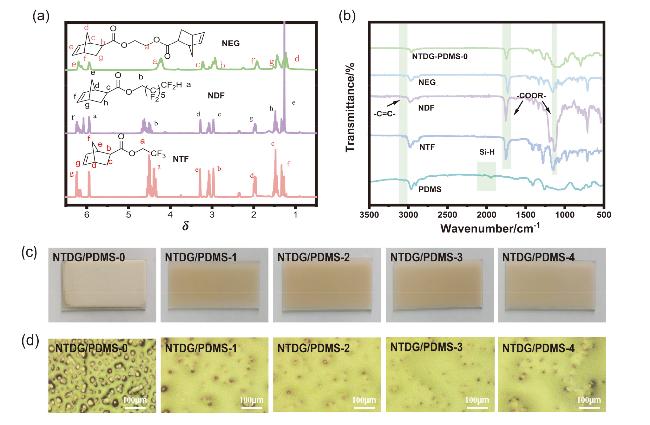
图2 (a) NDF、NTF、NEG的1H NMR; (b) NDF、NTF、NEG、NTDG/PDMS-0的FT-IR; (c) NTDG/PDMS的宏观照片; (d) NTDG/PDMS的光学显微镜图像Figure 2 (a) ¹H NMR spectra of NDF, NTF, and NEG; (b) FT-IR spectra of NDF, NTF, NEG, and NTDG/PDMS-0; (c) macroscopic image of the NTDG/PDMS organogels; (d) optical microscopic image of the NTDG/PDMS organogel |
进一步通过FT-IR对比NTDG/PDMS-0和单体的结构. 如图2b所示, 单体NDF和NTF的C=O和C—O特征吸收峰分别位于1755和1160 cm⁻1处, NEG交联剂的C=O和C—O特征吸收峰分别位于1755和1160 cm⁻1处. 3067 cm⁻1处的吸收峰为NDF、NTF及NEG中降冰片烯环上-HC=CH-的伸缩振动峰. 合成的双网络NTDG/PDMS-0聚合物在3067 cm⁻1处的-HC=CH-峰消失, 且无Sylgard184 A和B组分的SiH和CH2=CH2特征峰, 同时在962 cm⁻1处出现了聚合物主链中新生成双键的特征吸收峰. 此外, NDF、NTF和NTDG/PDMS-0在1200 cm⁻1处均出现C—F键的特征吸收峰. 在NTDG/PDMS-0中, 还观察到1262和798 cm⁻1处Si-CH3的特征吸收峰, 以及1193 cm⁻1处较宽的Si-O-Si吸收峰. 以上结果表明, 通过ROMP聚合和硅氢加成反应成功制备了NTDG/PDMS-0双网络聚合物. 如图2c所示, 所有NTDG/PDMS样品表面均匀平整、无气泡. 其中, NTDG/PDMS-0因不含二甲基硅油, 仅由聚合物基质组成, 样品表面泛白色. 进一步通过偏光显微镜观察NTDG/PDMS的表面形貌. 如图2d所示, 随着二甲基硅油的加入, NTDG/PDMS中聚合物网络在二甲基硅油中发生不同程度的溶胀, 且溶胀程度随二甲基硅油含量增加而逐渐增强.
2.3 NTDG/PDMS有机凝胶的稳定性能研究
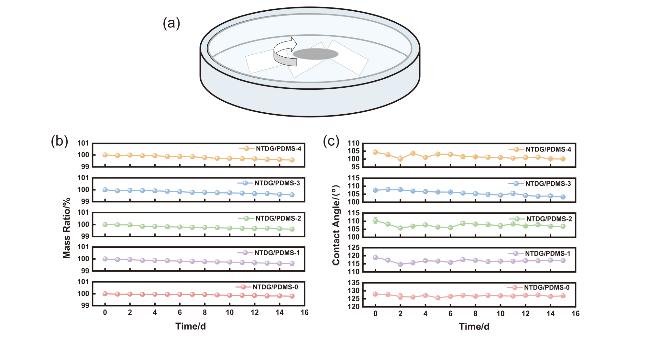
目前抗结冰有机凝胶通常存在润滑剂保留能力差、易流失等问题, 严重限制了其长期应用. 对NTDG/PDMS有机凝胶在流动水中稳定性进行了测试, 稳定性的测试方法如图3a所示. 结果如图3b, 有机凝胶NTDG/PDMS在流动水环境中浸泡15 d后, 凝胶现在的质量与原来的质量比分别为99.8%, 99.61%, 99.62%, 99.58%和99.59%, 凝胶质量基本不变, 损失低于质量分数0.5%; 此外, 凝胶表面的静态接触角分别为128°, 119.1°, 110.4°, 115.5°和104.3°, 表面的静态接触角均明显高于90°, 呈现疏水特性, 且在流动水中浸泡15 d接触角分别变化为126.9°, 117°, 106.9°, 113.3°和100.1°, 变化幅度较小, 如图3c所示, 表明NTDG/PDMS表面的疏水性能未受影响. NTDG/PDMS有机凝胶是由含氟降冰片烯聚合物网络和PDMS双网络组成, 二甲基硅油(低分子量PDMS)与凝胶基质中的柔性PDMS网络具有化学同源性(均为-Si-O-主链), 二者相容性优异[23]; 二甲基硅油-水体系的界面张力达53.6 mN/m[24]. 高界面张力意味着水分子需克服53.6 mN/m的能量壁垒才能渗透至硅油相, 而流动水的冲刷动能通常仅<10 mN/m[25], 远不足以突破这一热力学屏障, 因此二者始终维持清晰的相界面. 含氟链段具有典型的低表面能与双疏特性, 既疏水又疏油. 含氟链段与硅油的相容性较差, 这可以起到限制硅油在材料内部过度迁移和扩散的作用. 同时, 当材料处于潮湿、雨淋或存在其他液体的环境中时, 含氟结构形成的致密屏障能有效阻止外部介质渗入材料内部[26].
2.4 NTDG/PDMS有机凝胶的力学性能研究
如图4和表1所示, NTDG/PDMS-0双网络的拉伸强度为4.18 MPa, 杨氏模量为12.78 MPa, 韧性为7.75 MJ/m3, 随着二甲基硅油质量分数由0增加至80%, NTDG/PDMS的拉伸强度由4.18 MPa逐渐降至1.33 MPa, 杨氏模量由12.19 MPa降至2.83 MPa, 韧性由4.06 MJ/m3降至1.19 MJ/m3. 这是由于随着二甲基硅油的用量增加体积增加, 硅油渗透使有机凝胶的体积膨胀, 凝胶的聚合物网络的交联密度逐渐降低, 聚合物的分子链运动能力增强. 导致构建的网络内分子之间作用力降低, 产生类似于润张现象导致强度降低[27], 与图2d结果一致, 尽管如此, 得益于含氟降冰片烯聚合物主链的五元环结构和互穿双网络的结构设计, 含氟降冰片烯基聚合物网络与PDMS网络互相缠结、互穿, NTDG/PDMS-4含有质量分数80%二甲基硅油其拉伸强度仍高达1.33 MPa, 远高于大部分PDMS基的有机凝 胶[28-30]. 不仅高于航空领域≥0.8 MPa[31]的最低需求, 还能完全覆盖电力(≥1 MPa)[32]与风电领域(≥1 MPa)[33]的强度要求.
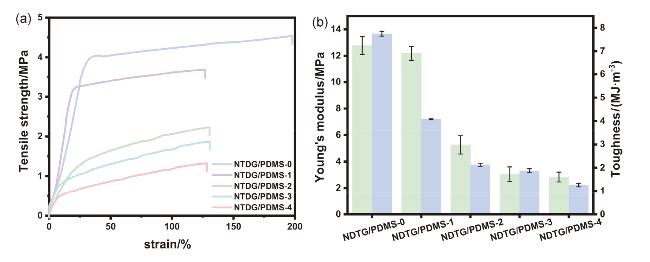
图4 (a) NTDG/PDMS的力学性能; (b) NTDG/PDMS杨氏模量和韧性图Figure 4 (a) Mechanical properties of NTDG/PDMS; (b) Young's modulus and toughness diagram of NTDG/PDMS |
表1 NTDG/PDMS的拉伸强度、断裂伸长率和弹性模量Table 1 Tensile strength, elongation at break, and elastic modulus of NTDG/PDMS organogels |
| Sample | Tensile strength/MPa | Elongation at break/% | Elastic modulus/MPa |
|---|---|---|---|
| NTDG/PDMS-0 | 4.18±0.27 | 197.97±14.89 | 12.78±0.68 |
| NTDG/PDMS-1 | 3.67±0.24 | 127.00±16.74 | 12.19±0.53 |
| NTDG/PDMS-2 | 2.27±0.18 | 130.53±6.24 | 5.26±0.69 |
| NTDG/PDMS-3 | 1.87±0.09 | 130.65±9.78 | 3.04±0.56 |
| NTDG/PDMS-4 | 1.33±0.04 | 128.25±7.88 | 2.83±0.37 |
2.5 NTDG/PDMS有机凝胶的压力响应性能表征
采用万能试验机通过压缩测试对NTDG/PDMS有机凝胶的压力响应性能进行表征, 如图5a所示. 当压缩速度设定为2 mm/min时, NTDG/PDMS-3样品在压力达到2.13 kPa时, 凝胶内部包裹的二甲基硅油会被挤压释 放进而迁移至凝胶表面, 形成均匀液体层; 而当压力卸载后, 凝胶表面部分二甲基硅油可重新被凝胶内部结构吸收. 二甲基硅油“释放-吸收”过程证实了NTDG/PDMS有机凝胶可逆的压力响应特性.
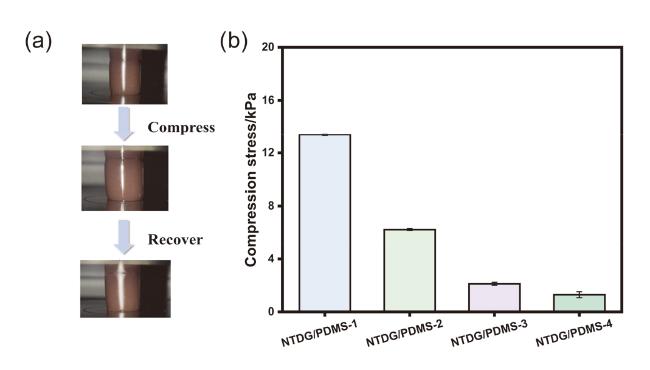
图5b进一步给出了不同NTDG/PDMS样品表面释放二甲基硅油的临界压力, 具体数值为: NTDG/PDMS-1(13.39 kPa)>NTDG/PDMS-2(6.22 kPa)>NTDG/PDMS-3(2.13 kPa)>NTDG/PDMS-4(1.30 kPa). 结果表明, 随着凝胶中二甲基硅油含量的增加, NTDG/PDMS释放硅油的临界压力逐渐降低, 表明其对外界压力刺激的敏感性显著提升. 这一现象的本质在于: 二甲基硅油含量增加导致NTDG/PDMS内部网络的交联密度降低, 进而减小凝胶弹性模量, 内部硅油所受的束缚作用减弱, 因此更易在较低压力下被挤压释放.
NTDG/PDMS有机凝胶所具备的高灵敏、可逆压力响应特性, 在防冰领域及智能材料设计中展现出多重关键应用价值: 其一, 该凝胶表面可通过压力触发硅油可控释放, 借助润滑剂在冰-凝胶界面形成动态隔离层, 显著削弱冰层与基体间的粘附作用, 进一步优化防冰性能; 其二, 压力卸载后凝胶对释放硅油的高效回收能力, 能大幅提升润滑剂的界面保留效率, 有效抑制润滑剂损耗, 进而强化有机凝胶的长期使用耐久性, 显著延长其服役寿命; 其三, 这种“压力诱导释放-卸载自主回收” 的动态响应机制, 为开发兼具可修复功能与长效稳定性的智能有机凝胶提供了创新思路与技术支撑.
2.6 NTDG/PDMS有机凝胶的抗结冰性能表征
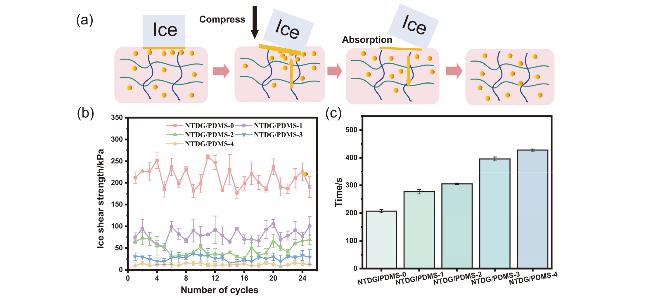
通过推拉力机测试NTDG/PDMS凝胶在-20 ℃的冰剪切强度, 结果如图6b所示. NTDG/PDMS-0的冰剪切强度高达211.59 kPa. 随着二甲基硅油含量的增加, 有机凝胶的冰剪切强度显著降低, 即NTDG/PDMS-0(211.59 kPa)>NTDG/PDMS-1(75 kPa)>NTDG/PDMS-2 (64.25 kPa)>NTDG/PDMS-3(30.55 kPa)>NTDG/PDMS-4 (9.96 kPa). 其中, NTDG/PDMS-4表现出极低的冰剪切强度. 即使经过25次结冰/除冰循环后, 其冰剪切强度仍低至12.59 kPa, NTDG/PDMS-4有机凝胶冰剪切强度低的原因如下: 首先, 含氟降冰片烯聚合物的五元环结构为含氟侧链提供了较大的自由体积, 有利于分子链的滑移, 且含氟降冰片烯聚合物和PDMS呈现较低的表面能[34]. 此外, 在压力作用下, 二甲基硅油迁移到有机凝胶表面, 形成稳定的润滑层, 润滑层作为屏障, 避免了冰和基质的直接接触, 即液-固界面转变为液-液界面, 界面能降低, 因而增加润滑剂含量能够有效降低冰粘附强度(如图6a所示). 如图6b所示, 随着二甲基硅油含量的增加, 其冰剪切强度逐渐降低, 同时在结冰/除冰循环过程中冰剪切强度的变化幅度逐渐减小. 随着二甲基硅油含量的增加凝胶抗结冰稳定性增强.
2.7 NTDG/PDMS有机凝胶的耐摩擦性能表征
如图7a所示, 利用偏光显微镜测试了NTDG/PDMS凝胶表面经摩擦60次前后的形貌, NTDG/PDMS凝胶初始表面均较为平整, 经过60次摩擦后, NTDG/PDMS-0磨损最为严重, 随着二甲基硅油含量增加, NTDG/PDMS凝胶表面损伤程度显著减轻. 上述现象可归因于NTDG/PDMS凝胶的压力响应性能和二甲基硅油润滑层的作用: 凝胶表面在摩擦过程中产生压力, 二甲基硅油迁移到有机凝胶表面, 形成稳定的润滑层, 避免了砂纸与基体的直接接触; 即使在摩擦过程中表面硅油有所损失, 内部储存的二甲基硅油也能持续向表面迁移, 修复粗糙结构. 如图7b所示, 经过60次摩擦循环后, NTDG/PDMS-0的表面粗糙度从初始的0.54 µm显著增大至1.13 µm. 随着二甲基硅油含量的增加, NTDG/PDMS-1至NTDG/PDMS-4的粗糙度分别从0.33 µm, 0.20 µm, 0.26 µm, 0.34 µm增加至0.54 µm, 0.43 µm, 0.31 µm, 0.47 µm. 与不含硅油的凝胶相比较, 表面粗糙度变化较小.
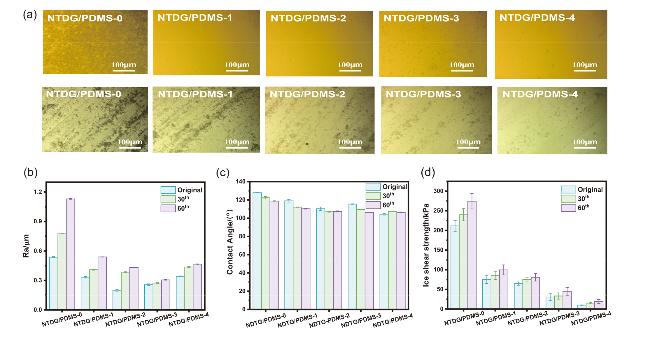


如图7c所示, NTDG/PDMS-0在摩擦后接触角由127.98°降低至118.79°, 下降约10°, 其表面疏水性在摩擦过程中降低; 而随着二甲基硅油含量的增加, NTDG/PDMS-1至NTDG/PDMS-4的接触角变化幅度逐渐减小, 呈现出更好的稳定性.
如图7d所示, NTDG/PDMS-0经60次摩擦后从211.59 kPa上升至274.36 kPa, 增加了62.77 kPa. 随二甲基硅油含量增加, NTDG/PDMS-1至NTDG/PDMS-4的冰剪切强度分别从75.01 kPa, 64.65 kPa, 30.55 kPa, 9.96 kPa增加至99.61 kPa, 80.78 kPa, 44.24 kPa, 19.13 kPa, 分别增加24.61 kPa、16.13 kPa、13.69 kPa和9.17 kPa, 但增幅依次降低, 并且NTDG/PDMS-4的冰剪切强度仍低于20 kPa的需求阈值[35], 结果表明增加二甲基硅油含量显著增强NTDG/PDMS有机凝胶的机械耐久性.
3 结论
本工作通过ROMP聚合和硅氢加成反应成功制备了一系列含氟降冰片烯/PDMS双网络有机凝胶(NTDG/PDMS), 系统研究了NTDG/PDMS的机械性能、抗结冰性能和耐摩擦等性能, 揭示了结构-性能的“构-效”关系, 结论如下: 随着硅油含量的增加, NTDG/PDMS的拉伸强度可在4.18~1.33 MPa宽范围内调控, 冰剪切强度逐渐降低, 结冰延迟时间逐渐增加. 其中含有质量分数80%硅油的NTDG/PDMS-4拉伸强度高达1.33 MPa, 冰剪切强度低至9.96 kPa, 经25次结冰/除冰循环, 其冰剪切强度仍低至12.59 kPa, 表现出高强度、优异的抗结冰性能. 此外, NTDG/PDMS-4呈现良好的结冰延迟性, 结冰延迟时间长达428 s. 同时, NTDG/PDMS-4在60次摩擦循环后, 表面粗糙度由0.34 µm增加至0.47 µm, 冰剪切强度仅增加9.17 kPa, 展现出优异的机械耐久性. 该研究为兼具高机械强度、高耐久性和优异抗结冰性能的有机凝胶的开发提供科学依据.
4 实验部分
4.1 降冰片烯基十二氟庚酯(NDF)/降冰片烯基三氟乙醇(NTF)/二降冰片烯基乙二醇酯(NEG)的制备
室温下将1H,1H,7H-十二氟-1-庚醇( 0.072 mol)、5-降冰片烯-2-羧酸 (0.073 mol)、三甲基乙酸酐(TA) (0.073 mol)、4-二甲氨基吡啶(DMAP) (0.72 mmol)溶于四氢呋喃(100 mL) 中, 在氮气环境下, 60 ℃下反应24 h后, 停止加热, 冷却至室温, 减压蒸馏除去四氢呋喃后, 加入适量二氯甲烷, 依次使用150 mL饱和碳酸氢钠溶液、饱和氯化钠溶液、蒸馏水各洗涤三次、每次洗涤后静置30 min, 取下层有机相, 有机相中加入无水硫酸镁干燥过夜、过滤, 旋蒸除去溶剂, 40 ℃真空干燥得到无色透明液体为降冰片烯十二氟庚酯(NDF), 产率为55.98%. 降冰片烯基三氟乙醇和二降冰片烯基乙二醇酯的制备步骤与降冰片烯基十二氟庚酯的制备步骤相同.
4.2 含氟降冰片烯聚合物/PDMS双网络有机凝胶(NTDG/PDMS)的制备
将降冰片烯基十二氟庚酯(0.40 g)、降冰片烯基三氟乙酯(0.60 g)、二降冰片烯基乙二醇酯(33.80 mg)、Sylgard 184组分A (0.20 g)及二甲基硅油(50 mPa•s), 溶于4 mL二甲苯, 混合均匀, 标记为A管. 将Grubbs 2nd (4.70 mg) 和Sylgard 184组分B (0.02 g) 溶于1 mL二甲苯, 混合均匀, 标记为B管. 将A管与B管内溶液混合均匀, 在聚四氟乙烯模具(长×宽×高度: 40 mm×30 mm×5 mm)中浇铸成型, 室温下放置12 h, 再转移至60 ℃的烘箱中12 h, 即可得到含氟降冰片烯/PDMS双网络有机凝胶. 其中, 二甲基硅油的质量分数分别为0、20%、40%、60%和80%. 有机凝胶的样品号分别为NTDG/PDMS-0、NTDG/PDMS-1、NTDG/PDMS-2、 NTDG/PDMS-3、NTDG/PDMS-4.
(Cheng, B.)