化学学报 >

0 20251203 - 20251203

DOI: https://doi.org/10.6023/A25080290

研究论文

富锰P2/P3双相Na0.67Mn0.9Ni0.1O2自蔓延燃烧合成与储钠性能

  • 张庆堂 ,
  • 杜纯阳 ,
  • 高鹏飞 ,
  • 王晓梅
展开
  • a兰州理工大学石油化工学院 兰州 730050;
    b兰州理工大学材料科学与工程学院 兰州 730050

收稿日期: 2025-08-26

  网络出版日期: 2025-12-03

基金资助

国家自然科学基金项目(21968016).

Self-propagating combustion synthesis and sodium storage performance of manganese-rich P2/P3 biphasic Na0.67Mn0.9Ni0.1O2

  • Zhang Qingtang ,
  • Du Chunyang ,
  • Gao Pengfei ,
  • Wang Xiaomei
Expand
  • aSchool of Petrochemical engineering, Lanzhou University of Technology, Lanzhou 730050;
    bSchool of Materials Science and Engineering, Lanzhou University of Technology, Lanzhou 730050

Received date: 2025-08-26

  Online published: 2025-12-03

Supported by

National Natural Science Foundation of China (21968016).

摘要

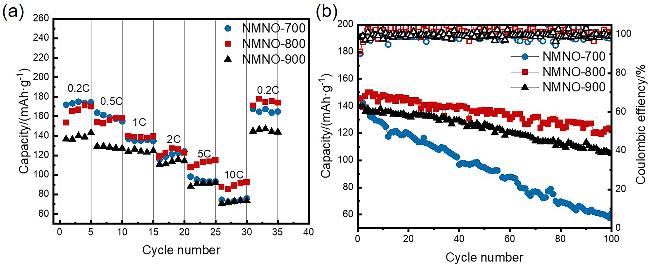
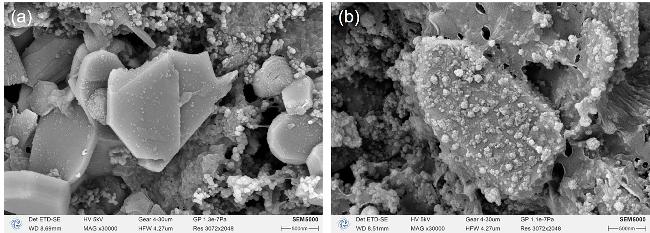
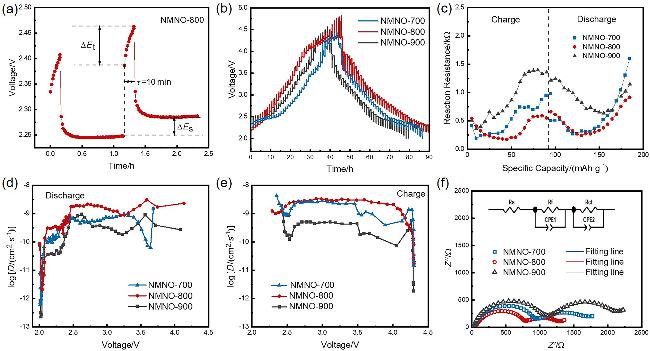
富锰层状氧化物因比容量高、成本低等优势,成为备受关注的钠离子电池正极材料。然而,该材料在深度脱钠状态下的容量衰减和合成过程中结构易受煅烧温度影响,为其应用带来了巨大挑战。本文采用自蔓延燃烧合成,通过调控煅烧温度,制备了一种P2/P3双相结构Na0.67Mn0.9Ni0.1O2(NMNO-800)正极材料。XRD结果表明,煅烧温度的改变可以促使多相材料形成,当煅烧温度在700 ℃和900 ℃时 ,NMNO-700和NMNO-900分别为P3相结构(空间群R3m)和P2相结构(空间群P63 /mmc),而当煅烧温度为800 ℃时,NMNO-800呈现出稳定的P2/P3双相结构,经计算确定两相比例分别为42.2%和57.6%。SEM分析表明,NMNO-800为纳微复合结构,微米颗粒分布在1.94~2.57 μm之间,同时微米级片状颗粒表面附着许多纳米颗粒。NMNO-800结合P2相和P3相的优势,既有P2相的稳定结构,又具有P3相的高初始容量,展现出优异的电化学性能。该材料在0.2 C下表现出165.44 mAh/g的高可逆比容量,10 C大倍率下仍有89.18 mAh/g的可逆容量,在0.5 C下循环100次后容量保持率为84.2%,显著优于单相层状氧化物。GITT和EIS分析表明,具有P2/P3双相结构的NNMO-800表现出较高的钠离子扩散系数。

本文引用格式

张庆堂 , 杜纯阳 , 高鹏飞 , 王晓梅 . 富锰P2/P3双相Na0.67Mn0.9Ni0.1O2自蔓延燃烧合成与储钠性能[J]. 化学学报, 0 : 20251203 -20251203 . DOI: 10.6023/A25080290

Abstract

The P2-type manganese-rich layered oxides have emerged as highly promising cathode materials for sodium-ion batteries owing to their exceptional advantages including high specific capacity and low production cost. However, significant challenges remain for their practical applications, particularly concerning the capacity degradation under deep desodiation conditions and the structural sensitivity to calcination temperatures during material synthesis. In this study, we successfully fabricated a P2/P3 biphasic Na0.67Mn0.9Ni0.1O2 (designated as NMNO-800) cathode material through a carefully controlled self-propagating combustion synthesis method with precise temperature regulation. Comprehensive XRD characterization revealed that the calcination temperature plays a critical role in phase formation: NMNO-700 (calcined at 700 ℃) exhibited a pure P3-phase structure with R3m space group, while NMNO-900 (calcined at 900 ℃) showed a pure P2-phase structure with P63/mmc space group. Remarkably, the NMNO-800 sample calcined at the optimal temperature of 800 ℃ demonstrated a well-defined and stable P2/P3 biphasic structure, with the phase ratio quantitatively determined to be 42.2% P2-phase and 57.6% P3-phase through Rietveld refinement analysis. SEM observations further confirmed that the NMNO-800 material possesses a unique hierarchical nano-micro composite architecture, consisting of well-dispersed micron-sized particles ranging from 1.94 to 2.57 μm in diameter, with numerous nanoparticles uniformly distributed on the surface of these micron-scale sheet-like particles. This ingenious designed biphasic Na0.67Mn0.9Ni0.1O2 successfully combines the advantageous features of both P2 and P3 phases, maintaining the excellent structural stability characteristic of P2-phase while preserving the high initial capacity inherent to P3-phase, thereby achieving superior electrochemical performance. Specifically, the NMNO-800 cathode delivered an outstanding reversible capacity of 165.44 mAh/g at 0.2 C rate, maintained a respectable capacity of 89.18 mAh/g even at an extremely high rate of 10 C, and showed excellent cycling stability with 84.2% capacity retention after 100 cycles at 0.5 C rate, significantly outperforming all single-phase counterparts. Studies indicate that the P2/P3 biphasic structure enhances the rate performance of manganese-rich layered oxide cathode materials, improves sodium ion diffusion efficiency, and maintains good cycling stability.

参考文献

[1] Bai H.; Yuan K.; Zhang C.; Zhang W.; Tang X.; Jiang S.; Jin T.; Ma Y.; Kou L.; Shen C.; Xie K.Energy Storage Mater. 2023, 61, 102879.
[2] Kong F.; Zhang J.; Tang Y.; Sun C.; Lin C.; Zhang T.; Chu W.; Song L.; Zhang L.; Tao S. Chin. Chem. Lett. 2025, 36, 110993.
[3] Yu G.; Xie M.; Yi A.; Wu Z.; Zhong J.; Zhao H.; Liu F. Appl. Surf. Sci. 2025, 709, 163565.
[4] Liu J.; Zhu J.; Zhang X.; Zhang J.; Huang C.; Jia G.; An S.Acta Chim. Sinica 2025, 83, 101(in Chinese). (刘继洪, 祝佳鹏, 张旭, 张纪阳, 黄超洋, 贾桂霄, 安胜利, 化学学报, 2025, 83, 101.)
[5] La C.; Lv Y.; Dai S.; Hao S.; Peng J.; Zhao J.; Huang C.; Xue L.; Zhang W.; Huang Y. Chem. Eng. J. 2025, 519, 164736.
[6] Zhang X.; Yang Y.; Yu J.; Li Z.; Zhang Y.; Xie X.; Zhang Z.; Guan Y.; Pi Y.; Wang F.; Ding Y. J.Alloys Compd. 2025, 1035, 181577.
[7] Huiming W.; Zibing P.; Haotian Z.; Chongrui, D.; Yan, D.; Yuliang, C. A Small Methods. 2021, 5, 2100372.
[8] Zhang R.; Raveendran V.; He Y.; Yau A.; Chang A.; Chi C.; Bong S.; Cheng F.; Ma W.; Chen J.Energy Mater. Adv. 2021, 2021, 2124862.
[9] Xie J.; Xiao Z.; Zuo W.; Yang Y.Acta Chim. Sinica 2021, 79, 1232(in Chinese). (谢佶晟, 肖竹梅, 左文华, 杨勇, 化学学报, 2021, 79, 1232.)
[10] Li X.; Yu S.; Peng J.; Liang L.; Pan Q.; Zheng F.; Wang H.; Li Q.; Hu S. Small. 2025, 21, 2500940.
[11] Ren C.; Dong Y.; Lei Y. Small. 2025, 21, 2501262.
[12] Guan Z.; Pang G.; Li M.; Zhuo H.; Wang K.; Hu J.; Xiao B.; Zhuang W. Mater. Today 2025, 87, 04009.
[13] Song G.; Lee S.; Kim T.; Jung M. S.; Kim K.; Choi S. H.; Lee S.; Park J.; Lee M.; Park C.; Kwon M.; Lee K. T. Adv. Energy Mater. 2024, 14, 202403374.
[14] Gao S.; Zhu Z.; Fang H.; Feng K.; Zhong J.; Hou M.; Guo Y.; Li F.; Zhang W.; Ma Z.; Li F. Adv.Mater. 2024, 36, 2311523.
[15] Wu Z.; Li C.; Gao P.; Zhang X.; Lin Y.; Yu X.; Liu Y.; Sun W.; Jiang Y.; Gao M.; Pan H.; Yang Y. J. Mater. Sci. Technol. 2025, 215, 05083.
[16] Huang R.; Luo S.; Zhao W.; Sun Q.; Feng J.; Yan S.; Qian L.; Li C. Mater.Today Chem. 2025, 43, 102481.
[17] Zhang W.; Zhang C.; Li Z.; Wang D.; Liu S.; Yang J.; Yu X.; Qiu J. Nat.Commun. 2025, 16, 6691.
[18] Su L.; Sun B.; Wu M.; Liu G.; Xu B.; Ouyang C. J. Chem. Phys. 2024, 160, 064703.
[19] Liu C.; Chen K.; Xiong H.; Zhao A.; Zhang H.; Li Q.; Ai X.; Yang H.; Fang Y.; Cao, Y. eScience. 2024, 4, 100186.
[20] Dang Y.; Xu Z.; Wu Y.; Zheng R.; Wang Z.; Lin X.; Liu Y.; Li Z.; Sun K.; Chen D.; Wang D. J.Energy Chem. 2024, 95, 03055.
[21] Jamil S.; Mudasar F.; Yuan T.; Fasehullah M.; Ali G.; Chae K. H.; Voznyy O.; Zhan Y.; Xu M. ACS Appl. Mater. Interfaces2024, 16, 3c15667.
[22] Sengupta A.; Kumar A.; Bano A.; Ahuja A.; Lohani H.; Akella S. H.; Kumari P.; Noked M.; Major D. T.; Mitra S.Energy Storage Mater. 2024, 69, 103435.
[23] Shi Q.; Qi R.; Feng X.; Wang J.; Li Y.; Yao Z.; Wang X.; Li Q.; Lu X.; Zhang J.; Zhao Y. Nat.Commun. 2022, 13, 3205.
[24] Wang J.; Shen M.; Li W.; Wu T. ACS Appl. Mater. Interfaces2024, 16, 4c07191.
[25] Wu W.; Zhang P.; Chen S.; Liu X.; Feng G.; Zuo M.; Xing W.; Zhang B.; Fan W.; Zhang H.; Zhang P.; Zhang J.; Xiang W. J.Colloid Interface Sci. 2024, 6741, 06136.
[26] Shi Y.; Zhang Z.; Jiang P.; Gao A.; Li K.; Zhang Q.; Sun Y.; Lu X.; Cao D.; Lu X.Energy Storage Mater. 2021, 37, 02020.
[27] Jiang Y.; Li W.; Song H.; Ding R.; Luo K. Chem. Eng. J. 2025, 513, 163001.
[28] Mudassir H. M.; Xie C.; Xia F.; Fang R.; Chen Q.; Liu Z.; Dong T.; Liu F.; Hu S.; Jian Z.; Wu J. J. Mater. Sci. Technol. 2025, 238, 238230.
[29] Zhou Y.; Wang P.; Niu Y.; Li Q.; Yu X.; Yin Y.; Xu S.; Guo Y.Nano Energy. 2019, 55, 102072.
[30] Jiang N.; Liu Q.; Wang J.; Yang W.; Ma W.; Zhang L.; Peng Z.; Zhang Z. Small. 2021, 17, 2007103.
[31] Graff K.; Hou D.; Gabriel E.; Park J.; Koisch A.; Schrock R.; Conrado A.; Schwartz D.; Gutierrez A.; Johnson C. S.; Lee E.; Xiong H.Chem Electro Chem. 2025, 12, 202400662.
[32] Hong F.; Zhou X.; Liu X.; Feng G.; Zhang H.; Fan W.; Zhang B.; Zuo M.; Xing W.; Zhang P.; Yan H.; Xiang W. J.Energy Chem. 2024, 91, 501-511.
[33] Vasavan H. N.; Badole M.; Saxena S.; Srihari V.; Das A. K.; Gami P.; Deswal S.; Kumar P.,& Kumar, S. Journal of Energy Storage, 74, 109428.
[34] Zhang X.; Yi B.; Jia W.; Zhao S.; Savilov S.; Yao S.; Shen Z. X.; Chen G.; Wei Z.; Du F. Angew.Chem. 2024, 137, 202413214.
[35] Yin S.; Tao Z.; Zhang Y.; Zhang X.; Yu L.; Ji F.; Ma X.; Yuan G.; Zhang G. ACS Appl. Mater. Interfaces2024, 16, 4c04855.
[36] Rahman M. M.; Mao J.; Kan W. H.; Sun C.; Li L.; Zhang Y.; Avdeev M.; Du X.; Lin F. ACS Mater. Lett.2019, 1, 9b00347.
[37] Kumar A.; Chakraborty D.; Nabi Z.; Wadibhasme N.; Dusane R. O.; Johari P.; Mukhopadhyay A. J.Solid State Electrochem. 2023, 27, 05436.
[38] Hashimoto K.; Kubota K.; Tatara R.; Hosaka T.; Komaba S. Inorg.Chem. 2024, 146, 04001.
[39] Hakim C.; Asfaw H. D.; Younesi R.; Brandell D.; Edström K.; Saadoune I.Electrochim Acta. 2023, 43, 8141540.
[40] Yan S.; Luo S.; Yang L.; Feng J.; Li P.; Wang Q.; Zhang Y.; Liu X. J. Adv. Ceram. 2021, 11, 524.
[41] Zhang X.; Xie F.; Han J.; Wang X.; Liu T.; Yu J.; Zhang L. Small. 2025, 21, 2502292.
[42] Liu Q.; Liu J.; Yang Z.; Miao H.; Liu Y. J.Alloys Compd. 2023, 968, 172272.
[43] Zhang Q.; Wu X.; Shu Q.; Su C.; Wang X. Chem. Eng. J. 2023, 480, 148257.
[44] Guo S.; Sun Y.; Yi J.; Zhu K.; Liu P.; Zhu Y.; Zhu G.; Chen M.; Ishida M.; Zhou H. NPG Asia Mater. 2016, 8, 266.
[45] Chen T.; Liu W.; Zhuo Y.; Hu H.; Zhu M.; Cai R.; Chen X.; Yan J.; Liu K. J.Energy Chem. 2020, 43, 016.
[46] Liu Q.; Hu Z.; Chen M.; Zou C.; Jin H.; Wang S.; Gu Q.; Chou S. J. Mater. Chem. A 2019, 7, 11927.
[47] Azahidi A.; Kasim M.; Elong K.; Kamarulzaman N.; Mastuli M. S.; Rusop M. Ceram.Int. 2022, 48, 29790.
文章导航

/