


 石伟群, 上海交通大学特聘教授, 核燃料循环与核材料研究所所长, 国家杰出青年科学基金获得者. 2007年1月在清华大学化学系获博士学位. 长期致力于核燃料循环化学相关基础研究, 在JACS、Angew. Chem、Chem.、CCS Chem.、Nat. Commun、Adv. Mater.等国际知名期刊发表SCI论文400余篇, 成果被国内外同行广泛关注和引用, 文章总引两万余次, H因子71 (Google Scholar), 2020~2024年连续入选Elsevier中国高被引学者榜单(核科学技术). 分别担任期刊《Supramolecular Materials》副主编, 《Industrial Chemistry & Materials》、《Chinese Chemical Letters》、《Journal of Nuclear Fuel Cycle and Waste Technology》、《International Journal of Advanced Nuclear Reactor Design and Technology》和《Journal of Nuclear Science and Technology》的编委与国际顾问编委, 中文期刊《化学学报》、《高等学校化学学报》、《核化学与放射化学》、《核动力》编委. 现为中国核工业教育学会副理事长、中国核学会锕系物理与化学分会副理事长、中国有色金属学会熔盐化学与技术专业委员会副主任委员、中国化学会核化学与放射化学专业委员会委员、中国核学会核化工分会常务理事兼副秘书长.
1 引言
2 熔盐技术与核级锆制备
2.1 锆铪分离工艺
2.1.1 溶液体系的锆铪分离工艺
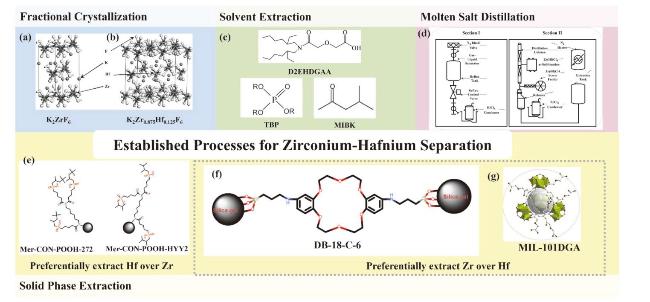
图2 相对成熟的Zr/Hf分离工艺, 分级结晶中的(a) K2ZrF6晶体单胞结构[42], (b)固溶体晶体单胞结构[42]; (c)溶剂萃取法中代表性的萃取剂[48]; (d)熔盐精馏法的精馏塔结构示意图[52]; 固相吸附法中的代表性材料(e)接枝树脂[49], (f)修饰硅胶[50], (g) MOF吸附剂[51]Figure 2 Established Zr/Hf separation technologies: (a) Crystal structure of the K2ZrF6 unit cell[42]; (b) Crystal structure of a solid solution unit cell[42]; (c) Representative extractants used in solvent extraction methods[48]; (d) Schematic diagram of the distillation column structure in molten salt distillation method[52]; Representative materials in solid phase extraction methods: (e) Grafted resin[49], (f) Modified silica gel[50], (g) MOF adsorbent[51] |
表1 四种Zr/Hf分离工艺的优缺点Table 1 Advantages and disadvantages of Zr-Hf separation methods |
| Methods | Advantage | Challenges |
|---|---|---|
| Fractional Crystallization | Simplicity principle; Mild operating conditions | Low separation factor; Low productivity; Intermittent operation |
| Solvent Extraction | Large-scale production; Mature process; Separation efficiency | High consumption; High waste generation; Process complexity |
| Solid-phase Extraction | Eco-Friendly; Highly efficient | Adsorbent cost; Low stability |
| Molten Salt Distillation | Process simplicity; Simplifies downstream; Waste minimization | High temperature; Corrosivity; High energy consumption |
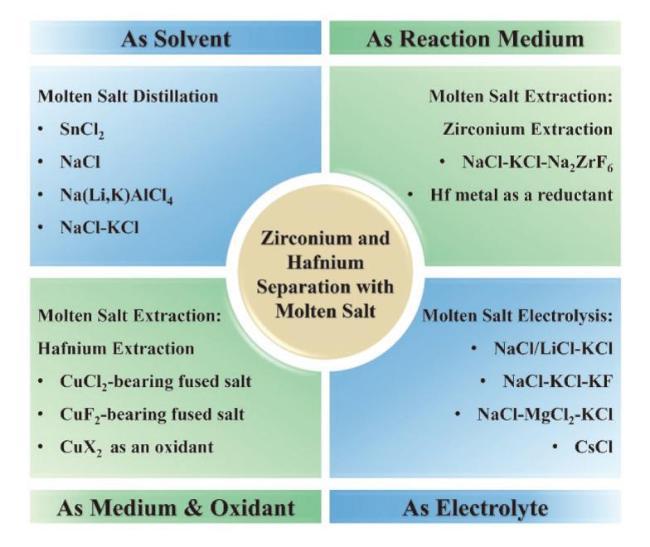
2.1.2 熔盐体系的锆铪分离工艺
2.2 金属锆制备工艺
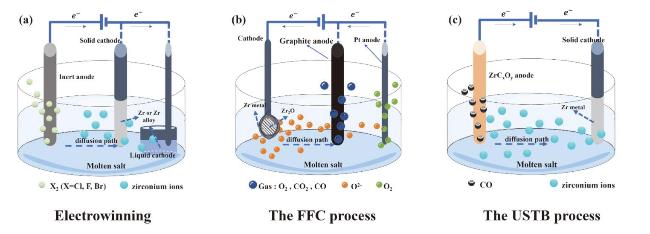
图4 不同熔盐电解工艺的原理示意图: (a)传统的电沉积法; (b)阴极氧化物电脱氧法(The FFC process); (c)可溶性阳极电解法(The USTB process)Figure 4 Schematic diagrams of the principles of different molten salt electrolysis processes: (a) Traditional electrowinning method; (b) Cathodic oxide electro-deoxidation method (The FFC process); (c) Soluble anode electrolysis method (The USTB process) |
2.2.1 电沉积法制备金属锆
2.2.2 FFC法制备金属锆
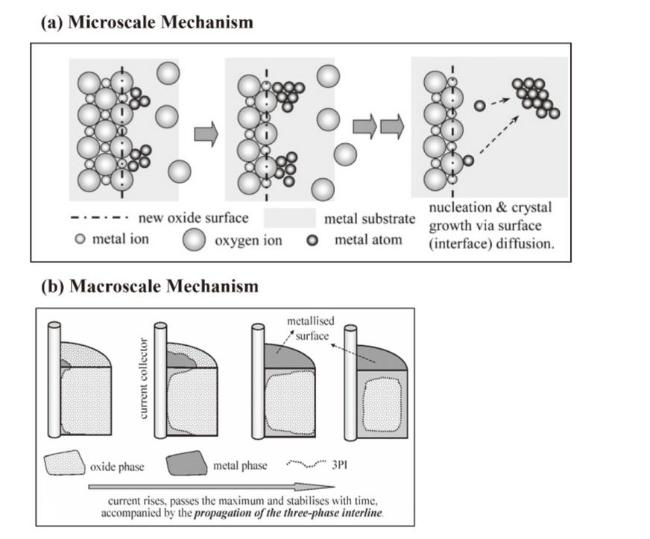
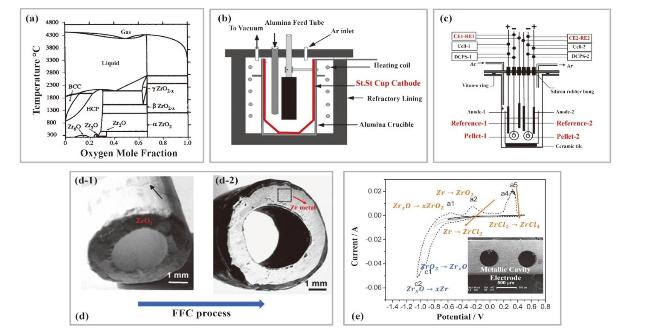
图6 (a) Zr-O相图[97]; (b)特殊阴极的FFC工艺装置图[99]; (c)二合一的双电池装置示意图[103]; (d) FFC工艺制备的锆金属管[100]; (e) MCE电极和氧化锆在熔融CaCl2中的CV曲线[102]Figure 6 (a) Zr-O phase diagram[97]; (b) Diagram of the FFC process device with special cathode[99]; (c) Schematic diagram of the dual-cell device[103]; (d) Zirconium metal tube prepared by FFC process[100]; (e) CV curves of MCE electrode and zirconia in molten CaCl2[102] |
2.2.3 USTB法制备金属锆
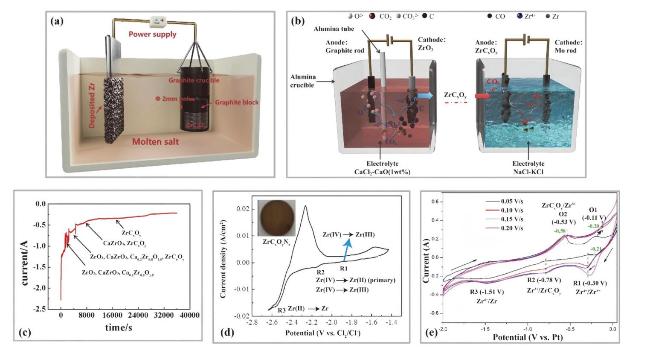
图7 (a)石墨坩埚作为阴极的电解池设计图[113]; (b)耦合碳捕集的USTB工艺设计图[116]; (c)电解ZrO2-C混合物的I-t曲线[117]; (d)熔体中锆离子(来源于ZrCxOyNz氧化溶解)的CV曲线[114]; (e)以ZrCxOy为工作电极的CV曲线[115]Figure 7 (a) Design diagram of an electrolytic cell with a graphite crucible as the cathode[113]; (b) Design diagram of the USTB process coupled with carbon capture[116]; (c) I-t curve of the electrolytic ZrO2-C mixture[117]; (d) CV curve of zirconium ions (from the oxidative dissolution of ZrCxOyNz)[114]; (e) CV curve with ZrCxOy as the working electrode[115] |
3 熔盐技术与核级锆回收
3.1 化学法回收金属锆
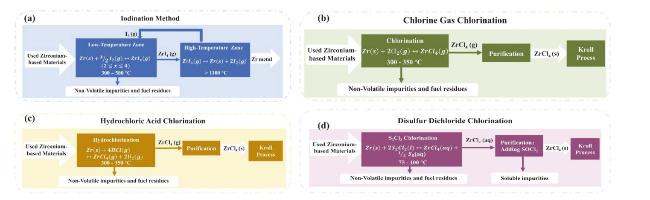
图8 金属锆回收方法流程简图: (a)碘化法流程简图; (b)氯气氯化法流程简图; (c)氯化氢氯化法流程简图; (d) S2Cl2氯化法流程简图Figure 8 Methods for recovering metallic zirconium: Schematic diagram of (a) The iodination method; (b) The chlorination method using chlorine gas; (c) The chlorination method using hydrogen chloride; (d) The chlorination method using disulfur dichloride |
3.2 熔盐电精炼回收金属锆
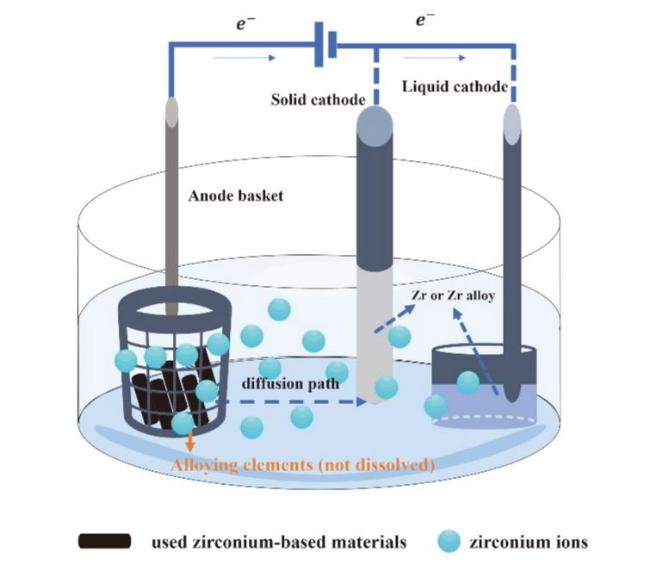
3.2.1 氟化物熔盐中回收金属锆
3.2.2 氯化物熔盐中回收金属锆
4 熔盐体系设计的关键: 锆的电化学行为
表2 适用于核级锆冶金关键环节的熔盐体系特性Table 2 Characteristics of molten salt systems applicable to critical processes in nuclear-grade zirconium metallurgy |
| Components | Melting/Eutectic Temp. (℃) | Characteristics/Properties | Primary Applications in Zr Industry |
|---|---|---|---|
| NaCl | 801 |  Wide electrochemical window; High Zr-salt solubility; Low cost; Formation of dense, adherent Zr deposits. Wide electrochemical window; High Zr-salt solubility; Low cost; Formation of dense, adherent Zr deposits. | Molten Salt Distillation; Molten Salt Electrolysis for Zr/Hf Separation; Electrowinning for Zirconium Production. |
| MgCl2 | 714 | Denser Kroll byproduct than molten Mg; Electrolytically regeneratable. | Kroll Process for Zirconium Production. |
| CaCl2 | 772 | High O2− affinity/solubility; Efficient O2− transport. | FFC Process for Zirconium Production. |
| NaCl-KCl | 657 | Powdery, non-adherent zirconium deposits; Favorable solubility for ZrCxOy anodes. | Molten Salt Distillation; Molten Salt Extraction for Zr/Hf Separation; Molten Salt Electrolysis for Zr/Hf Separation; Electrowinning for Zirconium Production; USTB Process for Zirconium Production. |
| LiCl-KCl | 352 | Multi-metallic processing capability; Highly purifiable; Wide/stable electrochemical window. | Molten Salt Electrolysis for Zr/Hf Separation; Electrowinning for Zirconium Production; Electrorefining for Zirconium Recovery. |
| LiF-KF | 492 | High Zr(IV) reduction efficiency; Dense Zr deposition; Fluoride-induced anode passivation; High viscosity and corrosivity. | Electrorefining for Zirconium Recovery. |
| LiF-NaF | 649 | ||
| LiF-NaF-KF | 460 |
表3 熔盐电化学测试中使用到的电化学计算公式Table 3 Summary of electrochemical calculation formulas used in molten salt electrochemical testing |
| Technique | Description/Formula Name | Equation | Applicable System & Notes |
|---|---|---|---|
| EFMa | Nernst Equation | | Ecell: Measured potential (V) C: Concentration of the electroactive species (mol/L) |
| LSV/CV | Reversible System Half-Wave Potential | | Reversible System: Fast electron transfer. EP/2: Half-wave potential (V) EP: Peak potential (V) Constant 2.2 is characteristic of a reversible process. |
| Irreversible System Half-Wave Potential | | Totally Irreversible System: Slow electron transfer. Constant 1.85 is characteristic of an irreversible process. | |
| SWV | Peak Width at Half Height | | W1/2: Peak width at half height (V) Applicable when electron transfer is sufficiently fast. |
| CP | Sand's Equation | | Used to calculate the diffusion coefficient D or n. i: Applied constant current (A) A: Electrode area (cm2) C: Bulk concentration (mol/cm3) |
| Calculation | Randles-Sevcik Equation | | Primarily used in LSV/CV to calculate the diffusion coefficient D from the peak current ip. ip: Peak current (A) ν: Scan rate (V/s) |
a Electromotive force measurements. |
表4 氟化物熔体中锆离子的电还原行为研究: 文献综述Table 4 Electroreduction analysis of zirconium in fluoride melts: a literature review |
| FLiNaK (LiF:NaF:KF) | |||||
|---|---|---|---|---|---|
| Author | Time | Zr(IV) Ion Source | Electrode | Electroreduction behavior of Zr(IV) | D(Zr4+)/(cm2•s−1) |
| Mellors[77] | 1966 | ZrF4 & K2ZrF6 | Mo | Zr(IV)→Zr | — |
| Li[135] | 2023 | K2ZrF6 | Cu | | — |
| Zuo[140] | 2025 | ZrF4 | W | | 3.85×10⁻⁶ (600 ℃) |
| LiF-CaF2 | |||||
| Gibilaro[134] | 2013 | ZrF4 | Ta, Cu, Ni | Zr(IV)→Zr | 9.96×10⁻⁶ (840 ℃) |
| Fabian[139] | 2022 | ZrF4 | Mo, Ni | Zr(IV)→Zr0(sol)→Zr | 2.6×10⁻⁵ (840 ℃) |
| LiF-KF | |||||
| Mellors[77] | 1966 | ZrF4 & K2ZrF6 | Mo | Zr(IV)→Zr | — |
| Park[136] | 2013 | ZrF4 | Mo | Zr(IV)→Zr | — |
| Xu[152] | 2016 | ZrF4 | Mo | Step 1: Zr4+→Zr2+ Step 2: Zr4+, Zr2+→Zr+ Step 3: Zr+, Zr2+, Zr4+→Zr | 1.32×10⁻⁶~1.53×10⁻⁵ (600 ℃) |
| LiF-NaF | |||||
| Groult[153] | 2007 | ZrF4 | W, Mo, C, Ni | Zr(IV)→Zr | 1.19×10⁻⁵ (694 ℃) 2.59×10⁻⁵ (730 ℃) 3.19×10⁻⁵ (762 ℃) |
| Groult[154] | 2011 | n(LiF):n(KF):n(ZrF4)= (26:37:37) | C | Zr(IV)→ZrC | — |
| Xu[155] | 2017 | K2ZrF6 | Mo | Zr(IV)→Zr(II) Zr(IV)/Zr(II)→Zr | 8.14×10⁻⁶~1.91×10⁻⁵ (750 ℃) |
| Quaranta[87] | 2018 | ZrF4 | Ag | Zr(IV)→Zr | 1.21×10⁻⁵~1.35×10⁻⁵ (750 ℃) |
4.1 氟化物熔体中锆的电还原行为
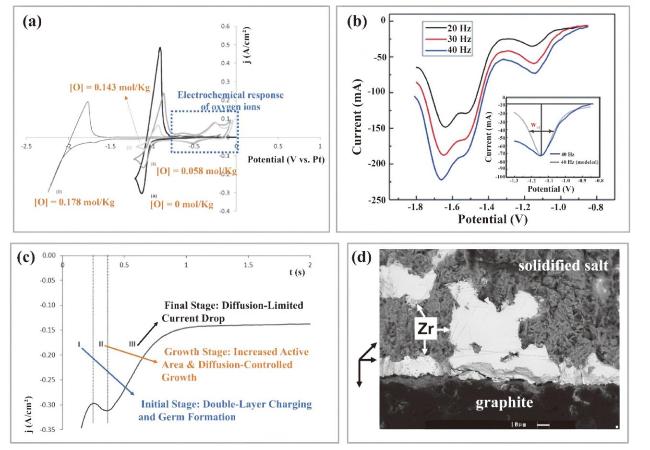
图10 (a) LiF-CaF2熔体中氧离子对Zr(IV)离子电化学行为的影响[134]; (b) LiF-KF熔体中ZrF4还原的SWV曲线[152]; (c) LiF-NaF熔体中Ag电极上锆成核行为表征的I-t曲线[87]; (d)石墨电极作为阴极在LiF-NaF-ZrF4熔体中沉积金属锆后的SEM形貌图[154]Figure 10 (a) Influence of oxygen ions on the electrochemical behavior of Zr(IV) ions in LiF-CaF2 melts[134]; (b) SWV curve of ZrF4 reduction in LiF-KF melts[152]; (c) Chronoamperometric curve characterizing zirconium nucleation behavior on Ag electrode in LiF-NaF melts[87]; (d) SEM morphology of metallic zirconium deposited on graphite electrode in LiF-NaF-ZrF4 melts[154] |
4.2 氯化物熔体中锆的电还原行为
4.2.1 LiCl-KCl熔体
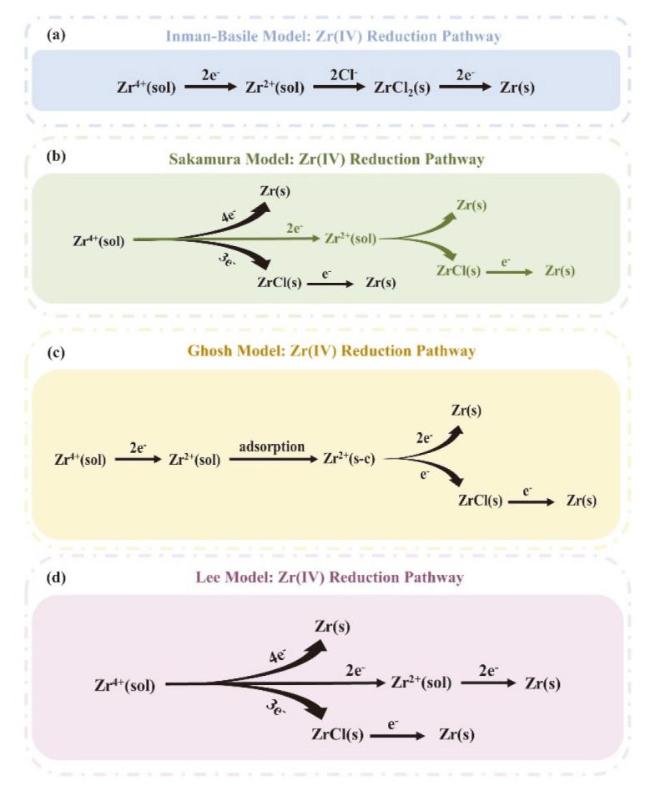
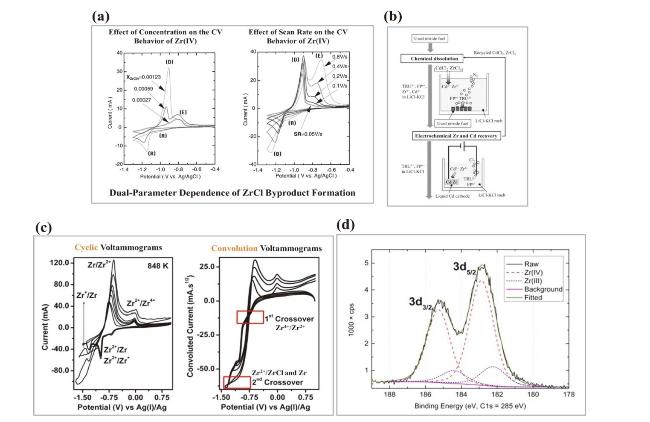
图12 (a)不同浓度和扫描速率下LiCl-KCl-ZrCl4体系的CV曲线, 图中氧化还原峰对应的氧化还原电对: Zr(IV)/Zr(II) (A)、Zr(IV)/Zr(0)与Zr(IV)/ZrCl (B)、ZrCl/Zr(IV) (D)和Zr(0)/Zr(IV) (E)[158]; (b)利用电还原回收Zr(IV)离子和Cd(II)离子的示意图[169]; (c)原始CV曲线与其对应的卷积伏安图对比[166]; (d) LiCl-KCl-ZrCl4熔体的XPS测试图[172]Figure 12 (a) CV curves of the LiCl-KCl-ZrCl4 system at different concentrations and scan rates, with the peaks corresponding to the redox couples: Zr(IV)/Zr(II) (A), Zr(IV)/Zr(0) and Zr(IV)/ZrCl (B), ZrCl/Zr(IV) (D), and Zr(0)/Zr(IV) (E)[158]; (b) Schematic diagram of the electrochemical recovery of Zr(IV) and Cd(II) ions[169]; (c) Comparison of the original CV curve and its corresponding convolution voltammogram[166]; (d) XPS test results of LiCl-KCl-ZrCl4 melt[172] |
4.2.2 NaCl熔体
4.2.3 NaCl-KCl熔体
表5 NaCl-KCl熔体中锆电还原行为的研究: 文献综述Table 5 Electrochemical analysis of zirconium in NaCl-KCl molten salts: a literature review |
| Author | Year | Technique/Method | Electrolyte | Electroreduction behavior of Zr(IV) | Temp.a/℃ |
|---|---|---|---|---|---|
| Mellors[77] | 1966 | ED b | NaCl-KCl-ZrCl4 NaCl-KCl-K2ZrF6 | ZrCl2 forms in electroreduction | 600~900 |
| Swaroop[176] | 1966 | EFM | NaCl-KCl-ZrCl2 NaCl-KCl-ZrCl2-ZrCl3 NaCl-KCl-ZrCl3-ZrCl4 | Zr(IV)→Zr(III)→Zr(II)→Zr(0) | 670~740 |
| Sakakura[177] | 1976 | CP | NaCl-KCl-ZrCl2 NaCl-KCl-ZrCl4 | Zr(IV)→Low Valency→Zr(0) | 700~900 |
| Polyakova[80] | 1982 | LSV | NaCl-KCl-ZrCl4 | Zr(IV)→Zr(II)→Zr(0) | 735 |
| NaCl-KCl-K2ZrF6 | | 805 | |||
| Guang-Sen[68] | 1990 | LSV and CV | NaCl-KCl-ZrCl4 | | 760 |
| Wu[81] | 2011 | CV and SWV | NaCl-KCl-K2ZrF6 | Zr(IV)→Zr(II)→Zr(0) | 750 |
| Ueda[88] | 2015 | CV | AlCl3-NaCl-KCl-ZrCl4 | Zr(IV)→Zr(II)→Zr(0) | 175 |
| Wang[82] | 2016 | CV, CP and ED b | NaCl-KCl-K2ZrF6 | Pathway 1: Zr(IV)→Zr(III)→Zr(II)→Zr(0) Pathway 2: Zr(IV)→Zr(0) | 750 |
| Tekeda[111] | 2018 | CV and SWV | NaCl-KCl-ZrCl4 | Pathway 1: Zr(IV)→Zr(II)→Zr(0) Pathway 2: Zr(IV)→Zr(0) | 800 |
| NaCl-KCl-K2ZrF6 | | ||||
| Zhang[83] | 2022 | CV | NaCl-KCl-K2ZrF6 | Zr(IV)→Zr(II)→Zr(0) | 750 |
| Wang[89] | 2023 | CV | NaCl-KCl-K2ZrF6 | Pathway 1: Zr(IV)→Zr(III)→Zr(II)→Zr(0) Pathway 2: Zr(IV)→Zr(0) | 750 |
a Temperature; b Electrodeposition. |