






1 引言
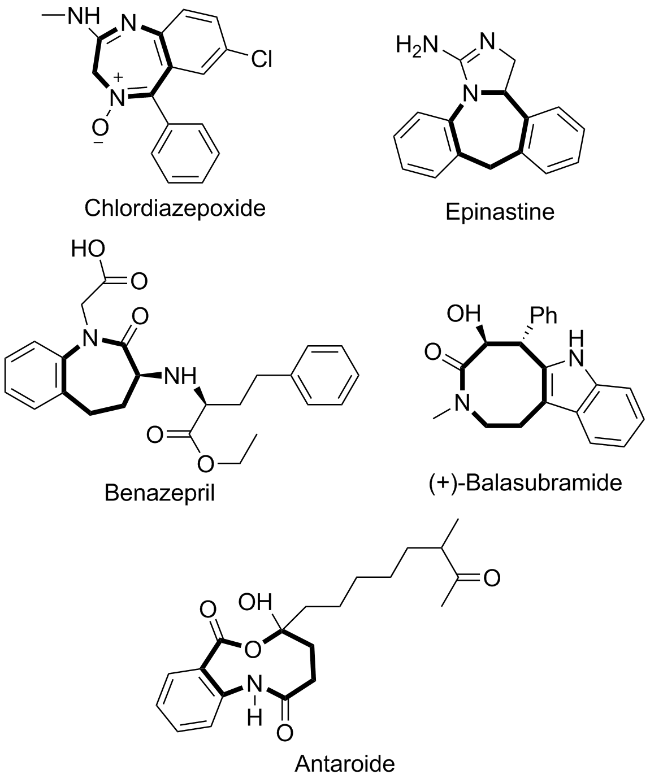
中环化合物凭借其独特的化学结构和生物活性, 在药物研发中已得到广泛应用(图1), 如: 主要用于镇静催眠、抗焦虑的苯二氮卓类药物Chlordiazepoxide[1], 具有抗炎、抗过敏作用的Epinastine[2]; 对高血压、心力衰竭有显著治疗作用的血管紧张素转换酶抑制剂Benazepril[3], 具有抗氧化和抗神经炎症作用的(+)-Balasubramide及生物碱Antaroide[4]等. 截至目前, 已经有许多合成中环化合物的策略, 如: 分子内环化反应[5]、过渡金属催化环化反应[6]、酶催化环化等. 然而, 由于中环骨架独特的结构特征、环张力大、构象灵活易变等特点, 使得中环化合物的合成仍然面临着较大挑战. 因此, 探索并发展高效、绿色、普适的中环化合物合成策略具有重要意义.
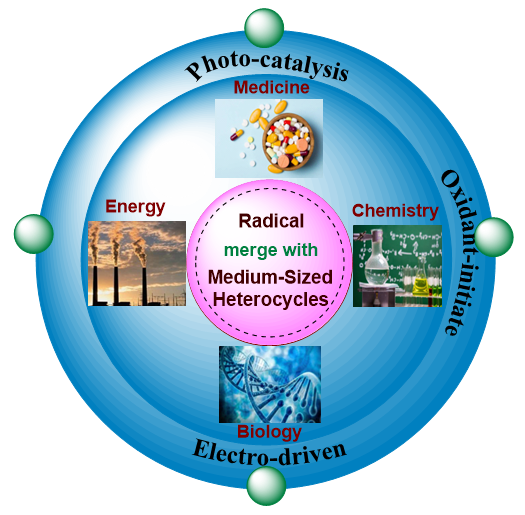
自由基串联环化策略, 可以快速地从简单分子得到结构复杂的多环化合物, 特别适用于构建位阻较大或官能团较复杂的化合物, 在药物和天然产物的合成中已被广泛使用. 通过自由基串联环化策略构建中环化合物具有步骤简洁、原子经济性高、底物适用范围广等诸多优势[7], 激起了广大有机合成研究者的兴趣和关注. 近年来, 利用光催化、电催化以及外部氧化剂介导的自由基串联环化策略用于合成五、六元环, 已经取得了较大的进展. 然而, 关于自由基引发的中环化合物的多样性合成方法以及综述报道却较少. 因此, 本文总结了近年来国内外课题组对自由基串联环化策略合成中环化合物的研究结果及进展, 按照环的尺寸大小分类, 分别总结了七元环、八元环、九元至十二元环化合物的合成策略, 并且对部分反应的机理、底物拓展、实际应用等进行重点介绍.
2 自由基串联环化策略合成七元环化合物
七元环具有独特的物理、化学性质, 构象灵活性强, 这使得其在分子识别和与生物靶点结合时展示出独特优势, 在天然产物和药物分子中广泛存在. 此外, 还可作用于有机半导体材料中, 有助于器件性能的提升; 若用于高分子材料中, 还可提高材料的热稳定性. 同时, 七元环还是连接五、六元环与中环的桥梁, 可以通过环扩张反应从五、六元环得到七、八元乃至更大的环, 反之, 七元环也可以通过一系列反应或者环收缩得到五元及其他环系. 为了有效地构建七元环, 化学研究者们开发了诸多合成方法和策略. 因此, 按照光催化、电催化、金属催化、外部氧化剂(过氧/硫化合物)介导进行分类介绍.
2.1 光催化
光催化以可见光为驱动力, 反应条件温和, 规避了传统反应中强酸、强碱、强氧化剂的使用, 符合绿色化学的原则. 可以产生独特的、高活性的中间体, 反应选择性及官能团耐受性均较强, 还可以实现以前难以进行或无法进行的反应. 此外, 光催化还可与其他催化模式相结合, 产生“1+1≥2”的效果.
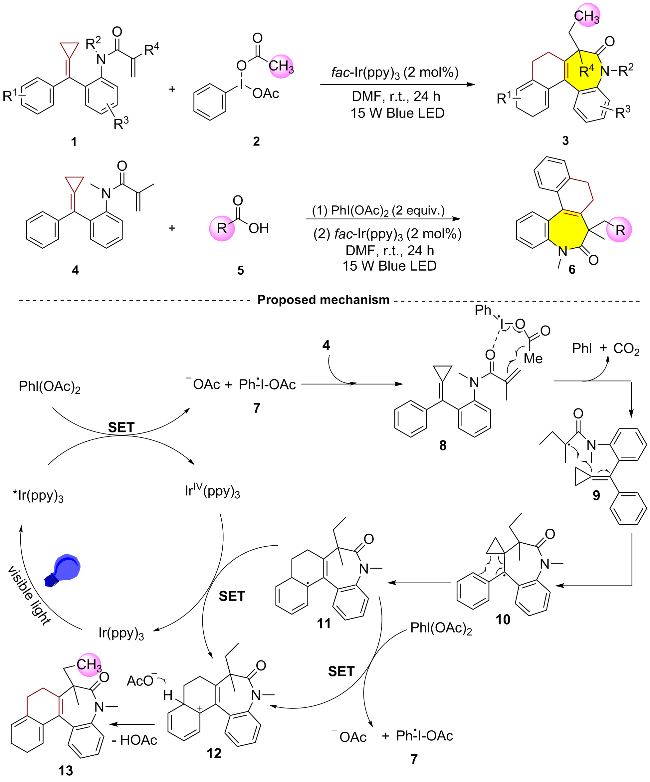
同时, 基于之前文献的报道和课题组共同的研究, 提出了如下的反应机理: 在可见光的照射下, 光催化剂Ir(ppy)3被激发至激发态∗Ir(ppy)3, 激发态的∗Ir(ppy)3与PhI(OAc)2结合发生单电子转移(SET)生成7和IrIV(ppy)3, 7与4中的羰基相互作用生成中间体8, 中间体8通过释放CO2和PhI, 生成一个烷基自由基中间体. 随后, 烷基自由基中间体与4加成生成自由基中间体9, 中间体9可以与亚烷基环丙烷中位阻较小的中心碳原子相加成生成自由基中间体10, 自由基中间体10开环生成中间体11, 中间体11与IrIV(ppy)3发生第二次单电子转移, 生成相应的阳离子中间体12. 此外, 中间体12也可以通过中间体11与PhI(OAc)2发生SET形成. 最后, 中间体12通过AcO−去质子化, 生成目标产物13.
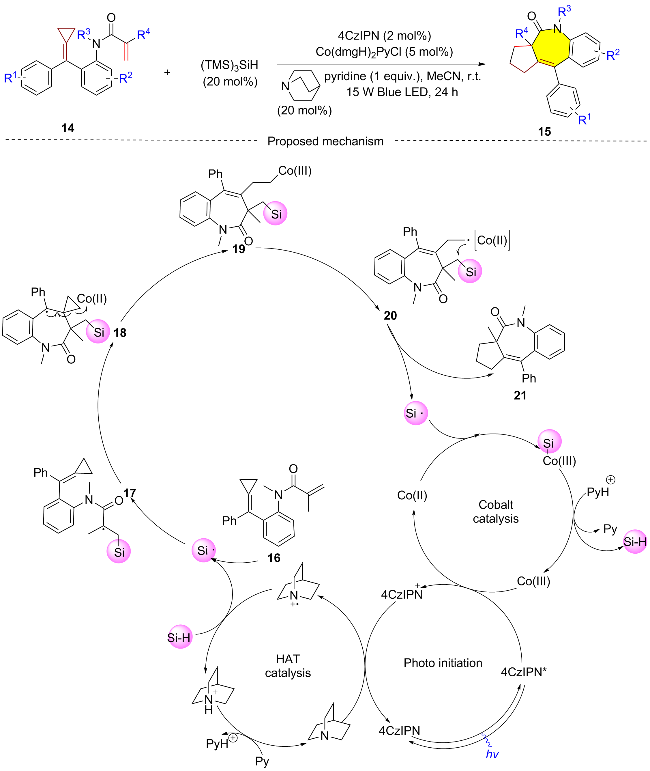
2021年, 施敏课题组[9]报道了一种通过光氧化还原催化, 利用硅基自由基介导丙烯酰胺/乙烯基磺酰胺连接的亚烷基环丙烷的碳环化反应(图式2). 作者通过控制实验发现光敏剂、三(三甲基硅基)硅烷(TTMSS)和Co(dmgH)2PyCl (I)在该反应中是必不可少的. 后续, 基于自由基捕获实验、量子产率测量、密度泛函理论计算(DFT)及其他文献的报道, 提出了其可能的反应机理: 在蓝光照射下, 基态光敏剂4CzIPN被激发为*4CzIPN, 激发态光敏剂将CoIII(dmgH)2PyCl还原为Co(Ⅱ); 随后, 生成的4CzIPN+将喹啉氧化形成亲电性强的喹啉鎓自由基阳离子, 喹啉鎓自由基阳离子会夺取TTMSS的氢原子生成硅基自由基. 硅基自由基加成到缺电子烯烃16的C=C键上得到中间体17, 中间体17发生环化反应形成自由基中间体18. 接着18上的环丙烷开环, 同时烯丙基自由基被Co(Ⅱ)捕获得到中间体19. 最后, 烷基钴配合物经光催化产生烷基自由基进攻硅-烷基部分得到目标产物21, 同时生成的硅基自由基与Co(Ⅱ)反应生成硅-钴配合物, 质子化生成Co(dmgH)2PyCl和TTMSS, 进入下一次循环.
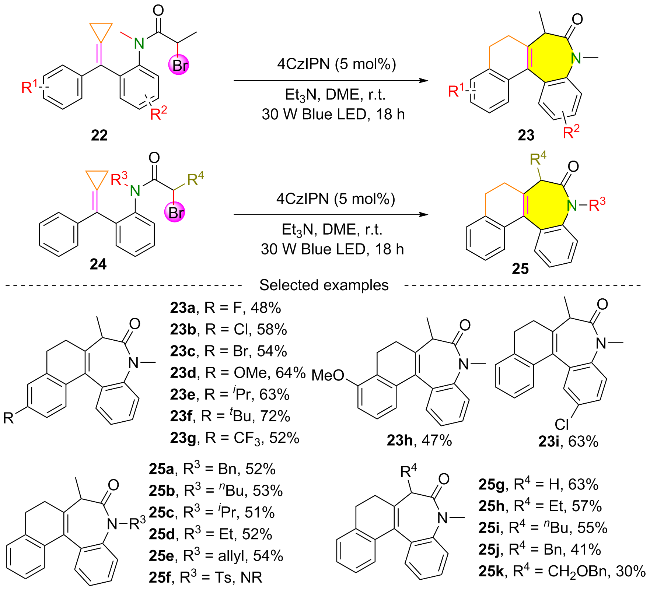
由于对该领域的持续兴趣, 2022年, 施敏课题组[10]又报道了一种可见光介导的α-溴代酰胺连接的亚烷基环丙烷的分子内自由基环化合成多环苯并氮杂卓类衍生物的方法(图式3). 作者研究了底物上不同取代基对反应的影响, 发现芳环上连接不同的吸电子基或给电子基、不同的N-保护基以及其他位置的取代基大多都能适应该反应条件, 且能以中等至良好的产率得到相应产物. 通过自由基捕获实验、调整Et3N用量及荧光淬灭实验(Stern-Volmer)等, 推测反应涉及卤素原子转移(XAT)过程和自由基链过程. 在可见光照射下, 4CzIPN被激发产生α-氨基烷基自由基, 经XAT过程引发反应, 再经多步自由基转化得到最终产物.
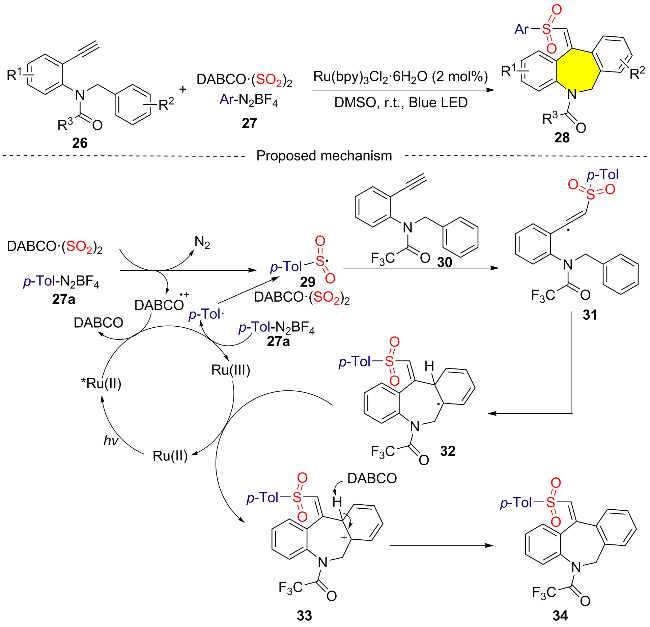
为了进一步研究这种三组分反应的机理, 课题组在标准条件下进行了自由基捕获实验, 且对紫外-可见吸收光谱进行分析, 并结合之前的报道提出了可能的反应机理: 首先, 4-甲基苯基四氟硼酸重氮盐27a与DABCO(SO2)2反应生成中间体29和叔胺自由基阳离子, 并释放N2. 同时, 基态Ru(II)经过光激发生成激发态*Ru(II), 其可以被叔胺自由基阳离子氧化成Ru(III). 另一条路线, 27a与*Ru(II)进行单电子转移, 得到4-甲基苯基自由基, 该自由基会与二氧化硫反应形成4-甲基苯基磺酰自由基29. 随后, 中间体29会攻击N-苄基-N-(2-乙炔基苯基)-2,2,2-三氟乙酰胺30上的C≡C键得到含有乙烯自由基31, 31会进一步发生7-exo cyclization形成自由基中间体32. 接着, 自由基中间体32将通过Ru(III)的单电子氧化生成阳离子中间体33. 最后, 中间体33在三乙烯二胺(DABCO)作用下去质子化, 得到所需的产物34.
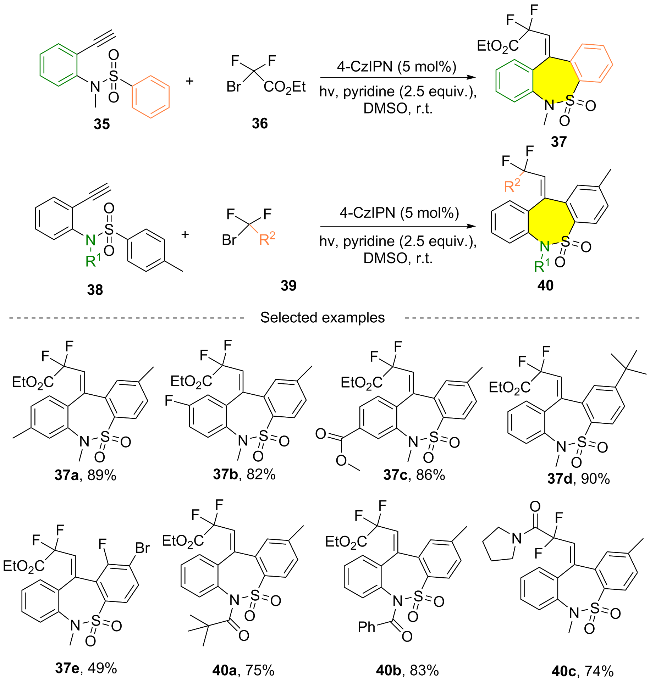
2021年, 钟建基课题组[12]报道了一种通过光催化合成二氟烷基化二氧代二苯并噻氮卓类化合物的方法(图式5). 该方法以廉价易得的BrCF2CO2Et为-CF2源, 邻磺酰胺基苯乙炔为自由基受体, 在光敏剂4-CzIPN、pyridine为碱、蓝光LED照射下进行反应. 通过优化反应条件, 发现以二甲基亚砜(DMSO)为溶剂、吡啶作碱时反应效果最佳. 该反应底物范围广泛, 对苯环上带有不同取代基的邻磺酰胺基苯乙炔, 以及多种带有N-保护基团的底物都能适应该反应条件, 且能以良好至较高的产率得到目标产物. 并且能与含有卤素、酯基、氰基等基团的化合物反应, 这使得产物具备更优异的后续衍生化潜力. 另外, 此方法没有使用过渡金属为催化剂, 克服了金属催化剂毒性和残留等问题, 反应条件温和, 为通过自由基串联环化合成中环化合物提供了新的途径.
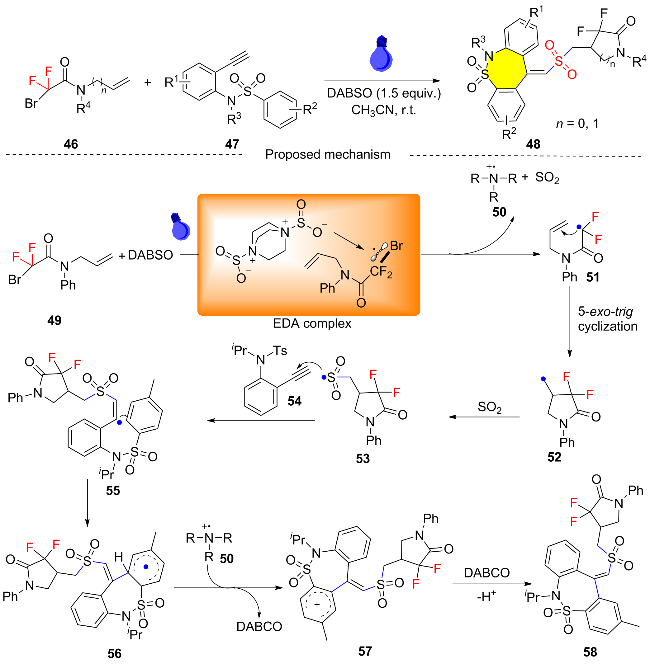
2022年, 俞传明课题组[14]报道了一种光诱导的三组分自由基双环化级联反应制备二氟酰胺磺酰化的二氧代二苯并噻氮卓类中环化合物的方法(图式7). 该反应无需添加金属催化剂、光敏剂, 避免了金属残留和光敏剂的潜在毒性等问题. 通过向反应体系中加入2,2,6,6-四甲基哌啶氧化物(TEMPO)、1,1-二苯基乙烯(DPE)、二丁基羟基甲苯(BHT)自由基捕获剂, 发现在反应过程中生成了自由基中间体. 此外, 对不同反应组分进行紫外-可见光谱测量(UV-vis), 发现底物49与1,4-二氮杂双环[2.2.2]辛烷-1,4-二鎓-1,4-二亚磺酸(DABSO)二者形成了电子供体-受体(EDA)复合物. 基于以上实验和其他文献的报道, 作者提出了可能的反应机理: 首先, 在可见光照射下49与DABSO形成EDA复合体, 经单电子转移过程产生二氟烷基自由基51、二氧化硫、叔胺阳离子自由基50. 随后, 二氟烷基自由基51发生分子内环化形成环状自由基中间体52; 二氧化硫进攻中间体52生成磺酰基自由基53, 53与底物54加成得到乙烯基自由基55; 55进一步分子内环化生成七元自由基中间体56; 中间体56与自由基50经单电子转移生成阳离子中间体57和DABCO; 最后, 在DABCO的作用下57去质子化, 得到最终产物58.
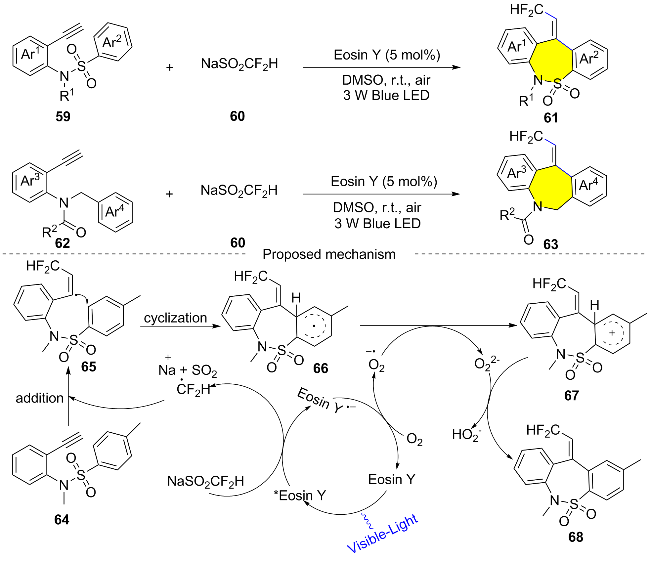
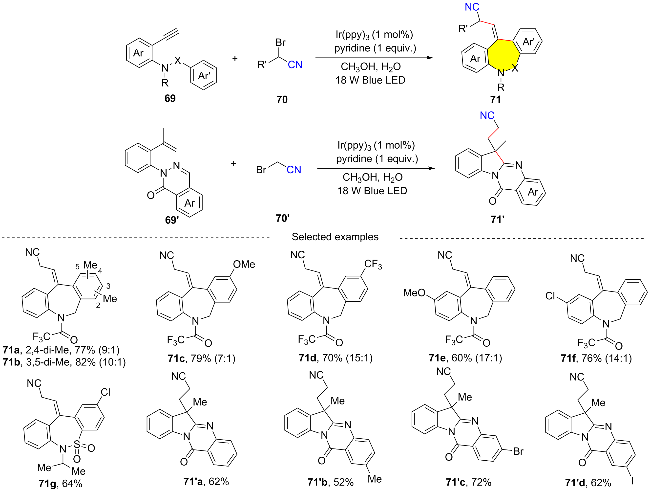
此外, 课题组通过自由基捕获实验、紫外-可见光谱测量、荧光淬灭实验、光开关实验及其他文献的报道, 给出了可能的反应机理: 在可见光照射下, 光催化剂Eosin Y被激发到激发态*EosinY, *EosinY与NaSO2CF2H发生单电子转移, NaSO2CF2H失去一个电子生成CF2H•, 同时*EosinY得到电子形成EosinY•−. 生成的CF2H•具有较高活性, 可以进攻炔烃64的炔基部分, 形成乙烯基自由基中间体65. 中间体65发生分子内自由基环化, 形成中间体66. 同时, 反应体系中的O2与EosinY•−发生单电子转移(SET), 生成氧气负离子(O2•−)和Eosin Y. O2•−具有氧化性, 可以将中间体66氧化为67, 而O2•−可转变为超氧离子(O22−). 中间体67给O22−一个氢原子, 最终得到目标产物68.
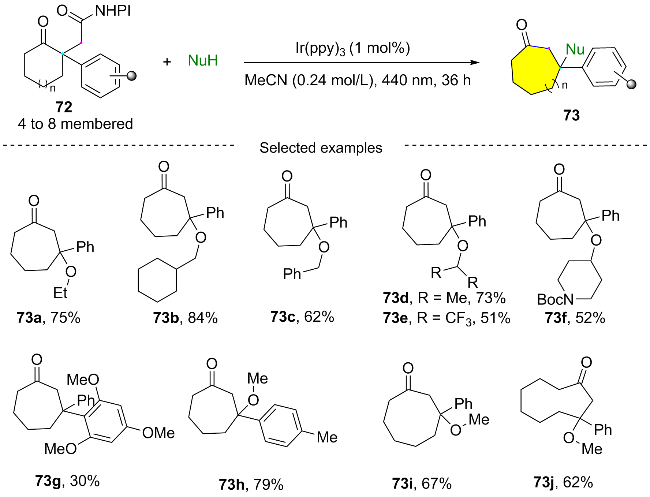
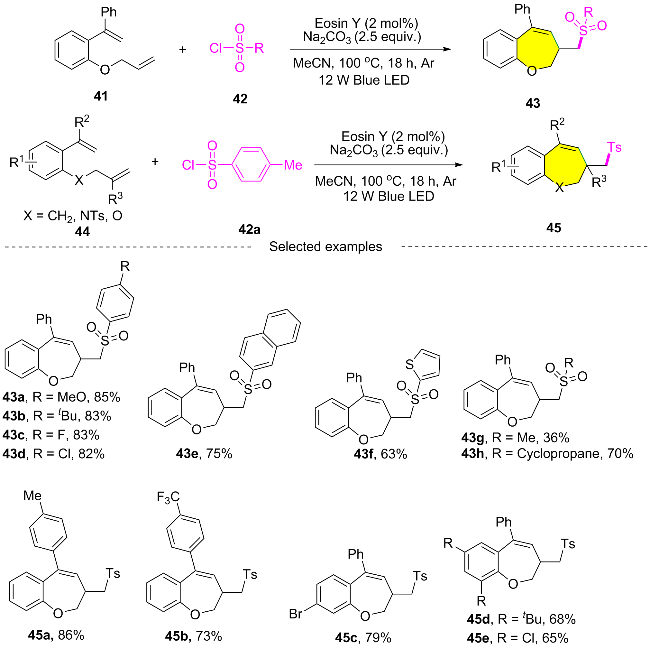
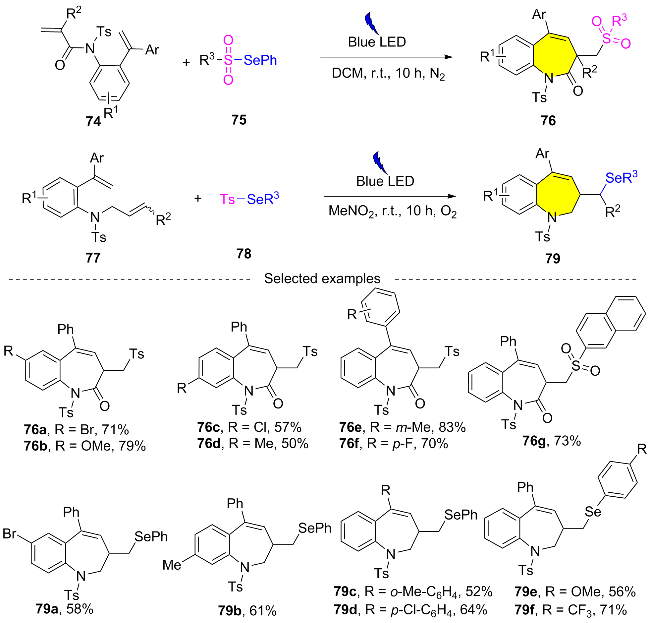
2023年, 孙凯课题组[18]报道了一种可见光促进的, 以硒代磺酸酯和带有活化或未活化烯烃的二烯(N-烯丙基-2-(1-苯基乙烯基)苯胺衍生物)为底物, 选择性地发生磺酰化或硒化反应, 分别生成磺酰基苯并[b]氮杂卓酮和硒代苯并[b]氮杂卓(图式11). 随着反应条件的改变, 所得产物有所不同; 在N2氛围下, 反应主要发生磺酰化环化; 在O2氛围下, 则主要进行硒化环化. 反应底物范围广, 在磺酰化反应中, 作者对多种带有不同取代基的底物进行了考察, 发现对于活化二烯, 苯环上四位或五位带有-CH3、-OMe、-NO2和-X等常见取代基, 以及与烯烃相连接的苯环上的各类取代基都可以中等至良好的产率得到目标产物; 对于硒代磺酸酯, 多种苯磺酰结构的底物也能顺利反应, 萘基、杂芳基和甲基磺酰基等取代的底物也适用于该反应条件.
2.2 电催化
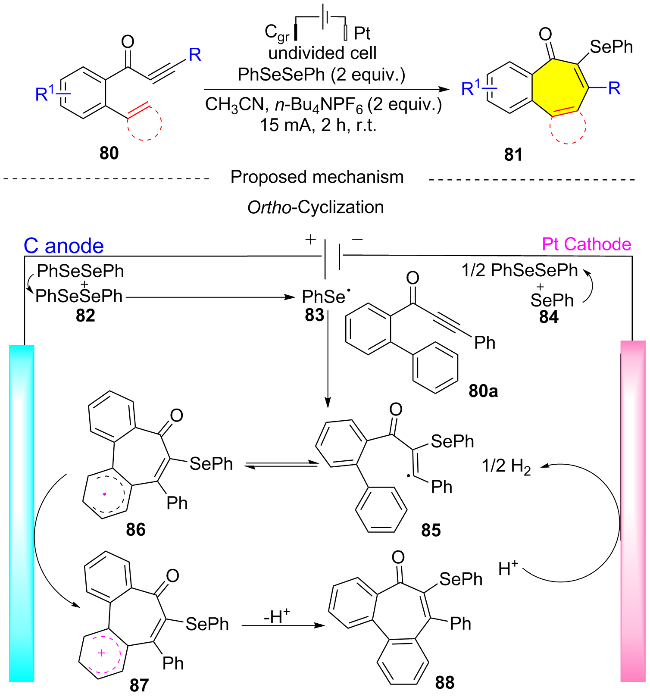
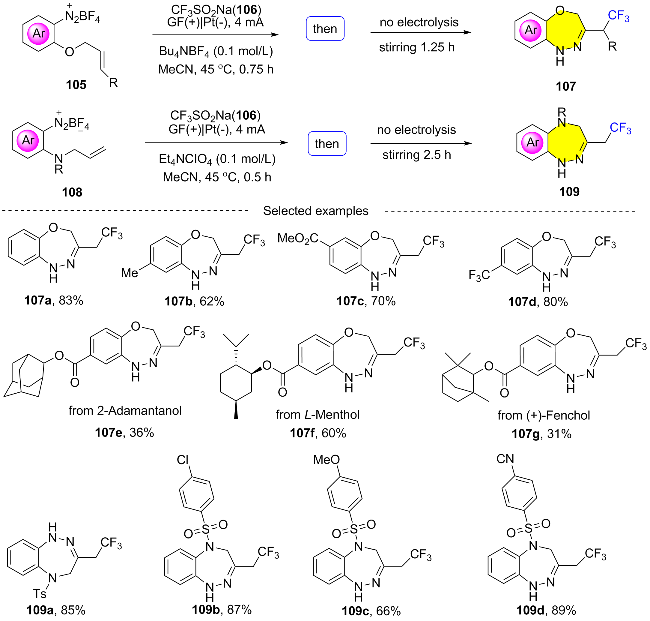
为了研究反应的可能机理, Raji Reddy等进行了一系列对照试验. 首先, 在反应体系中不加入PhSeSePh, 结果发现仅得到起始原料, 没有产物生成, 这表明反应是由向炔中加入PhSeSePh引发的. 随后, 进行自由基捕获实验, 发现反应是通过自由基途径进行的. 最后, 进行循环伏安法(CV)实验, 显示二苯二硒醚优先在阳极被氧化. 基于以上实验结果和之前文献报道, 作者提出了可能的反应机理: 在阳极, 二苯二硒醚被氧化生成阳离子自由基82, 随后被分解为苯基硒自由基83和苯基硒阳离子84. 苯基硒自由基83与联芳基炔酮80a的炔基发生区域选择性加成, 生成乙烯基自由基85. 85经7-exo-trig cyclization生成86, 86在阳极进一步氧化为阳离子中间体87, 最后通过去质子化得到目标产物88.
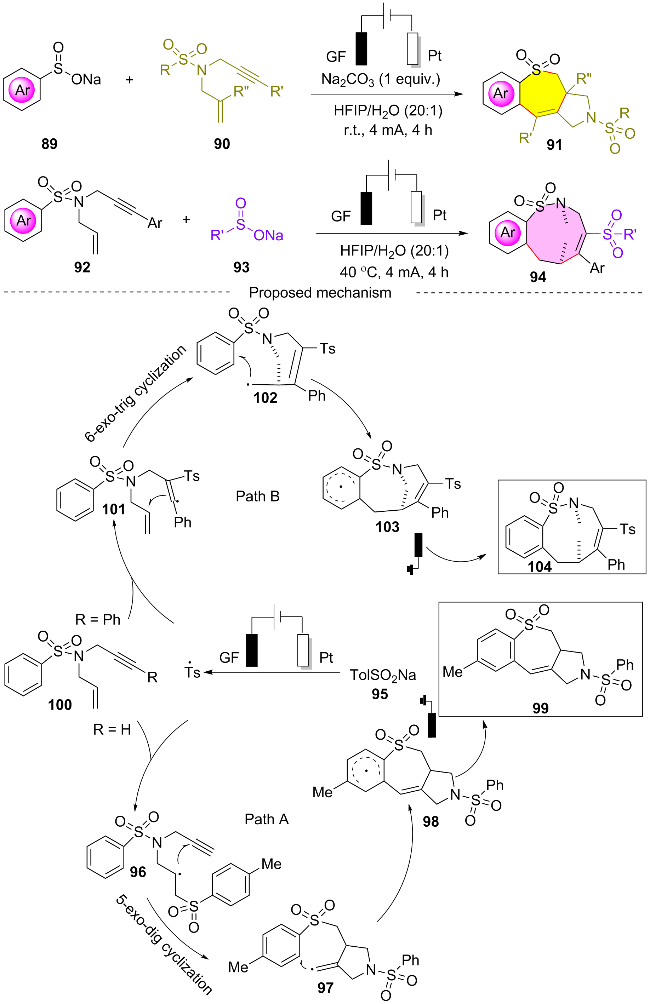
随后, 作者通过自由基捕获实验和循环伏安法实验, 提出了可能的反应机理: (1)七元环形成路径: 当底物炔基100取代基为H时: 在阳极亚磺酸钠95被氧化生成磺酰基自由基(Ts•), Ts•优先与100的C=C键加成形成烷基自由基中间体96, 96经5-exo-dig cyclization生成乙烯基自由基97, 97进一步环化得到自由基中间体98, 最后中间体98经单电子转移氧化并脱质子生成稠合型七元环产物99. (2)九元环形成路径: 当底物炔基取代基为苯基时, 磺酰基自由基优先加成到1,6-烯炔100的C≡C键上形成乙烯基自由基101, 101经6-exo-trig cyclization生成中间体102, 102随后通过分子内环化形成自由基中间体103, 103氧化脱质子得到桥连型九元环产物104. 在进行底物拓展时发现该方法具有很好的普适性, 且产物可以进行下一步的结构修饰, 为药物研发中含磺酰胺骨架活性分子的构建提供新的合成策略.
2.3 外部氧化剂
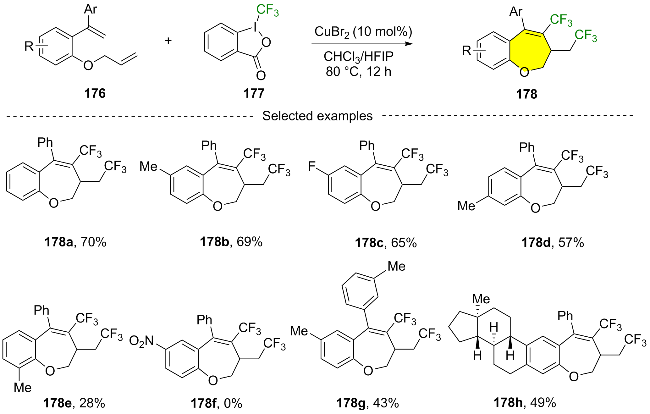
外部氧化剂在有机合成中具有独特且不可替代的优点, 比如操作简单、应用广泛、氧化能力强、底物范围广, 以及成熟可靠、反应性可预测等优势, 所以其在有机合成领域具有不可或缺的作用. 2022年, 孙凯课题组[22]报道了一种新颖且实用的方法合成硝基-苯并[b]氮杂卓类化合物(图式15). 作者设计了一种独特的二烯体系(N-烯丙基-2-(1-苯基乙烯基)苯胺衍生物), 利用NO2•引发的加成反应和7-endo cyclization反应得到目标产物. 在研究过程中, 主要解决了以下三个关键问题: 一是NO2•加成的区域选择性难以控制, 且底物中的二苯乙烯片段易捕获自由基进而抑制反应; 二是要克服竞争的5-exo cyclization; 三是要实现对芳烃或烯烃的化学和区域选择性加成. 研究开始以N-烯丙基-4-甲基-N-(2-(1-苯基乙烯基)苯基)苯磺酰胺为模型底物, 对反应条件进行优化. 随后, 确定的最佳反应条件是K2S2O8为氧化剂、AgNO3为NO2•自由基源、CH3NO2为溶剂, 120 ℃反应5 h. 对多种底物进行考察, 发现不同取代基的底物都能顺利反应, 且能以44%~92%的产率得到相应的硝基-苯并[b]氮杂卓类化合物. 此外, 该反应可进行克级规模合成, 所得产物还能进行N-Ts和N-Cbz脱保护等其它反应, 展现出良好的实用性.
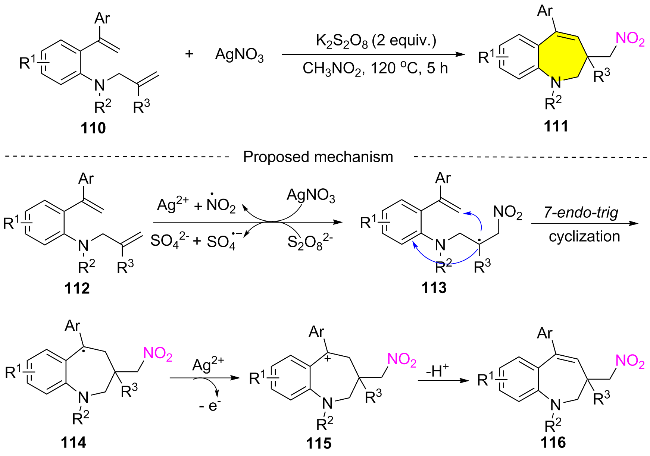
后续作者通过自由基捕获实验及其他文献的报道, 提出了可能的反应机理. AgNO3与过硫酸根阴离子(S2O82−)反应生成Ag2+和NO2•, NO2•与烯丙基112上的C=C键反应生成自由基中间体113, 113经分子内7-endo cyclization得到中间体114, 中间体114被Ag2+氧化为碳正离子中间体115, 115去质子化得到目标产物116.
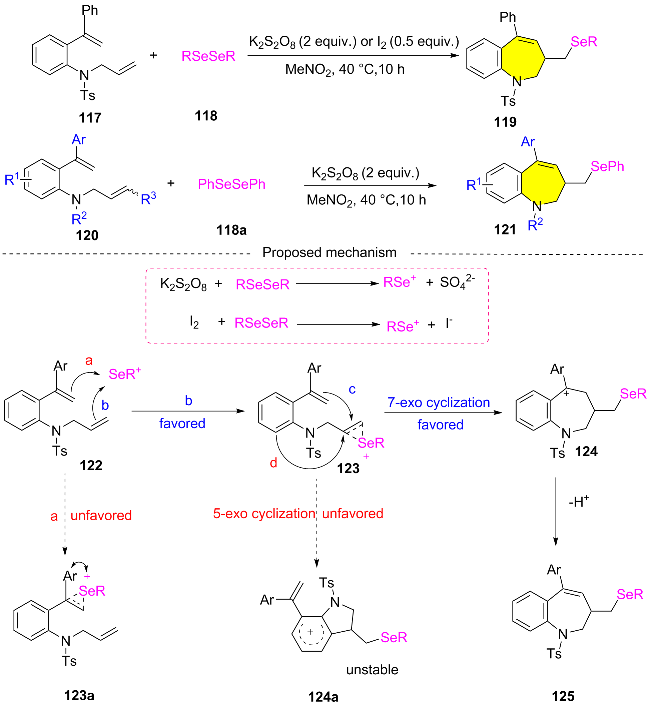
同年, 孙凯课题组[23]报道了一种由K2S2O8/I2促进, 通过亲电硒化环化制备硒-苯并[b]氮卓类化合物的方法(图式16). 反应起始时, 二硒化物在K2S2O8/I2的氧化作用下, 生成亲电的RSe+中间体. 由于空间位阻的影响, RSe+更容易与N-烯丙基-2-(1-苯基乙烯基)苯胺衍生物中烯丙基的双键发生亲电加成反应, 形成硒鎓阳离子123. 而硒鎓阳离子123具有7-exo cyclization和5-exo cyclization两种环化路径, 分别会形成七元环的苯并[b]氮杂卓和五元环的吲哚啉结构. 但实验结果表明在整个反应过程中, 主要生成七元环产物. 造成此结果的原因主要是因为从热力学稳定性来看, 形成的苄基碳正离子中间体124比五元环的芳基碳正离子中间体124a更稳定, 所以更有利于七元环的生成. 最后, 中间体124去质子化, 得到目标产物硒代苯并[b]氮杂卓125.
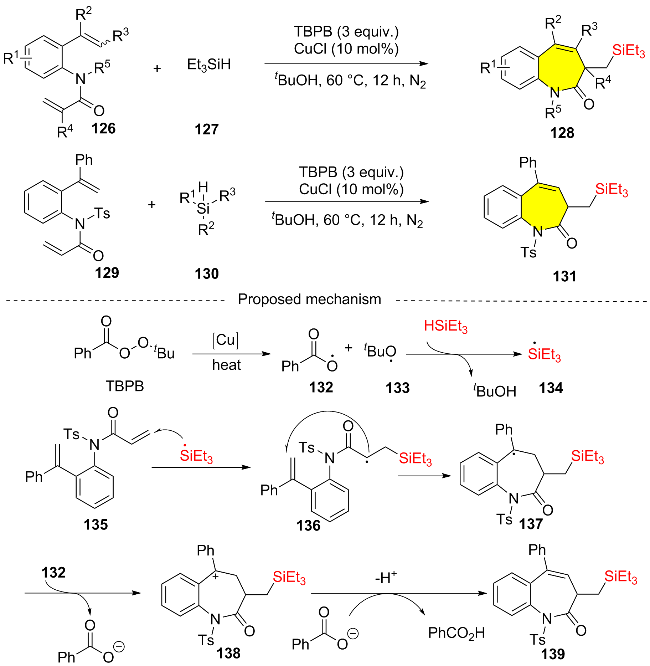
随后, 作者通过自由基捕获实验和动力学同位素效应(KIE)研究等实验和之前文献的报道提出了可能的反应机理. 首先, 在加热时TBPB与CuCl相互作用, O—O键断裂, 生成过氧苯甲酸根自由基132和叔丁氧基自由基133, 133从三乙基硅烷夺取氢原子, 产生硅基自由基134. 硅基自由基134与1,7-二烯底物135上的C=C键加成, 形成碳中心自由基中间体136. 中间体136发生分子内7-exo-trig, 生成七元环自由基中间体137. 随后, 137经单电子转移, 产生苯甲酸根阴离子和阳离子中间体138. 最后, 138在苯甲酸根阴离子帮助下去质子化, 得到目标产物139.
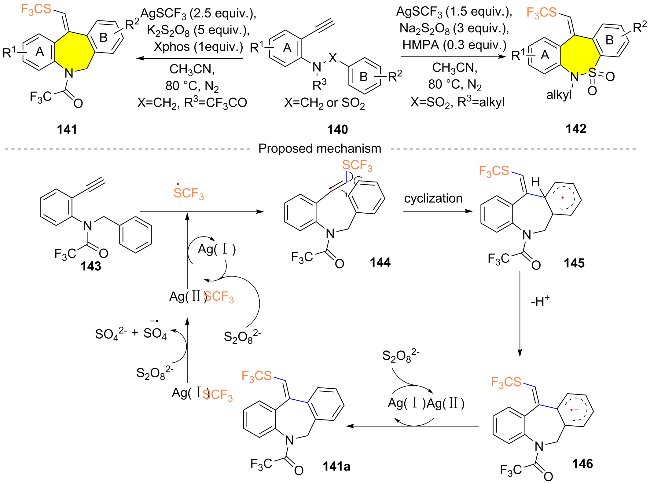
2022年, 李泽江课题组[25]报道了一种自由基促进炔的三氟甲基硫基化以获得含SCF3的二苯并氮卓类或二氧二苯并氮卓类反应(图式18). 该反应以过硫酸盐K2S2O8为引发剂, AgSCF3为三氟甲硫基化试剂. 作者通过自由基捕获实验和之前文献的报道提出了该反应的可能反应机理: 首先, AgSCF3在K2S2O8作用下发生单电子氧化反应, 生成三氟甲硫基自由基(SCF3•). SCF3•与143中的炔基发生加成反应, 形成乙烯基自由基144. 乙烯基自由基144进攻相邻的芳环, 生成中间体145. 中间体145失去一个质子, 转化为芳基阴离子自由基146. 最后, 芳基阴离子自由基146经过单电子转移和氧化过程, 生成目标产物141a. 从实验结果观察产物大多为Z型结构, 这可能是由于空间位阻效应造成的.
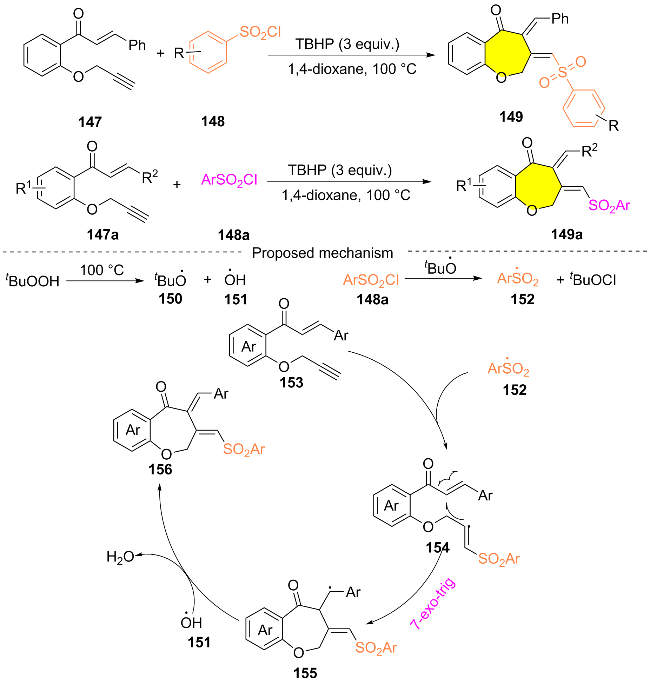
此外, 通过自由基捕获实验, 作者提出了可能的反应机理: 首先, 在100 ℃下TBHP发生均裂反应生成自由基150和151, 自由基150促使磺酰基自由基152生成. 接下来, 以生成磺化苯并[b]氧杂环庚烯酮产物156为例, 1,8-烯炔153与磺酰基自由基152发生自由基加成反应, 得到自由基中间体154, 154 经7-exo-trig模式进行分子内环化反应, 生成自由基中间体155, 155再与自由基151通过脱水反应得到产物156.
2.4 金属介导
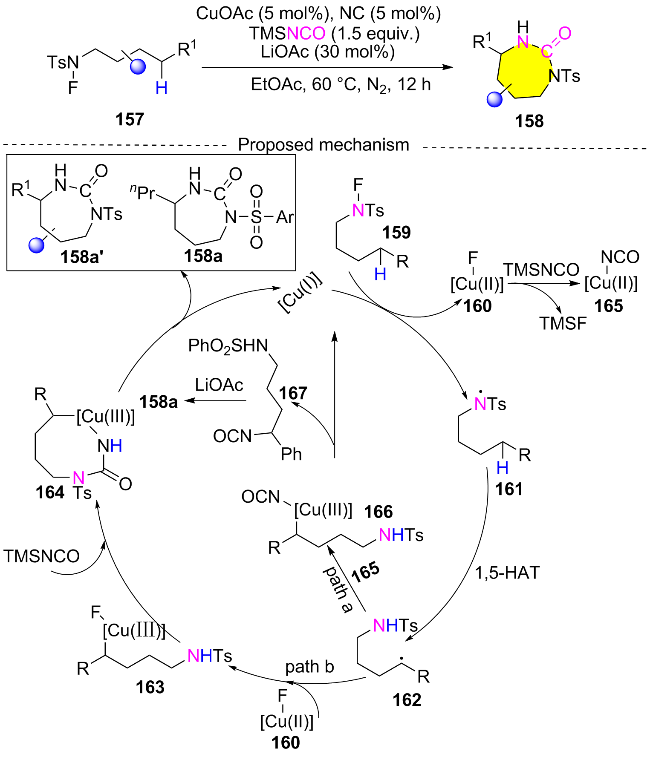
此外, 作者通过动力学同位素效应研究、自由基捕获实验、自由基时钟实验并结合之前文献的报道提出了合理的反应机理: 首先, [Cu(I)]通过单电子转移将N-氟代甲苯磺酰胺159还原为[Cu(II)]-F 160和酰胺基自由基161; 酰胺基自由基161经分子内1,5-氢原子转移(1,5-HAT)生成以碳为中心的自由基162; 接着, 160和Si的强亲和力促进[Cu(II)]-与TMSNCO的配体转移, 生成中间体165; 中间体165与162碳中心自由基结合得到166, 经还原消除得到远程C(sp3)—H异氰酸酯化产物167, 最后在碱的作用下环化形成七元环尿素158a. 此外, 162可以被160捕获得到163, 中间体163与TMSNCO结合生成164, 164经还原消除得到最终产物158a/158a'. 该方法利用Hofmann-Loffler-Freytag反应的1,5-HAT过程构建七元氮杂环, 成功克服了以往合成七元环尿素的难题, 为合成七元环尿素提供了新的有效途径, 在药物合成和天然产物修饰领域具有潜在的应用价值, 推动了自由基串联环化合成中环化合物的发展.
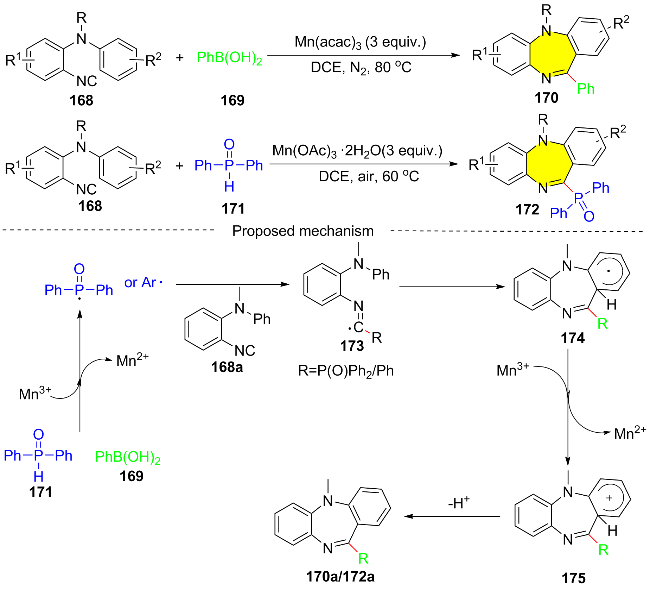
2023年, 丁秋平课题组[28]报道了一种Mn(III)介导的异氰酸酯与芳基硼酸/二芳基氧化膦的自由基加成/环化反应, 在温和条件下高效构建了一系列11-芳基/膦酰基二苯并二氮杂卓类中环化合物(图式21). 通过自由基捕获实验和其他文献的报道, 作者提出了可能的反应机理如下: 首先, 在Mn3+氧化剂作用下, 芳基硼酸或二芳基氧化膦被氧化生成芳基或膦酰基自由基; 接着, 该自由基与异氰酸酯168a发生分子间自由基加成反应, 形成亚胺基自由基中间体173; 然后, 中间体173发生分子内环化, 生成环己二烯基型自由基中间体174; 接着, 在Mn3+盐存在下, 自由基中间体174转化为阳离子中间体175; 最后, 中间体175去质子化得到目标产物170a/172a. 与以往合成二苯并二氮杂卓的方法相比此反应具有良好的官能团耐受性和广泛的底物范围, 且能在温和条件下以中等至优异的产率得到目标产物, 丰富了中环化合物的合成方法.
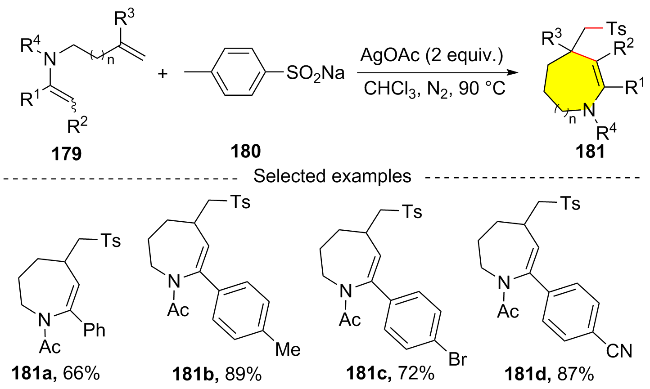
2024年, 高辉课题组[30]报道了一种银介导的线性二烯与亚磺酸钠的区域选择性磺酰化环化反应, 用于构建磺酰化的六至七元环烯胺(图式23). 以N-(3-丁烯-1-基)-N-(1-苯基乙烯基)乙酰胺和对甲苯亚磺酸钠(180)为模型底物进行条件筛选, 发现以AgOAc为氧化剂、CHCl3为溶剂、在90 ℃和N2氛围下反应效果最好, 目标产物产率可达87%. 在进行底物拓展时, 发现各类烯酰胺-烯烃底物均表现出良好的兼容性, 且芳环上带有吸电子或给电子取代基、不同的N-保护基以及不同取代的烷基等底物都可以很好地适应该反应条件. 此外, 多种亚磺酸钠也能参与反应, 卤代、吸电子或给电子取代的亚磺酸钠均可反应.
3 自由基串联环化策略合成的八元环化合物
3.1 光催化
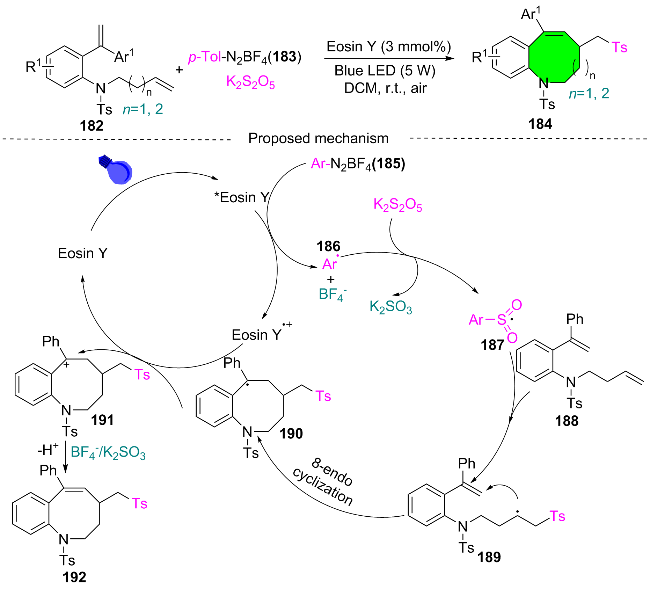
以二烯和芳基重氮盐为底物, K2S2O5为二氧化硫源, Eosin Y为光催化剂, 在5 W蓝光LED 照射下进行反应. 根据自由基捕获实验、高分辨质谱检测(HRMS)及之前文献的报道, 孙等提出了其可能的反应机理: 首先, Eosin Y 吸收455~460 nm的可见光, 从基态跃迁至第一激发单重态*Eosin Y, 随后迅速跃迁到三重态*Eosin Y, 此时*Eosin Y具有强还原性, 能将ArN2BF4还原为活性亲电芳基自由基186, 并释放出N2. 随后, 186与K2S2O5 反应产生的二氧化硫反应并生成芳基磺酰基自由基187中间体. 该中间体具有区域选择性和化学选择性可以选择性加成到丁烯基188的C=C键上, 形成自由基中间体189, 189再发生分子内八元内型环化, 生成自由基中间体190. 具有强氧化性的Eosin Y•+将190单电子氧化, 使光催化剂Eosin Y再生, 并形成中间体191. 最后, 在BF4−或K2SO3的帮助下, 191去质子化得到目标产物磺酰基苯并[b]氮杂卓192. 此外, 作者还进行了密度泛函理论计算, 研究发现6-endo cyclization与8-endo cyclization环化存在一定竞争, 但总体8-endo cyclization环化在动力学和热力学上都更占优势.
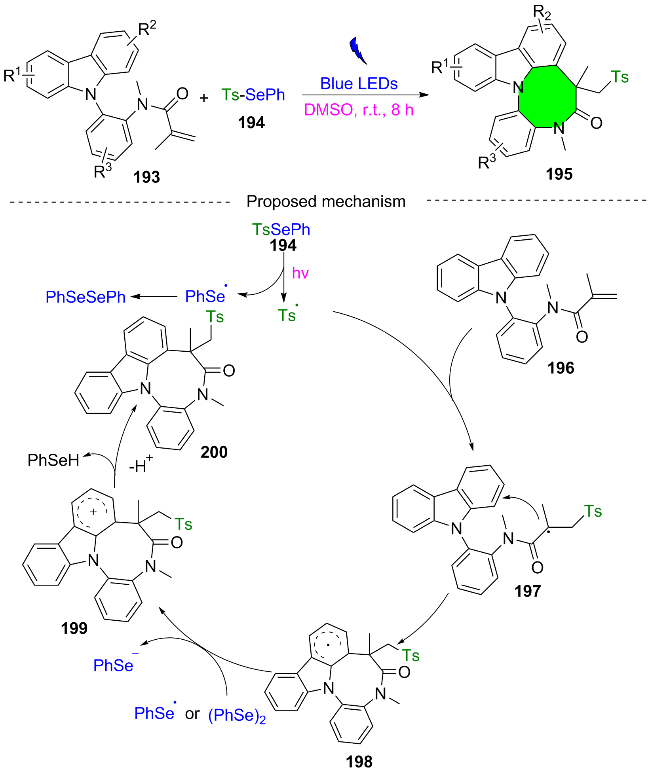
课题组通过自由基捕获实验、光开关实验、表观量子效率计算(AQE)、紫外-可见吸收光谱研究及其他文献的报道, 提出了可能的反应机理. 在可见光照射下, TssePh发生均裂生成磺酰自由基和硒自由基. 磺酰自由基加成到底物196的C=C键上形成自由基中间体197, 接着发生分子内环化生成自由基中间体198. 中间体198通过硒自由基的单电子氧化生成阳离子中间体199和PhSe−. 最后, 199失去质子在PhSe−的作用下生成目标产物200. 同时, 硒自由基会二聚生成二硒化物 (PhSe)2.
3.2 电催化
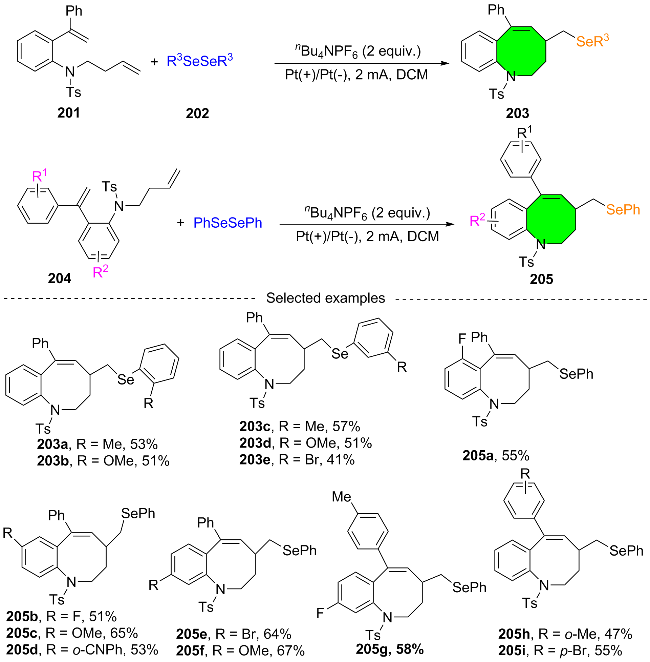
3.3 外部氧化剂
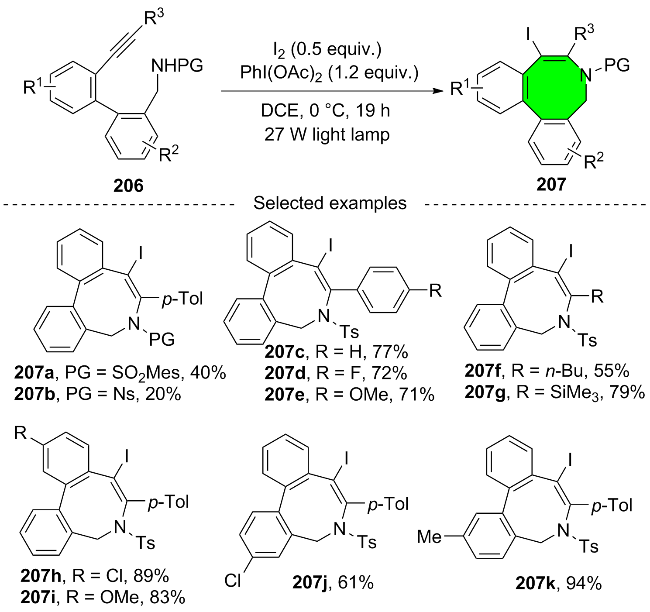
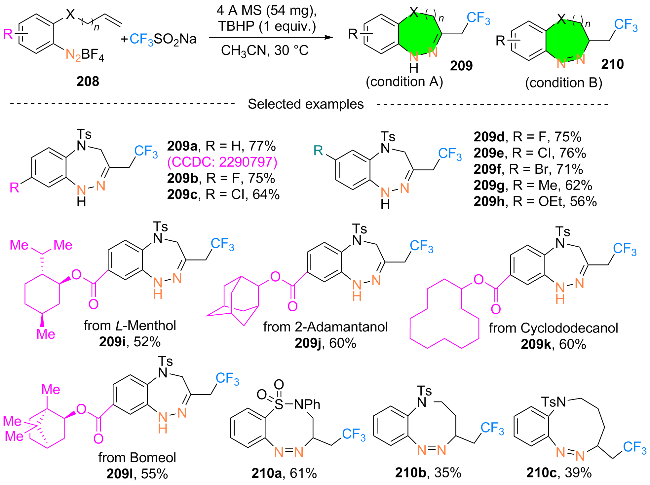
3.4 金属介导
2020年, de Bruin课题组[36]报道了一种通过钴(III)卡宾自由基催化合成八元环化合物的新策略(图式29). 该策略利用邻芳基醛、对甲苯磺酰肼和钴(II)卟啉催化剂, 产生钴(III)-卡宾自由基中间体, 从而实现了八元环化合物的合成. 反应对多种取代基具有良好的兼容性, 底物范围广泛, 可在近克级规模上进行, 且催化剂用量降低至1 mol%对产率也没有明显影响. 通过DFT计算、动力学氢-氘(H, D)同位素竞争等实验提出了该反应的可能机理: 邻芳基醛211a与对甲苯磺酰肼(p-TsNHNH2)在碱(LiOtBu)作用下, 先形成N-甲苯磺酰腙中间体(215), 随后脱质子生成重氮化合物216(卡宾前体), 216被钴催化剂捕获脱掉氮气生成该反应的核心中间体217, 中间体217具有夺氢能力, 可以从底物的“双烯丙基C—H键”或“苄基C—H键”夺取一个氢原子生成中间体218. 最后, 218通过两种不同路径关环形成两类产物: 途径一, 对于二苯并环辛烯类, 218发生钴-碳键的均裂, 解离出邻醌二甲烷(o-QDM)219中间体;
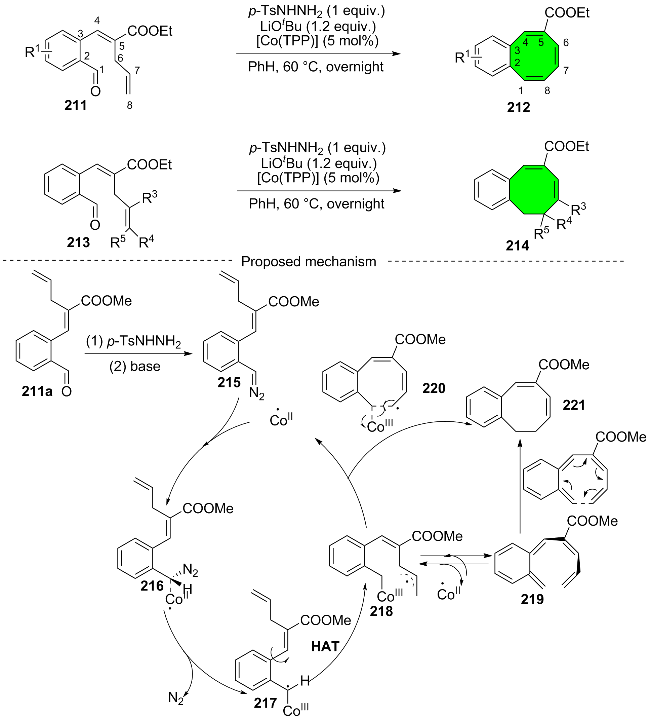
随后, 219发生8π-环化反应, 同时双键迁移, 生成二苯并环辛烯221, 此关环过程无催化剂参与. 途径二, 对于单苯并环辛二烯, 烯丙基末端碳进攻钴(III)-碳键的反键轨道, 使Co—C键发生断裂, 再生钴(II)催化剂, 同时形成新的C—C键, 最终生成单苯并环辛二烯221.
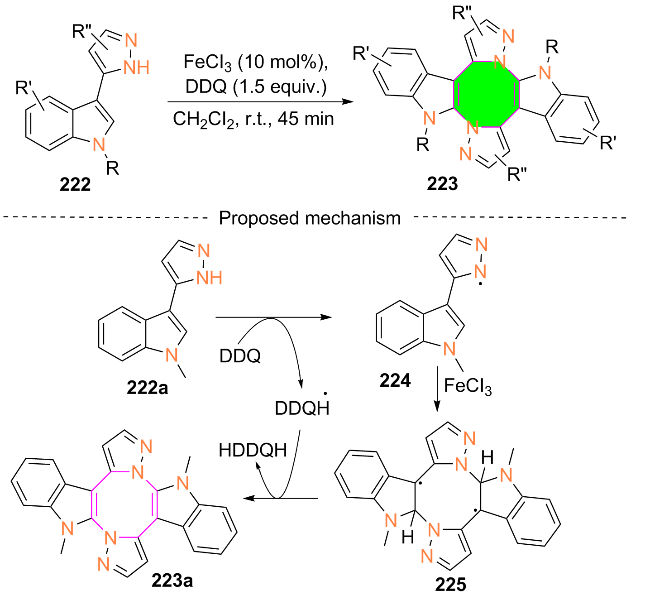
为了得到可能的反应机理, 作者用TEMPO、BHT自由基捕获剂进行了自由基捕获实验、HRMS检测、电子顺磁共振(EPR)研究等并结合之前文献的报道, 推测出以下的反应机理: 首先, 222a在DDQ的作用下失去与氮原子相连的氢, 生成吡唑N-自由基中间体224, 中间体224在FeCl3作用下发生分子间偶联反应, 同时引发吲哚环亲核进攻, 经多米诺过程形成两个C—N键和八元环骨架中间体225, 最后, 中间体225通过氢转移生成产物223a并再生DDQ.
4 自由基串联环化策略合成的九至十二元环化合物
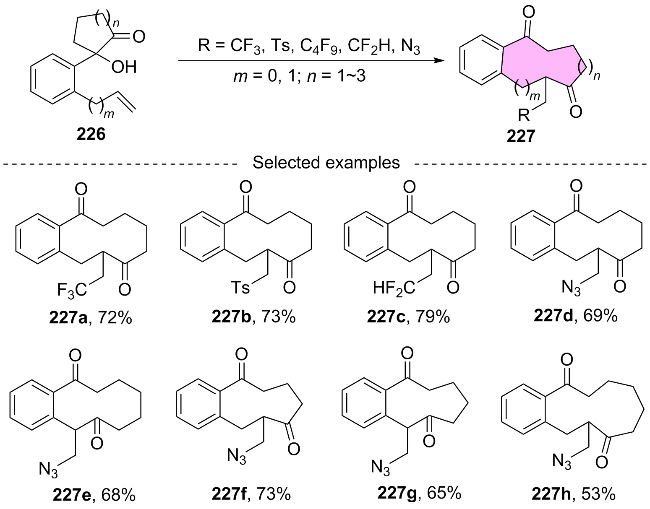
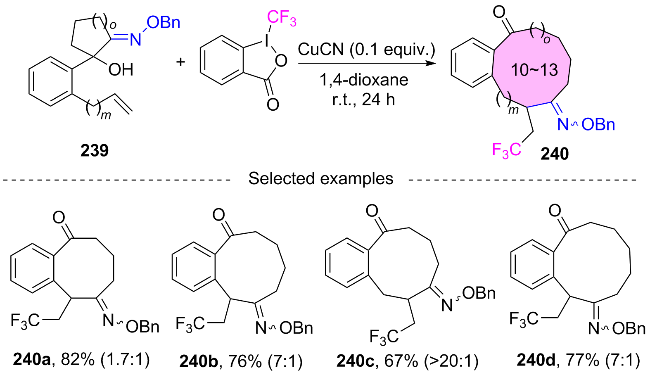
该方法以含烯烃结构的α-羟基醛/酮为底物, 通过三氟甲基化、磺酰化、叠氮化等自由基引发1,2-、1,4-或1,5-远程迁移构建中环骨架, 突破了传统中环合成的熵变与焓变限制. 该方法条件温和、操作简单, 通过Cu(I)催化或可见光光催化实现, 不需要高温和强氧化剂的使用, 有效地避免了敏感官能团分解的潜在可能. 底物拓展展现出广泛兼容性与结构多样性, 为具有稠环、桥环结构的生物活性分子构建提供了高效的合成策略.
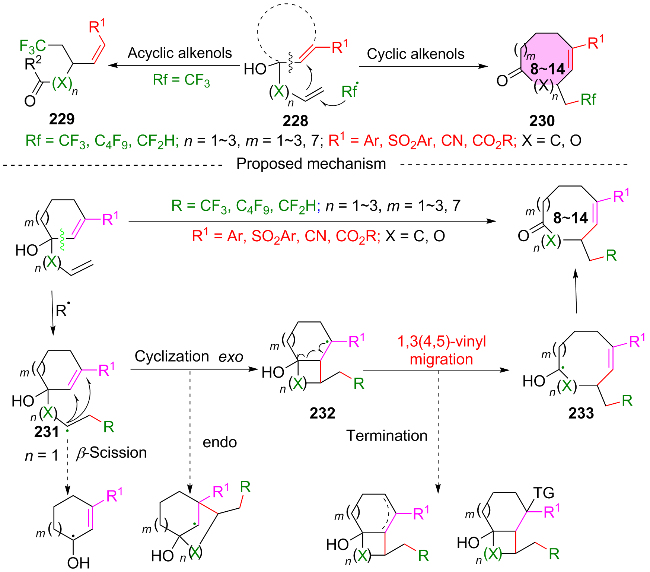
通过自由基捕获实验和外型环化产物的观察作者提出了可能的反应机理: 首先, 在Cu(I)作用下氟烷基前体发生单电子转移, 生成氟烷基自由基. 氟烷基自由基优先进攻位阻较小的末端烯烃, 形成烷基自由基中间体231. 接着, 中间体231经过外型环化形成环丁基自由基中间体232, 随后发生β-断裂促使乙烯基远程迁移, 生成扩环后的自由基中间体233. 233经氧化与质子转移得到E/Z选择性优异的目标中环烯烃.
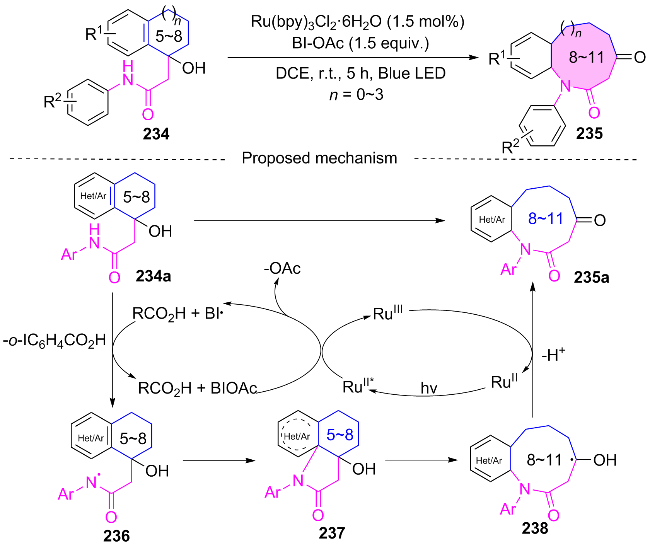
为了得到可能的反应机理, 作者进行了自由基捕获实验、荧光淬灭实验、循环伏安法分析并借助之前文献的报道推测出如下的反应机理: 高价碘试剂BI-OAc产生的苯并碘噁唑基自由基(BI•)与羧酸共同氧化底物, 生成酰胺基自由基236. 236随后进攻(杂)芳环, 形成新的C—N键得到中间体237, 237发生选择性的C—C键断裂生成中性酮基自由基238, 238经单电子氧化生成中环内酰胺235a, 同时使Ru(bpy)32+再生.
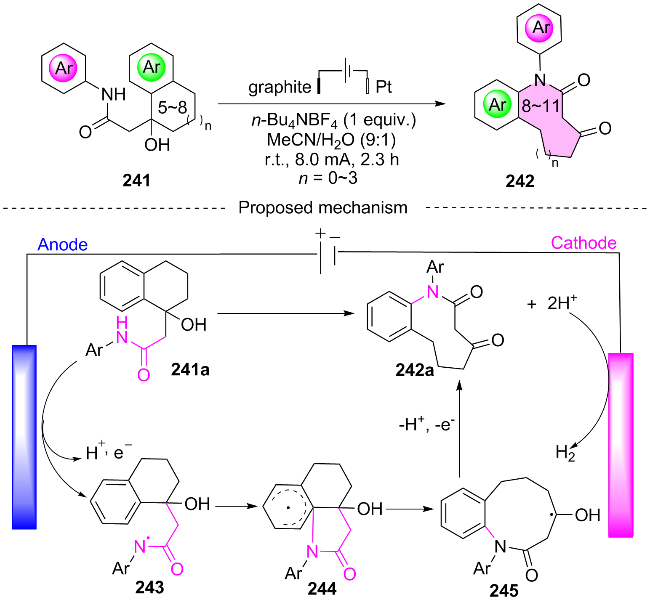
2019年, 阮志雄课题组[42]报道了一种不需要催化剂和碱, 直接通过C—C键断裂的酰胺基迁移合成中环内酰胺的首个电化学合成方法(图式35). 该方法通过酰胺基迁移实现了经济可行的环扩张, 能在温和、无金属和外部氧化剂的条件下, 合成八至十一元(杂)芳环稠合的中环内酰胺. 课题组通过自由基捕获实验、循环伏安法分析及密度泛函理论计算对反应机理进行了深入探究, 提出了可能的反应机理: 首先, 底物241a的酰胺N—H键在阳极氧化生成酰胺基自由基中间体243, 243与芳环发生分子内环化形成新的C—N键, 离域后得到自由基244, 244发生选择性C—C键断裂生成中性酮基自由基245, 245经单电子氧化并失去一个质子, 生成中环内酰胺242a. 该方法突破了传统合成方法的限制, 避免了过渡金属催化剂及氧化剂的使用, 符合绿色化学的原则. 以往典型的酰胺基自由基环化反应只能生成五元或六元环, 而此方法成功地实现了通过电化学氧化C—N键形成八至十一元的中环内酰胺, 拓宽了通过电化学合成中环化合物的范围, 为合成结构多样的中环内酰胺提供了一种高效、绿色的合成策略.
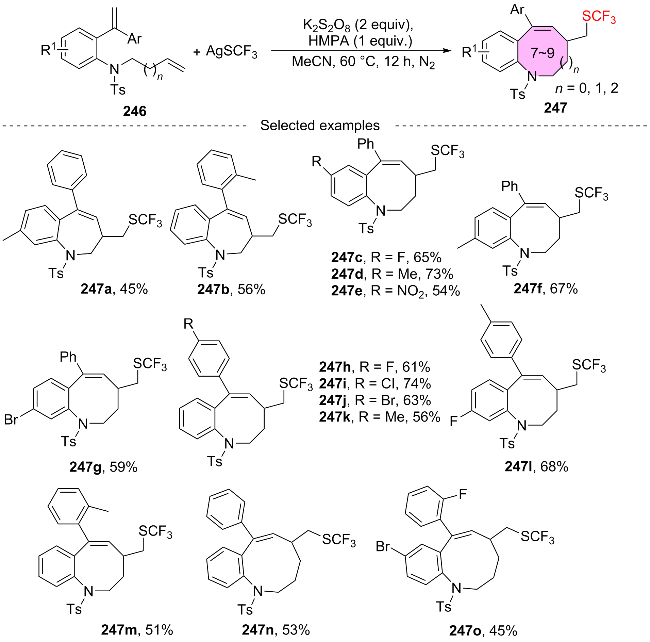
2023年, 孙凯课题组[43]报道了一种利用烯烃衍生物与AgSCF3进行自由基串联反应构建含SCF3的中环化合物的新方法(图式36). 反应成功地合成了一系列八元环化合物, 如六氢苯并[b]氮杂辛环衍生物. 此外, 通过对苯环上不同位置的取代基(如卤素、甲基、甲氧基和硝基等)进行更换, 可以得到具有不同取代基的八元环产物, 且产率中等至良好. 另外, 该反应条件还能兼容与烯烃相连接的苯环上的各种取代基, 为后续的结构修饰和实际应用提供了诸多可能性. 同时, 作者还对九元环的合成进行了探索, 发现提高反应温度, 可以成功地制备六氢苯并[b]氮杂壬环衍生物, 尽管产率相对较低, 但也为九元环的合成提供了初步的合成方法和经验.


5 总结及展望
中环化合物具有环张力低、构象灵活、空间结构独特、生物活性高等特点, 近年来在药物合成、材料化学及有机合成领域已被广泛应用. 自由基串联环化策略反应条件温和且反应活性高, 可以通过连续环化或者一步即可构建结构复杂的多环、稠环及具有一定立体化学结构的环状化合物. 将自由基串联环化策略同光催化、电催化、金属催化及外部氧化剂介导结合在一起, 更是为有机合成研究注入了强大的动力. 多种催化体系的结合使得自由基反应控制更加精准、反应路径新颖、产物多样等诸多优势. 本文按照七元、八元、九至十二元环化合物进行分类, 对反应机理、底物拓展、实际应用等内容进行介绍.
虽然基于自由基串联环化策略构建中环化合物已经取得了一定的发展, 但仍然面临诸多亟待解决的问题. 比如: 需要进一步探讨如何在复杂分子合成中控制反应选择性问题; 开发更多高效、绿色的新型自由基引发剂和催化体系; 更深入地研究反应机理, 进而使反应条件更加简单、高效、普适; 开发更大尺寸中环(十二/十三元)化合物的合成策略等; 另外, 也要提高反应的实际应用问题, 使其在材料、化工、医疗等行业有更多实际的应用. 相信在广大学者的不断努力、持续研究下, 通过自由基环化策略构建中环化合物在有机化学领域一定会取得更新的进展和突破.
(Cheng, B.)