


1 引言
含氮杂环是药物、天然产物及功能材料中至关重要的结构单元, 在药物化学领域具有广泛的应用[1]. 在这些杂环骨架中, 3,3-二烷基-2-吲哚酮结构尤为突出, 是广泛存在于生物活性天然产物及治疗剂中的一类优势骨架(图式1a)[2]. 例如[3], 阿迪本旦(Adibendan)和吲哚利旦(Indolidan)可作为磷酸二酯酶III的选择性抑制剂; 西舒那托韦(Sisunatovir)是一种具有口服生物利用度的抗病毒衍生物; 蓝蓟素(Coerulescine)和Horsfiline是天然存在的吲哚酮生物碱, 在神经科学中具有潜在应用价值; 阿梅达林(Amedalin)和利诺哌啶(Linopiridine)在神经保护活性方面已有明确作用. 鉴于其广泛用途, 既作为优势终产物, 也是关键的合成砌块, 3,3-二取代-2-吲哚酮的骨架构建一直吸引着持续的研究关注, 亟需发展新的合成策略. 因此, 大量研究致力于开发高效合成3,3-二取代-2-吲哚酮的方法[4].
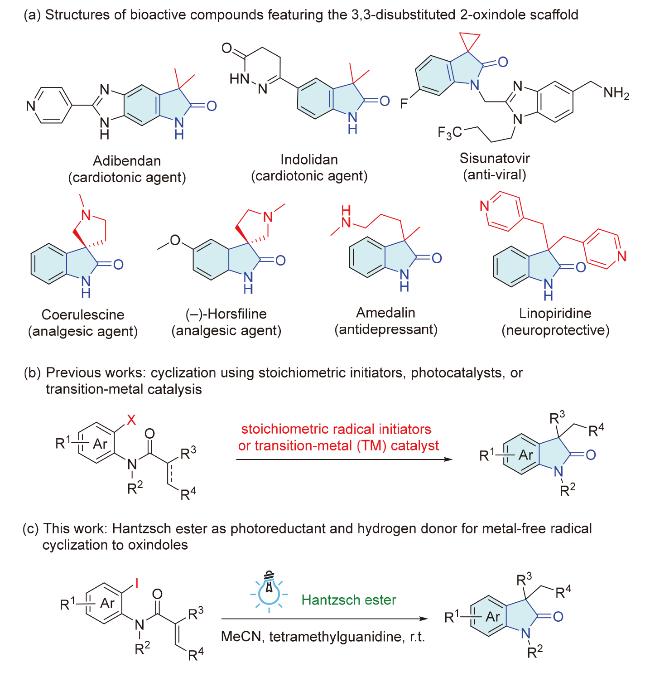
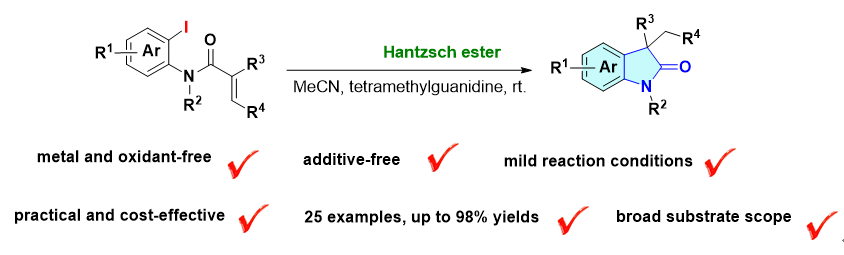
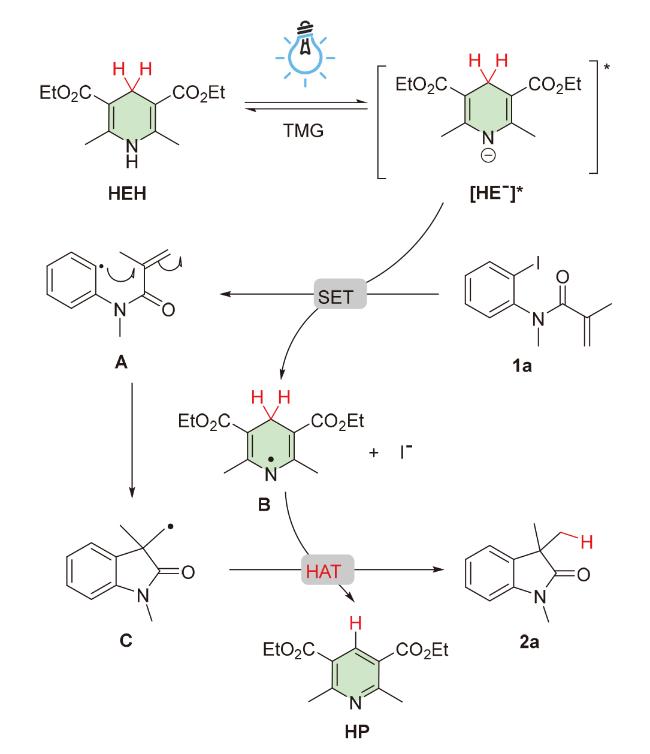
汉斯酯(Hantzsch esters, HEHs)是一类在3-和5-位含有酯基的1,4-二氢吡啶(1,4-DHP)衍生物. 这类受生物启发的氢负离子供体被广泛用于不饱和化合物的还原反应中[10]. 随着光化学反应的快速发展, 汉斯酯作为电子供体、质子源和烷基化试剂的新应用不断涌现. 特别值得注意的是, 汉斯酯能够参与光诱导电子转移 (PET)、能量转移(EnT)和氢原子转移(HAT)过程, 而无需外加光催化剂或化学计量的金属还原剂[11]. 这种多功能的双重反应性为开发简洁的合成方法提供了一个极具吸引力的策略. 其作为光还原剂和氢源的双重能力极大地简化了光化学反应体系, 从而显著提高了反应的经济性、便捷性和环境友好性[12]. 需要指出的是, 已有报道利用光诱导脱卤环化反应合成氧吲哚类化合物[9b,12e]. 鉴于3,3-二取代-2-吲哚酮在生物活性分子中的重要性, 开发一种高效且环境友好的方法仍十分必要. 基于此, 我们开发了一种无金属光化学策略, 通过2-碘-N-甲基甲基丙烯酰胺的分子内自由基环化反应来合成3,3-二取代- 2-吲哚酮(图式1c). 具体而言, 我们的方法使用一种经济的HEH作为化学计量的光还原剂, 在四甲基胍(TMG)作用下, 通过温和的可见光照射, 同时起到单电子供体和氢原子源的双重作用.
2 结果与讨论
2.1 反应条件优化
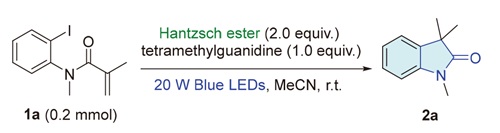
我们选择N-(2-碘苯基)-N-甲基甲基丙烯酰胺(1a) 作为模型底物, 对反应条件进行优化(表1). 经过参数优化, 确定最佳反应条件为: 在氩气氛围下, 以乙腈为溶剂, 使用2.0 equiv. HEH和1.0 equiv.四甲基胍(TMG), 并在20 W蓝色LED照射下反应, 能以98%的产率得到目标产物3,3-二取代-2-吲哚酮(2a) (Entry 1). 当采用5 mol%的光催化剂(如fac-Ir(ppy)3或4-CzIPN)替代HEH时, 产率分别下降至88%和41% (Entries 2, 3). 其他碱(如K2CO3、DABCO、TEA、DIPEA和Cs2CO3)大多效果不佳, 仅得微量产物(<15%); 只有使用Cs2CO3时获得了59%的产率(Entry 4). 将HEH用量减少至1.0 equiv.时, 产率下降至78% (Entry 5). 溶剂的选择至关重要, 将乙腈替换为1,4-二氧六环、甲苯、二氯甲烷(DCM)或二甲基亚砜(DMSO)均导致产率显著降低(Entry 6). 对光源的进一步研究表明, 使用50 W紫色LED或10 W绿色LED效果较差(Entries 7, 8). 对照实验证实了HEH、TMG、光照以及惰性氛围的必要性(Entries 9~12). 此外, 使用N-(2-溴苯基)-N-甲基甲基丙烯酰胺或N-(2-氯苯基)-N-甲基甲基丙烯酰胺替代底物1a进行的对照实验, 分别以60%和12%的产率得到目标产物2a, 这表明芳基溴化物和氯化物的反应活性较差(Entries 13, 14).
表1 反应条件的优化aTable 1 Optimization of the reaction conditionsa |
| Entry | Variation from the standard conditions | Yield/% |
|---|---|---|
| 1a | None | 98 |
| 2 | 5 mol% of fac-Ir(ppy)3 instead of HEH | 88 |
| 3 | 5 mol% of 4CzIPN instead of HEH | 41 |
| 4 | K2CO3/DABCO/TEA/DIPEA/Cs2CO3 (2.0 equiv.) instead of TMG | 14/15/9/5/59 |
| 5 | 1.0 equiv. of HEH used | 78 |
| 6 | 1,4-dioxane/toluene/DCM/DMSO instead of MeCN | 18/28/71/61 |
| 7 | 50 W Purple LED instead of 20 W Blue LED | 93 |
| 8 | 10 W Green LED instead of 20 W Blue LED | 5 |
| 9 | Without HEH | NR |
| 10 | Without TMG | NR |
| 11 | In dark | NR |
| 12 | In air | 36 |
| 13 | N-(2-bromophenyl)-N-methylmethacrylamide instead of 1a | 60 |
| 14 | N-(2-chlorophenyl)-N-methylmethacrylamide instead of 1a | 12 |
a Reaction conditions: Under an argon atmosphere, 1a (0.2 mmol), HEH (0.4 mmol) and TMG (0.2 mmol) were placed in acetonitrile (2.0 mL) and irradiated with a 20 W blue LED (λₘₐₓ=460~470 nm) at room temperature for 21 h. Yields are isolated yields. NR=no reaction. |
2.2 反应底物普适性的考察
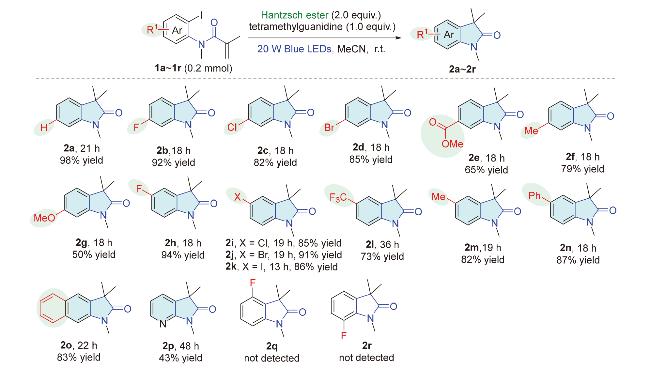
在确立了最佳的反应条件后, 我们考察了芳基丙烯酰胺(图式2)芳环上不同取代基(R¹)对反应的影响. 为评估该方法的底物适用范围, 我们首先合成了碘苯环对位和间位带有不同取代基的芳基丙烯酰胺, 其在标准条件下均可顺利转化为相应的3,3-二取代-2-吲哚酮衍生物 (2a~2n). 值得注意的是, 无论芳环对位带有吸电子基团(-F、-Cl、-Br)还是供电子基团, 反应均能顺利进行. 其中, 对位带有-COOMe的底物1e和对位带有-OMe的底物1g分别以中等产率(65%和50%)得到目标产物2e和2g. 此外, 一系列对位具有不同电性官能团的底物也顺利反应, 生成对应的3,3-二取代-2-吲哚酮(2h~2n). 该策略对于其他芳香体系底物同样适用, 萘基取代的芳基丙烯酰胺可以83%的产率转化为产物2o. 相比之下, 吡啶基取代的类似底物仅以43%的较低产率得到产物 2p. 遗憾的是, 可能由于空间位阻原因, 当前反应体系不适用于含有邻位取代基的2-吲哚酮2q及2r的合成.
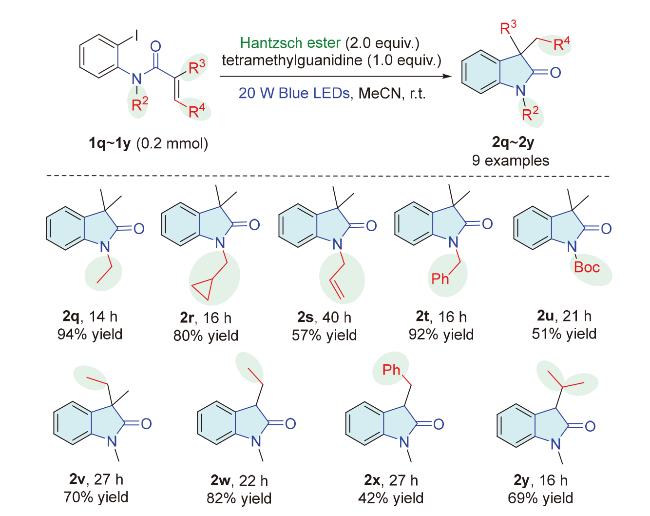
在完成芳环取代基的考察后, 我们进一步将反应底物适用性研究拓展至N-丙烯酰胺部分(图式3). 实验表明, 当N上含有不同烷基时, 如乙基(2q, 产率94%)、环丙基(2r, 80%)、烯丙基(2s, 57%)和苄基(2t, 92%), 相应的2-吲哚酮产物均可高效生成, 说明该位置的结构变化对于反应影响较小. 相比之下, 当引入位阻与电性影响较为显著的N-Boc保护基时, 产物2u的产率下降至51%. 此外, 丙烯酰基部分含有不同取代基的底物适用都较好, 可以方便地以良好产率获得相应产物(如2y).
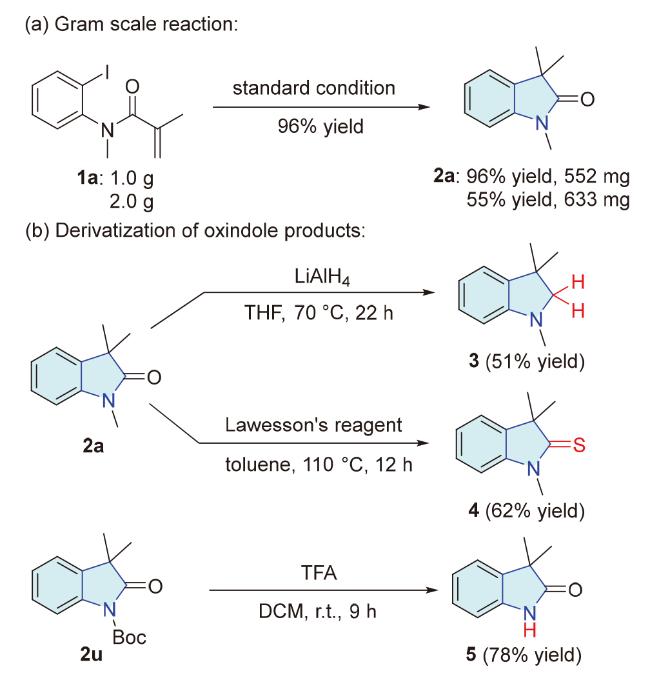
2.3 克级规模反应及衍生化
2.4 反应机理研究
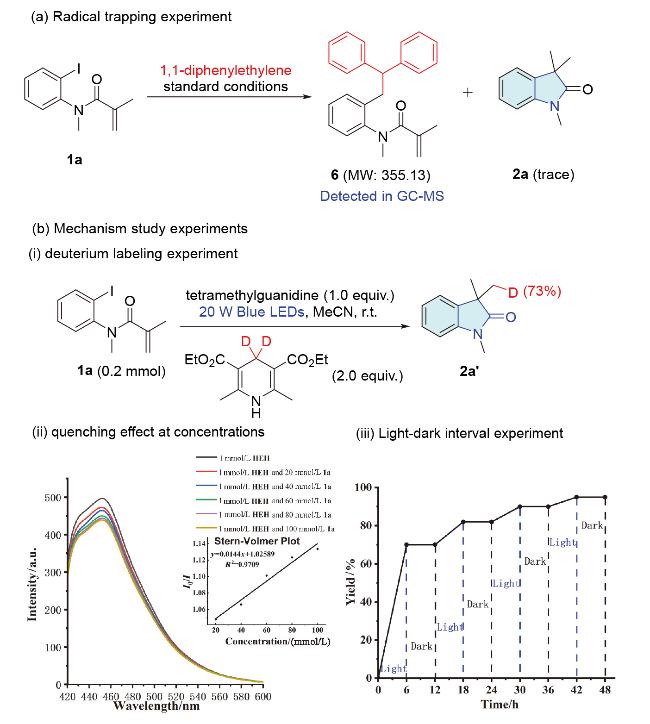
为了探究该反应的反应机理, 我们开展了自由基捕获实验(图式5a). 当在标准反应体系中加入自由基捕获剂1,1-二苯基乙烯(DPE)时, 产物2a的生成被显著抑制. 通过气相色谱-质谱(GC-MS)对反应混合物进行分析, 检测到自由基加合物6的形成, 其分子离子峰为m/z 355.13(对应于[M]+). 这一发现为反应中芳基自由基中间体的存在提供了有力证据. 氘标记实验表明, 使用HEH-D2代替HEH时, 能得到氘代率为73%的2a', 证实了HEH是当前自由基环化反应中的氢源(图式5b). 通过荧光猝灭实验, 观察到底物1a对激发态HEH*的荧光猝灭强度呈现浓度依赖性的线性关系, 符合Stern- Volmer方程, 该结果证实了从激发态(HEH*)到1a发生了光诱导电子转移(PET)过程. 此外, 通过光照开关(明/暗)实验进一步证实了光照的关键作用, 产物2a仅在蓝色LED照射期间生成.


3 结论
本研究发展了一种无金属光催化体系, 通过可见光诱导的自由基环化反应高效合成3,3-二取代-2-吲哚酮, 产率最高可达98%. 该方法无需额外使用光催化剂或金属即可高效进行. 其利用HEH同时作为光还原剂和氢原子供体, 促进了2-碘-N-甲基甲基丙烯酰胺的高效环化, 且不依赖于过渡金属或化学计量的自由基引发剂. 机理研究为光诱导电子转移途径提供了证据, 该途径首先生成芳基自由基中间体, 随后发生5-exo-trig环化和氢原子转移(HAT). 该合成方法操作简单、可规模化且易于进行下游衍生化, 突显了其在构建优势骨架3,3-二烷基-2-吲哚酮方面的实用性.
4 实验部分
4.1 吲哚酮类化合物的通用制备方法示例: 1,3,3-三甲基吲哚啉-2-酮
在氩气氛围下, 于干燥的25 mL反应管中依次加入HEH (101 mg, 0.4 mmol)、TMG (23 mg, 0.2 mmol)和1a (61 mg, 0.2 mmol), 再加入乙腈(2 mL)溶解. 反应混合物于室温下搅拌, 并用20 W蓝色LED (460~470 nm)照射21 h(通过薄层色谱(TLC)监测反应). 待1a完全消耗后, 将反应液真空浓缩. 通过柱色谱纯化, 得到目标2-吲哚酮产物.
(Cheng, B.)