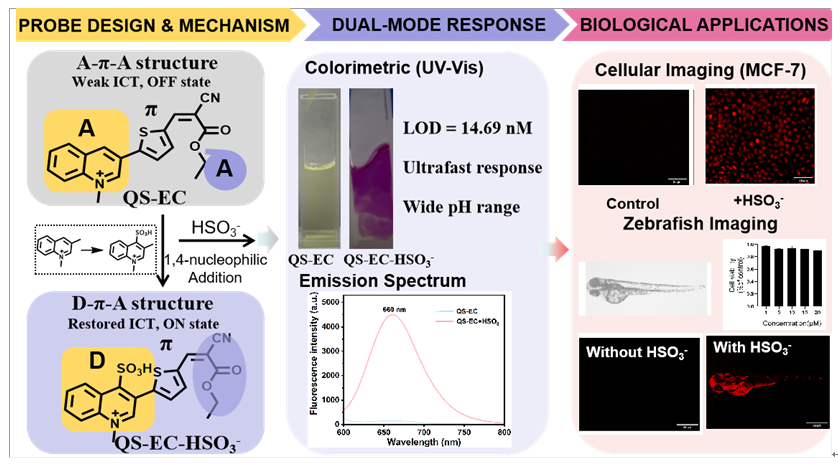
SO2作为生物体内重要的气体分子,其浓度异常与呼吸系统及中枢神经系统疾病等多种生理病理过程密切相关. SO2在水溶液中主要以HSO3-的形式存在,因此,开发高对比度、高特异性的检测HSO3-的方法对于探究SO2的生理功能及相关疾病的预防和早期诊断具有重要意义. 本研究设计合成了一种基于A-π-A结构的喹啉基新型荧光探针QS-EC. 该探针在初始状态下处于“暗态”,而与HSO3⁻发生特异性识别后,通过1,4-亲核加成反应,其结构转变为D-π-A构型,恢复分子内电荷转移(Intramolecular Charge Transfer,ICT)效应,从而实现溶液颜色加深与荧光开启的双模式响应. 此外,探针QS-EC对HSO3-表现出优异的光学性能,具有超快速响应、灵敏度高、检测限低、抗干扰能力强、适用pH范围广等优点. 细胞成像实验证实了QS-EC能够用于监测活细胞中外源及内源性HSO3⁻的动态变化. 更重要的是,在活体斑马鱼成像中,QS-EC表现出高对比度的红色荧光开启信号,成功实现了对体内HSO3⁻的可视化追踪,进一步验证了其优异的体内适用性. 本研究为QS-EC在SO2相关疾病早期诊断方面的应用提供了坚实的理论依据.
田明玉
,
孟令莹
,
钟克利
,
汤立军
,
宋锋玲
. 新型喹啉基近红外HSO3-双模式探针的构建及生物成像[J]. 化学学报, 0
: 26040114
-26040114
.
DOI: 10.6023/A26040114
SO2 is an important gaseous signaling molecule in living organisms, and its abnormal concentration is closely associated with various physiological and pathological processes, including respiratory and central nervous system diseases. SO2 exists mainly as HSO3⁻ in aqueous solution, making the development of highly specific and high-contrast detection methods for HSO3⁻ crucial for studying the physiological functions of SO2 and the early diagnosis of related diseases. In this study, a quinoline-based near-infrared fluorescent probe, QS-EC, with an A-π-A structure was designed and synthesized. The probe initially exists in a fluorescent "dark state." Upon specific 1,4-nucleophilic addition with HSO3⁻, its structure transforms into a D-π-A configuration, restoring the intramolecular charge transfer (ICT) effect and resulting in a dual-mode response of solution color deepening and fluorescence turn-on. The optical performance of QS-EC was systematically evaluated using UV-Vis and fluorescence spectroscopy. Spectroscopic results showed that the QS-EC responded to HSO3- within 3 s, with a detection limit of 14.69 nmol/L, and remains stable within a pH range of 6-13. Competitive experiments demonstrated that QS-EC exhibits high selectivity for HSO3⁻ without interference from other anions or biothiols. It is worth emphasizing that QS-EC enables efficient detection of HSO3⁻, which not only simplifies the detection process but also significantly enhances the probe's practicality and biocompatibility. Furthermore, MTT assays were used to evaluate its biocompatibility, revealing that cell viability remained above 80% after incubation with 0-20 μM of QS-EC for 24 hours, confirming its low cytotoxicity. For cellular imaging, QS-EC successfully enabled dynamic monitoring of both exogenous and endogenous HSO3⁻ in live cells. Further in vivo imaging experiments in zebrafish model showed a high signal-to-noise ratio red fluorescence turn-on signal, with fluorescence intensity increasing as the HSO3⁻ concentration rose. This indicates that QS-EC is capable of visually tracking HSO3⁻ distribution in complex living environments. Through systematic evaluation from molecular design and spectral performance to cellular and in vivo applications, this study fully demonstrates the potential of QS-EC for early diagnosis research in SO2-related diseases.
[1] Cao H.; Yu F.; Dou K.; Wang R.; Xing Y.; Luo X.; Yu F.Anal Chem. 2024, 96 (46), 18574-18583.
[2] Gao S.; Wang S.; Li M.; Zhang W.; Zhang W.; Yang L.; Li Z.; Yu M.Sensors and Actuators B: Chemical . 2026, 447,138873.
[3] Liang T.; Jiang Y.; Li Y.; Tian M.; Wu C.; Yan X.; Sun X.; Shen T.; Zhong K.; Tang L.Sensors and Actuators B: Chemical. 2026, 446, 138694.
[4] Tamima U.; Santra M.; Song C. W.; Reo Y. J.; Ahn K. H.Anal Chem. 2019, 91 (16), 10779-10785.
[5] Yang L.-N.; Zhou, N. Chin. Appl. Chem.2026, 43(04),481-497(in Chinese).(杨乐妮, 周娜. 应用化学, 2026, 43 (04):481-497.)
[6] Wan Q.; Chen S.; Shi W.; Li L.; Ma H.Angew Chem Int Ed Engl. 2014, 126 (41): 11096-11100.
[7] Ren R.; Tian M.; Li J.; Yan X.; Liang T.; Wu C.; Li Y.; Tang L.; Zhong K.Dyes and Pigments. 2026, 245,113191.
[8] Wang S.; Zheng H.; Ma L.; Yang L.; Song Q.; Yu M.; Li Z.Sensors and Actuators B: Chemical. 2024, 417, 136113.
[9] Li K.; Li L.-L.; Zhou Q.; Yu K.-K.; Kim J. S.; Yu X.-Q.Coordination Chemistry Reviews. 2019, 388, 310-333.
[10] Lu Y.; Li H.; Yao Q.; Sun W.; Fan J.; Du J.; Wang J.; Peng X.Dyes and Pigments. 2020, 180, 108440.
[11] Xu Y.-L.; Chen H.; Xu B.-S.; Li D.; Sun J.-Q.; Zhou L.; Cai F.-Z.; Wang H. Anal. Sci.2021, 37(2), 234-238 (in Chinese).(徐永玲, 陈浩, 许丙嵩, 李迪, 孙建强, 周乐, 蔡丰泽, 王慧. 分析科学学报, 2021, 37(02): 234-238.)
[12] Koch M.; Koppen R.; Siegel D.; Witt A.; Nehls I.J Agric Food Chem. 2010, 58 (17), 9463-7.
[13] Stipanuk M. H.; Ueki I.J Inherit Metab Dis. 2011, 34 (1), 17-32.
[14] Kalimuthu P.; Tkac J.; Kappler U.; Davis J. J.; Bernhardt P. V.Anal Chem 2010, 82 (17), 7374-9.
[15] Su T.; Song X.; Tu D.; Wang R.; Xing Y.; Yu F.; Luo X.Anal Chem. 2025, 97 (39), 21679-21687.
[16] Li C.-C.; Meng Y.-L.; Niu J.-T.; Liu C.; Wang L.; Liang T.; Jia X.-J.; Liu X.-Y.; Kang Y.-F.Sensors and Actuators B: Chemical. 2026, 447, 138736.
[17] Ouyang J.; Sun L.; Pan J.; Zeng Z.; Zeng C.; Zeng F.; Tian M.; Wu S.Small. 2021, 17 (42): e2102598
[18] Willmann J. K.; van Bruggen, N.; Dinkelborg, L. M.; Gambhir, S. S.Nat Rev Drug Discov. 2008, 7 (7), 591-607.
[19] Huang J.; Li J.; Lyu Y.; Miao Q.; Pu K.Nat Mater.2019, 18 (10), 1133-1143.
[20] Jiang Y.; Wang L.; Hu B.; Nong C.; Shen X. C.; Chen H.Adv Healthc Mater. 2024, 13 (32), e2402828.
[21] Wang F.; Jiang X.; Xiang H.; Wang N.; Zhang Y.; Yao X.; Wang P.; Pan H.; Yu L.; Cheng Y.; Hu Y.; Lin W.; Li X.Biosens Bioelectron. 2021, 172, 112756.
[22] Ma X.; Han R.; Wang J.; Zhang B.; Ruan M.; Zhao W.; Zhang J.Spectrochim Acta A Mol Biomol Spectrosc . 2025, 328, 125497.
[23] Yin H. Y.; Song B.; Chen W. L.; Xiong X. Q.; Wang J. Y.; Song F. L.Chem. Commun. 2020, 56, 10549-10551.
[24] Zhang Q.; Hu X.; Dai X.; Sun J.; Gao F.J Mater Chem B. 2021, 9(16), 3554-3562.
[25] Singh G.; Sharma S.; Singh A.; Jyoti; Pawan; Kaur, J. D.; Kaur, H.; Mohan, B.; Rana, S. Materials Chemistry and Physics 2024, 319, 129347.
[26] Wang Y.; Gao, W.-Y. J. Shanxi Univ., Nat. Sci. Ed.2022, 45(3), 807-815(in Chinese). (王煜, 高文英. 山西大学学报(自然科学版), 2022, 45 (03): 807-815.)
[27] Singh G.; Stanzin J.; Devi A.; Sharma S.; Sharma D.; Mithun; Singh Gill, B.; Vikas; Mohan, B.Inorganica Chimica Acta 2024, 569,122148.
[28] Singh G.; Stanzin J.; Khurana S.; Devi S.; Vikas; Singh, G.; Singh, J.; Sabharwal, S.; Mohan, B.Spectrochim Acta A Mol Biomol Spectrosc. 2024, 316, 124319.
[29] Bian C.; Zhang S.; Fan J.; Chen S.; Yu M.; Li Z.,Dyes and Pigments. 2023, 216:111308.
[30] Wang C.; Wang X.; Zhong K.-L.; Hou S.-H.; Yan X.-M.; Bian Y.-J.; Tang, L.-J. Chin. Org. Chem.2021, 41(6), 2417-2423(in Chinese). (王超, 王鑫, 钟克利, 侯淑华, 燕小梅, 边延江, 汤立军.有机化学, 2021, 41 (06): 2417-2423.)
[31] Wu M. Y.; Wu J.; Wang Y.; Liu Y. H.; Yu X. Q.Molecules. 2018, 23 (4), 871.
[32] Xu Z.; Chen Z.; Liu A.; Ji R.; Cao X.; Ge Y.RSC Adv. 2019, 9(16), 8943-8948.


