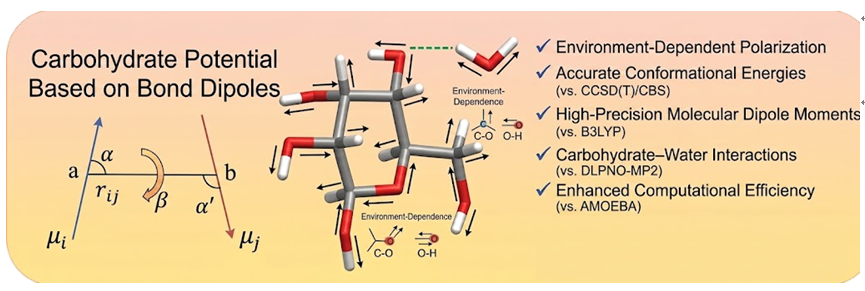
A carbohydrate-specific molecular potential is developed by explicitly representing bond polarity through an environment-dependent bond-dipole framework. The C-O, O-H, and C-H bonds in carbohydrate molecules are treated as bond dipoles whose dipole moment magnitudes vary with the surrounding chemical environment, allowing polarization effects to be incorporated without introducing atomic charges. Electrostatic interactions are described using pairwise dipole-dipole interactions, while van der Waals interactions are modeled with a Lennard-Jones 12-6 potential. In addition, standard bonded interaction terms, including bond stretching, angle bending, and dihedral torsions, are included, together with an explicit hydrogen-bond interaction term. All parameters of the potential are determined by fitting to high-level quantum mechanical reference data. The resulting carbohydrate potential is applied to compute conformational energies and molecular dipole moments for a benchmark set of eight carbohydrate molecules comprising a total of 42 distinct conformations. Furthermore, intermolecular interaction energies and many-body polarization energies are evaluated for eight carbohydrate-water cluster systems. The calculated results are systematically compared with those obtained from quantum mechanical methods, including CCSD(T)/CBS for conformational energies, B3LYP/aug-cc-pVTZ for molecular dipole moments, and DLPNO-MP2/aug-cc-pVTZ for cluster interaction and polarization energies, as well as with predictions from the fixed-charge force fields CHARMM36 and GLYCAM06 and the polarizable force field AMOEBA. For conformational energies, the proposed method yields a root-mean-square deviation (RMSD) of 11.48 kJ·mol-1 relative to CCSD(T)/CBS results, comparable to CHARMM36 and significantly better than GLYCAM06 and AMOEBA. For molecular dipole moments, an RMSD of 0.78 × 10⁻³⁰ C·m is obtained relative to B3LYP/aug-cc-pVTZ, outperforming all three reference force fields. In carbohydrate-water clusters, the method reproduces DLPNO-MP2/aug-cc-pVTZ total interaction energies with an RMSD of 13.72 kJ·mol-1 and a relative deviation of 1.55%, achieving accuracy slightly lower than AMOEBA but superior to CHARMM36 and GLYCAM06. Many-body polarization energies are also reasonably captured, with an RMSD of 7.96 kJ·mol-1. Timing statistics for single-point energy calculations demonstrate that the proposed method is more than twice as fast as AMOEBA for the cluster systems considered. These results indicate that the environment-dependent bond-dipole potential provides an effective balance between accuracy and efficiency, making it well suited for molecular simulations of carbohydrates and for applications in carbohydrate-related drug design.
[1] Zong A.; Cao H.; Wang F. Carbohydr. Polym.2012, 90, 1395-1410.
[2] Gonzalez P. S.; O’Prey J.; Cardaci S.; Barthet V. J. A.; Sakamaki J.-i.; Beaumatin F.; Roseweir A.; Gay D. M.; Mackay G.; Malviya G.; Kania E.; Ritchie S.; Baudot A. D.; Zunino B.; Mrowinska A.; Nixon C.; Ennis D.; Hoyle A.; Millan D.; McNeish I. A.; Sansom O. J.; Edwards J.; Ryan K. M. Nature2018, 563, 719-723.
[3] Sha J.; Cao D.; Cui R.; Xia L.; Hua X.; Lu Y.; Han, S. Cancer Manage. Res.2020, 12, 11077-11083.
[4] Kong H.; Yu L.; Li C.; Ban X.; Gu Z.; Liu L.; Li Z. Carbohydr. Polym.2022, 292, 119621.
[5] 高春艳; 崔馨月; 王凯月; 石雪怡; 贺卿; 赵晋忠; 岳爱琴; 杜维俊; 张永坡. 化学学报2026, 84, 353-363.
[6] 于恺然; 张娜娜; 刘宇博. 化学学报2026, 84, 409-424.
[7] Branca C.; Magazù S.; Maisano G.; Migliardo F.; Migliardo P.; Romeo, G. J. Phys. Chem. B2001, 105, 10140-10145.
[8] Çarçabal P.; Patsias T.; Hünig I.; Liu B.; Kaposta C.; Snoek L. C.; Gamblin D. P.; Davis B. G.; Simons, J. P. Phys. Chem. Chem. Phys.2006, 8, 129-136.
[9] Blanco P.; Wiegand, S. J. Phys. Chem. B2010, 114, 2807-2813.
[10] Cardoso M. V. C.; Carvalho L. V. C.; Sabadini E. Carbohydr. Res.2012, 353, 57-61.
[11] Rhys N. H.; Bruni F.; Imberti S.; McLain S. E.; Ricci, M. A. J. Phys. Chem. B2017, 121, 7771-7776.
[12] Bruni F.; Di Mino C.; Imberti S.; McLain S. E.; Rhys N. H.; Ricci, M. A. J. Phys. Chem. Lett.2018, 9, 3667-3672.
[13] Olsson C.; Swenson, J. J. Phys. Chem. B2020, 124, 3074-3082.
[14] Řezáč J.; Bím D.; Gutten O.; Rulíšek, L. J. Chem. Theory Comput.2018, 14, 1254-1266.
[15] Wang P.; Shu C.; Ye H.; Biczysko, M. J. Phys. Chem. A2021, 125, 9826-9837.
[16] Hornak V.; Abel R.; Okur A.; Strockbine B.; Roitberg A.; Simmerling, C. Proteins: Struct., Funct., Bioinf.2006, 65, 712-725.
[17] Kirschner K. N.; Yongye A. B.; Tschampel S. M.; González‐Outeiriño J.; Daniels C. R.; Foley B. L.; Woods, R. J. J. Comput. Chem.2007, 29, 622-655.
[18] Raman E. P.; Guvench O.; MacKerell, A. D. J. Phys. Chem. B2010, 114, 12981-12994.
[19] Lin F.-Y.; MacKerell, A. D. J. Chem. Theory Comput.2018, 14, 1083-1098.
[20] Zhang C.; Lu C.; Jing Z.; Wu C.; Piquemal J.-P.; Ponder J. W.; Ren P.J. Chem. Theory Comput. 2018, 14, 2084-2108.
[21] Newman L. A.; Patton M. G.; Rodriguez B. A.; Sumner E. W.; Vaissier Welborn, V. Chem. Commun.2024, 60, 14431-14434.
[22] Shi Y.; Xia Z.; Zhang J.; Best R.; Wu C.; Ponder J. W.; Ren, P. J. Chem. Theory Comput.2013, 9, 4046-4063.
[23] Li S.-S.; Huang C.-Y.; Hao J.-J.; Wang, C.-S. J. Comput. Chem.2014, 35, 415-426.
[24] Gao X.-C.; Hao Q.; Wang, C.-S. J. Chem. Theory Comput.2017, 13, 2730-2741.
[25] Hao J.-J.; Wang C.-S. RSC Adv.2015, 5, 6452-6461.
[26] Huang C.; Hao Q.; Wang, C. Chem. Res. Chin. Univ.2017, 33, 94-99.
[27] 李晓蕾; 孙云娇; 唐颖; 王长生. 高等学校化学学报2021, 42, 3664-3671.
[28] Li X.-L.; Li C.-M.; Zhu J.-Y.; Zhou Z.; Hao Q.; Wang, C.-S. J. Comput. Chem.2022, 44, 677-686.
[29] Zhu J.-Y.; Jiang X.-N.; Hao Q.; Wang, C.-S. J. Chem. Theory Comput.2025, 21, 11049-11069.
[30] Zheng X.-H.; Zhu J.-Y.; Li X.-L.; Hao Q.; Wang, C.-S. Chem. J. Chinese Universities,2025, 46, 20250173 (in Chinese).
(郑笑函; 祝佳怡; 李晓蕾; 郝强; 王长生. 高等学校化学学报2025, 46, 20250173.)
[31] Zhu J.-Y.; Jiang X.-N.; Zheng X.-H.; Hao Q.; Wang, C.-S. Chem. J. Chinese Universities,2025, 46, 20240518 (in Chinese).
(祝佳怡; 姜笑楠; 郑笑函; 郝强; 王长生. 高等学校化学学报2025, 46, 20240518.).
[32] Sameera W. M. C.; Pantazis, D. A. J. Chem. Theory Comput.2012, 8, 2630-2645.
[33] Dean J. A.Lange's handbook of chemistry, McGraw-Hill Education: New York, NY, 2005, 1.171.
[34] Bai M.-Y.; Zheng X.-H.; Gao S.-S.; Jiang X.-N.; Zhu J.-Y.; Hao Q.;Gong L.-D.; Wang, Lei; Wang, C.-S. Molecules2026, 31, 533.
[35] Hickey A. L.; Rowley, C. N. J. Phys. Chem. A2014, 118, 3678-3687.
[36] Frisch M. J.; Trucks G. W.; Schlegel H. B.; Scuseria G. E.; Robb M. A.; Cheeseman J. R.; Scalmani G.; Barone V.; Petersson G. A.; Nakatsuji H.; Li X.; Caricato M.; Marenich A. V.; Bloino J.; Janesko B. G.; Gomperts R.; Mennucci B.; Hratchian H. P.; Ortiz J. V.; Izmaylov A. F.; Sonnenberg J. L.; Williams; Ding, F.; Lipparini, F.; Egidi, F.; Goings, J.; Peng, B.; Petrone, A.; Henderson, T.; Ranasinghe, D.; Zakrzewski, V. G.; Gao, J.; Rega, N.; Zheng, G.; Liang, W.; Hada, M.; Ehara, M.; Toyota, K.; Fukuda, R.; Hasegawa, J.; Ishida, M.; Nakajima, T.; Honda, Y.; Kitao, O.; Nakai, H.; Vreven, T.; Throssell, K.; Montgomery Jr., J. A.; Peralta, J. E.; Ogliaro, F.; Bearpark, M. J.; Heyd, J. J.; Brothers, E. N.; Kudin, K. N.; Staroverov, V. N.; Keith, T. A.; Kobayashi, R.; Normand, J.; Raghavachari, K.; Rendell, A. P.; Burant, J. C.; Iyengar, S. S.; Tomasi, J.; Cossi, M.; Millam, J. M.; Klene, M.; Adamo, C.; Cammi, R.; Ochterski, J. W.; Martin, R. L.; Morokuma, K.; Farkas, O.; Foresman, J. B.; Fox, D. J., Gaussian 09 Rev. D.01.
[37] Neese, F. WIREs Comput. Mol. Sci.2022, 12, e1606.
[38] Hao Q.; Wang C.-S.,PBFF (Polarizable Bond-dipole-based Force Field Package) is our inhouse developed computational code., http://haoq.home.lnnu.edu.cn/r/cms/haoqiang/PBFF/.
[39] Rackers J. A.; Wang Z.; Lu C.; Laury M. L.; Lagardere L.; Schnieders M. J.; Piquemal J. P.; Ren P.; Ponder, J. W. J. Chem. Theory Comput.2018, 14, 5273-5289.
[40] Chen D.; Gao J.; Zheng D.; Guo Z.; Zhao Z. Molecules2023, 28, 8093.


