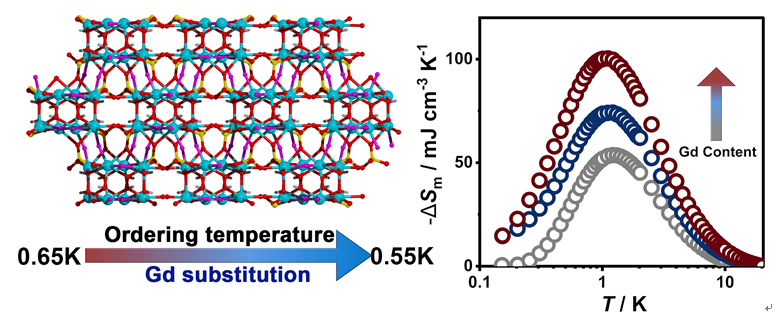
基于磁热效应的绝热去磁制冷技术是实现亚开尔文温区的重要途径之一,其无需依赖3He资源或重力环境,具有高效、可靠等优势。然而,目前该技术的发展仍受到高性能磁制冷材料匮乏的限制,理想的超低温磁制冷材料需要同时具备大的磁熵变、低的磁有序温度以及优异的化学稳定性。本文中,我们合成并系统研究了一种新型镱基氟羟基硫酸盐框架材料 Yb2SO4(OH)2F2 (1)及其 Gd 掺杂衍生物 (Yb0.9Gd0.1)2SO4(OH)2F2 (2)和 (Yb0.7Gd0.3)2SO4(OH)2F2 (3)。结构分析表明,该系列化合物由 Yb 配位多面体通过 F- 和 SO42- 桥联形成的致密三维框架结构。磁化率和热容测试结果表明:三种化合物均表现出弱反铁磁相互作用,并且磁有序出现在 1 K 以下温区。值得注意的是,Gd的引入不仅显著提高了体系的磁熵,而且进一步降低了磁有序温度,实现了磁密度增加与磁有序温度降低的协同优化。得益于这一特征,化合物 3 在 0-2 T 磁场变化下表现出约 100 mJ cm-3 K-1 的最大磁熵变,约为铁铵矾的2倍,并超过铬钾矾的2倍。研究结果表明,通过Gd掺杂实现磁密度优化是提升超低温磁热性能的有效策略,同时也表明氟羟基硫酸盐框架材料是一类极具潜力的绝热去磁制冷候选材料。
丁书颖
,
付名扬
,
吴若彤
,
孟银杉
,
徐侨飞
,
庄桂林
,
刘涛
,
龙腊生
. (Yb1-xGdx)2SO4(OH)2F2的合成、结构及亚开尔文温区磁热效应★[J]. 化学学报, 0
: 0
.
DOI: 10.6023/A26060187
Adiabatic demagnetization refrigeration based on the magnetocaloric effect represents an efficient route to achieving sub-Kelvin temperatures without relying on scarce 3He resources or gravity-dependent cooling systems. However, the development of this technology remains limited by the lack of high-performance refrigerants that simultaneously exhibit large magnetic entropy changes, low magnetic ordering temperatures and good chemical stability. Herein, we report a new ytterbium fluorohydroxysulfate framework, Yb2SO4(OH)2F2 (1), together with its Gd-substituted analogues, (Yb0.9Gd0.1)2SO4(OH)2F2 (2) and (Yb0.7Gd0.3)2SO4(OH)2F2 (3). Structural analysis reveals a dense three-dimensional framework assembled from interconnected Yb-centered polyhedra linked by fluoride and sulfate groups. Magnetic susceptibility and heat-capacity measurements indicate weak antiferromagnetic interactions and low magnetic ordering temperatures below 1 K. Notably, Gd substitution significantly enhances the magnetic entropy while simultaneously suppressing the ordering temperature, resulting in an unusual combination of increased magnetic density and reduced magnetic ordering. Consequently, 3 exhibits a maximum magnetic entropy change of 100 mJ cm-3 K-1 under 2 T, nearly twice that of ferric ammonium alum and more than twice that of chromic potassium alum. These results demonstrate that magnetic-density optimization through Gd incorporation is an effective strategy for enhancing sub-Kelvin magnetocaloric performance and establish fluorohydroxysulfate frameworks as promising candidates for adiabatic demagnetization refrigeration.
(1) Jordan C.; Bernhardt J.; Rahamim J.; Kirichenko A.; Bharadwaj K.; Fry-Bouriaux L.; Somoroff A.; Porsch K.; Tsai K.-T.; Walter J.; Weis A.; Yu M.-J.; Renzullo M.; Javelle J.; Checkley C.; Mukhanov O.; Yohannes D.; Vernik I.; Han, S.-J. A Quantum Computer Controlled by Superconducting Digital Electronics at Millikelvin Temperature. Nat. Electron.2026, 9, 287-294.
(2) Wang Z.; Rea N.; Bao T.; Kaplan D. L.; Lenc E.; Wadiasingh Z.; Hare J.; Zic A.; Anumarlapudi A.; Bera A.; Beniamini P.; Cooper A. J.; Clarke T. E.; Deller A. T.; Dawson J. R.; Glowacki M.; Hurley-Walker N.; McSweeney S. J.; Polisensky E. J.; Peters W. M.; Younes G.; Bannister K. W.; Caleb M.; Dage K. C.; James C. W.; Kasliwal M. M.; Karambelkar V.; Lower M. E.; Mori K.; Ocker S. K.; Pérez-Torres M.; Qiu H.; Rose K.; Shannon R. M.; Taub R.; Wang F.; Wang Y.; Zhao Z.; Bhat N. D. R.; Dobie D.; Driessen L. N.; Murphy T.; Jaini A.; Deng X.; Jahns-Schindler J. N.; Lee Y. W. J.; Pritchard J.; Tuthill J.; Thyagarajan, N. Detection of X-Ray Emission from a Bright Long-Period Radio Transient. Nature2025, 642, 583-586.
(3) Shu M.; Xu X.; Xi N.; He M.; Xiang J.; Qu G.; Khalyavin D.; Manuel P.; Nakamura J. G.; Jiao J.; Liu Y.; Wu G.; Guo K.; Zhao H.; Xu W.; Duan Q.; Zhong R.; Wang X.; Han Y.; Ling L.; Sun X.; Song D.; Gao Y.; Wang Z.; Chen X.; Qian T.; Jia S.; Du H.; Su G.; Li W.; Ma J.; Qu Z. Giant Magnetocaloric Effect and Spin Supersolid in a Metallic Dipolar Magnet. Nature2026, 651, 61-67.
(4) Xiang J.; Zhang C.; Gao Y.; Schmidt W.; Schmalzl K.; Wang C.-W.; Li B.; Xi N.; Liu X.-Y.; Jin H.; Li G.; Shen J.; Chen Z.; Qi Y.; Wan Y.; Jin W.; Li W.; Sun P.; Su, G. Giant Magnetocaloric Effect in Spin Supersolid Candidate Na2BaCo(PO4)2. Nature2024, 625, 270-275.
(5) Jang D.; Gruner T.; Steppke A.; Mitsumoto K.; Geibel C.; Brando M. Large Magnetocaloric Effect and Adiabatic Demagnetization Refrigeration with YbPt2Sn. Nat. Commun.2015, 6, 8680.
(6) Yang, Y.; Zhang, Q.-C.; Pan, Y.-Y.; Long, L.-S.; Zheng, L.-S. Magnetocaloric Effect and Thermal Conductivity of Gd(OH)3 and Gd2O(OH)4(H2O)2. Chem. Commun. 2015, 51, 7317-7320.
(7) Palacios E.; Rodríguez-Velamazán J. A.; Evangelisti M.; McIntyre G. J.; Lorusso G.; Visser D.; De Jongh L. J.; Boatner L. A. Magnetic Structure and Magnetocalorics of GdPO4. Phys. Rev. B2014, 90, 214423.
(8) Chen Y.-C.; Qin L.; Meng Z.-S.; Yang D.-F.; Wu C.; Fu Z.; Zheng Y.-Z.; Liu J.-L.; Tarasenko R.; Orendáč M.; Prokleška J.; Sechovský V.; Tong, M.-L. Study of a Magnetic-Cooling Material Gd(OH)CO3. J. Mater. Chem. A2014, 2, 9851-9858.
(9) Lorusso G.; Sharples J. W.; Palacios E.; Roubeau O.; Brechin E. K.; Sessoli R.; Rossin A.; Tuna F.; McInnes E. J. L.; Collison D.; Evangelisti, M. A Dense Metal-Organic Framework for Enhanced Magnetic Refrigeration. Adv. Mater.2013, 25, 4653-4656.
(10) Mo Z.; Jiang J.; Tian L.; Xie H.; Li Y.; Zheng X.; Zhang L.; Gao X.; Li Z.; Liu G.; Li L.; Shen, J. Ferromagnetic Eu2SiO4 Compound with a Record Low-Field Magnetocaloric Effect and Excellent Thermal Conductivity near Liquid Helium Temperature. J. Am. Chem. Soc.2025, 147, 14684-14693.
(11) Manvell A. S.; Dunstan M. A.; Gracia D.; Hrubý J.; Kubus M.; McPherson J. N.; Palacios E.; Weihe H.; Hill S.; Schnack J.; Evangelisti M.; Pedersen K. S. A Triangular Frustrated Eu(II)-Organic Framework for Sub-Kelvin Magnetic Refrigeration. J. Am. Chem. Soc.2025, 147, 7597-7603.
(12) Xu N.; Chen W.; Ding Y.-S.; Zheng, Z. A Cubic Tinkertoy-like Heterometallic Cluster with a Record Magnetocaloric Effect. J. Am. Chem. Soc.2024, 146, 9506-9511.
(13) Wang Y.; Xiang J.; Zhang L.; Gong J.; Li W.; Mo Z.; Shen, J. Giant Low-Field Cryogenic Magnetocaloric Effect in a Polycrystalline EuB4O7 Compound. J. Am. Chem. Soc.2024, 146, 3315-3322.
(14) Tokiwa Y.; Bachus S.; Kavita K.; Jesche A.; Tsirlin A. A.; Gegenwart, P. Frustrated Magnet for Adiabatic Demagnetization Cooling to Milli-Kelvin Temperatures. Commun. Mater.2021, 2, 42.
(15) Telang P.; Treu T.; Klinger M.; Tsirlin A. A.; Gegenwart P.; Jesche, A. Adiabatic Demagnetization Refrigeration with Antiferromagnetically Ordered NaGdP2O7. Phys. Rev. B2025, 111, 064431.
(16) Bag, R.; Ennis, M.; Liu, C.; Dissanayake, S. E.; Shi, Z.; Liu, J.; Balents, L.; Haravifard, S. Realization of Quantum Dipoles in Triangular Lattice Crystal Ba3Yb(BO3)3. Phys. Rev. B 2021, 104, L220403.
(17) Schmidt B.; Sichelschmidt J.; Ranjith K. M.; Doert Th.; Baenitz, M. Yb Delafossites: Unique Exchange Frustration of 4f Spin-1/2 Moments on a Perfect Triangular Lattice. Phys. Rev. B2021, 103, 214445.
(18) Xu Q.-F.; Chen M.-T.; Wu R.-T.; Long L.-S.; Zheng, L.-S. Achieving Magnetic Refrigerants with Large Magnetic Entropy Changes and Low Magnetic Ordering Temperatures. J. Am. Chem. Soc.2024, 146, 20116-20121.
(19) Xu Q.; Zhao P.; Chen M.; Wu R.; Dai W.; Long L.; Zheng, L. Exceptional Cooling Capacity of LiGd0.1Yb0.9F4 at Sub‐kelvin Temperatures. Adv. Mater.2025, 37, 2414226.
(20) Xu Q.; Zhao P.; Chen M.-T.; Wu R.-T.; Dai W.; Long L.-S.; Zheng L. K(Gd0.1Yb0.9)3F10, A Promising Refrigerant for Sub-100 mK Adiabatic Demagnetization Refrigeration. Ind. Chem. Mater.2026, 10.1039.D6IM00032K.
(21) Zhang Y.; Na Y.; Liu X.; Xiang J.; Chen F.; Li H.-F.; Sun P.; Zhou S.; Zhang X.; Li, L. Refrigeration down to 0.16 K Using a Frustrated Magnet Gd2B2MoO9. Nat. Commun.2026, 17, 1554.
(22) Xu Q.-F.; Liu X.-Y.; Wu R.-T.; Fu M.-Y.; Chen M.-T.; Xiang J.-S.; Meng Y.-S.; Liu T.; Sun P.-J.; Long L.-S.; Zheng, L.-S. Temperature Below 30 mK Achieved by Adiabatic Demagnetization Refrigeration. J. Am. Chem. Soc.2025, 147, 27089-27094.
(23) Paixao Brasiliano D. A.; Duval J.-M.; Marin C.; Bichaud E.; Brison J.-P.; Zhitomirsky M.; Luchier, N. YbGG Material for Adiabatic Demagnetization in the 100 mK-3 K Range. Cryogenics2020, 105, 103002.
(24) Shimura Y.; Watanabe K.; Taniguchi T.; Osato K.; Yamamoto R.; Kusanose Y.; Umeo K.; Fujita M.; Onimaru T.; Takabatake, T. Magnetic Refrigeration down to 0.2 K by Heavy Fermion Metal YbCu4Ni. J. Appl. Phys.2022, 131, 013903.
(25) Gruner T.; Chen J.; Jang D.; Banda J.; Geibel C.; Brando M.; Grosche, F. M. Metallic Local-Moment Magnetocalorics as a Route to Cryogenic Refrigeration. Commun. Mater.2024, 5, 63.
(26) Vilches O. E.; Wheatley, J. C. Measurements of the Specific Heats of Three Magnetic Salts at Low Temperatures. Phys. Rev.1966, 148, 509-516.


