


1 引言
金属有机骨架材料(Metal-Organic Frameworks, MOFs)作为由金属离子与有机配体通过配位作用构筑而成的晶态多孔材料, 因其结构多样性和高度可设计性, 在化学与材料领域得到了广泛关注[1-4]. 近年来, 随着研究的不断深入, 如何通过精细调控配位环境实现特定结构单元的有序组装, 已成为该领域的重要研究方向之一[5-8]. 在众多MOFs体系中, 混合价态MOFs因同时包含不同氧化态的金属中心, 表现出更为复杂的配位结构和独特性质, 在结构和新材料化学研究中具有重要意义[9-12]. 以铜为代表的过渡金属, 由于其常见的+1和 +2两种氧化态以及灵活多变的配位模式, 使其成为构筑混合价态MOFs的理想候选[13-15]. 铜基混合价MOFs由于其电子结构的变化, 可提升配合物的导电性、水解稳定性、吸附性能和催化活性等性能, 因而引起了广泛关注[16-19]. 然而, 混合价态铜基MOFs的合成一直具有一定的挑战性, 原因在于其自组装过程中需精确调控铜离子的氧化态, 并维持不同价态铜中心的稳定共存[20]. 目前, 具有混合价铜的三维MOFs材料报道相对较少, 尤其是Cu(I)和Cu(II) 均为单核的三维MOFs材料较为罕见[21-22]. 同时, 由于不同价态的铜离子配位模式的差异, 所构建MOFs结构的拓扑类型千差万别, 这不利于系统性的性能探究及对比[23-24]. 因此, 如何合成具有可稳定存在的混合价态铜金属中心的MOFs, 并通过同网格修饰系统探索其性能, 在精准构筑化学及精细调控方面具有一定的科学意义[25].
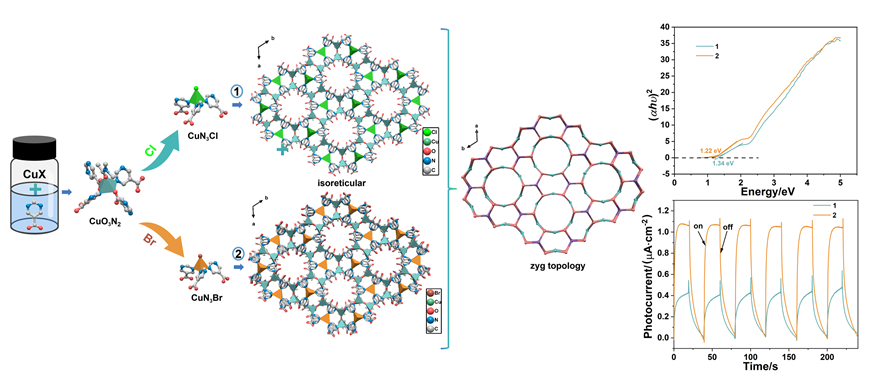
本工作以CuCl(或CuBr)作为金属盐, 在溶剂热条件下将Cu(I)直接引入体系, 同时卤素离子与嘧啶-5-羧酸(HL)共同构建的配位环境有利于Cu(I)的稳定存在. 反应过程中部分铜中心发生氧化, 从而形成Cu(I)和Cu(II)共存的混合价态体系, 成功构筑了两例具有相同zyg拓扑类型的混合价态铜基MOFs. 在该体系中, 不同价态的铜金属可以稳定共存, 其中Cu(Ⅰ)与卤素阴离子形成配位单元, 而Cu(Ⅱ)以单核形式参与骨架构筑. 通过单晶结构解析及多种表征手段, 对其结构特征及组成进行了系统分析. 光电化学性能测试表明在该MOF体系中, 卤素种类的改变可有效调节材料的带隙和光电流响应强度. 其中, 溴离子配位的MOF材料表现出更窄的带隙以及更强的光电流响应, 具备一定的光电性能应用潜力.
2 结果与讨论
2.1 1和2的晶体结构
单晶X射线结构分析表明1属于三方晶系, P3c1空间群. 如图S1(见支持信息)所示, 1的最小不对称单元中包含一个Cu(Ⅱ)离子, 两个L-配体, 一个配位的N,N-二甲基乙酰胺(DMA), 两个Cu(Ⅰ)离子, 两个卤素Cl-离子. 如图1a所示, 金属和L-组装构筑了五配位Cu(Ⅱ)中心, 包括一个配位DMA的O原子, 两个羧基O原子和两个嘧啶上的N原子(图1b). 在ab面上, 6个Cu(Ⅱ)通过L-配体连接形成含未配位氧原子的六边形孔道, 孔道直径为0.64 nm(图1c). 同时, 四配位的Cu(Ⅰ)离子由三个嘧啶的N原子和一个卤素CL-离子配位(图1d). 两种铜离子以n(Cu(Ⅱ))∶n(Cu(Ⅰ))=3∶2的比例与配体L-连接, 共同组装形成三维网络(图1e). 与1不同的是, 2的最小不对称单元的卤素是两个Br-离子(见支持信息图S2). 2是Cu(Ⅰ)-Br作为Cu(Ⅱ)和配体L-形成的六边形孔道的连接点. 此外, 如图1f所示, 将Cu(Ⅱ)、Cu(Ⅰ)以及有机配体分别简化为4-, 3-, 3-连接节点, 整个晶体网络可进一步简化为一个具有4, 3, 3连接性的zyg型网络结构, 如图1g所示. 1和2均具有显著的沿c轴方向的一维孔道, 尺寸均约为0.64 nm, 经PLATON计算, 二者孔隙率分别为14.2%和13.6%.
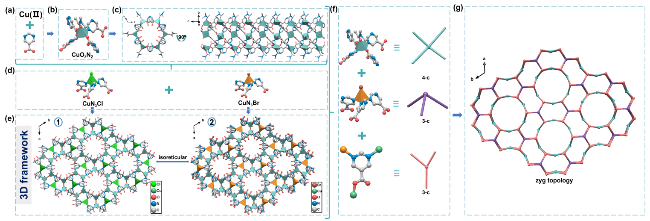
图1 (a) Cu(Ⅱ)和HL配体; (b) Cu(Ⅱ)的配位环境图; (c) 左边为沿c轴的一维孔道图, 右边为沿a轴的一维孔道图; (d) 左边为Cu(Ⅰ)-Cl的配位环境图, 右边为Cu(Ⅰ)-Br的配位环境图; (e) 左边为1的三维骨架结构, 右边为2的三维骨架结构; (f) Cu(Ⅱ)、Cu(Ⅰ)和配体分别简化为三种不同的连接节点; (g) 1和2的zyg型拓扑网络. 为了更清楚显示结构, 氢原子已被省略Figure 1 (a) Cu(II) and HL ligands; (b) Coordination sphere of Cu(II); (c) 1D channel diagram along the c-axis on the left and along the a-axis on the right; (d) Coordination spheres of Cu(I)-Cl on the left and Cu(I)-Br on the right; (e) The left panel shows the 3D framework structure of 1, and the right panel shows the 3D framework structure of 2; (f) Cu(II), Cu(I), and the ligands are simplified into three distinct types of nodes; (g) zyg-type topological of 1 and 2. Hydrogen atoms have been omitted to clarify the structure |
2.2 X射线光电子能谱(XPS)表征
通过X射线光电子能谱(XPS)分析了1和2表面元素及其化学状态, 证实了C、N、O、Cu和X (X=Cl或Br)元素的存在, 与晶体结构中的元素组成结果一致(图2a和图2c). 1的C 1s高分辨谱图经拟合后可得四个峰: 284.8 eV处的主峰归属于sp2杂化的C—C/C=C骨架, 286.1 eV峰来源于C—N键, 287.0 eV的峰为C—O键, 288.4 eV的峰归属于C=O双键(见支持信息图S3). 所有的结合能均以284.8 eV为基准校正. N 1s谱图可拟合为399.2 eV和400.1 eV两个峰, 分别对应C—N键和 C=N—C(见支持信息图S4). 最重要的是, XPS分析了1和2中Cu的价态. 如图2b所示, 1中Cu 2p3/2和2p1/2的特征峰932.0和951.9 eV, 可归属于Cu(Ⅰ)的特征结合能; 934.5和954.2 eV, 可归属于Cu(Ⅱ)的特征结合能[13]. 对Cu(Ⅰ)和Cu(Ⅱ)的谱峰分别积分得到谱峰面积比为40.3%∶59.7%, 表明1中Cu(Ⅰ)和Cu(Ⅱ)的比例为1∶1.48, 与晶体学结果所得出的分子式中Cu(Ⅰ)和Cu(Ⅱ)的比例(2∶3)基本一致.
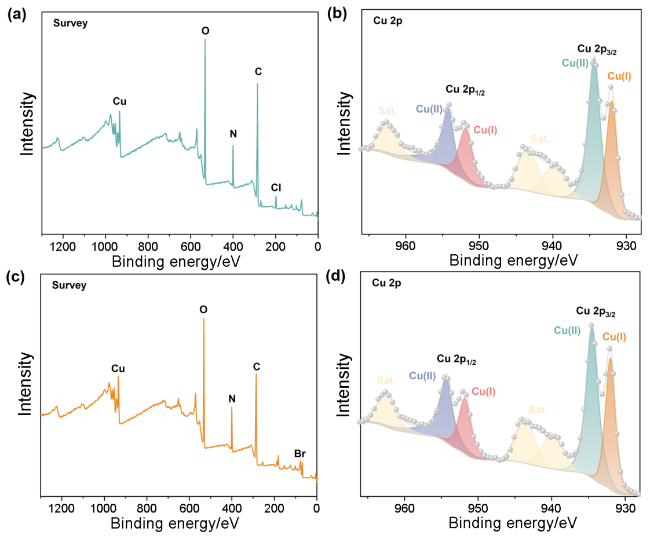
2的C 1s高分辨谱图经拟合后可得四个峰: 284.8 eV处的主峰归属于sp2杂化的C—C/C=C骨架, 286.3 eV峰来源于C—N键, 287.3 eV的峰为C—O键, 288.6 eV的峰归属于C=O双键. 所有的结合能均以284.8 eV为基准校正(见支持信息图S5). N 1s谱图可拟合为399.5 eV和400.3 eV两个峰, 分别对应C—N键和C=N—C(见支持信息图S6). 2中Cu的价态如图2d所示, Cu 2p3/2和2p1/2的特征峰932.0和951.8 eV, 可归属于Cu(Ⅰ)的特征结合能; 934.4和954.3 eV, 可归属于Cu(Ⅱ)的特征结合能. 对Cu(Ⅰ)和Cu(Ⅱ)的谱峰分别积分得到谱峰面积比为39.8%∶60.2%, 表明2中Cu(Ⅰ)和Cu(Ⅱ)的比例为1∶1.51, 与晶体学结果所得出的分子式中Cu(Ⅰ)和Cu(Ⅱ)的比例(2∶3)基本一致.
2.3 傅里叶变换红外(FT-IR)光谱分析
我们对化合物1和2的红外光谱进行了研究, 如图S7(见支持信息)所示, 777 cm-1为嘧啶环上的=C—H的弯曲振动, 1174 cm-1为嘧啶环上的C—C的伸缩振动, 1358 cm-1为嘧啶环上的C=C的伸缩振动, 3062 cm-1为嘧啶环上的C—H的伸缩振动, 1625 cm-1为类羰基不对称伸缩振动(类羰基, 羧酸盐形式上类似羰基峰), 为有机配体和金属中心之间的配位提供了明确的证据.
2.4 粉末X射线衍射(PXRD)表征
如图S8(见支持信息)所示, 实验所获得新合成样品1和2的粉末衍射花样与利用单晶结构数据模拟所得的衍射花样吻合度较好, 表明1和2的粉末样品均具有较高的相纯度.
2.5 热稳定性分析和溶剂稳定性
如图S9(见支持信息)所示, 为了研究1和2的热稳定性, 我们对化合物1和2进行了热分析(TGA)测试. 测试条件: 氮气流速为10 cm3•min-1, 升温速率为10 ℃• min-1, 温度从30 ℃开始, 600 ℃结束. TGA曲线显示1共有两步明显失重, 30~97 ℃之间失重1.84%, 对应1表面的水分子, 97~200 ℃之间处于平台, 200~260 ℃失重52.49%, 对应配体HL和配位DMA的分解, 从260 ℃开始失重, 最后剩余残余物为氧化铜和碳等化合物. 对于2, 第一段失重同1一样, 不同的是, 97~220 ℃之间处于平台, 220~260 ℃失重48.39%, 对应配体HL和配位DMA的分解, 从260 ℃开始失重, 最后剩余残余物为氧化铜和碳等化合物. TGA分析表明, 1和2均具有良好的热稳定性, 在200 ℃以下均能保持结构的完整.
接着, 我们进一步考察了1和2的溶剂稳定性. 室温下, 将合成的1和2在各种溶剂中浸泡24 h后测试PXRD曲线. 由图S10和图S11(见支持信息)可知, 除水外, 1和2在其他常见溶剂中结构框架均能保持稳定, 表明1和2具有较好的化学稳定性.
2.6 紫外可见漫反射光谱(UV-Vis DRS)及光学带隙
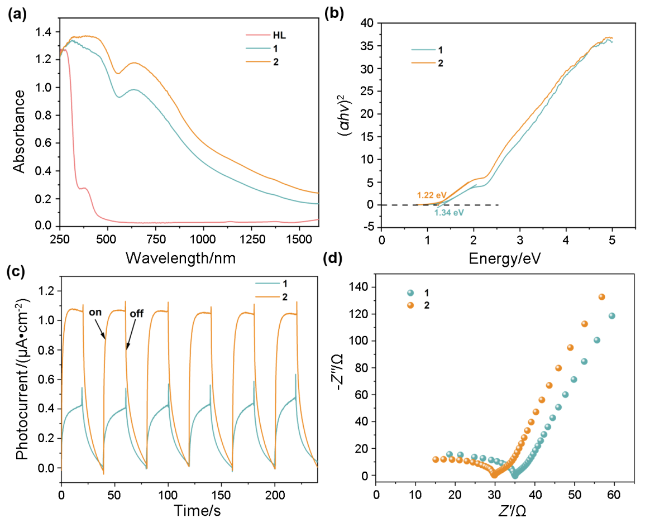
我们对1和2进行了UV-Vis DRS测试. 结果表明1和2有良好的光吸收能力, 展现出全光谱吸收的行为, 吸收带边可延伸至1600 nm(图3a). 宽的光谱吸收范围是由于Cu(I)/Cu(II)混合价中心之间可能存在价态间电荷转移(Intervalence Charge Transfer, IVCT), 有利于产生可见-近红外区域的电子跃迁[9]. 为确定材料的光学跃迁类型, 我们采用Tauc公式计算1和2的直接带隙(图3b)和间接带隙(见支持信息图S12). 结果表明, 直接带隙在吸收边附近具有更好的线性关系, 因此采用直接带隙计算材料带隙, 1和2的直接带隙分别为1.34 eV和1.22 eV. 由于Br-离子的4p轨道能量高于CL-离子的3p轨道从而使带隙变窄[37]. 1和2相比较, 2具有更宽的吸光范围和更窄的带隙.


2.7 光电流响应
我们进一步研究了1和2在300 W氙灯(320 nm<λ<2500 nm)照射下的光电流响应. 在测试过程中, 使用手动遮挡物保持氙灯开-关循环照射(间隔为20 s). 如图3c所示, 1和2均观察到明显的光电流响应, 其中2的光电流响应(1.06 μA•cm-2)是1光电流响应的(0.42 μA•cm-2)的2.52倍, 表明通过卤素替换改善了光电流响应.
2.8 电化学阻抗测试
电化学阻抗(EIS)验证电荷转移效率, 如图3d所示, 我们还研究了1和2的EIS, EIS的奈奎斯特图显示2具有更低的阻抗, 表明2比1具有更低的电荷转移电阻和更快的电子转移动力学.
3 结论
本工作以嘧啶-5-羧酸为配体, 通过引入不同卤素阴离子(CL-和Br-), 成功合成了两例具有相同zyg拓扑的混合价态铜基MOFs. 结构分析表明, 1和2同时含有单核Cu(Ⅰ)和单核Cu(Ⅱ)中心. 光电性能测试表明, 这些MOFs都表现出全光谱吸收和良好的光电流响应, 在光电催化和光传感方面具有应用潜力. 此外, 对比氯配位的1, 溴配位的2具有更窄的带隙和更好的光电流响应.
4 实验部分
4.1 仪器与试剂
晶体的数据收集和结构分析是在Rigaku XtaLABW Synergy-DW衍射仪使用石墨单色器Cu/Kα辐射(λ=0.154184 nm)采集. 晶体结构通过直接法(SHELXT程序)解析, 并采用基于Olex2软件包的全矩阵最小二乘法(SHELXT程序)进行精修. 主要晶体学数据和细化参数列于表S1, 表S2和表S3(见支持信息)给出了1和2的主要键长和键角. X射线光电子能谱是在美国Thermo Fisher Scientific K-Alpha进行测试, 其中, 分析室真空度5×10⁻¹⁰ Pa, 激发源采用Al/Kα射线(hν=1486.68 eV), 工作电压15 kV, 灯丝电流10 mA, 并进行5~10次循环的信号累加, 测试通能(Passing-Energy)为50 eV, 步长0.1 V, 并以C 1s=284.80 eV结合能为能量标准进行荷电校正. 傅里叶变换红外光谱在配备DTGS探测器的Nicolet is10 FTIR光谱仪上采集, 通过KBr压片进行制样, 波长范围为4000~400 cm-1. 粉末X射线衍射仪为Bruker D8 ADVANCE型, 线聚焦Cu X射线(Cu/Kα1辐射, λ=0.154056 nm)管在40 kV和40 mA下工作, 扫描速度为5 (°)•min-1. 热重分析测试在德国耐驰STA2500型热重分析仪上进行, 测试环境为N2气氛, 升温速率为10 ℃•min-1, 温度范围为30~600 ℃. 有机元素分析仪(elementar vario Micro cube), 采用CHNS分析模式, 氦气和氧气(气体纯度大于99.99%)的压力均为120000 Pa, 燃烧管设置温度为1150 ℃, 还原管设置温度为 850 ℃, 通氦气流量为200 mL•min-1, 通氧气体流量为15 mL•min-1, 采用热导检测器(TCD), 检测器温度为 65 ℃.
4.2 MOF材料1和2的合成
4.2.1 {(CuⅠCl)2[CuⅠⅠ3(L)6(DMA)3](H2O)2}n (1)的合成
室温下, 将配体HL (44 mg, 0.36 mmol), DABCO (22 mg, 0.18 mmol), DMA (3 mL), MeCN (2 mL), 置于20 mL的耐高温高压的玻璃反应瓶中, 加入160 µL HCOOH, 最后加入CuCl (64 mg, 0.65 mmol), 转移至85 ℃烘箱中反应3 d, 然后取出冷却至室温, 用DMA洗涤. 得到深墨绿色棒状晶体1, 产率为83%(以配体量计算). 计算元素分析值(C42Cl2Cu5N15O17H49)为: C 35.43%, N 14.70%, H 3.70%; 实验值为: C 35.41%, N 14.75%, H 3.47%.
4.2.2 {(CuⅠBr)2[CuⅠⅠ3(L)6(DMA)3](H2O)2}n (2)的合成
室温下, 将配体HL (22 mg, 0.18 mmol), DABCO (11 mg, 0.09 mmol), DMA (3 mL), MeCN (2 mL), 置于20 mL的耐高温高压的玻璃反应瓶中, 加入20 µL HBr, 最后加入CuBr (60 mg, 0.42 mmol), 转移至120 ℃烘箱中反应3 d, 然后取出冷却至室温, 用DMA洗涤. 得到深墨绿色棒状晶体2, 产率为86%(以配体量计算). 计算元素分析值(C42Br2Cu5N15O17H49)为: C 33.33%, N 13.88%, H 3.26%; 实验值为: C 33.19%, N 13.62%, H 3.39%.
4.3 紫外可见漫反射光谱
紫外可见漫反射光谱是在UV-3600 Shimadzu光谱仪上进行测试, BaSO4作为参比. 基于测得的紫外可见近红外谱线, 通过Tauc公式, (αhν)2=hν-Eg, 估算样品的光学带隙(Eg).
4.4 电化学性质测试
采用CHI 660E三电极电化学工作站进行样品的光电流测试, Ag/AgCl作为参比电极, Pt丝作为对比电极.
薄膜工作电极制备: 将2 mg样品分散在950 µL乙醇和50 µL Nafion D-520分散溶液的混合溶液中, 超声5 min. 随后, 移取200 µL该悬浮液涂在ITO导电玻璃板上(1 cm×1 cm), 室温下干燥. 电解液选用0.2 mol•L-1 Na2SO4水溶液. 光电流响应测试是通过周期性开关光源(间隔20 s开关切换300 W氙灯照射状态)进行测试, 持续6个明暗交换周期, 记录光电极在动态光照条件下的电流瞬态响应曲线. 电化学阻抗(EIS)在0.1~10 MHz频率下测得.
(Cheng, B.)