Wide-bandgap bromide perovskites, exemplified by FAPbBr3, have emerged as indispensable components in tandem photovoltaics and semi-transparent solar cells, owing to their large bandgap, elevated theoretical open-circuit voltage, and enhanced environmental robustness relative to iodide-based analogues. Nevertheless, the practical efficiency of FAPbBr3 devices remains markedly below their theoretical ceiling, largely constrained by poorly regulated crystallization dynamics during film formation. The intrinsically low solubility of PbBr2, coupled with the rapid conversion kinetics of bromide systems, frequently induces incomplete phase transformation and microstructural heterogeneity, thereby generating pervasive bulk and interfacial defects. These defects act as dominant nonradiative recombination centers, undermining carrier lifetime and operational stability, particularly in carbon-electrode architectures.
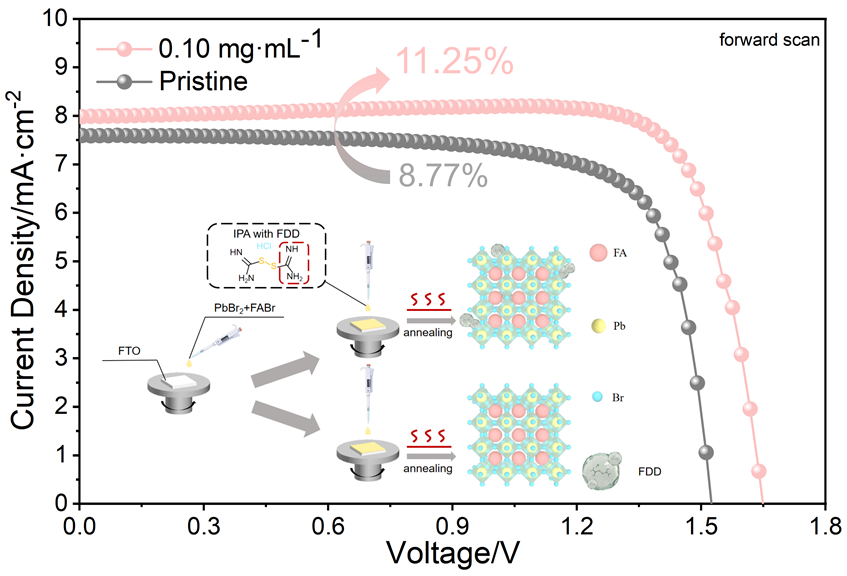
To address these limitations, a molecularly engineered interfacial strategy is developed by introducing formamidinium disulfide dihydrochloride (FDD) as a functional interlayer between the FAPbBr3 absorber and the carbon electrode. The FAPbBr3 films are constructed via a two-step spin-coating protocol, followed by the deposition of an ultrathin FDD modification layer. Notably, the molecular configuration of FDD enables a cooperative dual-site passivation mechanism: sulfur-containing groups exhibit strong coordination with undercoordinated Pb2+ species, while the formamidinium moieties contribute to surface defect passivation through intermolecular interactions.This synergistic interaction effectively suppresses interfacial defect formation and modulates crystallization behavior, leading to concurrent improvements in structural order and electronic quality.
A suite of structural, optical, and electrical characterizations systematically elucidates the role of FDD modification. Morphological analyses (SEM, AFM) reveal enlarged grain domains, enhanced film compactness, and reduced macroscopic roughness, indicative of suppressed grain-boundary defects and improved crystallinity. XRD patterns confirm increased phase purity with diminished residual PbBr2 signatures. Optical measurements, including UV-Vis absorption and Tauc analysis, demonstrate enhanced absorption coefficients alongside reduced Urbach energy, reflecting decreased sub-bandgap states and minimized energetic disorder.
Photophysical investigations further corroborate the suppression of nonradiative pathways. Steady-state and time-resolved PL measurements exhibit intensified emission and prolonged carrier lifetimes. Space-charge-limited current analysis indicates a reduced trap-state density, while electrochemical impedance spectroscopy reveals elevated recombination resistance and decreased transport resistance, evidencing facilitated charge extraction. Transient photocurrent and photovoltage responses further confirm accelerated carrier dynamics and extended recombination lifetimes, underscoring improved interfacial charge-transfer kinetics.
Benefiting from these collective enhancements, the optimized FDD-modified device delivers a champion PCE of 11.25%, with an open-circuit voltage of 1.64 V, a short-circuit current density of 7.98 mA cm-2, and a fill factor of 85.96%, substantially surpassing previously reported benchmarks for FAPbBr3 systems. Device statistics indicate improved reproducibility with reduced performance dispersion. Moreover, unencapsulated devices retain 96.88% of their initial efficiency after 30 days under ambient conditions (~20% RH, 25 °C), highlighting markedly enhanced environmental stability.
In essence, this work establishes a refined molecular-level interfacial engineering paradigm for wide-bandgap FAPbBr3 photovoltaics. By constructing a synergistic dual-site passivation framework that concurrently targets Pb2+-related surface defects and other surface defect sites, the FDD interlayer effectively tailors crystallization behavior, suppresses nonradiative recombination, and promotes efficient charge transport. This strategy not only advances the efficiency ceiling of carbon-based wide-bandgap perovskite solar cells but also provides deeper mechanistic insights into defect governance and interface design in bromide perovskite systems.
[1] Li X. H.; Li Y. F.; Feng Y. X.; Qi J. H.; Shen J. L.; Shi G. D.; Yang S. P.; Yuan M. J.; He, T. W. Adv.Mater.-95 Proc.Int.Symp.2024, 36, 2401103.
[2] Wen J.; Zhao Y. C.; Liu Z.; Gao H.; Lin R. X.; Wan S. S.; Ji C. L.; Xiao K.; Gao Y.; Tian Y. X.; Xie J.; Brabec C.; Tan, H. R. Adv.Mater.-95 Proc.Int.Symp.2022, 34, 2110356.
[3] Passi M.; Pal B. Powder Technol.2021, 388, 274-304.
[4] Karuturi S. K.; Shen H.; Sharma A.; Beck F. J.; Varadhan P.; Duong T.; Narangari P. R.; Zhang D. D.; Wan Y. M.; He J. H.; Tan H. H.; Jagadish C.; Catchpole K. Adv.Energy Mater.2020, 10, 2000772.
[5] Li J.; Liu J.; Xu W.; Long J.; Huang W. H.; Zhang Y. P.; Chu L. Y. Chem.Eng.J.2022, 437, 135414.
[6] Hanusch F. C.; Wiesenmayer E.; Mankel E.; Binek A.; Angloher P.; Fraunhofer C.; Giesbrecht N.; Feckl J. M.; Jaegermann W.; Johrendt D.; Bein T.; Docampo P. Phys.Chem.Lett,2014, 5, 2791-2795.
[7] Arora N.; Orlandi S.; Dar M. I.; Aghazada S.; Jacopin G.; Cavazzini M.; Mosconi E.; Gratia P.; De A. F.; Pozzi G.; Graetzel M.; Nazeeruddin M. K. ACS Energy Lett.2016, 1, 107-112.
[8] Subbiah A. S.; Agarwal S.; Mahuli N.; Nair P.; Hest M.; Sarkar S K. Adv.Mater.Interfaces.2017, 4, 1601143.
[9] Liu Y. W.; Kim B. J.; Wu H.; Boschloo G.; Johansson E. M. J. ACS Appl. Energy Mater.2021, 4, 9276-9282.
[10] Xu H. F.; Liang Z.; Ye J. J.; Xu S. D.; Wang Z. H.; Zhu L. Z.; Chen X. J.; Xiao Z. G.; Pan X.; Liu G. Z. Chem.Eng.J.2022, 437, 135181.
[11] Liu Y. W.; Cai B.; Yang H.; Boschloo G.; Johansson E. M. J. ACS Appl. Energy Mater.2023, 6, 7102-7108.
[12] Yi C.; Kim T.; Lee C.; Ahn J.; Lee M.; Son H. J.; Ko Y.; Jun, Y. ACS Appl. Mater. Interfaces,2024, 16, 44756-44766.
[13] Zhang Y. F.; Liang Y. Q.; Wang Y. J.; Guo F. W.; Sun L. C.; Xu D. S. ACS Energy Lett.2018, 3, 1808-1814.
[14] Shang W. L.; Wang L. K.; Zhang X. C.; Yu X.; Li Y. F.; Wan Z. H.; Yang H. Y.; Li T.; Wang H. Acta Phys.sin.2025, 74, 028401(in Chinese).
(商文丽, 王立坤, 张晓春, 岳鑫, 李一锋, 万政慧, 杨华翼, 李婷, 王辉, 物理学报, 2025, 74, 028401.)
[15] Wu Y. J.; Wang J. Y.; Zhu W. H.; Liang K. B.; Wang Y.; Chen X. H.; Sun W. H.; Fu C. P. Sci.Bull.2025, 71, 1-14(in Chinese).
(吴韫佳, 汪佳艳, 朱文昊, 梁凯博, 汪杨, 陈宣衡, 孙伟海, 傅超萍, 科学通报, 2025, 71, 1-14.)
[16] Zhao Y. Y.; Duan J. L.; Wang Y. D.; Yang X. Y.; Tang Q. W. Nano Energy.2020, 67, 104286-104286.
[17] Paci B.; Riva F. R.; Generosi A.; Guaragno M.; Barichello J.; Matteocci F.; Carlo A. D. Nanomaterials.2025, 15, 327-327.
[18] Ince M.; Kuboi R.; Ince T.; Yoshimura K.; Motoyoshi D.; Sonobe M.; Kudo R.; Mori S.; Kimura M.; Torres T. Sustainable Energy Fuels.2021, 5, 584-589.
[19] Cao F. X.; Pan W. C.; Zhang Z. Y.; Chen P. X.; He R. W.; Tong A. L.; Zheng Q. S.; Lan Z.; Sun W. H.; Wu J. H. Appl.Surf.Sci.2023, 623, 157003.
[20] Zhu N. M.; Zhu W. H.; Yin X. Y.; Zheng S. Z.; Li H.; Wang Z. Y.; Wei W. H.; Chen X. H.; Sun W. H. Chin.J.Inorg.Chem.2025, 41, 1131-1140(in Chinese).
(朱能敏, 朱文昊, 殷逍遥, 郑松志, 李浩, 王则远, 位文豪, 陈宣衡, 孙伟海, 无机化学学报, 2025, 41, 1131-1140.)
[21] Gao L. L.; Hao K.; Hu P.; Zhang J.; Yang F.; Huang S.; Su H.; Zheng X. X.; Que M. D. ACS Appl. Mater. Interfaces.2023, 15, 50148-50154.
[22] Cantas A.; Gundogan S. H.; Turkoglu F.; Koseoglu H.; Aygun G.; Ozyuzer L. Thin Solid Films.2023, 784, 140070.
[23] Gao D. Y.; Yang L. Q.; Ma X. H.; Shang X. N.; Wang C.; Li M. J.; Zhuang X. M.; Zhang B. X.; Song H. W.; Chen J. Z.; Chen C. J. Energy Chem.2022, 69, 659-666.
[24] Zou Y.; Li Z.; Chen H. H.; Liu Y. C.; Tong A. L.; Yan H. Y.; He R. W.; Hua G. X.; Zeng W. D.; Sun W. H. Faguang Xuebao.2021, 42, 682-690.
(邹宇, 李昭, 陈衡慧, 刘伊辰, 童安玲, 颜惠英, 何若玮,花国鑫, 曾伟东, 孙伟海, 发光学报, 2021, 42, 682-690.)
[25] Pan T.; Zhou W.; Wei Q.;Peng, Z. J; Wang, H.; Jiang X. Y.; Zang Z. H.; Li H. S.; Yu D. N.; Zhou Q. L.; Pan M. L.; Zhou W. J.; Ning, Z. J. Advanced Materials,2023, 35, 2208522.
[26] Xiang W. C.; Pan J. Y.; Chen Q. ACS Appl. Energy Mater.2020, 3, 5977-5983.
[27] Duan J. L.; Zhao Y. Y.; Yang X. Y.; Wang Y. D.; He B. L.; Tang, Q. W. Adv.Energy Mater.2018, 8, 1802346.
[28] Liu J. M.; Wu J. H.; Li G. D.; Chen Q.; Chen X.; Geng J. L.; Ouyang Q.; Sun W. H.; Lan Z. ACS Appl. Energy Mater.2022, 5, 4270-4278.
[29] Zhang W. Y.; Liu X. J.; He B. L.; Gong Z. K.; Zhu J. W.; Ding Y.; Chen H. Y.; Tang Q. W. ACS Appl. Mater. Interfaces.2020, 12, 4540-4548.
[30] Zolfaghari Z.; Hassanabadi E.; Pitarch-Tena D.; Yoon S. J.; Shariatinia Z.; Lagemaat J.; Luther J. M.; Iván Mora-Seró. ACS Energy Lett.2018, 4, 251-258.
[31] Liang K. B.; Zhang Y. Y.; Wang C. H.; Hua G. X.; Yang W. D.; Jin Y. N.; Zhang C. H.; Chen S. T.; Zhu C. W.; Sun W. H. Sci.Bull.2023, 68, 1689-1698(in Chinese).
(梁凯博, 张羊羊, 汪琛皓, 花国鑫, 杨吴单, 金一诺, 张春虹, 陈劭添, 朱晨溦, 孙伟海, 科学通报, 2023, 68, 1689-1698.)
[32] Wang S. B.; Cao F. X.; Chen P. X.; He R. W.; Tong A. L.; Lan Z.; Gao P.; Sun W. H.; Wu J. H. Chem. Eng. J.2023, 453, 139721.
[33] Zhu W. D.; Ma J. X.; Chai W. M.; Han T. J.; Chen D. D.; Xie X. P.; Liu G.; Dong P.; Xi H.; Chen D. Z.; Zhang J. C.; Zhang C. F.; Hao Y. Sol. RRL.2022, 6, 2200020.
[34] Yin X. Y.; Zhu W. H.; Shi P. Y.; Li Z. S.; Wang Y. C.; Zhu N. M.; Wang Y.; Sun W. H. Chin. J. Inorg. Chem.2025, 41, 469-479(in Chinese).
(殷逍遥, 朱文昊, 施谱垚, 李宗盛, 王艺超, 朱能敏, 汪杨, 孙伟海, 无机化学学报, 2025, 41, 469-479.)
[35] Glowienka D.; Galagan, Y. Adv.Mater.95 Proc.Int.Symp.2022, 34, 2105920.
[36] Xiang J. W.; Han C. Z.; Qi J. H.; Cheng Y. J.; Chen K.; Ma Y. M.; Xie J. Y.; Hu Y.; Mei A. Y.; Zhou Y. H.; Han H. W. AFM.2023, 33, 2300473.
[37] Chen Q.; Wang C.; Li Y. W.; Chen L. W. J.Am.Chem.Soc.2020, 142, 18281-18292.
[38] Cao F. X.; Zhu Z. Y.; Zhang C. H.; Chen P. X.; Wang S. B.; Tong A. L.; He R. W.; Wang Y.; Sun W. H.; Li Y. L.; Wu J. H. Small.2023, 19, 2207784.
[39] Wang S. B.; Sun W. H.; Zhang M. J.; Yan H. Y.; Hua G. X.; Li z.; He R. W.; Zeng W. D.; Lan z.; Wu, J. H. RSC Adv,2020, 10, 38736-38745.
[40] Yue W.; Yang H.; Cai H. Y.; Xiong Y. M.; Zhou T.; Liu Y. J.; Zhao J.; Huang F. Z.; Chen Y. B.; Zhong J. Adv. Mater.2023, 35, 2301548.
[41] Jafarzadeh F.; Dong L.R.; Jang D.J.; Wagner M.; Koch G.; Qiu S.D.; Feroze S.; Cerrillo J.G.; Brabec C.J.; Carlo A. D.; Brunetti F.; Egelhaaf H.J.; Matteocci F. Sol. RRL.2024, 8, 2400530
[42] Zhang Y. F.; Liang, Y. Q; Wang, Y. J.; Guo F.W.; Sun L.C.; Xu, D.S. ACS Energy Lett.2018, 3, 1808.
[43] Liu Y.W.; Kim B. J.; Wu H.;Boschloo G.; Johansson E. M J.; ACS Appl. Energy Mater.2021, 4, 9276.
[44] Arora N.; Dar M. I.; Mojtaba A.J.; Giordano Fabrizio.; Oellet N.; Jacopin G.; Friend R.H.; Zakeeruddin S. M.; Gratzel M. Nano Lett.2016, 16, 7155.


