化学学报 >

0 26060207 - 26060207

DOI: https://doi.org/10.6023/A26060207

研究论文

基于B-N配位的潜伏固化与高效降解环氧体系

  • Sun Xiaoran ,
  • Liu Ziyu ,
  • Liu Jingkai ,
  • Liu ,
  • Xiaoqing
展开
  • 中国科学院宁波材料技术与工程研究所 宁波 315201
“纪念兰州大学化学学科创建80周年”专辑

收稿日期: 2026-06-19

  网络出版日期: 2026-08-25

基金资助

国家自然科学基金资助项目 (U23A20589).

The Latent Curing and Highly Efficient Degrading Epoxy System based on B-N Coordination

  • 孙晓冉 ,
  • 刘子宇 ,
  • 刘敬楷 ,
  • 刘小青
Expand
  • Ningbo Institute of Materials Technology and Engineering, Chinese Academy of Sciences, Ningbo 315201

Received date: 2026-06-19

  Online published: 2026-08-25

Supported by

Project funded by the National Natural Science Foundation of China (U23A20589).

摘要

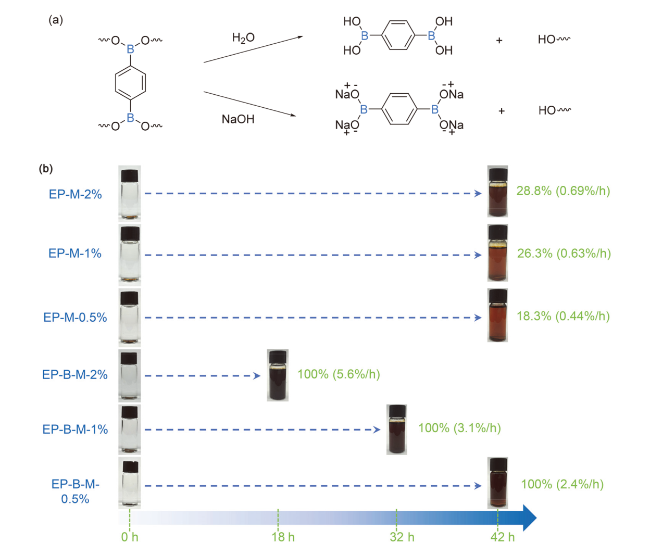
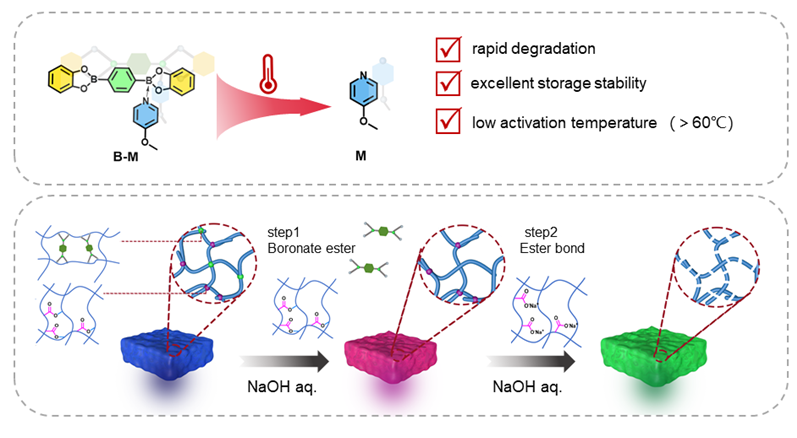
本研究通过硼酸酯与吡啶之间的配位作用,制备了B-N配合物(B-M)作为潜伏性固化促进剂,用于单组分环氧树脂,兼顾室温储存稳定性与交联网络高效降解。吡啶N的孤对电子与B空轨道配位,在室温下能够抑制吡啶N的固化促进作用;中高温时B-N键解离,释放活性吡啶N促进环氧固化。此外,硼酸酯参与固化反应,其在碱性条件下的快速水解特性显著提升了交联网络的降解效率。实验表明:21天室温储存后,实验组EP-B-M-0.5%前驱体固化度仅12.2%,80 ℃粘度增幅仅0.05 Pa·s,而对照组EP-M-0.5%固化度达70.8%且完全硬化;储存前后,EP-B-M-0.5%拉伸强度提升7.6%,Tg提升2.2%,性能保持稳定;在1 mol/L NaOH中,EP-B-M-0.5%的降解速率较EP-M-0.5%提升了4.5倍。该策略对环氧树脂加工技术及可持续材料发展具有重要借鉴意义。

本文引用格式

Sun Xiaoran , Liu Ziyu , Liu Jingkai , Liu , Xiaoqing . 基于B-N配位的潜伏固化与高效降解环氧体系[J]. 化学学报, 0 : 26060207 -26060207 . DOI: 10.6023/A26060207

Abstract

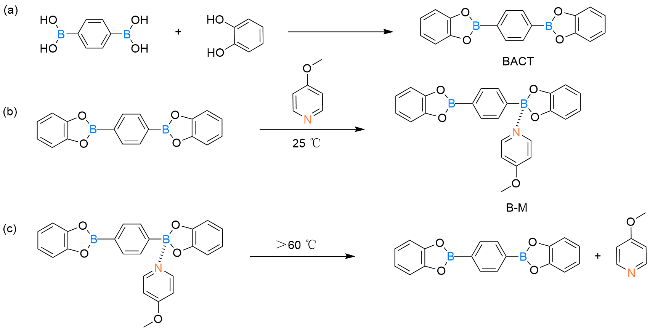
In this study, the bifunctional phenylboronic ester (BACT) was synthesized via a dehydrative condensation reaction between 1,4-benzenediboronic acid and catechol. Subsequently, a thermally reversible B-N coordinated complex (B-M) was prepared through the coordination of BACT with 4-methoxypyridine, which was then employed as a latent curing accelerator for the one-component epoxy/anhydride system (E-51/MTHPA). This molecular design strategically imparts two pivotal functionalities to the formulated resin: exceptional storage stability at room temperature (25 ℃) and markedly enhanced degradability of the crosslinked thermoset network upon exposure to alkaline conditions. Specifically, at ambient temperature, the lone-pair electrons of the pyridinic N coordinate with the vacant p-orbital of the B, forming a dative B-N bond that effectively sequesters the nucleophilic catalytic activity of the pyridine moiety. This coordination temporarily suppresses its ability to initiate the epoxy/anhydride system curing reaction, thereby ensuring prolonged storage life. Upon heating to medium-high temperatures (exceeding 60 ℃), the reversible B-N dative bond undergoes thermally induced dissociation, regenerating the active 4-methoxypyridine species to efficiently promote the curing reaction. Concurrently, beyond its role as a reversible protecting group for the catalyst, the BACT actively participates in the curing process with the epoxy/anhydride system, resulting in the covalent incorporation of more easily hydrolyzable borate ester linkages into the crosslinked network. The introduction of these dynamic covalent bonds significantly facilitates network degradation, as their rapid cleavage under alkaline conditions. The experimental results robustly corroborate this dual functionality. Notably, after 21 days of storage at room temperature, the experimental group (EP-B-M-0.5%) exhibited a remarkably low curing conversion of only 12.2%, along with a minimal increase in viscosity of just 0.05 Pa·s@80 ℃. In sharp contrast, the control group (EP-M-0.5%) reached a conversion of 70.8% and became fully hardened within the identical storage period, underscoring the critical role of B-N coordination in extending the usable working window. Furthermore, the mechanical and thermomechanical properties of EP-B-M-0.5% remained highly stable throughout the storage period; the tensile strength and glass transition temperature (Tg) showed only marginal variations of +7.6% and +2.2%, respectively, suggesting negligible post-curing or structural alteration during storage. In accelerated degradation tests conducted in a 1 mol/L NaOH aqueous solution, the fully cured EP-B-M-0.5% network demonstrated a degradation rate 4.5 times higher than that of the control EP-M-0.5% sample, unequivocally demonstrating the efficacy of incorporating borate ester junctions in promoting rapid hydrolytic decomposition of the thermoset. Overall, this work offers a promising and operationally simple approach for advancing the processing technology of high-performance epoxy resins while aligning with the principles of green and recyclable material development.

参考文献

[1] Hou B.; Lan T.; Zu L.; Dong S.; Xu L. Polym. Bull.2025, 82, 11323.
[2] Wang X.; Li F.; Jing C.; Yang S.; Du S.; Zhang F.; Ma, S. Sci. China. Chem.2025, 68, 4529.
[3] Zeng, K.; Deng, Y.; Zhou, L.; Zhou, X.; Yu, C.; Insulating Materials 10.16790/j.cnki.1009-9239.im.2026.07.003 (in Chinese). (曾昆, 邓莹, 周鲁直, 周学翔, 余传柏, 绝缘材料, 10.16790/j.cnki.1009-9239.im.2026.07.003.)
[4] Lv, K.; Feng, Y.; Yin, H. Materials Research and Application 2025, 19, 136 (in Chinese). (吕锟, 冯玉军, 殷鸿尧, 材料研究与应用, 2025, 19, 136.)
[5] Huang, T.; Li, Y.; Feng, J.; Huang, Z.; Liu, Q.; Wu, Y. Acta Materiae Compositae Sinica 10.13801/j.cnki.fhclxb.20260610.004 (in Chinese). (黄天龙, 李运潮, 冯健, 黄增彪, 刘潜发, 巫运辉, 复合材料学报, 10.13801/j.cnki.fhclxb.20260610.004.)
[6] Cheng J.; Wang J.; Yang S.; Zhang Q.; Huo S.; Zhang Q.; Hu Y.; Ding, G. Compos. Part B-Eng.2019, 177, 107440.
[7] Kudo K.; Furutani M.; Arimitsu, K. J. Polym. Sci., Polym. Chem.2018, 56, 471.
[8] Arimitsu K.; Fuse S.; Kudo K.; Furutani M. Mater. Lett.2015, 161, 408.
[9] Zhang Q.; Wang J.; Yang S.; Cheng J.; Ding G.; Huo, S. Compos. Part B-Eng.2019, 177, 107380.
[10] Yang S.; Huo S.; Wang J.; Zhang B.; Wang J.; Ran S.; Fang Z.; Song P.; Wang, H. Compos. Part B-Eng.2021, 207, 108601.
[11] Lei D.; Ma W.; Wang L.; Zhang, D. J. Appl. Polym. Sci.2015, 132, 42563.
[12] Shi K.; Shen Y.; Yang Y.; Wang, T. J. Appl. Polym. Sci.2020, 138, e49730.
[13] Sun, X.; Gou, H.; Zhou, Y.; Wei, W.; Li, X.; Liu, X. Thermosetting Resin 2022, 37, 6 (in Chinese). (孙鑫, 苟浩澜, 周洋龙, 魏玮, 李小杰, 刘晓亚, 热固性树脂, 2022, 37, 6.)
[14] Jung S.; Kim Y. S.; Jang H. G.; Park J. H.; Park M.; Choi Y. S.; Kim, J. ACS Appl. Polym. Mater.2022, 4, 6111.
[15] Li C.; Tan J.; Gu J.; Xue Y.; Qiao L.; Zhang, Q. Compos. Sci. Technol.2017, 142, 198.
[16] Zhao M.; Li X.-M.; Gao J. Polymer2025, 317, 127924.
[17] Zhang B.; Ma A.; Li J.; Xiao S.; Li C.; Zhao W.; Zhang G.; Zhang, H. J. Mater. Sci.2022, 57, 16541.
[18] Wang J.; Wang J.; Yang S.; Xu R.; Ding G.; Liu W.; Sun J.; Chen K.; Duan L.; Zhou G.; Liu X.; Huo, S. Polym. Degrad. Stab.2025, 239, 111383.
[19] Wang J.; Wang J.; Yang S.; Chen, K. Compos. Part B-Eng.2023, 253, 110571.
[20] Yang B.; Mao Y.; Zhang Y.; Bian G.; Zhang L.; Wei Y.; Jiang Q.; Qiu Y.; Liu W. Polymer2019, 178, 121586.
[21] Yu Z.; Ma S.; Liu Y.; Su Y.; Feng H.; Li P.; Dong Y.; Tang Z.; Zhang K.; Zhu, J. Eur. Polym. J.2022, 164, 110965.
[22] Xu Y.; Shi X.; Lu J.; Qi M.; Guo D.; Chen L.; Wang, Y. Compos. Part B-Eng.2020, 184, 107673.
[23] Wang J.; Wang J.; Yang S.; Chen X.; Chen K.; Zhou G.; Liu X.; Xu L.; Huo S.; Song P.; Wang, H. Chem. Eng. J.2024, 485, 149852.
[24] Wang J.; Chen X.; Wang J.; Yang S.; Chen K.; Zhu L.; Huo S.; Song P.; Wang, H. Polym. Degrad. Stab.2023, 208, 110261.
[25] Li H.; Li Y. Q.; You Y.; Xie, H. B. ACS Macro Lett.2024, 13, 775.
[26] Liu, W. Composites Science and Engineering 10.19936/j.cnki.2096-8000.20260428.009 (in Chinese). (刘伟, 复合材料科学与工程, 10.19936/j.cnki.2096-8000.20260428.009.)
[27] Li F.; Wang Y.; Wang Q.; Wang B.; Du S.; Zhang F.; Ma S. Macromolecules2024, 57, 9950.
[28] Wang L.; Chang Y.; Zhang Y.; Gao C.; Wang G.; Jing X.; Wang S. Chem. Mater.2026, 38, 4128.
[29] Jing C.; Peng Y.; Wang X.; Zhang F.; Ma S. Macromolecules2025, 58, 9064.
[30] Liu, J.; Wang, L. Acta Polymerica Sinica 2017, 12, 12 (in Chinese). (刘俊, 王利祥, 高分子学报, 2017, 12, 12.)
[31] Liu, R.; Meng, B.; Hu, J.; Liu, J. Acta Chimica Sinica 2023, 81, 1295 (in Chinese). (刘蕊, 孟彬, 胡俊丽, 刘俊, 化学学报, 2023, 81, 1295.)
[32] Wang J.; You W.; Chen Li.; Xiao D.; Xiao X.; Shan T.; Liu Y.; Liu M.; Li G.; Yu W.; Huang, F. Angew. Chem. Int. Ed.2024, 63, e202405761.
[33] Sheepwash E.; Luisier N.; Krause M. R.; Noe S.; Kubik S.; Severin K. Chem. Commun.2012, 48, 7808.
[34] Zhai, D.; Gao, J.; Tian, Q.; Jiang, C. Journal of Hebei University (Natural Science Edition) 2008, 28, 3 (in Chinese). (翟丁, 高俊刚, 田庆, 蒋超杰, 河北大学学报(自然科学版), 2008, 28, 3.)
[35] Xu C.; He C.; Dong J.; Yun J.; Yang S.; Du Y.; Xie Z.; Dong X.; Li Z.; Matyjaszewski K.; Pan X. Nat. Commun.2026, 10.1038/s41467-026-73149-2.
[36] Smith R. E.; Smith, C. H. J. Appl. Polym. Sci.1986, 31, 929.
[37] Daelman B.; Debuyck J.; Scholiers V.; Winne J. M.; Du Prez, F. E. Angew. Chem. Int. Ed.2025, 65, e19828.
[38] Li, Y.; Shen, X.; Yang, S.; Wang, X.; Shan, S. Shanghai Plastics 2026, 54, 33 (in Chinese). (李亚群, 沈兰晓, 杨舒婷, 王祥, 单士常, 上海塑料, 2026, 54, 33.)
[39] Chen Li.; Wang Y. Macromolecules2024, 57, 9498.
[40] Cai, C.; Li, C.; Zhang, Q.; Liu, Y.; Yu, R.; Li, X.; Wei, Z. Plastics Science and Technology 2023, 51, 60 (in Chinese). (蔡程帆, 李超群, 张奇, 刘一帆, 于人同, 李雄, 魏忠正, 塑料科技, 2023, 51, 60.)
[41] Wang M.; Liu Z.; Wang T.; Ma J.; Cheng J.; Liu X.; Zhang, J. Chem. Eng. J.2025, 510, 161661.
[42] Sun X.; Zhang Y.; Wang Y.; Niu M.; Liu Z.; Liu J.; Liu, X. Eur Polym J.2026, 250, 114713.
[43] Zhen, X.; Wu, Y.; Liu, H.; Gao, Z.; Du, G. Materials Reports 2025, 39, 72 (in Chinese). (郑新蕾, 吴艳玲, 刘赫, 高展瑶, 杜根行, 材料导报, 2025, 39, 72.)
[44] Liu, J.; Dai, J.; Wang, S.; Liu, X. Scientia Sinica Chimica 2026, 56, 61 (in Chinese). (刘敬楷, 代金月, 王帅朋, 刘小青, 中国科学:化学, 2026, 56, 61.)
[45] Yao, Y.; Xiao, H.; Yan, C.; Sha, Q.; Su, Z. Composites Science and Engineering 10. 19936 / j. cnki. 2096–8000. 20260628. 016 (in Chinese). (姚亚琳, 肖洪晴, 闫冲冲, 沙骑骑, 苏志强, 复合材料科学与工程, 10. 19936/j.cnki.2096–8000. 20260628. 016.)
[46] Du B.; Mi H.; Du Y.; Li Q.; Wang Y.; Kong, X. Chem. Eng. J.2026, 529, 173029.
文章导航

/