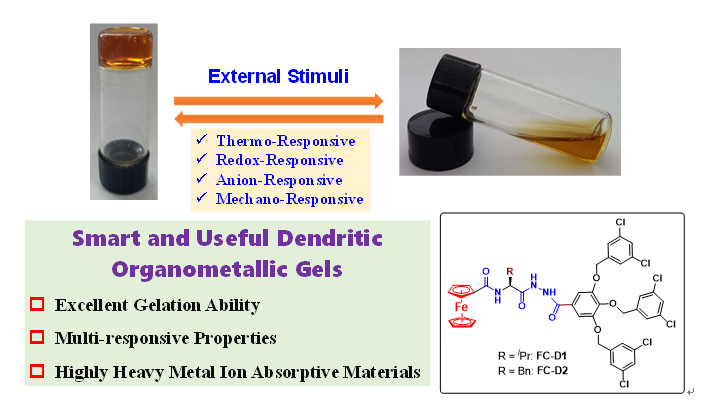
当前,开发兼具多重刺激响应性与重金属吸附性能的超分子凝胶仍面临挑战,其难点在于传统凝胶功能单一、协同效应不足,难以实现多种功能的有效集成。为此,本文设计并合成了两种新型二茂铁基聚苄醚树状分子有机金属凝胶(分别命名为FC-D1和FC-D2),以酰胺/酰肼键为连接单元,并对其结构进行了系统表征。研究结果表明,这两种凝胶在多种纯溶剂及混合溶剂中均展现出优良的成胶能力,能够在极低的临界凝胶浓度下构建出稳定性突出的有机金属凝胶体系。通过红外光谱和核磁共振氢谱对成胶机理的研究表明,凝胶的自组装主要依赖于酰腙与酰胺结构之间的分子间氢键作用,以及树状分子中多重芳环的π-π堆积作用,二者协同驱动组装过程。该有机金属凝胶体系具有优异且稳定的多重刺激响应性能,在温度变化、氧化还原(CAN/GSH体系)、化学(氟离子)及触变作用等条件下,均可实现凝胶与溶胶的可逆转变。在此基础上,进一步考察了FC-D1树枝状分子对重金属离子的吸附效果,结果显示该凝胶对水中的汞离子、铅离子和镉离子均具有良好的吸附能力,吸附率分别达到72%、51%和73%。同时,经四次连续吸附-脱附循环后,该凝胶体系仍能保持稳定的重金属吸附性能,表明其循环使用性良好。本研究为多功能树状分子有机金属凝胶的结构设计与可控合成提供了新思路和新策略,有望推动该类材料在智能传感和重金属废水治理领域的实际应用。
Developing supramolecular gels that effectively integrate multi-stimuli responsiveness with high-performance heavy metal adsorption remains a significant challenge, primarily due to the limited functionality and weak synergistic effects of conventional gelators. To address this issue, we have designed and synthesized two novel ferrocene-cored poly(aryl ether) dendritic organometallic gelators, designated as FC-D1 and FC-D2, which are functionalized with amide and acylhydrazide linkages. The chemical structures of both gelators were thoroughly characterized using standard spectroscopic techniques. Our experimental results demonstrate that both FC-D1 and FC-D2 exhibit outstanding gelation ability across a broad spectrum of pure organic solvents and binary solvent mixtures, forming highly stable organogels at remarkably low critical gelation concentrations (CGC). Mechanistic investigations employing Fourier-transform infrared (FT-IR) spectroscopy and variable-concentration proton nuclear magnetic resonance (¹H NMR) spectroscopy reveal that the self-assembly process is synergistically driven by two key non-covalent interactions: intermolecular hydrogen bonding originating from the acylhydrazone and amide moieties, and π-π stacking interactions among the aromatic rings of the dendritic branches. This cooperative assembly leads to the formation of robust three-dimensional network structures. The resulting metallogels exhibit excellent and reversible multi-stimuli-responsive properties, enabling reliable gel-to-sol transitions upon exposure to various external stimuli, including temperature changes, redox reactions (using ceric ammonium nitrate (CAN) and glutathione (GSH) as an oxidizing/reducing pair), chemical triggers (specifically fluoride ions), and mechanical thixotropic stimuli. Beyond their stimuli-responsive behavior, we also evaluated the potential of the FC-D1 dendron as an effective and recyclable adsorbent for the removal of toxic heavy metal ions from aqueous environments. The results show that FC-D1 achieves impressive removal efficiencies of 72%, 51%, and 73% for Hg2+, Pb2+, and Cd2+, respectively. Furthermore, the gel system maintains stable adsorption performance over four consecutive adsorption-desorption cycles, demonstrating good reusability. Overall, this work not only provides a new and effective molecular design strategy for constructing multifunctional dendritic organometallic gels but also significantly expands their potential applications in the fields of intelligent sensing and heavy metal wastewater remediation.
[1] Weiss R. G.Molecular gels: structure and dynamics.Royal Society of Chemistry, 2018.
[2] Jiao T.Supramolecular gels: materials and emerging applications. Wiley-VCH: Weinheim, Germany, 2022.
[3] Zhang J.; Hu Y.; Li Y. G.Gel chemistry: interactions, structures and properties.Springer: Singapore, 2018.
[4] Babu S. S.; Praveen V. K.; Ajayaghosh A.Chem. Rev. 2014, 114, 1973.
[5] Adams, D. J. J. Am. Chem. Soc.2022, 114, 11047.
[6] Zhang H.; Zhang H. K.; Feng Y. Supramol. Mater.2026, 5, 100124.
[7] Shao M.; Tian Y.; Wang J.; Miao R.; Fang Y.Acta Chim. Sinica 2026, 84, 484.
[8] Dastidar P.; Ganguly S.; Sarkar, K. Chem. Asian J.2016, 11, 2484.
[9] Tam Y.-Y.; Yam, V. W.-W. Chem. Soc. Rev.2013, 42, 1540.
[10] Wu H.; Zheng J.; Kjøniksen A.-L.; Wang W.; Zhang Y.; Ma J. Adv. Mater.2019, 31, 1806204.
[11] Kuosmanen R.; Rissanen K.; Sievänen E.Chem. Soc. Rev. 2020, 49, 1977.
[12] Alam N.; Mondal S.; Sarma, D. Coord. Chem. Rev.2024, 504, 215673.
[13] Fan W.; Chen L.; Yang, H. Chin. J. Org. Chem.2015, 35, 578.
[14] Liu Z.; Zhao X.; Chu Q.; Feng Y. Molecules2023, 28, 2274.
[15] Biradha K.; Das Dawn M.; Sultana S.; Paul, P. Coord. Chem. Rev.2026, 552, 217513.
[16] Liu Z.; Hou Y.; Zhang C.; Yang H.; Zhang M.; Feng, Y. Sci. Sin. Chim.2026, 56, 2214.
[17] Mahmoodi-Babolan N.; Nematollahzadeh A.; Shafiei, S. Coord. Chem. Rev.2026, 562, 217959.
[18] Wang X.; Wang Y.; Chen L.; Xie X. F.; Sun, J. Chem. Eng. J.2024, 499, 156241.
[19] Sui J.; Wang L.; Zhao W.; Hao J. Chem. Commun.2016, 52, 6993.
[20] Tchounwou P. B.; Ayensu W. K.; Ninashvili N.; Sutton D. Environ. Toxicol.2003, 18, 149.
[21] Riaz M.; Kamran M.; Fang Y.; Wang Q.; Cao H.; Yang G.; Deng L.; Wang Y.; Zhou Y.; Anastopoulos I.; Wang, X. J. Hazard. Mater.2021, 402, 123919.
[22] Cheng Q.; Zhang J.; Dai B.-Y.; Wang X.-Y.; Ji G.-Z.; Zhao, Y.-F. Comp. Biochem. Physiol. C2026, 299, 110346.
[23] Li J.; Wang X. X.; Zhao G.X.; Chen C. L.; Chai Z. F.; Alsaedi A.; Hayat T.; Wang, X. K. Chem. Soc. Rev.2018, 47, 2322.
[24] Das R.; Vecitis C.D.; Schulze A.; Cao B.; Ismail A. F.; Lu X.; Chen J.; Ramakrishna, S. Chem. Soc. Rev.2017, 46, 6946.
[25] Li X.; Bian C.; Meng X.; Xiao, F. J. Mater. Chem. A2016, 4, 5999.
[26] Wu Z.; Zhao D. Chem. Commun.2011, 47, 3332.
[27] Khajeh M.; Laurent S.; Dastafkan K. Chem. Rev.2013, 113, 7728.
[28] Wang S.; Yan Q.; Yang J.; Hu H.; Xiao S.; Gao Y.Green Energy Environ. 2025,10, 1235.
[29] Okesola B. O.; Smith, D. K. Chem. Soc. Rev.2016, 45, 4226.
[30] Muya F. N.; Sunday C. E.; Baker P.; Iwuoha, E. Water Sci. Technol.2016, 73, 983.
[31] Perumal S.; Atchudan R.; Edison T. N. J. I.; Babu R. S.; Karpagavinayagam P.; Vedhi C. Metals2021, 11, 864.
[32] Liu Z.; Zhang M.; Yang H.; Zhang C.; Hou Y.; Wang J.; Fei P.; Feng F.; Feng Y. Molecules2026, 31, 957.
[33] Feng Y.; He Y. M.; Fan, Q. H. Chem. Asian J.2014, 9, 1724.
[34] Feng Y.; Liu Z. X.; Chen H.; Fan, Q. H. Chem. Commun.2022, 58, 8736.
[35] Liu Z. X.; Chu Q.; Feng, Y. Acta Chim. Sinica2022, 80, 1424.
[36] Zhang H.; Fu D. Q.; Zhang H. K.; Feng, Y. Sci. Sin. Chim.2026, 56, 2259.
[37] Liu Z. X.; Feng Y.; Zhao Z. Y.; Yan Z. C.; He Y. M.; Luo X. J.; Liu C. Y.; Fan, Q. H. Chem. Eur. J.2014, 20, 533.
[38] Lakshmi N. V.; Mandal D.; Ghosh S.; Prasad, E. Chem. Eur. J.2014, 20, 9002.
[39] Jiang B.; Kong L.; Cheng X.; He M.; Zhang H.; Feng, Y. Chem. Asian J.2025, 20, e00426.
[40] Chen H.; Feng Y.; Deng G. J.; Liu Z.X.; He Y. M.; Fan, Q. H. Chem. Eur. J.2015, 21, 11018.
[41] Liu Z. X.; Sun Y.; Feng Y.; Chen H.; He Y. M.; Fan, Q. H. Chem. Commun.2016, 52, 2269.
[42] Kong L.-J.; Fu D.-Q.; Zhang H.; Luo R.; Zhang H.; Feng Y. Langmuir2026, 42, 7861.
[43] Fu D. Q.; Kong L. J.; Wu L. F.; Peng Z.; Zhang H. K.; Yi N.; Yi B.; Feng Y. Langmuir2026, 42, 13651.
[44] Fu D. Q.; Kong L. J.; Wang Q. Y.; Zhang H. K.; Feng, Y. J. Colloid Interface Sci.2026, 702, 138798.
[45] Wu L. F.; Li H. J.; Zhang T.; Tan J. P.; Sun Y. X.; Zhang H. K.; Feng, Y. J. Colloid Interface Sci.2026, 719, 140638.
[46] Rajamalli P.; Prasad E. Org. Lett.2011, 13, 3714.
[47] Liu J.; Feng Y.; Liu Z. X.; Yan Z.-C.; He Y.-M.; Liu C.-Y.; Fan, Q. H. Chem. Asian J.2013, 8, 572.
[48] Sui X.; Feng X.; Hempenius M. A.; Vancso, G. J. J. Mater. Chem. B2013, 1, 1658.
[49] Liu X.; Zhao L.; Liu F.; Astruc D.; Gu, H. Coord. Chem. Rev.2020, 419, 213406.
[50] Matsui H.; Morimoto M.; Horimoto K.; Nishimura, Y. Toxicol. in Vitro2007, 21, 1113.
[51] Barbier O.; Arreola-Mendoza L.; Del Razo, L. M. Chem. Biol. Interact.2010, 188, 319.
[52] Chakraborty, S. Results Chem. 2023, 6, 100994.
[53] Dutta S.; Sahana A. Anal. Methods2024, 16, 344.
[54] Cao X.; Gao A.; Hou J.; Yi, T. Coord. Chem. Rev.2021, 434, 213792.
[55] Percec V.; Peterca M.; Yurchenko M. E.; Rudick J. G.; Heiney, P. A. Chem. Eur. J.2008, 14, 909.
[56] Feng Y.; Liu Z. X.; Chen H.; Yan Z.-C.; He Y. M.; Liu C. Y.; Fan, Q. H. Chem. Eur. J.2014, 20, 7069.
[57] Liu Z. X.; Feng Y.; Yan Z. C.; He Y. M.; Liu C. Y.; Fan, Q. H. Chem. Mater.2012, 24, 3751.
[58] Zhang H. K.; Wu L. F.; Kong L. J.; Feng Y. Langmuir2026, 42, 22092.
[59] Zhang H. K.; Deng S. T.; Wu L. F.; Qiu H.; Feng, Y. Adv. Opt. Mater.2026, 14, e71543.
[60] Cheng X.; He M.; Wang Q.; Xiao Y.; Huo J.; Zhang H.; Feng Y. Langmuir2025, 41, 18257.


