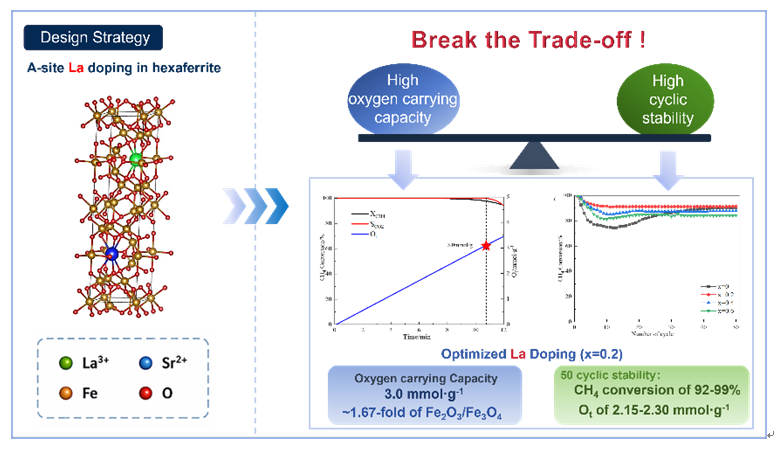
甲烷化学链燃烧是一种新兴的低碳燃烧技术,其利用固体载氧体进行“氧”传递与循环,将传统燃料燃烧过程进行时空解耦,具有内在CO2分离、近零NOₓ排放等显著优势。针对铁基载氧体高载氧量与高循环稳定性的“跷跷板”效应,本文以高铁容量六铁酸盐结构为基础,采用A位掺杂调控策略构筑了LaxSr1-xFe12O19载氧体。结果表明,适量La掺杂(x = 0.2)载氧体在100% CO2选择性下,出氧量高达3.0 mmol·g-1,约为Fe2O3/Fe3O4理论值的1.67倍;经50次循环后,CH4转化率仍维持在92%~99%,兼顾了高载氧量与高循环稳定性。表征结果揭示,La掺杂可以抑制SrFe2O5杂相生成,促使载氧体生成低价态的Sr4Fe6O12,增强可逆再生能力与抗烧结性能。A位La掺杂调控六铁酸盐结构演变为破解铁基载氧体“跷跷板”效应提供了有效途径。
贾欣瑶
,
周裕梅
,
宋哲
,
赵培杰
,
王若涵
,
丁义浩
,
任朔元
,
朱燕燕
. La诱导六铁酸盐结构演变及其甲烷化学链燃烧性能研究[J]. 化学学报, 0
: 2
-2
.
DOI: 10.6023/A26040136
Chemical looping combustion of methane, as an emerging low-carbon combustion technology, employs solid oxygen carriers to transfer oxygen between the fuel reactor and the air reactor, enabling the temporal and spatial separation of the conventional fuel combustion process without the direct contact between fuel and air. This technology offers significant advantages such as inherent CO2 separation and near-zero NOx emissions, making it an important technological pathway for achieving carbon neutrality. As the medium for oxygen transfer, oxygen carriers are cyclically transported between the fuel reactor and the air reactor, where their oxygen carrying capacity and cyclic stability are critical. Iron-based oxygen carriers have attracted extensive attention due to their low cost and environmental friendliness. This paper proposes a strategy that utilizes both the high iron capacity characteristics of hexaferrites (AFe12O19) structure and A-site cation regulation to overcome the performance bottlenecks of conventional iron-based oxygen carriers. In this work, a series of La-doped LaxSr1-xFe12O19 (x = 0, 0.2, 0.4, and 0.6) oxygen carriers were synthesized via a coprecipitation method, and the effects of La substitution on phase structure, lattice oxygen mobility, redox activity, and cyclic stability were systematically investigated. The results of fixed-bed reactor evaluation show that, the oxygen carrier with an appropriate La doping (x = 0.2) achieves an Ot as high as 3.0 mmol g-1 while maintaining 100% CO2 selectivity, which is approximately 1.67 times the theoretical Ot of Fe2O3/Fe3O4 redox pair. After 50 redox cycles, the CH4 conversion remains between 92% and 99%, and the Ot is maintained at 2.13 mmol·g-1~2.30 mmol·g-1, achieving both high Ot and high cyclic stability. Characterization results including XRD, BET, H2-TPR, SEM, and XPS reveal that, the overall performance of the oxygen carriers was enhanced by La doping through the following mechanisms: (1) suppressing the formation of the SrFe2O5 impurity phase, increasing the specific surface area from 4.2 m2·g-1 to 6.2 m2·g-1~6.9 m2·g-1, and promoting lattice oxygen mobility; (2) altering the structural evolution pathway during reduction, thereby promoting the preferential formation of low-valence Sr4Fe6O12 with an average Fe valence state of +2.67, which breaks through the redox window limitation of the conventional Fe2O3/Fe3O4 system; and (3) enhancing the reversible regeneration capability and sintering resistance of the hexaferrite structure, thus enabling the Fe species to recover to a near-initial state even after 50 redox cycles. This study demonstrate that A-site La doping to regulate the structural evolution of hexaferrites provides an effective strategy to overcome the trade-off effect in iron-based oxygen carriers, which paves the way for rational design of high-performance iron-based oxygen carriers.
[1] Erlach B.; Schmidt M.; Tsatsaronis G. Energy 2011, 6, 3804-3815.
[2] Lyngfelt A.; Brink A.; Langørgen Ø.; Mattisson T.; Rydén M.; Linderholm C. Int.[J]. Greenh. Gas. Con. 2019, 88, 38-56.
[3] Obara, S. y. Energy 2023, 262, 125403.
[4] Qasim M.; Ayoub M.; Ghazali N. A.; Aqsha A.; Ameen M. Ind. Eng. Chem. Res. 2021, 24, 8621-8641.
[5] Zeng L.; Cheng Z.; Fan J. A.; Fan L.-S.; Gong J. Nat. Rev. Chem. 2018, 11, 349-364.
[6] Güleç F.; Okolie J. A. Environ. Chem. Lett. 2024, 1, 121-147.
[7] Li X.; Li J.; Wang L.; Liu L.; Lin Y.; Teng S.; Song Y.; Zeng D.; Qiu Y. Chem. Eng. J. 2026, 532, 174530.
[8] Fan L.-S.; Zeng L.; Luo S.AlChE J. 2015, 1, 2-22.
[9] Tang M.; Xu L.; Fan M. Appl. Energy 2015, 151, 143-156.
[10] Sun Z.; Russell C. K.; Whitty K. J.; Eddings E. G.; Dai J.; Zhang Y.; Fan M.; Sun Z. Prog.Energy Combust. Sci. 2023, 96, 101045.
[11] Hu J.; Galvita V. V.; Poelman H.; Marin G. B. Materials 2018, 7, 1187.
[12] Li F.; Sun Z.; Luo S.; Fan L.-S.Energy Environ. Sci. 2011, 3, 876-880.
[13] Cao Y.; Liu F.; Song C.; Yang L.; Zhai C. Chem. Eng. J. 2024, 480, 148285.
[14] Qiu Y.; Zeng D.; Xiao R. Energy Fuels 2024, 15, 13819-13836.
[15] Li R.; Du X.; Feng X.; Wang J.; Ta N.; Fu Q.; Bao X. Chin.[J]. Catal. 2026, 82, 327-336.
[16] Fang Y.; Liu Y.; Li Z.; Pan Y.; Liu Q.; Jin H. Appl. Energy 2026, 415, 127918.
[17] Rubel A. M.; Zhang Y.; Neathery J. K.; Liu K. Energy Fuels 2011, 10, 4271-4279.
[18] Qin L.; Cheng Z.; Guo M.; Xu M.; Fan J. A.; Fan, L.-S. ACS Energy Lett. 2017, 1, 70-74.
[19] Qin L.; Guo M.; Cheng Z.; Xu M.; Liu Y.; Xu D.; Fan J. A.; Fan L.-S.J. Mater. Chem. A 2017, 38, 20153-20160.
[20] Zong T.; Zhu X.; Tian M.; Wang C.; Wang N.; Yang J.; Liu S.; Wang X. J.Energy Chem. 2026, 116, 399-408.
[21] Wen L.; Li Z.; Chen N.; Yuan J.; Li Y.; Jiang L.; Wang H.; Li K.Green Energy Environ. 2026.
[22] Huang F.; Tian M.; Zhu Y.; Wang X.; Wang A.; Li L.; Lin J.; Wang J. J.Energy Chem. 2019, 29, 50-57.
[23] Galinsky N. L.; Huang Y.; Shafiefarhood A.; Li F.ACS Sustain Chem Eng. 2013, 3, 364-373.
[24] Aihara T.; Aoki W.; Ishikawa S.; Bae S.; Kiyohara S.; Kumagai Y.; Hara M.; Kamata K. ACS Appl.Nano Mater. 2025, 32, 15988-15998.
[25] Ha J.; Kim H. S.; Kim H.; Kim Y.; Asih S. A.N.; Lee, J. W. ChemSusChem 2025, 24, e202501667.
[26] Ma Z.; Liu G.; Lu Y.; Wang J.; Zhang H.Fuel Process. Technol. 2021, 224, 107030.
[27] Wang M.; Li W.; Wang S.; Shi Z. Langmuir 2023, 1, 285-294.
[28] Dai X.; Cheng J.; Li Z.; Liu M.; Ma Y.; Zhang X. Chem. Eng. Sci. 2016, 153, 236-245.
[29] He F.; Zhao K.; Huang Z.; Li, X. a.; Wei, G.; Li, H. Chin. [J]. Catal. 2013, 6, 1242-1249.
[30] Torrez-Herrera, J. J.; Korili, S. A.; Gil, A. Catal. Rev. Sci. Eng. 2022, 3, 592-630.
[31] Utsis N.; Landau M. V.; Erenburg A.; Herskowitz M. Catalysts 2020, 9, 1082.
[32] Kumar S.; Bastien G.; Colman R. H.; Savinov M.; Proschek P.; Vališka M.; Kempiński M.; Kempiński W.; Śliwińska-Bartkowiak, M.; Kamba, S. [J]. Alloy. Compd. 2026, 187535.
[33] Ha J.; Kim H. S.; Kim H.; Kim Y.; Asih S. A.N.; Lee, J. W. ChemSusChem 2025, 24, e202501667.
[34] Xia Y.; Pu G.; Wu J.; Yang Q.; Zhou R.; Wang J.; Gao J. J. Environ. Chem. Eng. 2025, 3, 116425.
[35] Zhu Y.; Zhou Y.; Chen L.; Zhu H.; Chen H.; Liu R.; He J.; Yang Q.; Hu J.; Huang C.; Wang X.AlChE J. 2025, 12, e70100.
[36] Kim T. K.; Kang M.; Choi Y. S.; Kim H. K.; Lee W.; Chang H.; Seung D. J. Power Sources 2007, 1, 1-8.
[37] Wang P.; Hong Q.; Shen L.; Song T. Energy Fuels 2022, 24, 15037-15046.
[38] Zhang S.; Feng Y.; Guo X. Energy Fuels 2021, 1, 626-635.
[39] Kang Y.; Tian M.; Wang Y.; Wang Y.; Huang C.; Zhu Y.; Li L.; Wang G.; Wang X. ACS Sustainable Chem.Eng. 2018, 10, 12884-12892.
[40] Tian M.; Wang C.; Li L.; Wang X.AlChE J. 2017, 7, 2827-2838.
[41] Deng G.; Li K.; Zhang G.; Gu Z.; Zhu X.; Wei Y.; Wang H. Appl. Energy 2019, 253, 113534.
[42] 张善超, 张. 王. 梁. 杨. 杨. 苏. 马. 朱. 化工进展 2025, 10, 5703-5716.
[43] He J.; Wang T.; Bi X.; Tian Y.; Huang C.; Xu W.; Hu Y.; Wang Z.; Jiang B.; Gao Y.; Zhu Y.; Wang X. Nat.Commun. 2024, 1, 5422.
[44] Song Z.; Hong J.; Yang Q.; Huang C.; Shao M.; Wang Z.; Su W.; Yang G.; Jiang B.; Zhu Y. Chem. Eng. J. 2025, 511, 162225.


