神经胶质瘤是常见的原发性脑肿瘤,其临床药物治疗面临血脑屏障穿透性差和耐药性高的双重挑战。多肽药物偶联物(PDC)通过多肽靶向实现药物精准递送,其中双功能性多肽兼具穿透和靶向能力,有望解决上述临床问题。本研究设计并合成了一系列以Nestin蛋白为靶点的双功能性多肽NTP及其类似物,并将其与替莫唑胺偶联形成PDC化合物,系统评价其蛋白靶向性、体外抗胶质瘤活性及血脑屏障穿透性。结果显示,将NTP序列中的Asn残基替换成丙氨酸的化合物对U87细胞的抑制作用最优,IC50值约为24μM,且表现出良好的血脑屏障穿透性。这一发现为后续结构优化提供了参考,并为克服胶质瘤治疗难题提供了新的策略。
戴志成
,
郝建博
,
刘琪
,
官瑞丽
,
王少华
. 抗神经胶质瘤多肽药物偶联物的设计、合成及活性研究★[J]. 化学学报, 0
: 26060212
-26060212
.
DOI: 10.6023/A26060212
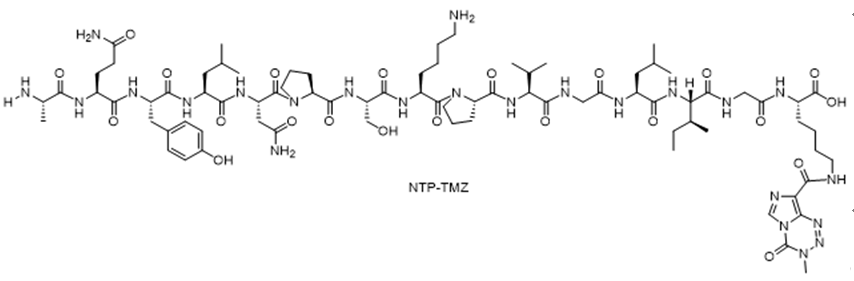
Glioma is a highly malignant primary brain tumor, with glioblastoma (GBM) exhibiting the highest incidence and a recurrence rate near 100%, imposing severe economic and clinical burdens. Its clinical treatment is severely limited by poor blood-brain barrier (BBB) permeability and high multidrug resistance. To address these challenges, peptide-drug conjugates (PDCs) provide a promising strategy by pairing small-molecule drugs with targeting or cell-penetrating peptides to achieve precise delivery. In this study, a novel Nestin-targeting peptide (NTP) was designed by combining a GSCT peptide (AQYLNPS) that specifically binds to Nestin—a marker highly expressed in glioma stem cells—with a matrix metalloproteinase (MMP)-2/9 sensitive cleavage linker (PVGLIG) and a lysine residue providing a covalent conjugation site via its side-chain ε-amino group. Temozolomide (TMZ), a frontline chemotherapeutic payload prone to systemic toxicity, was conjugated to NTP and its alanine-scanning mutants (NTP-9 to NTP-14) to systematically elucidate the key functional hotspots and structure-activity relationships of the sequence. The synthesized PDC-5 series compounds were thoroughly evaluated across U87, U251, and LN229 glioma cell lines for cellular uptake, in vitro cytotoxicity, and BBB permeability. Western blot analysis revealed that the cellular uptake efficiency of the fluorescently labeled PDCs strongly correlated with the gradient of Nestin protein expression levels across the cell lines (U251 > LN229 > U87), confirming excellent targeting specificity. In vitro cytotoxicity assays via CCK-8 demonstrated distinct activity profiles among the mutants; notably, substituting asparagine (Asn) with alanine in the sequence showed potent inhibition of U87 glioma cells with an IC50 value of approximately 24 μM. Furthermore, MTT assays confirmed that the PDC-5 series exerted no obvious toxic effects against bEnd.3 brain microvascular endothelial cells. Transwell permeability assays showed that the prototype NTP-TMZ possessed the highest BBB penetration capability. Alanine substitutions at the N-terminal side of the Asn residue caused minor changes, whereas substituting Asn itself or its C-terminal adjacent residues significantly decreased permeability. Crucially, replacing Asn with alanine reduced the apparent permeability coefficient to less than half of the prototype, identifying Asn as a critical hotspot for maintaining BBB crossing functionality. Although in vitro antitumor efficacy faced limitations due to potential tertiary structure shielding or absence of environmental MMP enzymes for linker cleavage, these findings establish a valuable foundation for future structural optimizations, including orthotopic glioma model evaluations, offering a novel strategy for targeted glioma therapy.
[1] Ostrom Q. T.; Price M.; Neff C.; Cioffi G.; Waite K.; Kruchko C.; Barnholtz J. Neuro. Oncol.2022, 24: 1-95.
[2] National Health Commission Medical Administration and Administration Bureau, Glioma Professional Committee of the Chinese Anti-Cancer Association, Glioma Professional Committee of the Chinese Medical Doctor Association, Jiang, T.; Zhang W.; Fan X.;Liu X.; Liu Y.; Chen B.; Chai R.; Wang Z.; Li G.; Wang, Y. Chin J Neurosurg,2022, 38:757-777(in Chinese).
(国家卫生健康委员会医政医管局, 中国抗癌协会脑胶质瘤专业委员会, 中国医师协会脑胶质瘤专业委员会, 江涛, 张伟, 樊星, 刘幸, 刘彦伟, 陈宝师, 柴睿超, 王政, 李冠璋, 王引言. 脑胶质瘤诊疗指南(2022版)中华神经外科杂志, 2022,38:757-777.)
[3] Anders G.; Mikael S.; Frank J.; Christer A.; Jordi A.; Ettore B.; Richard D.; Mattias E.; Carlo F.; Laura F. Eur. Neur.,2011, 21: 718-779.
[4] Jin Z.; Yue Q.; Duan W.; Sui A.; Zhao B.; Deng Y.; Zhai Y.; Zhang Y.; Sun T.; Zhang G.; Han L.; Mao Y.; Yu J.; Zhang X.; Li C. Adv Sci,2022, 9: e2104935.
[5] Wang Z.; Zhang M.; Chi S.; Zhu M.; Wang C.; Liu, Z. Adv Healthc Mater,2022; 11: e2200521.
[6] Wu S.; Cao R.; Tao B.; Wu P.; Peng C.; Gao H.; Liang J.; Yang, W. Adv Sci2022, 9: e2104055.
[7] Yang Z.; Hu N.; Wang W.; Hu W.; Zhou S.; Shi J.; Li M.; Jing Z.; Chen C.; Zhang X.; Yang R.; Fu X.; Wang X. Cancer Res,2022, 82: 497-509.
[8] He Y.; Dong X.; Zhu Q.; Xu Y.; Chen M.; Liu, Z. Mil Med Res,2022, 9: 9.
[9] Gai Q.; Fu Z.; He J.; Mao M.; Yao X.; Qin Y.; Lan X.; Zhang L.; Miao J.; Wang Y.; Zhu J.; Yang F.; Lu H.; Yan Z.; Chen F.; Shi Y.; Ping Y.; Cui Y.; Zhang X.; Liu X.; Yao X.; Lv S.; Bian X.; Wang, Y. Signal Transduct Target Ther,2022, 7: 33.
[10] Ji M.; Wang D.; Lin S.; Wang C.; Li L.; Zhang Z.; Jin J.; Wu D.; Dong Y.; Xu H.; Lu D.; Chen, X. Acta Pharm Sin B,2022, 12:774-786.
[11] Zhao P.; Qu J.; Wu A.; Wang S.; Tang X.; Ou A.; Zhang J.; Xu Y.; Zhao Q.; Huang Y. Nano Today,2022, 44: 101448.
[12] Shi R.; Pan P.; Lv R.; Ma C.; Wu E.; Guo R.; Zhao Z.; Song H.; Zhou J.; Liu Y.; Xu G.; Hou T.; Kang Z.; Liu J. Sci Adv,2022, 8: eab14923.
[13] Zhang H.; Liu C.; Hao C.; Xu H.Prog Pharm Sci, 2024, 48(5):390-400(in Chinese).
(张徽, 刘晨, 郝朝威, 徐寒梅. 药学进展, 2024, 48(5):390-400.)
[14] Gong, l.; Zhao, H.; Liu, Y.; Wu, H.; Liu, C.; Chang, S.; Chen, L.; Jin, M.; Wang, Q.; Gao, Z.; Huang, W.Acta Pharm Sin, 2023, 9: 3659-3677.
[15] Beck, S. Jin, X.; Yin, J.; Kim, S.; Lee, N.; Oh, S.; Jin, X.; Kim, E.; Son, J.; Kim, S.; Nam, D.; Kim, S.; Kang, S.; Kim, H.; Choi, Y.Biomaterials, 2011, 32: 8518-8528.
[16] Yin H.; Chen X.; Fu X.; Ma Y.; Xu Y.; Zhang T.; Liang S.; Du S.; Qi Y.; Wang K. Acta Chim. Sinica 2022,80,444 (in Chinese).
(尹昊, 陈西同, 付邢言, 马艳楠, 徐以梅, 张特, 梁帅, 杜姗姗, 齐昀坤, 王克威. 化学学报,2022,80,444.)