


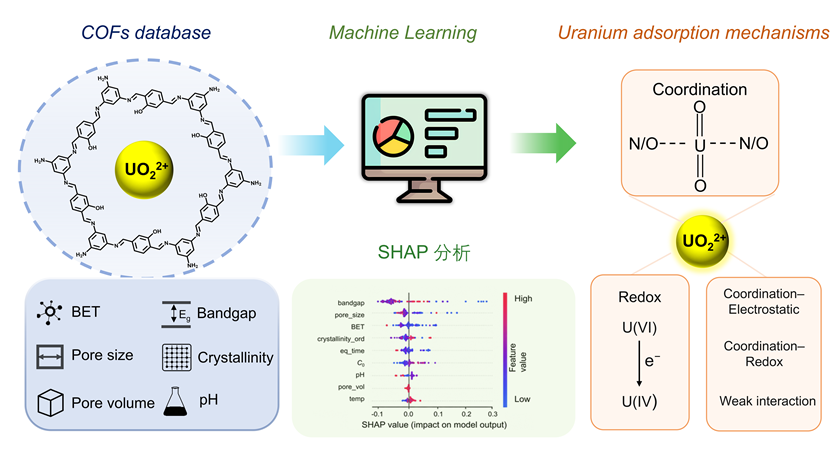
1 引言
2 结果与讨论
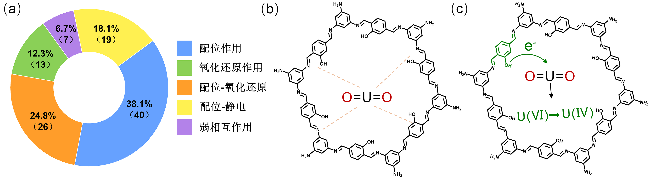
2.1 铀吸附机制分类与作用模式归纳
表1 COFs-铀吸附机制标签归并规则及判定依据aTable 1 Rules and criteria for labeling and determining the adsorption mechanism of COFs-uranium |
| 机制类别 | 原始机制标签 | 判定依据 | 典型证据 |
|---|---|---|---|
| 配位作用 | 配位、螯合、表面 络合、配位键作用 | $\mathrm{UO}_{2}^{2+}$与COFs骨架中的N/O/S/P等 供电子位点形成稳定结合 | 傅里叶变换红外光谱法(FTIR)/X射线光电子能谱(XPS)中N, O, S和P等官能团峰位或结合能变化; 扩展X射线吸收精细结构(EXAFS)证实U—O/U—N等配位结构; 密度泛函理论(DFT)显示较强结合能或稳定配位构型; 吸附前后官能团特征变化 |
| 氧化还原 作用 | 氧化还原、化学还 原、光催化还原、 电化学还原 | U(VI)发生电子转移, 形成 U(IV)或低价铀物种 | XPS出现U(IV)信号; 光催化或电化学还原证据; 光电流、EPR或能带分析等电子转移证据 |
| 配位-氧化 还原作用 | 配位-氧化还原、 螯合-还原、配位- 化学还原、配位- 光催化还原 | $\mathrm{UO}_{2}^{2+}$先通过配位作用实现界面 富集, 随后发生电子转移或价态转化 | 配位证据与U(IV)或低价铀证据同时存在; 或光/电催化还原过程伴随明显官能团络合证据 |
| 配位-静电 作用 | 配位-静电、配位- 离子交换、静电- 离子交换-配位 | 配位结合同时伴随表面电荷吸引、 离子交换或pH依赖富集过程 | Zeta电位变化; pH依赖吸附行为; 离子竞争实验; 表面电荷分析; FTIR/XPS配位证据 |
| 弱相互作用 | 物理吸附、物理嵌 合、氢键、范德华 力、π-π作用、非特 异性吸附 | 缺乏明确强配位或价态变化证据, 吸附主要依赖孔结构匹配或弱界 面作用 | 孔结构匹配分析; 氢键、范德华力或π-π作用讨论; 较弱光谱变化; 非特异性吸附现象 |
a For samples that exhibit multiple modes of action, they are classified first based on whether there is clear evidence of U(VI) oxidation state change and coordination. If multiple pieces of evidence are present simultaneously, their coupling mechanism characteristics are retained. |
2.2 数据集组成与特征空间分析
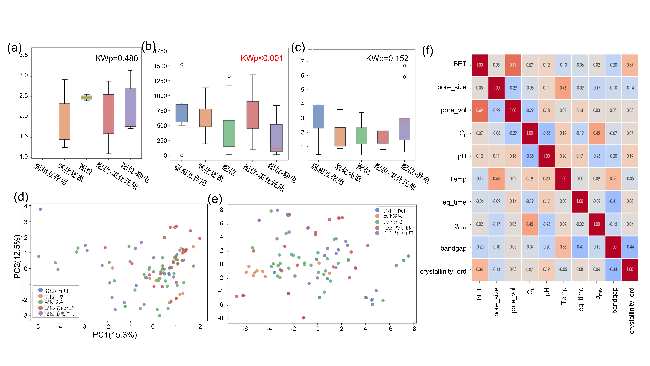
图2 (a)不同吸附机制样本的带隙、(b)比表面积和(c)孔径分布; (d) PCA得分图; (e) t-SNE降维可视化结果; (f)主要结构参数与实验变量的相关性热图Figure 2 (a) Distributions of bandgap, (b) specific surface area, and (c) pore size among samples assigned to different uranyl adsorption mechanisms; (d) PCA score plot; (e) t-SNE visualization; (f) correlation heatmap of the main structural parameters and experimental variables |
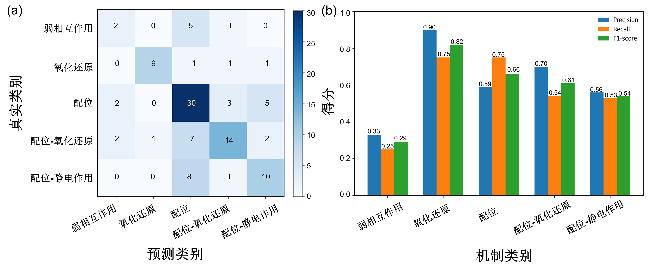
2.3 吸附机制分类模型性能分析
2.4 结构变量贡献与机制驱动关系的SHAP分析
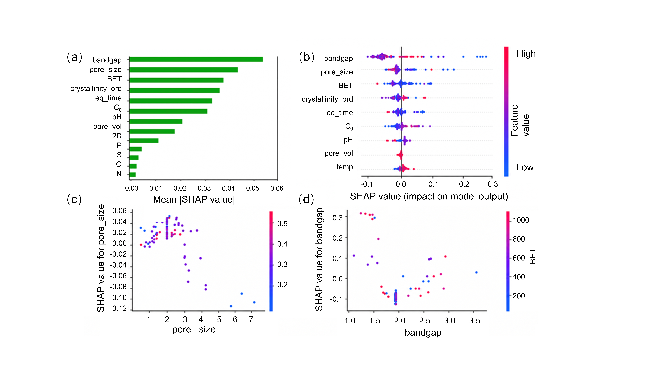
图4 基于SHAP的结构变量贡献与机制关联. (a)全局平均SHAP特征重要性排序; (b)全局SHAP beeswarm分析; (c)配位机制中pore_size的SHAP依赖关系; (d)氧化还原机制中bandgap的SHAP依赖关系Figure 4 Analysis of the contribution of structural variables and the mechanism-driven relationship based on SHAP. (a) Global average SHAP feature importance ranking; (b) Global SHAP beeswarm analysis; (c) SHAP dependency relationship of pore_size in the coordination mechanism; (d) SHAP dependency relationship of bandgap in the redox mechanism |
2.5 局部机制解释与协同作用路径
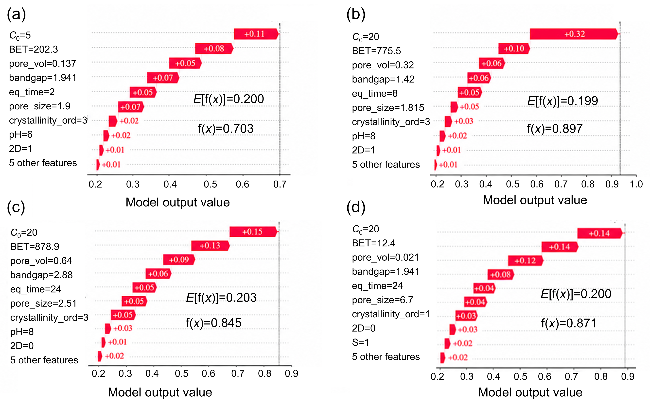


图5 不同吸附机制的局部SHAP解释分析. (a)配位机制; (b)氧化还原机制; (c)配位-氧化还原耦合机制; (d)配位-静电耦合机制. 每个waterfall图从基线期望值E[f(x)]出发, 按照变量贡献逐步累加至样本预测输出f(x)Figure 5 Local SHAP explanations for different adsorption mechanisms. (a) Coordination mechanism; (b) Redox mechanism; (c) Coordination-redox coupled mechanism; (d) Coordination-electrostatic coupled mechanism. Each waterfall plot starts from the baseline expected value E[f(x)], and accumulates variable contributions step by step to the sample prediction output f(x) |
3 结论
4 方法
4.1 数据集构建与机制分类
表2 COFs-铀吸附数据集中主要结构参数与实验变量统计aTable 2 Statistics of main structural parameters and experimental variables in the COFs-uranium adsorption dataset |
| 类别 | 参数 | 单位 | 缩写 | 数据范围 | 样本数 |
|---|---|---|---|---|---|
| 吸附剂结构 | 比表面积 | m2/g | SA | 0.80~1713.00 | 98 |
| 孔径 | nm | pore_size | 0.40~7.49 | 68 | |
| 孔容 | cm³/g | pore_vol | 0.02~0.90 | 33 | |
| 带隙 | eV | bandgap | 1.25~3.58 | 35 | |
| 结晶有序性 | — | crystallinity | 高/中/低 | 102 | |
| 实验条件 | 初始浓度 | mg/L | C0 | 0.0033~500.00 | 105 |
| pH | — | pH | 1.50~9.00 | 105 | |
| 温度 | K | T | 293.00~318.00 | 105 | |
| 平衡时间 | h | eq_time | 0.03~288.00 | 98 |
a The crystalline orderliness is classified based on the PXRD characterization results in the literature and the author's description of the material's crystallinity/ordering; samples with clear and strong diffraction peaks are classified as high, those with identifiable but weak diffraction peaks are classified as medium, and those with indistinct or reported as amorphous/lowly ordered diffraction peaks are classified as low. |