综述

铜/手性磷酸协同催化不对称自由基反应研究进展★

  • 黄特鹏 ,
  • 陈继君 ,
  • 刘心元
展开
  • 新基石科学实验室 南方科技大学化学系 深圳格拉布斯研究院 光明高等研究院 深圳 518055
黄特鹏, 南方科技大学化学系2024级硕士研究生. 2024年获华南师范大学理学学士学位, 同年进入南方科技大学化学系刘心元教授课题组攻读硕士学位, 主要从事铜催化不对称自由基反应研究;陈继君, 南方科技大学深圳格拉布斯研究院研究副教授、硕士生导师. 2012年和2018年分别获苏州大学理学学士学位和理学博士学位, 博士期间师从万小兵教授. 2018年加入南方科技大学刘心元教授课题组从事博士后研究. 2020年起先后任南方科技大学化学系高级研究学者、研究助理教授, 2023年任深圳格拉布斯研究院研究助理教授, 2026年晋升为研究副教授. 主要从事不对称自由基-极性交叉偶联化学研究;刘心元, 南方科技大学化学系讲席教授. 2001年本科毕业于安徽师范大学; 2004年毕业于安徽师范大学化学系和上海有机所(联合培养), 获理学硕士学位, 师从朱仕正研究员和王绍武教授; 2010年毕业于香港大学化学系, 获哲学博士学位, 师从支志明院士. 2010~2012年先后在香港大学和美国Scripps研究所从事博士后研究, 合作导师为支志明院士和Carlos F. Barbas III教授. 2012年加入南方科技大学化学系, 主要从事不对称自由基化学研究. 曾获国家自然科学基金优秀青年科学基金和国家杰出青年科学基金资助, 入选教育部青年人才项目及新基石研究员项目, 并获广东省自然科学奖一等奖. ★“不对称协同催化”专辑

收稿日期: 2026-07-25

  网络出版日期: 2026-09-14

基金资助

广东省基础与应用基础研究重大项目(No. 2023B0303000020)、国家自然科学基金(Nos. 22331006, 22401136)、广东省基础与应用基础研究基金(No. 2024A1515010325)、深圳市科技计划(Nos. KQTD20210811090112004, JCYJ20240813094223031)、新基石科学基金会

Recent Advances in Copper/Chiral Phosphoric Acid Cooperative Catalysis for Asymmetric Radical Reactions

  • Huang Tepeng ,
  • Chen Jijun ,
  • Liu Xinyuan
Expand
  • New Cornerstone Science Laboratory, Department of Chemistry, Shenzhen Grubbs Institute, and Guangming Advanced Research Institute, Southern University of Science and Technology, Shenzhen 518055, China

Received date: 2026-07-25

  Online published: 2026-09-14

Supported by

Guangdong Major Project of Basic and Applied Basic Research (No. 2023B0303000020), the National Natural Science Foundation of China (Nos. 22331006, 22401136), the Guangdong Basic and Applied Basic Research Foundation (No. 2024A1515010325), the Shenzhen Science and Technology Program (Nos. KQTD20210811090112004, JCYJ20240813094223031), the New Cornerstone Science Foundation.

摘要

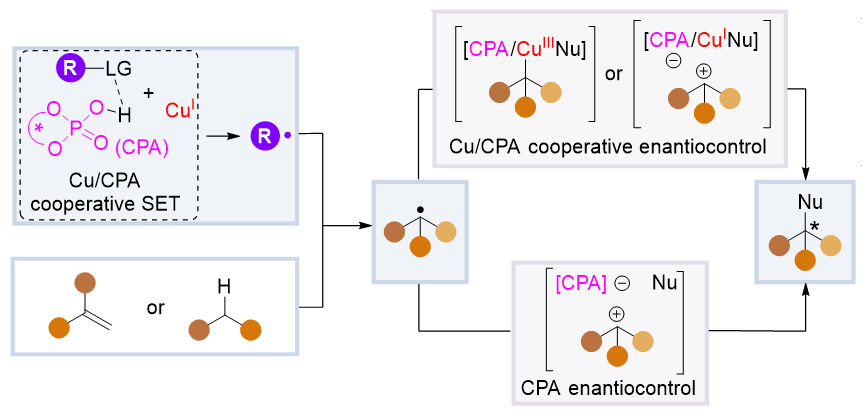
自由基反应具有反应活性高、条件温和及官能团兼容性好等特点, 但高活性自由基中间体的精确立体控制仍是不对称合成领域的核心挑战. 铜催化剂具有优异的单电子转移、自由基捕获和氧化态调节能力, 而手性磷酸可通过氢键、离子对与空间限域等非共价相互作用构建手性微环境. 二者的协同为单一催化体系难以实现的不对称自由基转化提供了新的催化模式. 根据主要手性决定步骤的不同, 相关反应可归纳为铜/手性磷酸协同参与手性决定步骤和自由基-极性交叉/手性离子对控制两类模式. 近年来, 该策略已成功应用于烯烃的不对称自由基1,2-双官能团化、C(sp3)-H键的对映选择性自由基官能团化及烯基-1,3-二醇的对映选择性自由基去对称化等反应. 本文系统总结该领域的研究进展, 重点阐述不同反应中的立体控制模式, 并分析当前面临的挑战及未来发展方向.

本文引用格式

黄特鹏 , 陈继君 , 刘心元 . 铜/手性磷酸协同催化不对称自由基反应研究进展★[J]. 化学学报, 2026 : 26070268 . DOI: 10.6023/A26070268

Abstract

Radical reactions are characterized by high reactivity, mild reaction conditions, and broad functional-group compatibility, yet precise stereocontrol of highly reactive radical intermediates remains a central challenge in asymmetric synthesis. Copper catalysts possess versatile capabilities for single-electron transfer, radical capture, and redox-state modulation, whereas chiral phosphoric acids (CPAs) can create well-defined chiral microenvironments through noncovalent interactions such as hydrogen bonding, ion-pairing, and spatial confinement. The synergistic integration of these two catalytic components therefore provides a powerful platform for asymmetric radical transformations that are difficult to achieve with either catalyst alone. Importantly, Cu/CPA cooperative catalysis does not represent a simple division of labor in which copper generates radicals and CPA controls stereochemistry; rather, the two components can cooperate dynamically at multiple stages of the catalytic cycle, including single-electron transfer, radical capture or oxidation, and stereoselective bond formation. According to the predominant stereodetermining step, Cu/CPA-catalyzed asymmetric radical reactions can be broadly classified into two principal mechanistic modes. In the first mode, copper and CPA jointly participate in the stereodetermining step: carbon-centered radicals are either trapped by chiral Cu(II)-phosphate species to form high-valent Cu(III) intermediates or undergo facially selective addition to copper-coordinated alkenes, with stereochemical differentiation occurring within the chiral environment established by the Cu/CPA catalytic system. In the second mode, radical-polar crossover generates carbocationic or iminium intermediates through single-electron oxidation of carbon radicals by Cu(II) species, after which stereoselective nucleophilic addition or rearrangement is governed predominantly by chiral phosphate ion pairing. In recent years, this cooperative catalytic strategy has been successfully applied to asymmetric radical 1,2-difunctionalization of alkenes, enantioselective radical functionalization of C(sp3)-H bonds, and enantioselective radical desymmetrization of olefinic 1,3-diols. These advances have enabled efficient access to structurally diverse chiral pyrrolidines, tetrahydrofurans, bridged and spirocyclic frameworks, including molecules bearing contiguous stereocenters and all-carbon quaternary stereocenters. In this review, we systematically summarize recent advances in Cu/CPA cooperative catalysis for asymmetric radical reactions, with particular emphasis on the mechanistic modes of stereocontrol across different reaction classes, and discuss current challenges and future perspectives of this emerging research field.

参考文献

[1] (a) Hung, K.; Hu, X.-R.; Maimone, T. J. Nat. Prod. Rep. 2018, 35, 174. (b) Romero, K. J.; Galliher, M. S.; Pratt, D. A.; Stephenson, C. R. J. Chem. Soc. Rev. 2018, 47, 7851. (c) Zhang M.-A., Jin H.-R., Sun K., Zhu Y.-P., Wang X. Acta Chim. Sinica 2026, 84, 572 (in Chinese). (张蒙爱, 靳皓冉, 孙凯, 祝艳平, 王薪, 化学学报, 2026, 84, 572). (d) Liao W.-Q., Ding Q.-P, Zhang J., Wu J. Acta Chim. Sinica 2026, 84, 385 (in Chinese). (廖文权, 丁秋平, 张俊, 吴劼, 化学学报, 2026, 84, 385.) (e) Li K.-K., Long X.-Y., Huang Y., Zhu S.-F. Acta Chim. Sinica 2024, 82, 658 (in Chinese). (李康葵, 龙先扬, 黄岳, 祝诗发, 化学学报, 2024, 82, 658.
[2] (a) Gu, Q.-S.; Li, Z.-L.; Liu, X.-Y. Acc. Chem. Res. 2020, 53, 170. (b) Chen, J.-J.; Fang, J.-H.; Du, X.-Y.; Zhang, J.-Y.; Bian, J.-Q.; Wang, F.-L.; Luan, C.; Liu, W.-L.; Dong, X.-Y.; Li, Z.-L.; Dong, Z.; Liu, X.-Y. Nature 2023, 618, 294. (c) Zhang, Y.-F.; Wang, B.; Chen, Z.; Liu, J.-R.; Yang, N.-Y.; Xiang, J.-M.; Liu J.; Gu Q.-S.; Liu, X.-Y. Science 2025, 388, 283. (d) Dong, X.-Y.; Li, Z.-L.; Gu Q.-S.; Liu, X.-Y. J. Am. Chem. Soc. 2022, 144, 17319.
[3] Phipps, R. J. ; Hamilton, G. L.; Toste, F. D. Nat. Chem. 2012, 4, 603
[4] (a) Brak, K.; Jacobsen, E. N. Angew. Chem. Int. Ed. 2013, 52, 534. (b) Betinol, I. O.; Kuang, Y.-T.; Mulley, B. P.; Reid, J. P. Chem. Rev. 2025, 125, 4184.
[5] Lin, J.-S.; Dong, X.-Y.; Li, T.-T.; Jiang, N.-C.; Tan, B.; Liu, X.-Y. J. Am. Chem. Soc. 2016, 138, 9357.
[6] Zhao, B.-G.; Du, H.-F.; Shi, Y.-A. J. Org. Chem. 2009, 74, 8392.
[7] Lin, J.-S.; Wang, F.-L.; Dong, X.-Y.; He, W.-W.; Yuan, Y.; Chen, S.; Liu, X.-Y. Nat. Commun. 2017, 8, 14841.
[8] Wang, F.-L.; Dong, X.-Y.; Lin, J.-S.; Zeng, Y.; Jiao, G.-Y.; Gu, Q.-S.; Guo, X.-Q.; Ma, C.-L.; Liu, X.-Y. Chem. 2017, 3, 979
[9] Li, X.-F.; Lin, J.-S.; Wang, J.; Li, Z.-L.; Gu Q.-S.; Liu, X.-Y. Acta Chim. Sinica 2018, 76, 878 (in Chinese). (李雪飞, 林进顺, 王建, 李忠良, 顾强帅, 刘心元, 化学学报, 2018, 76, 878).
[10] Zeng, Y.; Liu, D.-X.; Guo, X.-Q.; Gu, Q.-S. Li, Z.-L.; Chang, X.-Y.; Liu, X.-Y. Sci China Chem. 2019, 62: 1529.
[11] Cheng, Y.-F.; Dong, X.-Y.; Gu Q.-S.; Liu, X.-Y. Angew. Chem. Int. Ed. 2017, 56, 8883.
[12] Zhong, J.; Li, M.-X.; Ma J.; Zhang, Z.-M.; Fang, H.; Gao, S.; Lin, A.-J.; Yao, H.-Q. Angew. Chem. Int. Ed. 2026, 65, e21476.
[13] Lin, J.-S.; Li, T.-T.; Liu, J.-R.; Jiao, G.-Y.; Gu, Q.-S.; Cheng, J.-T.; Guo, Y.-L.; Hong, X.; Liu, X.-Y. J. Am. Chem. Soc. 2019, 141, 1074.
[14] Wang, Z.; Cheng, J.-T.; Shi, Z.-C.; Wang. N.; Zhan, F.; Jiang, S.-P.; Lin, J.-S.; Jiang, Y.-Y.; Liu, X.-Y. ChemCatChem. 2021, 13, 185.
[15] Yu, P.; Lin, J.-S.; Li, L.; Zheng, S.-C.; Xiong, Y.-P.; Zhao, L.-J. Tan, B.; Liu, X.-Y. Angew. Chem. Int. Ed. 2014, 53, 11890.
[16] Li, T.-T.; Yu, P.; Du, Y.-M.; Lin, J.-S.; Zhi Y.-G.; Liu, X.-Y. J. Fluor. Chem. 2017, 203, 210.
[17] Shi, J.; Zhou, X.-T.; Yang, B.-Q.; Jiao, B.-B.; Wu, W.; Ren, H. Chin. Chem. Lett. 2026, 37, 111250
[18] Yang, C.-J.; Zhang, C.; Gu, Q.-S.; Fang, J.-H.; Su, X.-L.; Ye, L.; Sun, Y.; Tian, Y.; Li, Z.-L.; Liu, X.-Y. Nat. Catal. 2020, 3, 539.
[19] Ye, L.; Tian, Y.; Meng, X.; Gu, Q.-S.; Liu, X.-Y. Angew. Chem. Int. Ed. 2020, 59, 1129.
[20] Gao, A.; Ren, Y.-Q.; Luan, C.; Tian, Y.; Liu L.; Gu, Q.-S.; Li, Z.-L.; Yang, C.-J.; Liu, X.-Y. Asian J. Org. Chem. 2023, 12, e202300220.
[21] Xiao, T.-F.; Jian, K.-R.; Gu, Y.-C.; Xu, G.-Q.; Xu, P.-F. Chem. Sci. 2026, 17, 3240.
[22] Cheng, Y.-F.; Liu, J.-R.; Gu, Q.-S.; Yu, Z.-L.; Wang, J.; Li, Z.-L.; Bian, J.-Q.; Wen, H.-T.; Wang, X.-J.; Hong, X.; Liu, X.-Y. Nat. Catal. 2020, 3, 401.
[23] (a) Egami, H.; Sodeoka, M. Angew. Chem. Int. Ed. 2014, 53, 8294. (b) Li, Z.-L.; Fang, G.-C.; Gu, Q.-S.; Liu, X.-Y. Chem. Soc. Rev. 2020, 49, 32. (c) Crossley, S. W., Obradors, C.; Martinez, R. M.; Shenvi, R. A. Chem. Rev. 2016, 116, 8912.
[24] (a) Studer, A.; Curran, D. P. Angew. Chem. Int. Ed. 2016, 55, 58. (b) McCann, S. D.; Stahl, S. S. Acc. Chem. Res. 2015, 48, 1756.
[25] (a) Newhouse, T.; Baran, P. S. Angew. Chem. Int. Ed. 2011, 50, 3362. (b) Ackermann, L. Chem. Rev. 2011, 111, 1315.
[26] (a) Wang, Y.; Wen, X.; Cui, X.; X. Peter Zhang. J. Am. Chem. Soc. 2018, 140, 4792. (b) Paradine, S. M.; Griffin, J. R.; Zhao, J.-P.; Petronico, A. L.; Miller, S. M.; White M. C. Nat. Chem. 2015, 7, 987.
[27] (a) Zeng, X.-P.; Cao, Z.-Y.; Wang, Y.-H.; Zhou, F.; Zhou, J. Chem. Rev. 2016, 116, 7330. (b) Yang, C.-J.; Liu, L.; Gu, Q.-S.; Liu, X.-Y. CCS Chem. 2024, 6, 1612. (c) Yu, Z.-L.; Li, Z.-L.; Yang, C.-J.; Gu, Q.-S.; Liu, X.-Y. Acta Chim. Sinica 2023, 81, 955 (in Chinese). (鱼章龙, 李忠良, 杨昌江, 顾强帅, 刘心元, 化学学报, 2023, 81, 955).
文章导航

/

〈 〉