压电耦合过一硫酸盐(PMS)高级氧化工艺在新兴药物污染物治理领域具有广阔应用前景。本工作构建了Co掺杂ZnO压电耦合PMS活化体系,用于水中卡马西平(CBZ)高效降解。结果表明,Co掺杂可引发ZnO晶格畸变,增强材料内部压电极化效应并促进载流子分离,从而提升PMS活化性能。活性物种捕获实验证实,Co掺杂后PMS活化过程中的主导活性物种为单线态氧(1O2),表明反应路径以非自由基为主。性能测试表明,最优Co/ZnO协同PMS超声体系在60 min内对CBZ降解效率可达94%,同时,以该体系制备的PVDF复合膜具有良好的催化性能和经济效益。本研究证实Co掺杂可实现压电催化与过硫酸盐氧化协同增效,为水体中微量药物污染物治理提供新思路。
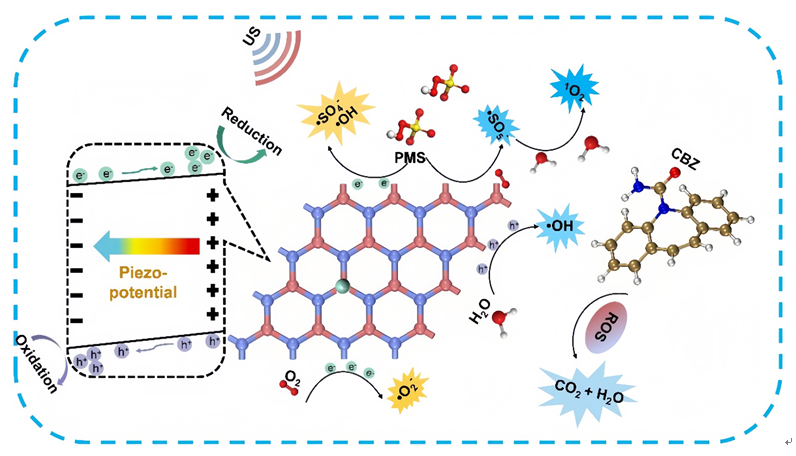
The piezoelectric-coupled peroxymonosulfate (PMS) advanced oxidation process, which harnesses mechanical energy to generate reactive oxygen species, holds great promise for the remediation of emerging pharmaceutical pollutants. In this work, Co-doped ZnO piezocatalysts with varying Co doping levels were fabricated via a one-step hydrothermal method, and their catalytic performance for PMS activation was systematically investigated using carbamazepine (CBZ) as the target pollutant. X-ray diffraction and Raman spectroscopy confirmed the successful substitutional doping of Co2+ into the ZnO lattice, inducing lattice distortion and enhancing non-centrosymmetry. Piezoresponse force microscopy revealed a typical piezoelectric response for 2-Co/ZnO with a d33 coefficient of approximately 58 pm•V–1. Electrochemical measurements demonstrated that Co doping significantly increased the piezoelectric current density and reduced the charge transfer resistance. Under optimized conditions (catalyst dosage: 0.6 g•L–1, PMS concentration: 0.1 g•L–1, ultrasonic power: 240 W), the 2-Co/ZnO/PMS/US system achieved 94% degradation of 10 mg•L–1 CBZ within 60 min, with a pseudo-first-order rate constant of 0.04 min–1. Radical quenching experiments and electron paramagnetic resonance spectroscopy identified singlet oxygen (1O2) as the dominant reactive species, with a non-radical pathway contributing over 60% to the overall degradation. The system exhibited robust catalytic activity across a wide pH range (3-9) and in the presence of various coexisting ions. Recycling tests showed that the catalyst retained 81.2% of its initial activity after four consecutive cycles. Based on liquid chromatography-mass spectrometry (LC-MS) intermediate identification and density functional theory (DFT) Fukui function calculations, two oxidative mineralization pathways for CBZ were proposed, involving hydroxylation, oxidation, and ring-opening reactions, with the C(11) and C(12) sites (f0=0.0746 and 0.0755, respectively) identified as the most vulnerable reactive centers. Finally, the 2-Co/ZnO powder was incorporated into a PVDF composite catalytic membrane via electrospinning, which achieved 89% CBZ removal under simulated low-frequency natural water flow conditions, demonstrating favorable cycling stability and economic feasibility. This study provides both theoretical insights and experimental support for the engineering application of piezocatalysis-coupled PMS activation technology in the remediation of recalcitrant organic pollutants in natural water bodies.
[1] Zhu L.; Lin X.; Di Z.; Cheng F.; Xu J. Water2024, 16, 3428.
[2] Bekele R. S.; Heiderscheidt E.; Rossi P. M.; Moges M. E.; Janka E. Environ. Pollut.2026, 393, 127702.
[3] Trognon J.; Albasi C.; Choubert, J.-M. Sci. Total. Environ.2024, 912, 169040.
[4] Zheng J.; Zhang P.; Li X.; Ge L.; Niu J. Chemosphere2023, 343, 140211
[5] Scaria J.; Nidheesh, P. V. Curr. Opin. Chem. Eng.2022, 36, 100830.
[6] Wang J.; Wang, S. Chem. Eng. J.2018, 334, 1502-1517.
[7] Wacławek S.; Lutze H. V.; Sharma V. K.; Xiao R.; Dionysiou, D. D. Curr. Opin. Chem. Eng.2022, 37, 100854.
[8] Peng W.; Dong Y.; Fu Y.; Wang L.; Li Q.; Liu Y.; Fan Q.; Wang, Z. Chem. Eng. J.2021, 421, 127818.
[9] Li X.J.; Ye Z.; Xie S.; Wang Y.; Wang Y.; Lv Y.; Lin C. Acta Chim.Sinica2022, 80, 1238(in Chinese).(李小娟,叶梓瑜,谢书涵,王永净,王永好,吕源财,林春香,化学学报,2022, 80, 1238)
[10] Zhou C.; Yin H.; Kong R.; Wang H.; Dai, B. J. Intell. Mat.2026, 1, 30-37.
[11] Nie G.; Xiao L.; Bi J.; Wang S.; Duan, X. Appl. Catal., B2022, 315, 121584.
[12] Dai J.; Zhu Y.; Fan Z.; Cheng M.; Wang B.; Huang F.; Yue W.; Deng Y.; Evcin A.; Mohamad A. A.; Long Y.; Chang Y.; Wang D. Microstructures2026, 6.
[13] Liu N.; Wang R.; Gao S.; Zhang R.; Fan F.; Ma Y.; Luo X.; Ding D.; Wu W. Nano Energy2023, 109, 108311.
[14] Liu N.; Wang R.; Gao S.; Zhang R.; Fan F.; Ma Y.; Luo X.; Ding D.; Wu W. Adv. Mater.2021, 33, 2105697.
[15] Huang D.; Wu T.; Xie D.; Che H.; Ao, Y. Composite Functional Materials2025, 1, 20250104.
[16] Ning X.; Hao A.; Cao Y.; Hu J.; Xie J.; Jia, D. J. Colloid. Interf. Sci.2020, 577, 290-299.
[17] Tan P.; Huang X.; Wang Y.; Xing B.; Zhang J.; Hu C.; Meng X.; Xu X.; Li D.; Wang X.; Zhou X.; Zhang N.; Wang Q.; Li F.; Zhang S.; Tian H. Nat. Commun.2024, 15, 10619.
[18] Nallagatla V. R.; Maier C.; Glettler J.; Feteira A.; Reichmann K.; Deluca, M. J. Eur. Ceram. Soc.2024, 44, 116689.
[19] Huang H.; Du J.; Meng Q.; Pu S.; Chen S.; Liu K.; Tian Q.; Wu J.; Li, Y. ACS Appl. Mater. Interfaces2026, 18, 10979-10993.
[20] Lu Y.; Ding C.; Guo J.; Gan W.; Chen P.; Chen R.; Ling Q.; Zhang M.; Wang P.; Sun Z. Nano Energy2023, 112, 108515.
[21] Anipsitakis G. P.; Dionysiou, D. D. Environ. Sci. Technol.2004, 38, 3705-3712.
[22] Zhang Z.-Q.; Duan P.-J.; Zheng J.-X.; Xie Y.-Q.; Bai C.-W.; Sun Y.-J.; Chen X.-J.; Chen F.; Yu H.-Q. Nat. Commun.2025, 16, 115.
[23] Wu X.; Liu S.; Li Y.; Yan M.; Lin H.; Chen J.; Liu S.; Wang S.; Duan, X. Angew. Chem. Int. Ed.2023, 62, e202305639.
[24] Zhang X.; Wang H.; Shi Q.; Zhang X.; Jiang W.; Lin X.; Hu R.; Liu T.; Jiang, X. J. Colloid. Interf. Sci.2025, 693, 137599.
[25] Xu C.; Fang G.; Liu C. Y.; Xu G. Y.; Zhu Y. M.; Zhang, Y. T. Chinese J. Inorg. Chem.2018, 34, 1625(in Chinese). (徐晨,方罡,刘初阳,徐国跃,朱永梅,张艳婷,无机化学学报,2018, 34, 1625)
[26] Arif D.; Kiani S. S.; Khan R.; Abid A. Y.; Safeen K.; Alotaibi K. M.; Shah W. H.; Ali A.; Shah S.; Girma W. M.; Shah A. U.; Safeen A. Sci. Rep.2025, 16, 1726.
[27] Wen Y.; Chen J.; Gao X.; Liu W.; Che H.; Liu B.; Ao Y. Nano Energy2023, 107, 108173.
[28] Bai-Qi W.; Chun-Hui X.; Qiang F.; Peng-Wei W.; Xu-Dong S.; Da-Peng, Y. Acta Phys. -Chim. Sin.2008, 24, 1165-1168(in Chinese).(王百齐,夏春辉,富强,王朋伟,单旭东,俞大鹏,物理化学学报,2008, 24, 1165-1168)
[29] Karpyna V.; Myroniuk L.; Myroniuk D.; Bykov O.; Olifan O.; Kolomys O.; Strelchuk V.; Bugaiova M.; Kovalchuk I.; Ievtushenko A. Catal. Lett.2024, 154, 2503-2512.
[30] Lin Y.-H.; Sivakumar C.; Balraj B.; Murugesan G.; Nagarajan S. K.; Ho M.-S. Nanomaterials2023, 13, 754.
[31] Lu Y.; Ding C.; Guo J.; Gan W.; Chen P.; Chen R.; Ling Q.; Zhang M.; Wang P.; Sun Z. Nano Energy2023, 112, 108515.
[32] Aljawf R. N.; Rahman F.; Kumar, S. Mater. Res. Bull.2016, 83, 108-115.
[33] Salameh B.; Alsmadi A. M.; Shatnawi, M. J. Alloy. Compd.2020, 835, 155287.
[34] Wang J.; Wang, S. Chem. Eng. J.2021, 411, 128392.
[35] Yang L.; Yang H.; Huang Z.; Gu Y.; Cai K.; Zhang, Y. Chem. Eng. J.2026, 530, 173249.
[36] Pan F.; Ji H.; Du P.; Huang T.; Wang C.; Liu, W. J. Hazard. Mater.2021, 402, 123779.
[37] Cao J.; Nie W.; Huang L.; Ding Y.; Lv K.; Tang, H. Appl. Catal., B2019, 241, 18-27.
[38] He X.; Luo Y.; Yi Y.; Su S.; Qin W. RSC Adv.2024, 14, 1141-1149.
[39] Cheng Y.; Chen J.; Wang P.; Liu W.; Che H.; Gao X.; Liu B.; Ao, Y. Appl. Catal., B2022, 317, 121793.